El Dorado County Grand Jury disbanded

By Kathryn Reed

El Dorado County no longer has a grand jury.

Steve Bailey, the Superior Court judge who oversees the volunteer board, signed a court order Feb. 22 dissolving this year’s jury. The document says the reason is because the grand jury numbers dropped below the minimum of 12 and “that due to the lateness of the year, alternate jurors cannot be sworn in and trained and thereafter conduct meaningful investigations before the statutory discharge of the jury in June 2013 ….”

grand juryBailey is out of town this week at a conference and could not be reached.

He oversees the grand jury that looks into county matters, even though he is married into a politically charged family with deep roots on the West Slope.

There had been 19 active grand jury members, with 14 of them resigning this year.

Sources close to the situation told Lake Tahoe News one member of the grand jury was regularly meeting with former El Dorado County Supervisor Jack Sweeney to tell him what the grand jury was doing. This violates state Penal Code.

That individual essentially became a poison pill within the group, creating distrust and disharmony, and prevented others from doing the job they were tasked with.

Sweeney is good friends with Supervisor Ron Briggs. On Dec. 18, 2012, John Briggs, father of the supervisor, was before the Board of Supervisors representing the Briggs Family Trust. On a 4-0 vote, with Supervisor Briggs recusing himself, the others agreed to purchase 5.2 acres from the trust on which a future courthouse is likely to be built.

Judge Bailey is the brother-in-law of the supervisor and son-in-law to the elder Briggs. And it is Bailey who watches over the grand jury, which looks into county matters, of which his in-laws are intricately involved in.

Judges receive regular training on ethics and are charged with determining whether a matter they are assigned creates an impermissible conflict of interest per the Code of Civil Procedure.

Ray Van Asten, who was foreman of the 2012-13 grand jury, told Lake Tahoe News he is one of the jurors who quit. But he would neither say why, nor talk about what led to others quitting.

“We are unable to say what happens inside the jury room,” Van Asten said.

It is not known what the grand jury was investigating.

“What they are looking at or not is not something I could talk about if I knew,” Suzanne Kingsbury, presiding judge of the El Dorado County Superior Court, told Lake Tahoe News.

She said in the 28 years she has lived in the county (she has been on the bench 17 of those years) she does not know of a time when a grand jury was discharged midterm.

“The purpose of the civil grand jury is to act as a public watchdog and examine the operations of cities, counties and special districts. I think that the role of the grand jury in our state is a critical one,” Kingsbury said.

Even so, there will be no grand jury report in June. It is possible that whatever this term’s jury was investigating could be taken up by the next grand jury that is seated.




People should be treated as well as dogs

By Mandy Kendall

It turned out that our puppy’s little episodes last week were a symptom of something a bit more serious than a tummy upset. This resulted in us spending pretty much every day for a week at the Carson Valley Veterinary Center.

The care and love we received there was truly inspiring. I say “we” because not only did they take care of our puppy, they also took care of us. There were hugs and tears and laughter, all during a pretty stressful time. Even the staff that was not involved in taking care of us stopped and chatted and rubbed a tummy (the dog’s tummy that is).

Mandy Kendall

Mandy Kendall

I can’t say I’ve ever been in a hospital for humans where that happened. What is it about animals that get us humans to open up and interact so much more freely?

I’ve noticed during our walks, too, that strangers seem much more comfortable about stopping to chat when you have a dog. Maybe it’s the unconditional love that pets are willing to offer with no judgments or -prejudice. A study of 5- and 6-year olds discussed by Jason G. Goldman on The Science Blog showed that those children “more attached to their pets showed greater empathy toward peers.”

Could it be that our social constraints prevent humans from being as open and friendly with each other as they would like to be? Do pets provide us that safe space for us to behave the way we really want to behave?

How often do we hear stories or see videos about how emotionally and physically beneficial pets have been to their owners. Pets seem to have a natural ability to accept us for who we are and love us regardless. Wouldn’t it be amazing if people were like that? Now I know some people are not very likeable, but what if we treated them as if they were? What if we just appreciated them regardless?

Here are some Qwik-e thoughts to take with you:

• Try to approach everyone with an open heart and mind, no prejudgments or agendas, just with love and appreciation.

• If you meet someone who appears unlikeable, just imagine him or her as being friendly and treat him or her accordingly.

• Treat everyone you meet as if they were carrying a really cute puppy.

Until next time.

Mandy Kendall operates Health Connective in South Lake Tahoe, which aligns wellness seekers with their ideal wellness provider. If you have questions, would like some advice, or would like to request some Qwik-e tips on any health and well-being topic, drop her an email at connect@healthconnective.com or keep an eye out on Lake Tahoe News for regular Qwik-e tips on how to make healthy changes one Quick and Easy step at a time.


Opinion: Gay Americans pay more taxes for fewer rights

By Suze Orman

That nine states and the District of Columbia have legalized same-sex marriage is encouraging progress for those of us who believe that everyone deserves to have basic civil rights. But, even if every state in the country could pass a similar legislation, it would not be enough. What we need is for our federal government to step up and make this basic right a law of the land.

Beyond the social discrimination, the refusal of our federal government to legally recognize same-sex marriages imposes steep financial penalties on same-sex couples. That two of the most costly penalties are triggered upon the death of one partner just adds to the ache of the senseless discrimination.

Suze Orman

Suze Orman

I have been with my partner, Kathy Travis, for 12 years. If I am lucky I will spend the rest of my life living and sharing my joys and happiness with her. We have worked very hard as a team to save for our future together and consider everything we have as equally owned by the other.

If the federal government recognized same-sex marriage, then when one of us dies our assets would seamlessly transfer free of tax to the survivor. That’s a basic right that every heterosexual married couple has.

But because there is no federal recognition of same-sex marriage, if I die first, or vice versa, before either of us can inherit what is now jointly our assets, there would be a federal estate tax bill that one of us would currently have to pay. Again, to be clear: If we were a heterosexual married couple, there would be no estate tax regardless of the size of the estate or who died first.

This spring, the Supreme Court will weigh in on the constitutionality of the federal Defense of Marriage Act. The Court needs to do the right thing and end discrimination against gay couples.

We all have 83-year-old Edith Windsor to thank for in pushing the issue of same-sex marriage equality on to the national front. Edie and her partner Thea were together for 40 years. How many marriages do you know that have lasted that long? But when Thea died in 2009, Edie was hit with a $363,000 federal estate tax bill because as a same-sex couple they were not eligible for the unlimited marital deduction. Are we really a nation that says it is fair and just to demand Edie pay a $363,000 penalty because she is gay?

There’s another penalty that’s even worse. Regardless of the size of their estates, every gay couple is discriminated against when it comes to Social Security benefits.

Married heterosexual couples can maximize their Social Security retirement benefits by taking advantage of the highest-earner’s benefit. When both spouses are alive, the lower earner can opt to collect a monthly benefit check that is equal to 50 percent of his or her spouse’s benefit. For many married couples, that 50% spousal benefit is often much higher than what the lower-wage-earning spouse could collect based on his or her own earnings record. Most important, when the high earner dies, the surviving spouse is allowed to collect 100 percent of the deceased’s higher benefit.

Because same-sex marriages aren’t recognized on the federal level, gay and lesbian couples are not eligible for Social Security spousal benefits. The lower earner cannot claim any benefits based on the higher earner’s benefit. A heterosexual couple married for just a few months is able to collect a federal benefit that same-sex couples who have been together for decades can’t. Are we really a nation that says that is fair?

Beyond those two glaring death penalties, health insurance is another area of severe federal financial discrimination against gay couples. I am so glad to see more employers extending health insurance benefits to same-sex partners. But because same-sex couples are not considered legally married under the eyes of the federal government, the dollar value of the health coverage is considered taxable income.

A 2007 study estimated that this gay health insurance penalty costs same-sex couples an aggregate $178 million ($1,069 per household), while employers paid an additional $57 million in payroll tax on that taxable income. No heterosexual married couple or their employers pay that penalty. Again, are we really a nation that says that is fair?

The social and civil discrimination that persists as long as our federal government does not recognize same-sex marriage is inexcusable. Add in the financial discrimination gay and lesbian couples face and the current policy becomes all the more indefensible.

Suze Orman is a personal finance expert and hosts “The Suze Orman Show” on CNBC. She is a bestselling author of ten books, including “The Money Class.” This first appeared on CNN.


Wine tasting benefits Sugar Pine Foundation

The Sugar Pine Foundation is putting on a wine tasting and fundraising at Ben’s Fine Wines & Spirits in south Reno on March 8 from 5-10pm.

The event will feature wine from five El Dorado County vineyards: Madrona, Fenton Herriott, Boeger, Lava Cap and Holly’s Hill.

There will also be hors d’oeuvres, a photography expose about the Sugar Pine Foundation, and a wine-centric live auction and raffle.

The cost is $15.


Online guns sales thriving

By Nick Leiber, Bloomberg Businessweek

In October, Google joined other big online marketplaces including eBay, Craigslist and Amazon.com in banning weapons listings on its revamped shopping site. The move, which the company said was in keeping with its advertising policy, predated the Newtown, Conn., school massacre by about two months. Yet there is no evidence that Google’s action has curbed online gun sales.

That’s because sellers, incensed by the prohibition on gun listings, are finding new outlets for their wares. Cory Brown, a sporting goods merchant who runs several e-commerce sites in Rockville, Md., estimates that Google once helped drive 80 percent of the roughly $5 million in annual sales of ammunition, shooting accessories and outdoor equipment at one of his online stores.

gunRather than just complain to the search giant, he started FreeGunShow.com in December, an online classified ad service for guns and other gear. “I was like, look, I’m tired of these companies, whatever (their) motivations, prohibiting the sale of things that are legal,” Brown said. “When Google pulled the plug on this kind of stuff, I knew something bad was happening.” Another firearms marketplace, GunCycle.com, based in Princeton, Kan., is scheduled to go online this week.

Internet auction sites

In 2000, when the U.S. Department of Justice last did an official tally, there were about 80 online firearms auction sites and approximately 4,000 other sites offering guns for sale in the country. Today, as the national gun control debate intensifies in the wake of the Newtown tragedy, it’s a safe bet that gun buyers have even more online options.

Bureau of Alcohol, Tobacco, Firearms and Explosives spokeswoman Ginger Colbrun says the federal agency is aware that there’s been a boom in gun buying sites. Federal gun safety proposals circulating in Washington that would tighten background checks might take a bite out of sales if passed by Congress. Yet none are intended to put these digital weapons bazaars out of business.

New sites like Brown’s and older ones such as GunBroker.com and Armslist function as marketplaces for buyers and sellers and make money through advertising or transaction charges. GunBroker.com, which bills itself as the world’s largest gun auction site, has brokered more than $2 billion in sales since its founding in 1999, according to the site.

Online sales anger gun control advocates because shoppers can use them to exploit a long-standing loophole in federal law that allows unlicensed private gun sellers to skip background checks on prospective buyers in their home state. Also, while it’s a felony to sell a firearm knowingly to an individual who would not pass a background check because of a criminal record or history of mental illness, many private sellers flout that rule.

Bob Ralph shuttered Express Police Supply, a brick-and-mortar store in Lenexa, Kan., that sold Smith & Wesson’s M&P 15 semiautomatic rifles and Glock’s 22 handguns, in 2011. Now he’s gearing up for GunCycle.com. Ralph acknowledges that a private collector who auctioned a gun through his site could meet the buyer in a parking lot and hand over the weapon without a background check. “There would be no way for me to stop that or preclude that,” he said. “And it would be legal for them to do it that way.”

An undercover investigation by New York City of private firearms sales online in 2011 showed 62 percent of sellers agreed to sell a firearm to investigators posing as buyers who indicated they probably couldn’t pass a background check.

“Buyers can buy and sellers can sell in almost complete anonymity. So if you’re looking to avoid being seen – a paper trail or legal scrutiny – you’re going to turn (to Internet sites) first,” said Mark Glaze, director of Mayors Against Illegal Guns. The group, which includes more than 850 U.S. mayors, was co-founded by New York City Mayor Michael Bloomberg.

Gun control advocates are trying to halt the proliferation of online marketplaces for firearms. Two days before the Dec. 14 Connecticut school shooting, Armslist was sued by relatives of a woman who was murdered in suburban Chicago in 2011 by a man who shot her with a weapon advertised on the site.

The wrongful-death lawsuit, the first against an online weapons seller, was launched by the Brady Center to Prevent Gun Violence on behalf of Jitka Vesel’s family. Armslist didn’t respond to requests for comment sent via its website; a telephone number wasn’t available.

Others in the same line of business have not been cowed. “This lawsuit will die. You cannot sue a third party in this case. Been proven over and over in case law,” Cory Brown wrote in an e-mail. He says his 2-month-old site has more than 1,000 registered users and would be doing even better if he had more merchandise. “A lot of our sellers own stores and inventory right now is real hard to get,” he wrote in another email. “Anytime we see an in-demand gun come up, it doesn’t last long.”


Sport-specific weather apps help with planning

By Bill Saporito, Time

Skiers in colorado know that the weather in vail can differ wildly from that of Beaver Creek, just 13 miles west on Interstate 70. The National Weather Service may forecast snow for the Rockies, but the amount in ski areas can vary by an entire foot; it’s tricky to gauge where and when the most snow will fall.

“People up here said it’s just too unpredictable,” says Joel Gratz, a Boulder-based meteorologist and skier. “But that’s not exactly true.”

appHow does he know? About five years ago, Gratz began to analyze microclimates in the Rockies — which are influenced by widely variable topography and wind flows–and e-mail his friends with predictions on where the most snow would fall so they could plan accordingly.

Those powder-pinpointing emails became so popular that Gratz eventually ditched his day job consulting for an insurance company to start OpenSnow.com It’s one of a number of travel weather sites such as BestSnow.net BestSkiWeather.com and SnowForecast.com that are aimed at skiers and snowboarders on the move.

This burgeoning category of sites not only serves skiers but is also a boon for surf, trail, rod and gun travelers, especially those who don’t book far in advance. With a five-day window, travelers can point themselves toward optimal conditions for golf, tennis, fishing or hunting. Lodges and resorts benefit too, emailing powder alerts, for example, to attract last-minute bookings.

Surfers were first to take weather into their own hands.

“They were their own meteorologists,” says Jens Rasmussen, a co-founder of Solspot.com a wave and weather site.

By retrieving data from ocean buoys and weather satellites, surfing-centered sites such as SurfLine.com MagicSeaweed.com BeachLive.com and Solspot create algorithms to alert riders when an epic swell is due at, for example, Cortes Bank off the California coast or Jaws in Maui, Hawaii. (The surf sites have awesome videos too.)

Your average weather site probably wouldn’t forecast the scent cone — the area downwind from hunters that might give them away to their prey. ScoutLookWeather.com does.

“ScoutLook’s mission is to tell them precisely where, when and how to maximize that time afield by being in the right place at the right time,” says Cy Weichert, a co-founder of the site.

ScoutLook includes sponsored apps that allow fishers to photograph their catch and upload it; the site also records location and weather conditions for future reference — “say, how many lake trout have I caught in northwest wind on a fly,” Weichert says.

Right now, he’s focused on developing more-detailed apps for the hunting and fishing markets in the next year.

Golfers too are getting focused weather. GolfWeatherNow.com also run by Rasmussen, says it has forecasts for 6,247 courses in the U.S., plus information on course conditions and amenities. Meanwhile, the U.K.’s Advanced Weather Applications is trying to flood the zone with information for a variety of sports on sites like LatestGolfWeather.com plus ones for hiking, motor sports and other activities around the world. Rasmussen plans a similarly comprehensive mountain-to-ocean approach, as does ScoutLook.

Only problem with all these sites: if you don’t catch the best waves or the biggest fish, you can’t blame the weather.


Resolution for some of Lane’s troubled South Shore land deals

By Kathryn Reed

Randy Lane, the developer of the would-be convention center in South Lake Tahoe that is a pile of rebar and concrete after his Lake Tahoe Development Company filed for bankruptcy on that project, is making news on both sides of the state line.

Regarding the property in South Tahoe, Owens Financial has filed a foreclosure notice on the remaining properties that were owned by Lane. If the trustee sale goes through on March 20, then Owens Financial will own those properties and Lane will not have any interest in the 11-acre site, South Lake Tahoe City Attorney Patrick Enright told Lake Tahoe News.

Lake Vista Apartments in Stateline.

Lake Vista Apartments in Stateline.

A portion of the project is going forward on land that Bill Owens already owns. His proposed retail development along six parcels that front Highway 50 is in the design review stage with the city. While he wants to start the project this building season, a performance bond and consolidation of the properties must be done first. He does not need a new building permit, just to tweak what was approved to allow for the project to go forward in stages. The proposal should be before the city Planning Commission in April or May.

In Douglas County, officials have worked out a settlement with the now-defunct Falcon Capital LCC that Lane once owned and ran.

The county filed a claim against Falcon Capital for breach of contract and misrepresentation. Falcon Capital was supposed to maintain the water quality improvements at Kahle Drive in Stateline after the county put them in. The construction of these improvements was a condition of approval imposed by the Tahoe Regional Planning Agency.

“When Falcon Capital did not perform its obligations under its contract with the county, the county filed suit and obtained a judgment against Falcon Capital on the breach of contract claim in the amount of $439,205.32,” County Manager Steve Mokrohisky told Lake Tahoe News. “Falcon Capital is now out-of-business and transferred its remaining assets, three parcels of undeveloped land located in Incline Village, to the county. The core claims against Meadow Brook Associates and Lake Vista Apartments are for unjust enrichment and equitable relief. Lake Vista is the managing partner for Meadow Brook Associates. These defendants were able to construct low-income housing on property formerly held by Falcon Capital.”

Douglas County commissioners at a meeting this month approved a 10-year settlement agreement that brings to a close the claims against Falcon Capital.

Mokrohisky said the only significant asset held by Meadow Brook and Lake Vista is the low-income housing project at 129 Market St. in Stateline. But, he added, it has been losing money for several years.

“The property is worth less than the amount due to the holder of the first deed of trust,” Mokrohisky said. “To settle the case, these defendants have agreed to perform maintenance for the county at a cost of $5,000 per year. Because the county wants to encourage affordable housing at Lake Tahoe, the county is willing to work to reach a settlement.”


Name released of South Lake Tahoe pedestrian who was killed

Updated Feb. 18 1:30pm:

The name of the man who was fatally struck by an alleged drunken driver Feb. 22 on Lake Tahoe Boulevard has been released.

John Carleton, 51, of South Lake Tahoe died at Barton Memorial Hospital.

The cause of the accident is still under investigation and autopsy results are pending.

—-

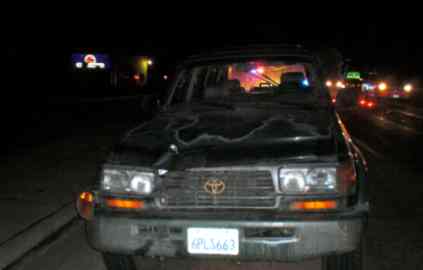
A South Lake Tahoe man died Friday night after being struck by a vehicle on Lake Tahoe Boulevard.

The vehicle involved in the fatal accident. Photo/Provided

The 51-year-old, whose name is not being released pending notification of next to kin, was near the Taco Bell when he was hit at 6:45pm Feb. 22.

Gregory Stearns, 49, of South Lake Tahoe was driving with a suspended driver’s license from a prior DUI conviction. He was arrested on charges of driving under the influence of alcohol and driving on a suspended license.

“The cause of the collision is still under investigation, initial indications are that the pedestrian was crossing Lake Tahoe Boulevard outside of a crosswalk, was wearing dark clothing in an unlit portion of the highway, and failed to yield to the oncoming traffic,” police Sgt. Shannon Laney said in a statement. “The pedestrian may also have been intoxicated and has a history with the South Lake Tahoe Police department for public intoxication.”

— Lake Tahoe News staff report


Dry January-February sets records

By Kathryn Reed

It’s another record snow year in Lake Tahoe and the greater Sierra Nevada. It’s just not the kind of record anyone wants to brag about.

Graphic/National Weather Service Reno

Graphic/National Weather Service Reno

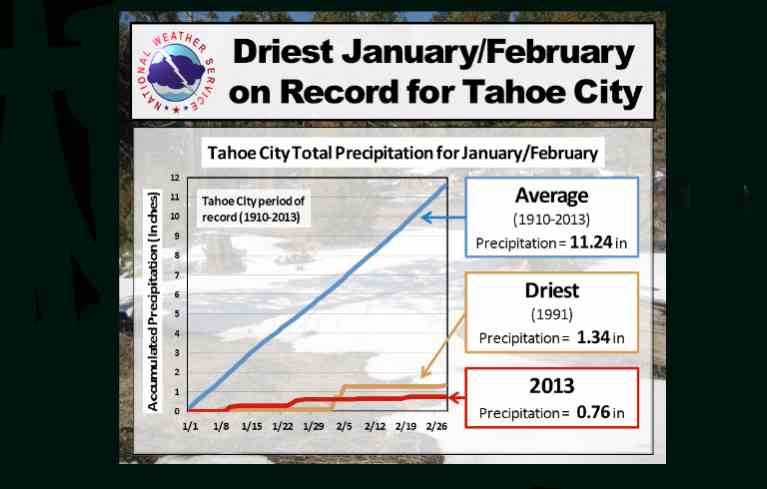
The National Weather Service in Reno has been collecting data from a station in Tahoe City since 1910. And with a matter of hours to go and no precipitation in sight for the rest of February, the first two months of 2013 will go down as the driest (0.76 inches) since stats have been collected there. The record was 1.34 inches in 1991, while the average is 11.24 inches. (See graphic to left.)

Snow surveyors across the Sierra found the same thing Feb. 28 as the water content was tabulated at various spots. Normally the reading this time of year builds on the totals from the previous two months. Not the case on Thursday.

Statewide, the snowpack water content is at 66 percent of average. It’s even worse at the Echo Summit location near Sierra-at-Tahoe where it came in at 54 percent of average. The snow measured 29 inches deep with 12.4 inches of water content at Phillips Station.

The Department of Water Resources, which conducts the snow surveys, has data dating to 1920. The driest January-February was in 1991, when 4 inches of precip fell from the mountainous area near Shasta Lake to the American River basin. For 2013, 2.2 inches of rain has fallen since December.

There is no substantial precipitation in the forecast to turn the tide. Reno weather officials say a small storm will move into the Lake Tahoe Basin on Saturday night, with another one rolling in Wednesday. But they said the snow totals are not expected to amount to much.

Despite the dismal snowpack, Lake Oroville in Butte County, the State Water Project’s principal storage reservoir, is at 113 percent of average and Lake Shasta by Redding, the federal Central Valley Project’s largest reservoir, is at 108 percent of its normal storage level.

The snow survey measurements by the Department of Water Resources determine how much water is released from Northern California reservoirs to irrigate crops and provide potable water for Southern California. Estimates by DWR are that it will be able to deliver 40 percent of the slightly more than 4 million acre-feet of State Water Project water requested for this calendar year by the 29 public agencies that supply more than 25 million Californians and nearly a million acres of irrigated farmland.


Out-of-bounds Heavenly skier found

It took search and rescue crews several hours Wednesday to find a Southern California man who had skied under the boundary ropes at Heavenly Mountain Resort.

Vahe Saradjian, 62, of Glendale told El Dorado County sheriff’s search and rescue team members that he ducked under the resort boundary ropes near the Powder Bowl Express lift.

Saradjian called 911 saying he was disorientated, lost and unable to navigate the terrain because of the lack of snow. He was not prepared to stay overnight in the wilderness.

At about 6:20pm Feb. 27 a CHP helicopter located Saradjian next to a campfire in the Cold Creek drainage. This is below the resort boundary lines. Teams from El Dorado and Douglas counties reached him at about 7:15pm.

Heavenly won’t be letting Saradjian ski at the resort the rest of the season.

— Lake Tahoe News staff report