White remains king of the superpipe

By Jason Blevins, Denver Post

The showdown became a battle of East vs. West at the Burton U.S. Open Saturday, with Shaun White eking past Japan’s rising son of snowboarding Ayumu Hirano to win his fifth open title.

Shaun White

Shaun White trains at Northstar in Truckee.

White’s second run — with five tricks including back-to-back double-cork 1080s and back-to-back double 1260s — earned the highest points of all tricks thrown by each of the 12 finalists in the 22-foot superpipe on Saturday. After a first run score of 92.5 drew pointed criticism that it should not have eclipsed 14-year-old Hirano’s monster first run, White crushed any judging skepticism with a dominant, indisputable second run.

While White’s win was hardly surprising — he’s now won 13 consecutive halfpipe contests — but Hirano’s performance solidified his status as the greatest threat to White’s decade-long reign and the leader of the next generation of snowboarding.

The 75-pound eighth-grader with springs for legs notched the highest airs of the contest — and arguably the loftiest airs in the history of snowboarding halfpipe competition — but was unable to match the master’s signature double-cork 1260 McTwists, the indomitable trick that has sustained White’s invincibility. Still, Hirano seemingly stalled in midair, floating as if in slow motion through technical spins and tight grabs.

Louie Vito, Ohio’s magnate of the board, took bronze with solid airs and technical spins.


Math is becoming bedtime reading for kids

By Bonnie Rochman, Time

One recent evening in West Caldwell, N.J., a library hosted a pajama party. Twenty little kids in princess nightgowns and football flannels counted out glittery animal stickers and pasted them onto homemade dominoes. Then they raced a stuffed pink frog on a carabiner up and down a zipline, raising and lowering their arms to speed it up and slow it down–physics in motion.

Laura Bilodeau Overdeck, a Princeton-trained astrophysicist turned stay-at-home mom, watched the scene intently. This pajama party was her idea. She’s the founder of the nonprofit Bedtime Math, and she wants kids to fall in love with numbers. As part of that mission, she wants to change the way parents put their kids to bed.

mathIt’s not that Overdeck, 43, is quibbling with the sacrosanct bath-then-book nighttime routine. She just wants parents to add a math problem, as she and her husband, investment-fund manager John Overdeck, have done with their kids, ages 4, 7 and 9. A year ago she launched the Bedtime Math website; an app and book are forthcoming. She’s reached out to libraries across the U.S., offering gratis do-it-yourself kits for Bedtime Math pajama parties–dominoes, stickers and zip-line cord included. She is exploring partnerships with organizations like the Girl Scouts in Chicago and is hoping to reach science museums. “Everyone knows they should read a book to their kids before bed,” she says, “but nobody knows they should be doing math too.”

The core of Bedtime Math is pretty simple: a free daily math problem, geared to one of three levels of difficulty: “wee ones” (prekindergarten), “little kids” (kindergarten to second grade or so) and “big kids” (second grade and up). The subjects tend to be ones that especially appeal to children–candy, for example. A recent wee-ones calculation: “M&M’s last 13 months, but Life Savers last only 9 months, despite their name. How many months will those M&M’s outlast the Life Savers?” States, weather and arcane holidays like International Pancake Day also play starring roles, as do animals; a recent problem asked kids to calculate how far a skunk can spray its scent.

Overdeck is hoping that candy and other child-friendly puzzles can be a remedy for math anxiety. Research shows that early math skills are a better predictor of academic success than reading ability. But the U.S. is in a numbers slump: America’s students rank 25th out of 34 industrialized countries in math. Everyone from the Girl Scouts to Sesame Street has launched efforts to reverse the trend.

“U.S. children are not performing up to the level one would expect,” says Sian Beilock, author of Choke, about performance anxiety. Part of the problem might be cultural. “You never hear people walking around bragging that they can’t read,” she says, “but you hear people all the time saying ‘I don’t do numbers.'” Beilock, a psychology professor at the University of Chicago, will soon lead a study of the program’s impact on two groups of preschool- and kindergarten-age children.

“Bedtime Math is part of a project that a lot of people are working on, which is, What is the cultural shift that will get kids coming into school already comfortable with math?” says Dan Finkel, a co-founder of Math for Love, a Seattle outfit that advises teachers on how to use games to spice up math education.

In contrast to Math for Love, Overdeck targets parents, not educators.

“If it’s related to schools, it sounds compulsory,” she says. “We want kids to feel about math the way they feel about dessert after dinner.”

The Overdecks have always done math — bedtime and otherwise — with their kids, beginning when their oldest was 2: they would count the appendages on the stuffed animals in her collection. Last February, Laura began to share her family’s math habit, e-mailing a few friends and relatives a sample problem. Since then, 20,000 people have signed up to receive her daily messages. Bedtime Math now has a staff of five; Laura still designs the problems, with the help of a calendar of dates worthy of a challenge, such as Cookie Monster’s birthday and the anniversary of Alaska’s statehood.

It’s hard to argue that Bedtime Math isn’t fun, but some are skeptical that it’s a cure-all.

“It won’t be a slam dunk for everyone who uses it,” says Finkel, who thinks math before bedtime revs kids up when they should be winding down.

With the University of Chicago study yet to start, the strongest evidence that Bedtime Math can change children’s skills comes from data collected from Snacktime Math, a program of Bedtime Math problems given to kids attending summer camp at a New Jersey Boys & Girls Club: more than 70 percent of the largely low-income students improved their skills after a six-week session.

Most of the other data in support of Bedtime Math are, for the time being, anecdotal.

One mother told Overdeck that her child’s zest for Bedtime Math enables her to use it as a threat: “If you don’t brush your teeth now, no math tonight!”

Sandy Smith, a Bedtime Math subscriber who attended the West Caldwell pajama party with her two preschoolers, says, “I always concentrated on the reading part, and I forgot to focus on the math.” Her confession is all the more revealing because she is an elementary school teacher.

In early February, Bedtime Math threw a pajama party at Manhattan’s brand-new Museum of Mathematics, where kids can do things like live out geometry by pedaling square-wheeled trikes over curved tracks. The Overdecks are major donors to the museum, where some 100 kids made their own card-stock clocks and tangrams while sipping hot chocolate. (Parents could opt for a splash of Kahlúa in theirs.)

“We want math to be warm and fuzzy,” says Overdeck. Which isn’t to say it should be easy. Thanks to popular demand, at the end of February, Bedtime Math is rolling out a new, Einstein-like level of difficulty, “the sky’s the limit,” for tweens, teens and even adults. When it comes to end-of-the-day problem solving, why should little kids have all the fun?




Mammoth athletes shine at skicross competition

By USSA

John Teller

John Teller

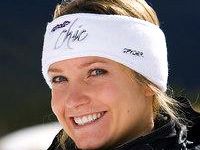
PARK CITY -– John Teller (Mammoth Lakes) defended his lead down the tight, technical course to win the USANA Skicross and the U.S. Championship title at the Sprint Grand Prix at Canyons Resort on March 1. Madeline Riffel (Mammoth Lakes) recovered after a first turn crash to snag second in the women’s race, also clinching the U.S. title.

Tyler Wallasch (Mammoth Lakes) finished second in the men’s race after a fierce battle to advance through the semi-finals, and Langley McNeal (Sun Valley, Idaho) took the third spot after going down in the final race. France’s Ophelie David won for the women.

The tricky, narrow course didn’t allow for much passing and yielded hard crashes throughout all the heats


3 U.S. women in top 10 in World Cup event

By USSA

GARMISCH-PARTENKIRCHEN, Germany — Laurenne Ross (Bend, Ore.) became the sixth U.S. Ski Team women’s speed athlete to finish in the Audi FIS Alpine World Cup top three this season with a stunning second in the Garmisch downhill on Saturday.

Julia Mancuso

Julia Mancuso

With her career first podium, Ross also became the fourth U.S. woman to land her first World Cup podium this season, joining teammates Stacey Cook (Mammoth Mountain), Leanne Smith (N. Conway, N.H.) and Alice McKennis (Glenwood Springs, Colo.).

Slovenia’s Tina Maze won the race to eclipse Austrian Hermann Maier’s single season World Cup point record and become the third woman in World Cup history to win in all five disciplines in the same season.

Julia Mancuso (Squaw Valley) was sixth in the race and Cook ninth for three U.S. women in the top 10.

Despite missing the last two downhill races, Lindsey Vonn (Vail) continues to lead the downhill standings. Maze is second. Cook fourth, Mancuso ninth, McKennis 10th, Smith 12th and Ross 16th.

McKennis crashed late in her run and was helicoptered off the slope as part of standard FIS procedure. Evaluation revealed a fractured right tibial plateau.


Ski report: Storm headed to Tahoe

ski report logoThere will be a change in weather later today.

Come support Special Olympics. I’ll be calling the play-by-play at the Special Olympics Celebrity Winterfest at Diamond Peak.

Here is the Feb. 2 ski report.

— Curtis Fong


Gaines, Bigelow bring no new taxes message to Tahoe

By Kathryn Reed

A unified anti-tax voice permeated the room as state Sen. Ted Gaines and Assemblyman Frank Bigelow spoke Friday to their constituents in South Lake Tahoe.

The two Republican legislators meandered through the crowd at Riva Grill before each addressed the assembled guests.

“We don’t need additional taxes, what we need is to streamline government,” Gaines said March 1 in response to a question by South Lake Tahoe City Councilwoman Angela Swanson.

State Sen. Ted Gaines and Assemblyman Frank Bigelow talk March 1 in South Lake Tahoe. Photo/Kathryn Reed

State Sen. Ted Gaines and Assemblyman Frank Bigelow talk March 1 in South Lake Tahoe. Photo/Kathryn Reed

She asked about whether the two men favored changing the current two-thirds requirement to raise taxes to be lowered to 55 percent.

“We have a problem in the system. There are a number of items that are bloated. We need to fix that before we ask anyone to step up and pay more,” Bigelow said.

Gaines touched on a few bills he is working on. From the get-go Gaines opposed the governor’s fire fee; instead calling it a tax. Senate Bill 17 would repeal the $150 fee CalFire levies on buildings in State Responsibility Areas (SRA). Senate Bill 125 exempts a property owner of a structure that is located both within an SRA and within the boundaries of a local fire protection district from paying the $150 tax. Senate Bill 147 exempts any property owner located within an SRA who has an income of less than 200 percent of the federal poverty level from paying the $150 fire tax.

He also talked about the state Board of Equalization on Feb. 28 voting to raise the excise tax on gasoline by 3.5 cents per gallon, which will be effective July 1.

Gaines also said he is working with Lake Tahoe Community College on a bill that would allow Nevada residents to attend the two-year institution at the rate Californians pay.

He tiptoed around the loop road controversy, saying it’s a “local decision.” While that is true, it is also a state issue because it involves a state highway.

This was Bigelow’s first public meeting on the South Shore since he was elected in November.

While the legislators said they are not anti-regulation, they agree it needs to be logical and reasonable. Considering the Lake Tahoe Basin is often touted as one of the most regulated regions in the country, the people listening are constantly facing layers of rules not often found elsewhere.

Both men represent a large swath of the state.

Gaines, who is from the Roseville area, is in a district that goes from Alpine County to the Oregon border. The 11 counties it encompasses is larger than 10 U.S. states. Bigelow’s Fifth District, which is newly realigned, takes in nine counties from El Dorado to Madera, where he is from.

Note:

Gaines is hosting a March 12 open house at his El Dorado Hills office that opened last month. It is from 6-8pm at 4359 Town Center Blvd., Ste. 112, El Dorado Hills.


‘Around the World in 80 Days’ at LTCC

Stampeding elephants, raging typhoons, and runaway trains will fill the Duke Theatre stage as the Lake Tahoe Community College Theater Arts Department presents the hit comedy “Around the World in 80 Days”.

Performances are March 15, 16, 21, 22, and 23 at 7:30pm, with Sunday matinees on March 17 and 24 at 2pm.

playThe year is 1872, and Phileas Fogg has agreed to an outrageous wager that puts his fortune and his life at risk. With his resourceful servant, Passepartout, Fogg sets out to circle the globe in an unheard of 80 days, putting his fortune and his very life at risk. But his every step is dogged by a detective who thinks he’s a robber on the run. Danger, romance, and comic surprises abound in this whirlwind of a show as a handful of actors portraying 39 characters traverse seven continents in this new adaptation of one of the great adventures of all time.

Tickets are $10 general admission, $7 for seniors and groups of eight or more, $5 for students with a valid student ID and children under 13. Tickets staring March 11 may be purchased in advance at LTCC’s bookstore Monday through Thursday, 9am to 7:30pm, and Friday 9am to 2:30pm. The box office will be open for ticket sales one hour prior to performances.

For information, call (530) 541.4660, ext. 207.


Letter: Tahoe Chamber vs. Sierra Club

To the community,

B Gorman, president of the Tahoe Chamber, has discovered evil. And it’s the Sierra Club. Why the Sierra Club? Well, in Ms. Gorman’s view the Sierra Club has filed a “frivolous” lawsuit that Gorman thinks is designed to prevent collaboration among stakeholders in the Tahoe basin.

Translated, the Sierra Club is opposed to the Regional Pan update, thus the lawsuit. In her newspaper statement Gorman raves that the Sierra Club is composed of elite nimbies, a select few that filed the lawsuit. Gorman suggest that they live in glass houses. She contends the lawsuit selfishly intends to halt progress in the Tahoe basin. Her rallying cry is people must “stand up to the elitist who wish to derail our community area plans that guide redevelopment.”

Bill Crawford

Bill Crawford

It appears Ms. Gorman thinks she has the revealed word on the creation of the new Eden. However, the devil in the details is the Sierra Club. But the question for her is, how does one get collaboration with such as the Sierra Club when you call the group selfish, etc.? That the Sierra Club’s agenda is to destroy your dream. We have to wait for a resolution on the lawsuit. If it goes to trial, the court may find some validity to the Sierra Club’s position. If so, it won’t be a frivolous lawsuit. But who knows? As Thomas Gore, the first elected senator from Oklahoma said, “Even a pancake has two sides.

Bill Crawford, South Lake Tahoe


Tahoe’s Dancing with Your Stars winner

Carol Chaplin, Lake Tahoe Visitors Authority executive director, won the March 1 Dancing with Your Stars competition at MontBleu. The audience voted, plus there were the judges — Pat Ronan, Marcia Sarosik and Paul Middlebrook. The March 1 event was a fundraiser for Tahoe Arts Project.


Placer County changes sand mixture for snowy roads

By Barbara Barte Osborn, Sacramento Bee

Placer County supervisors approved a plan Tuesday that is expected to keep many thousands of pounds of fine sediment from entering Lake Tahoe.

The plan, to be submitted to the state Lahontan Regional Water Quality Control Board, includes the use of coarser sand on roads this winter to improve vehicle traction.

placer countyThe sand is expected to reduce the amount of fine sediment reaching the lake in snow and rain runoff by nearly 5,000 pounds annually, according to county officials. The county will also purchase a high-efficiency, vacuum-assisted sweeper.

“Our choice of sand material was based on a Caltrans study of different abrasives … comparing fine-sediment content and durability,” said Robert Costa, manager of the county’s Department of Public Works.

The county’s plan is required under a recently updated federal permit regulating storm runoff into the lake. Ongoing since 1992, it is renewed every five years, each time with new requirements, Costa said.

Six additional Placer sediment-reduction projects have begun. Projects in Kings Beach and Tahoe City are expected to prevent nearly 17,000 pounds of pollutants from entering the lake when completed, according to a county news release.