Opinion: Copy critical documents before disaster strikes

By Tracy Franklin

This is the second of a series of articles highlighting emergency preparedness. Use these tools to prepare yourself for an emergency. More information is available in the city’s website.

After a major disaster, you may need financial assistance and will want to document any property loss for insurance and income tax purposes. Having ready access to the documents necessary for completing application forms, as well as those which could be difficult to replace, will help reduce delay and frustration.

sltAt a minimum:

1) Gather property insurance papers (home, auto, boat, etc.) and make copies.

2) Gather health insurance papers (medical provider, dental provider, life, extended disability, etc.) and make copies.

3) Gather financial papers (bank, investment, retirement, etc.) and make copies.

4) Gather wills, powers of attorney, and estate papers and make copies.

5) Take photos or videos of all valuables as documentation for insurance claims.

* Store these copies and photos in a safe deposit box, or in a ziplock bag in your freezer.

Important contact information

Because it may be difficult to think during the stress of a disaster and because normal routines have been disrupted, take a few moments and create a written record of these important numbers:

Work

Adult name _________________________________

Place of work _______________________________

Work phone ________________________________

Cell phone __________________________________

Work

Adult name _________________________________

Place of work _______________________________

Work phone ________________________________

Cell phone __________________________________

School

Child name _________________________________

School name ________________________________

School phone _______________________________

Cell phone __________________________________

School

Child name _________________________________

School name ________________________________

School phone _______________________________

Cell phone __________________________________

Other

Doctor name ________________________________

Doctor phone _______________________________

Dentist name _______________________________

Dentist phone _______________________________

Optometrist name ____________________________

Optometrist phone ___________________________

Insurance agent _____________________________

Insurance phone _____________________________

Vital records

Disasters not only affect community infrastructure and public works, but they often overcome family finances, making recovery difficult and sometimes impossible. Start by completing an emergency financial first aid kit created in partnership with Operation HOPE.

Research shows that while 71 percent of households reported having copies of important financial documents in a safe place, only 1 percent specifically mentioned the documents as being part of their household disaster supplies. Only 2 percent of households reported having cash as part of their disaster preparedness supplies.

Pre-disaster financial planning is essential for individuals and families to complete because disasters leave many Americans without access to finances or with expensive damages.

The EFFAK is a simple tool designed to assist you and your family in being financially prepared before a disaster strikes and maintaining financial stability in the event of an emergency. EFFAK helps you to identify and organize key financial records and provides a quick reference file for your most important financial documents.

One kit per household is recommended, although in the event one kit is used for a couple, all joint and separate accounts and liabilities should be included.

Inventory home possessions

Make a record of your personal property for insurance purposes. Take photos or a video of the interior and exterior of your home. Include personal belongings in your inventory. You may also want to download the free Household and Personal Property Inventory Book from the University of Illinois to help you record your possessions

Documents

Obtain property, health and life insurance if you do not have them. Review existing policies for the amount and extent of coverage to ensure that what you have in place is what is required for you and your family for all possible hazards.

Store important documents such as insurance policies, deeds, property records and other important papers in a safe place, such as a safety deposit box away from your home. Make copies of important documents for your disaster supplies kit. Having such information handy should make the registration process for FEMA benefits smoother, should you be involved in a presidentially declared disaster.

Tracy Franklin is the public information officer for South Lake Tahoe.



Part-time workers increasing during economic recovery

By Catherine Rampell, New York Times

One of the more unsettling trends in this recovery has been the rise of part-time work.

We are nowhere near recovering the jobs lost in the recession, and the track record looks even worse when you consider that so many of the jobs lost were full time, whereas so many of those gained have been part time.

When the recession began, 16.9 percent of those working usually worked part time. That share rose sharply in 2008 and 2009 and has not fallen much since then. Today the share of workers with part-time jobs is 19.2 percent.

Source: Bureau of Labor Statistics, via Haver Analytics. Graph/New York Times

Source: Bureau of Labor Statistics, via Haver Analytics. Graph/New York Times

This would not be so troubling if people were electing to work fewer hours. But that is not the case.

Basically all of the growth in part-time workers has been among people reluctantly working few hours because of either slack business conditions or an inability to find a full-time job. Together these people are considered to be working part time “for economic reasons.” Their numbers have grown by 3.4 million since the downturn began.

The number of people working part time “for noneconomic reasons,” on the other hand, has fallen by 639,000 since the recession began.

These trends are part of the reason that many people believe the standard unemployment rate of 7.7 percent understates the extent of underemployment. If you include both part-time workers who want full-time work and people who have stopped looking for jobs but still want to work, the unemployment rate is actually 14.3 percent.

It’s not clear what’s behind the growth in part-time work. It probably has to do mostly with companies’ not having as much need for labor today as they did when the economy was strong. The Affordable Care Act also has incentives for employers to keep their count of full-time workers below 50, but that has probably affected only a few companies at the margin at this point.


Climate change affecting food supply

By Vaishnavi Chandrashekhar, Christian Science Monitor

On an early Friday morning, the wholesale fish market at Mumbai’s historic Sassoon Dock is in full, cacophonous swing. As fishermen unload their catch, local fish-sellers, restaurant cooks, and housewives swarm the slick wharf, haggling over their favorites – salmon, pomfret, and king mackerel.

There are fewer takers for a new fish on the ice block – the small, oily sardine. Until two decades ago, these fish were found only off the southwest coast of India, but warming seas have expanded their territory north and east. In Mumbai, on the northwest coast, fishermen say sardines have become especially plentiful in the past five years. But they have yet to become popular with local residents.

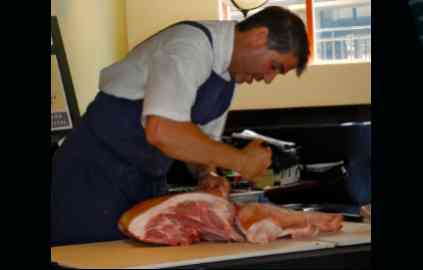
Reno chef Mark Estee demonstrates how to cut a whole pig. Photo/LTN file

Reno chef Mark Estee demonstrates how to cut a whole pig. Photo/LTN file

“We can always eat them at home if we don’t sell them,” says Bhavna Tandel, who is selling a big basketful for less than $10.

Mumbai’s new sardine bounty is an example of how warmer temperatures may be redrawing the world’s geographic distribution of food – with potential implications for what and how we eat.

The global average temperature has risen by 1.3 degrees Fahrenheit over the past century, according to the Intergovernmental Panel on Climate Change. Further temperature increases and greater climatic variability are expected to alter production of food staples such as wheat, rice, and maize worldwide in the coming decades. Warming is also expected to shift or expand the cultivation of foods, especially to the north.

In southern England, where average temperatures have risen by 3 degrees F since the mid-20th century, some farmers have started growing foods associated with the sunny Mediterranean – olives, apricots, and grapes.

In the northeastern United States, warming temperatures and a decrease in snowpack are shrinking the maple syrup season. Climatic changes are likely to move production north, according to a 2007 study by the U.S. Forest Service and Cornell University. Sugar-maple tree sap depends on cold nights and warm spring days.

While farmers in Vermont may be able to maintain yields by adapting to an earlier tapping season, maple farmers farther south in Pennsylvania will see production decline sooner, the Cornell study found.

And shifts in fish stocks aren’t restricted to the Indian Ocean. Warming sea temperatures along with ocean oscillations have drawn mackerel northward into Iceland’s waters – triggering a fishing conflict with Scotland – and brought sardines back into the North Sea and Baltic Sea after a 50-year absence.

English wine has boomed in recent years, with the number of hectares of vineyard more than tripling since the mid-1980s, according to the English Wine Producers Association. Climatic factors are partly responsible for the boost especially of red wines, the grapes for which usually fare poorly in rainy, chilly British weather. Red wine production increased from 72,000 bottles a year to more than 600,000 in the 2000s.

But as the surplus of sardines in Mumbai shows, adapting to new foods isn’t always easy.

Fishermen in this region “should be happy with the increase in sardine catch but that’s not the case,” says Vinay Deshmukh, the scientist in charge at the Mumbai branch of the government of India’s Central Marine Fisheries Research Institute (CMFRI). Because locals aren’t used to eating sardines, he says, “fishermen don’t know what to do with them.”

The fish are sold so cheap – at about 1 cent per pound – they are even used as poultry feed. “The northern way of cooking fish doesn’t seem to suit them,” he says.

Mumbai’s residents tend to favor larger, meaty fish. Shivani Jogle, a working-class mother of three, says her children don’t like sardines for their fried fish because they have so many bones. “They’re always asking for Chinese or pizza,” she says.

Changing diets and the increasing popularity of seafood restaurants has also hiked up demand for fancier varieties, like pomfrets and tiger prawns, says city chef Anando Solomon.

Some of the sardine catch in the state of Maharashtra, of which Mumbai is the capital, is thus dispatched south to states like Kerala – where the fish is traditionally eaten and sells at much higher prices.

Oil sardine catches only started to increase on the northwest and eastern coasts of India in the 1990s, says Elayuperumal Vivekanandan, the senior CMFRI scientist who has done the principal work on this subject.

Sardines are known to have cycles of abundance and scarcity that correspond with natural ocean system changes. But Viveknandan says there has been no significant change other than warmer temperatures to explain the northern movement of sardines in this region. Sea surface temperature increased by 0.2 Celsius to 0.3 C along the Indian coastline between 1960 and 2005, and is projected to increase by another 2 to 3.5 degrees C by 2099.

Sardines are not the only small fish to benefit from warming waters – Indian mackerel have also expanded their territory north and are also going deeper.

How long the gains will last is unclear. “Right now, we’re experiencing the beneficial aspects of this trend,” says Vivekanandan. “But in the future, that may change.”

Indian oil sardines have expanded – not relocated – northward. But temperatures in southern waters may eventually become too warm for them, say scientists. Meanwhile, in the waters off the northeastern coastal city of Calcutta, sardines could compete for plankton with another small fish, the hilsa, which is a local delicacy.

The ripple effect on larger fish is even less certain. An increased small fish population may boost numbers of larger, predator fish – or they may eventually replace them. Large fish are generally more sensitive to environmental change and are already under pressure from increased commercial fishing in the region.

In the state of Maharashtra, overfishing has caused a decline in most fish catches, save for small fish like sardines and mackerel, which have doubled in the past five years.

That makes adaptation even more important. A new government initiative on climate change is looking to give fishing communities here access to better fish dryers and deboning machines to help them sell their sardine catch.

As for Mumbai’s fish lovers, they may have no choice but to change their tastes, given the declining stock and rising price of traditional favorites like Bombay Duck. CMFRI’s Mr. Deshmukh notes that humans have adapted to changes in food availability before – including in this region.

Decades ago, tuna was unpopular here because of its bloody appearance, he recalls. But there was a shift in consumption, partly because of low prices.

“People are now eating it,” he says.


11 women receive special awards from Soroptimist

By Kathryn Reed

STATELINE – Courageous, committed, tenacious, dedicated, inspirational. Those are just some of the words used to describe the 11 women who were honored Thursday night by the two South Shore Soroptimist groups.

Soroptimist International South Lake Tahoe and Soroptimist International Tahoe Sierra recognized three distinct groups March 7 at Harrah’s Lake Tahoe. With a mission of helping girls and women, the two groups come together once a year to choose who to give the Violet Richardson Ward, Women’s Opportunity and Ruby awards to.

Soroptimist honor 11 women March 7. Photo/Sharon Sterling

Soroptimist honor 11 women March 7. Photo/Sharon Sterling

Six South Tahoe High School students were singled out for their volunteerism. The Violet Richardson Ward Award is named after the first president of the first Soroptimist club. Girls must be between the ages of 14 and 17 to be considered.

This years winners are: Catherine Baghadikian, Grace Bronken, Rose Campion, Margaret Carlson, Stephanie Thomaselli and Carli Valney.

While some of them have exceptional grades, or are star athletes, this award goes beyond those achievements – and doesn’t even have grades or sports as criteria. It’s about what they are doing for others that counts.

Several of them volunteer at Bread & Broth, are involved with church groups, volunteer with the Boys and Girls Club, are in Girl Scouts, in the National Honor Society, started a music program, planted trees post-Angora, help at Tahoe Youth & Family Services, and help at Barton’s Skilled Nursing Facility.

Michelle Flury and Marisol Jimenez-Torres were there to receive the Women’s Opportunity Award. They each received a check to help with their continued education.

These women have overcome the odds and obstacles, and yet know higher education is the answer to being self-sufficient and able to provide for their families. The award is not only money to help them, but recognition for their courage and determination.

For Susan Baker, Diana Hankins and Karin Holmes, the Ruby Award is bestowed on them for their work in making the lives of other women or girls be better. But none would take sole credit for her efforts, instead saying the team around them made their accomplishments become a reality.

Baker is the reason Mount Tallac High School has the Young Parents Program, and a big reason why in 1999 when it started there were 32 girls who were pregnant or young moms, and today there are three at the school.

Hankins is the woman behind the local chapter of NAMI – National Alliance of Mental Illness. Every day she is working to wipe away the stigma of mental illness and help those who have issues.

Holmes is the reason the South Tahoe Middle School track got built. She has been a coach and teacher for decades.


USFS rethinking fire policy

By KABC-TV

SAN FRANCISCO — After coming in $400 million over budget following last year’s busy fire season, the Forest Service is altering its approach and may let more fires burn instead of attacking every one.

The move, quietly made in a letter last month by Forest Service Chief Tom Tidwell, brings the agency more in line with the National Parks Service and back to what it had done until last year.

Tidwell described the change as simply an “evolution of the science and the expertise” with more emphasis on pre-fire planning and managed burns, which involve purposely setting fires to eliminate dead trees and other fuels that could help a wildfire quickly spread.

It also answers critics who said the agency wasted money and endangered firefighters by battling fires in remote areas that posed little or no danger.

The more aggressive “kill all fires” approach instituted last year was prompted by fears that fires left unchecked would quickly devour large swaths of the drought-stricken West, Tidwell said. New Mexico and Colorado reported record fire seasons in 2012, and with dry conditions remaining in much of the region 2013 could be another bad year in the West.

This approach, however, angered environmentalists, who said it was expensive and ignored fire’s natural ability to rid the landscape of dangerous fuels and bolster forest ecology.

But letting fires burn also has its dangers, even in remote areas.

Last year, the Parks Service allowed a fire to burn that started as a half-acre blaze in remote Lassen Volcanic National Park in Northern California. What became the Reading Fire eventually required firefighters and ended up charring 42 square miles of forestlands as it spread outside the park’s boundaries to lands managed by the Forest Service and California Department of Forestry and Fire Protection.

The fire damaged the region’s timber industry and cost an estimated $15 million to suppress. No structures were harmed.


State money to help fix Highway 89

The South Shore is getting a chunk of the $333 million in California Transportation Commission money that was awarded Tuesday.

El Dorado County is getting $12.4 million for a water quality collection and treatment facility project on Highway 89 from one-tenth mile north of the Eagle Falls sidehill viaduct to Meeks Creek Bridge.

This is one of 91 projects funded in part with $233 million from Proposition 1B, a transportation bond approved by voters in 2006. Another $100 million is from assorted transportation accounts funded by state and federal dollars.

The county is also getting money for improvements on Highway 50 east of Camp Sacramento.

— Lake Tahoe News staff report


Tribute bands popular with fans

By Mel Shields, Sacramento Bee

One of the major movements in live entertainment over the past decade has been the rise of tribute bands.

The advocates and critics of such groups seem about as divided as House Republicans and Democrats, or as staunch as defenders of the Beatles or the Rolling Stones as the better band.

The Spazmatics play tonight and again in the wee hours of Saturday at Red Hawk Casino.

The Spazmatics play March 8 at Red Hawk Casino.

Jackson Rancheria in Jackson presents the latter onstage Saturday with a “shootout” between the two (Beatles portrayed by the band Abbey Road, Rolling Stones portrayed by the band Jumping Jack Flash).

“Beatles vs. Stones” features two groups that seem dedicated to as much authenticity as possible. There’s a blacked-out tooth on the Keith Richards impersonator and a Brian Jones Vox Teardrop guitar. The Beatles, of course, sporting mop-tops and the music even includes flubs like Ringo’s chorus beat in the wrong place in “All My Lovin’.”

Audience reactions have been very positive for this show, like at Harrah’s Lake Tahoe just last week, and so far no soccer-style brawls have broken out. Maybe the fans are just too old.

Those who hate tribute bands might strongly despise a more recent trend – the brand band. The Spazmatics, who appear at Red Hawk Casino tonight and Saturday, are a perfect example. There are many editions of them, all of whom present the 1980s complete with horn-rimmed glasses, skinny ties, and a-ha songs.

Critics find it all too merchandised, but audiences don’t much care. Their party atmosphere is terrific and the evening is reliably great fun. Besides, where else can you hear a live version of the theme from “Fresh Prince of Bel-Air”?

Few entertainers can trace much of their popularity to covers, but Jose Feliciano, who performs a rare date Saturday at Harrah’s Tahoe, took on the Doors’ “Light My Fire” and redefined it, doing the same later with Tommy Tucker’s “Hi-Heel Sneakers.”

One cover made him briefly notorious – that was of “The Star-Spangled Banner” in 1968 at a World Series game. Now, 45 years later, its decidedly Latin twist may be considered prescient.

Of course, the Puerto Rican guitarist and singer has scored on his own terms. “Felice Navidad” anyone?

Feliciano, once a staple of casino showrooms, has been rare over the past decade. Gordon Lightfoot also is one of the few entertainers who can transform a giant performing space into a coffeehouse with songs like “If You Could Read My Mind” and his consummate ballading of “The Wreck of the Edmund Fitzgerald.” He’s at Cache Creek in Brooks on Saturday.


January not good for Nevada casinos

Lack of snow and the Chinese New Year falling in February contributed to Nevada’s drop in gaming revenue in January.

The numbers were off 12.44 percent compared to a year ago, with $909.2 million collected, according to the state Gaming Control Board on March 8.

Plus, the Super Bowl is now in February, too, which is often a cash cow for the sportbooks.

Stateline casinos were down, but not nearly to the state level. They were off 2.62 percent compared to the prior year. North Lake Tahoe casinos, though, were up by 0.62 percent.

 — Lake Tahoe News staff report


Lyn Landauer — 1926-2013

Lyn Landauer, one of Lake Tahoe’s noted historians, died Feb. 21 in Monterey. She was 86.

Lyn was president of the Lake Tahoe Historical Society and wrote many of the articles for the monthly newsletter. She authored “The Mountain Sea, A History of Lake Tahoe”.

Born Lyndall Deane Baker on Sept. 24, 1926, in Oakland, she married Donald Landauer in 1948. Both were teachers, writers, avid sailors, folk dancers, and travelers. They lived in Pasadena for 35 years, where they raised four sons.

Lyn received her doctorate in history from UCLA in 1980. She taught history in Los Angeles secondary schools, and later was a professor of history at Los Angeles City College, Pierce College and Lake Tahoe Community College.

Lyn Landauer

Lyn Landauer

She and Don retired to Lake Tahoe in 1987 and later split their time between Lake Tahoe and Kauai.

Lyn and Don wrote a book about the history of Hawaii and the U.S. Navy called “Pearl”. She also wrote many non-fiction and fiction books, magazine and newspaper articles, and was a popular lecturer on a range of historical topics.

After Don died in 2006, Lyn moved to Monterey. Although challenged by physical ailments in recent years, Lyn’s passion for writing, reading, and teaching never wavered. She passed away peacefully, surrounded by family.

Lyn was preceded in death by her son, Michael, in 2003 and husband, Don, in 2006.

She is survived by sons Christopher, Timothy and Douglas; daughters-in-law Deborah, JorJa, Mary Beth, and Kirstie; grandchildren Matthew, Robert, Nikolas, Shaughn, Kellie, and Benjamin; great-grandson Jordan; sister Meredith Wylie; nieces and a nephew.

Services will be private.

Donations in her honor may be made to the League to Save Lake Tahoe.


Ski report: Don’t ski out of bounds

ski report logoMore fresh powder and continued chance of snow showers throughout the day.

Wear good goggles — yellow or rose tinted.

Ski and ride with a buddy and stay in bounds on open runs and terrain only.

Here is the March 8 ski report

— Curtis Fong