Ski report: Follow the sun
 Get out early to enjoy the machine groomed corduroy, then follow the sun surfaces.
Here is the March 16 ski report.
— Curtis Fong
Get out early to enjoy the machine groomed corduroy, then follow the sun surfaces.
Here is the March 16 ski report.
— Curtis Fong
Barton Auxiliary is having a blood drive April 1 from noon to 6pm at Embassy Suites (First Floor Ballroom, 4130 Lake Tahoe Blvd., South Lake Tahoe).
There is free validated parking in the Embassy Suites parking lot.
For more information, call (775) 588.2376 or (775) 781.5343.
By Kathryn Reed
STATELINE – Vision. It’s what has kept Lake Tahoe Community College going for nearly 40 years.
President Kindred Murillo credits those who four decades ago created the college – which started in a motel on Highway 50 – as well as those who brought it to its current location off Al Tahoe Boulevard. But she is well aware the work is not done if the college is to be operating in another 40 years.
In a talk March 13 to Soroptimist International South Lake Tahoe at Harrah’s Lake Tahoe, Murillo spoke of the challenges facing the two-year college that are being handed down by Sacramento as well as the vision she, the board, staff and the community have for the next 40 years and beyond.
Online classes, aka distance education, are a double-edged sword for LTCC. With 22 percent of the enrollment last year coming from this segment of the population, it helped LTCC. But with a bill introduced into the Legislature last month, it would alter distance ed. It could hurt institutions and help students based on mandating California’s public colleges and universities accept faculty-approved online college courses for credit.
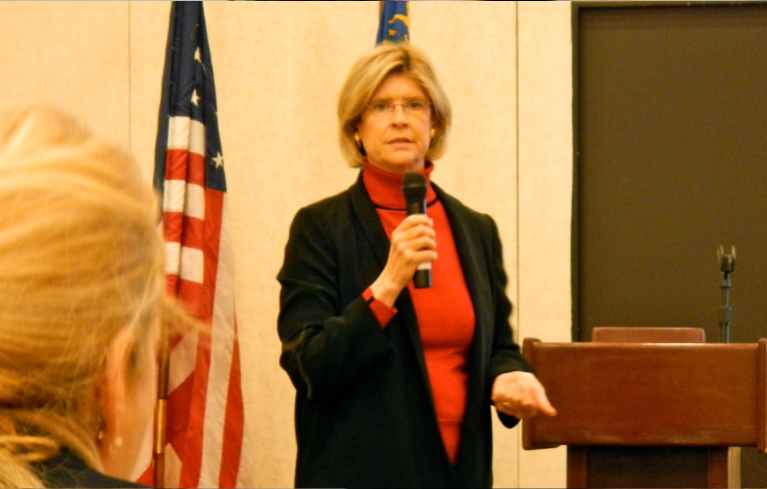
LTCC President Kindred Murillo is plotting the college’s future. Photo/Kathryn Reed
The other issue on the horizon is what’s called “massive online open course” where students don’t have to be enrolled at a university but can take an online course and other institutions must accept those credits.
“That could flip our world upside down,” Murillo said.
Another issue affecting LTCC is the state limiting how many times a student may take a class. For an area like South Lake Tahoe, many people in the community repeat physical education, art and culinary classes.
The state wants community colleges to focus on getting students to transfer to a four-year college, training them for a job or helping them with basic skills.
The life-long learning classes that community colleges came to be known for are going by the wayside. LTCC, though, is trying to keep many of them alive through Connect Ed. No grades are given, but some classes are more expensive than what they would have been through LTCC.
“It’s feeling like the state of California is raining down challenges on us. It’s harder on a small, rural college,” Murillo said.
Gov. Jerry Brown also wants to limit the total number of credits a community college student can obtain. So instead of floundering to find themselves, they’ll need direction faster.
Another issue for all colleges is that the high school population across the country is declining. Murillo said looking farther down the education chain there is good news with growth in grades 1-3 in Lake Tahoe Unified School District.
A bill introduced by state Sen. Ted Gaines, R-Roseville, would allow Whittell High School students to attend LTCC at the California rate. This would be a pilot program just for LTCC.
Sacramento is also likely to change how community colleges are funded. Now it is based on full-time equivalent students. There is talk of it changing in the next five years to be based on the number of students who complete a program.
“LTCC is going to have to make choices in the next two years,” Murillo said. And she isn’t shy about saying the community is going to like all of them.
Class sizes are likely to grow. Her goal is to be effective and efficient.
Murillo and the board are setting a path for LTCC to be a four-year college, a destination college, creating an international program, erecting student housing.
In the next two years, Murillo said LTCC needs to turn around the declining enrollment, deal with repeatability of classes and work with South Tahoe High on matching curriculum.
In May, the college will be inviting the community to give input about it envisions for the future.
By JoAnn Conner
Being an elected official can be difficult. No surprise there, but sometimes our “job” blends with the fact that we are also individuals and residents of this community. As such, I have been doing a lot of reflection lately, and there are a few observations I would like to share.
I have heard repeatedly that our town, not South Shore, but the city of South Lake Tahoe is drab, dirty and stuck in the past. I have heard, primarily from outside sources, that we are not doing anything to improve our town and it is dying. Really? In the past few years, in spite of a down economy, our little town has accomplished some amazing achievements:

JoAnn Conner
• Lakeview Commons. No one can say it is not one of the most beautiful, free public access points on the entire lake.
• The Harrison Avenue project is moving forward to revitalize the business core next to Lakeview Commons, and includes more walkable and bikeable areas.
• Bike trails have been built, not just along the streets, but paths with scenic quality, and more are coming this summer, along with much needed repair.
• Sidewalks on Highway 50 from the Y to the corner of Pioneer and Highway 50, initiated by the city, are being built by Caltrans to join the sidewalks already in place near Stateline. Those sidewalks are scheduled to round the corner and proceed down Pioneer Trail to Larch Avenue, then to Ski Run Boulevard. Definite steps to a walkable and bikable community.
• In regards to transportation, the city of South Lake Tahoe, with some service club partnerships, has installed bus shelters to help protect those who travel by bus.
• Lake Tahoe Airport has received millions of dollars from the FAA because of the determination of city government to rebuild its runway and tarmac area to ready it for the return of commercial service and keep it active for private and emergency service.
• The Village Center and the Heavenly Village areas, all on the California side of the “tourist core,” have been renovated, are walkable and bikable, and provide a variety of experiences, from shopping, to ice skating, to dining outside.
• The Ski Run BID is alive and well, with help from the city and funds from the California Tahoe Conservancy. The farmers’ markets in the summer are wonderful and well attended by locals and visitors alike.
• The city has adopted its own General Plan that is consistent with goals in the TRPA Regional Plan. We do review it, and we have made progress.
• Neighborhood meetings have been established and citizens invited to participate to gain input and consensus on a variety of important issues.
• Our area plans for the Y and Stateline are being advanced to encourage local economic growth and prosperity for existing businesses within South Lake Tahoe.
• The city government continues to make storm drainage improvements throughout South Lake Tahoe, as well as funding road resurfacing and repair projects for the whole community. We know more work is needed.
• We are working on a linear park near Wildwood and Highway 50.
• Bijou Park successfully hosts several community events per year, including the upcoming Earth Day.
• We have torn down some older buildings and built affordable housing, the most recent of which, The Aspens, is due to begin construction this building season.
• Our community college has added buildings and has one of the best fire academies in the state, if not the nation. It is working toward becoming a four-year college.
• The city and Recreation JPA are working in partnership with Lake Tahoe Unified School District to repair our playing fields and build a new one this season.
• The city also partnered with the school district and gave over $225,000 for the-state-of-the-art track at the recently upgraded middle school.
• Our high school has been renovated and over $100 million was spent to create a school that is far above most in the state for education, and offers preparation for careers in the arts, work force, and professional fields.
• The city of South Lake Tahoe is working in partnership with Lake Tahoe Unified School District, El Dorado County, and state and national entities to make our schools safer for our children.
I reflected on those that say the entrance to our “tourist core” needs work, and maybe some destruction. And again, I wondered why these things are being said and by whom? In my opinion, the California side of the “tourist core” looks pretty good, especially comparatively speaking, and we have made as many, if not more, improvements than the other side of “the core.” Think about this:
• The Bottle Shop is quaint and historic, and is at least as attractive as Dart Liquor.
• The triangle parcel with 7-Eleven and the Taqueria is much more pleasing and far less offensive than the Lucky Beaver sign, according to input from many of our citizens who drive that corridor.
• Many also feel that the upgraded Holiday Inn Express is certainly more attractive than the Lakeside Inn, with its ’70s era shingle siding.
• The entire Heavenly Village and Village Center, in California, with their upgraded shops, ice skating rink, and smokeless access to a quality movie theater are, in my opinion, far more attractive than the casino area of the “tourist core” with their dated exteriors.
Some say we haven’t done anything to bring jobs or businesses to the city. We have added Grocery Outlet, Ross, DIY, T.J. Maxx, and Big 5 is coming. These all provide jobs, some above minimum wage, and while some have added a little competition to existing businesses, their existence here have added to the tax base, allowing us to do more, and have helped contain “retail leakage” with more dollars being kept in our town.
The city also helped to bring SnowGlobe here, which, like it or not, still brought a lot of revenue to our businesses. We also have some new light manufacturing.
We have done this as the city of South Lake Tahoe, not South Shore. We don’t need our neighbors permission to make improvements and they don’t need our permission to do the same. Yes, we still have work to do, but the point is we are getting it done without funding from the rest of South Shore. Stop the blame game and start fixing up your own backyard.
If you live in a part of the South Shore that wants to expand sidewalks, plant greenways, or renovate buildings, do it. If you want to build bike paths, put in recycling bins, bring better than minimum wage jobs, and replace old buildings with affordable housing, we aren’t stopping you.
I have lived in South Lake Tahoe for 32 years, raised my family here, and I am helping to raise the next generation in our town. The best accomplishments and the most significant achievements have come from respect for the work of others, helping your neighbor, and working together. Sometimes you work with your neighbors, and sometimes you’ve just got to get it done yourself.
The worst effects have been seen when property has been taken (eminent domain), jobs have been lost, families have been devastated, and people start blaming others for their problems. I believe, personally, that most of us want to work together in ways that benefit us all fairly and equally.
We are really good at working together as a community. We have seen that with fundraisers for our sick children, injured community members, and after the Angora Fire. We know how to pull together and get something positive for all.
Please stop listening to outside sources and look around for yourselves. And the next time someone tries to tell you your town looks like garbage, I hope you set them straight.
JoAnn Conner is on the South Lake Tahoe City Council.
By Brian Joseph, Orange County Register
Two new reports released in conjunction with Sunshine Week, a national initiative to promote open government, have found that it ain’t exactly sunny in California.
The Washington, D.C.-based nonprofit Sunlight Foundation gives the California Legislature a “D” grade for its efforts to make bill and vote data available online. Meanwhile, the Golden State reform group California Forward is sharply critical of both state and local governments in its report “The State of Transparency in California: 2013.”
California Forward, which has started referring to itself as CA FWD, finds the Legislature’s transparency efforts a joke and lambasts local governments for releasing financial data that is essentially incomprehensible to average citizens. The report also asks why the home of Silicon Valley can’t seem to use advances in technology to provide better government transparency.
“Technology is not a cure for the accountability issues in California, but it is the most expedient vehicle for engaging the public and encouraging honest evaluation of its performance,” California Forward writes. “From top to bottom, California’s public sector is lagging in the adoption of tools that were invented by the private sector right in its backyard.”
The folks at Sunlight essentially came to the same conclusion. Sunlight developers recently launched an innovative Web application called Open States, which allows users to track pending legislation in every state legislature. While they were building the site, the developers found themselves “struggling with the often inadequate information made available. Impossibly difficult to navigate sites, information going missing and gnarly PDFs of tabular data have become daily occurrences for those of us working on Open States. People are always curious to know how their state stacked up compared to others – in fact one of the most frequent questions we have been asked has been ‘so which state was the worst?’ That question got us thinking: How could we derive a measure of how ‘open’ a state’s legislative data was?”
The result was Sunlight’s Open Legislative Data Report Card, which gave a letter grade to each state legislature for efforts made to post information online. Sunlight says “each state was evaluated in six categories based largely on the Ten Principles for Opening Up Government Information,” standards based on an October 2007 meeting of 30 open government advocates and expanded by Sunlight itself.
Six other states joined California in receiving D grades (Indiana, Louisiana, Maine, Oklahoma, Rhode Island and Wisconsin). Nine states received A’s (Arkansas, Connecticut, Georgia, Kansas, New Hampshire, New York, North Carolina, Texas and Washington). Five flunked (Alabama, Colorado, Kentucky, Massachusetts and Nebraska).
The only positive thing Sunlight could say about the California Legislature is that its bill data is “machine readable.” Sunlight was especially critical of the California Legislature under the “Ease of Access” principle, stating that California’s site “is rendered entirely inoperable without Javascript. Site was considered slightly more difficult than average to use.”
California Forward was equally critical of open government efforts in the Golden State.
“The harried nature with which state budgets – and indeed many laws – are passed in the Legislature is more or less a punch line in Sacramento,” California Forward wrote bluntly. “But it is a pox on our democracy.”
California Forward was specifically critical of a common Sacramento practice known as “Gut and Amend,” in which legislators remove the contents of a bill and replace the language with an entirely new proposal, often completely unrelated to the previous one. Gut and Amends can and often do dramatically change the intent of a bill and they frequently happen in the waning days or even hours of the legislative session, resulting in lawmakers approving legislation that hasn’t been vetted at all.
Last year, an initiative sponsored by California Forward, Proposition 31, would have required all bill proposals to sit for 72 hours before an official vote, but it failed. Currently, the Legislature can vote on proposals that aren’t even in print.
California Forward also questioned in its transparency report why state and local governments release budget information that is beyond the comprehension of all but a “handful of Capitol insiders and watchdogs.”
“Perhaps the worst example of lack of information is related to property tax,” California Forward writes. “Depending on the number of local governments that provide services, a homeowner’s tax payment may be split among a dozen or more entities, including the county, the city, school districts and a basket of special purpose districts. From the property taxpayer’s perspective, it is difficult if not impossible to find out which of the many local governments that provide services get the money. Californians should care about this since property tax is still the single largest tax financing local services.”
The report also notes that “little if any actionable data is available on pension and debt obligations.” This echoes an August 2011 report by the Orange County Register that found that the state law prohibits the release of key pension data. In all, the Register found at least 500 provisions of the California Government Code that exempt specific records from disclosure and another 16 code sections that prohibit the release of broad categories of documents.
Sunshine Week, which runs through Saturday, was established in 2005 to specifically shed light on these kinds of issues.
The Pain McShlonkey Classic returns to Squaw Valley March 30. Now in its third year, this action packed on- and off-mountain event serves as a tribute to legendary skier Shane McConkey where the winner is crowned fastest snow blader on the planet.
Hosted by the Shane McConkey Foundation, the event has grown to be a highly successful fundraiser for local nonprofits. This year’s event will benefit Make-A-Wish Foundation and the Tahoe Truckee Unified School District’s environmental education programs.
The festivities begin that Saturday at 9am as athletes line up atop KT-22 chairlift for an all-out snowblade blitz. The pros will take on 30 amateurs in an anything-goes battle to the finish on Squaw’s GS Bowl, named for the original 1960 Olympic Giant Slalom course. Pros are invited to compete, while amateur contestants are selected by submitting their most embarrassing moment in an online contest.
Later, spectators gather below the outcroppings of Squaw’s Enchanted Forrest for the Extreme Snowblade Small Mountain Invitational.
The Shane McConkey Foundation encourages skiers, riders and resorts around the world to celebrate the spirit of McConkey during this weekend.
For event details, registration information, after party tickets or to make a donation to the Shane McConkey Foundation, go online.
A meditation workshop to learn how to manage the ever-active mind with love and understanding is being sponsored by Unity at the Lake.
Living a Soul-Centered Life will be theme of Sarah McLean’s talk March 19, 7-9pm at Unity at the Lake, 1195 Rufus Allen Blvd., South Lake Tahoe.
McLean is a best-selling author who served as the education director of the Deepak Chopra Center for Well Being.Her methodology of teaching has been fine-tuned from teaching meditation for more than 22 years and she has integrated the best practices from a variety of philosophies.
The cost is $25 at the door. Book signing and reception to follow.
U.S. Forest Service fuels management crews will continue prescribed fire operations near Spooner Summit beginning March 18.
Crews expect to burn approximately 40 acres.
In addition, operations begin Monday on Tahoe Mountain near Dundee Circle. Crews expect to burn approximately 6 acres.
Operations in both locations may continue through the week, weather and conditions permitting.
Residents and visitors can expect to see smoke from these prescribed fire project areas. Smoke may be visible on Highway 50 near Spooner Summit. The Forest Service strives to minimize the impacts of smoke on local communities.
Smoke-sensitive residents should consider staying indoors and keeping doors, windows and outside vents closed. To directly receive prescribed fire updates, send an email to pa_ltbmu@fs.fed.us.
By Jason Blevins, Denver Post
ESPN on Tuesday announced it was ending best trick contests for motocross and snowmobile disciplines at the Summer and Winter X Games.
“This change reflects our decision to focus on motor sports disciplines which feature athletes who also compete in multiple, world-class competitions (e.g. professional events and tours) reflecting the highest degree of athlete participation, competitive development and the global nature of our X Games franchise,” read a statement from ESPN.
ESPN, which created and hosts the X Games events, has made more than 60 changes to competition disciplines over the X Games’ 18-year history. The network said Tuesday that dropping motorcycle and snowmobile best trick contests would continue the growth of the games and were designed “to capture the evolution of the sport.”

Snowmobiler Caleb Moore practices during the Winter X Games on Jan. 24 in Aspen. Photo/RJ Sangosti/Denver Post)
The decision comes as ESPN is reviewing its Winter X Games freestyle snowmobile contests following the first X Games death of a snowmobile athlete and four-time X Games medalist Caleb Moore. Moore, 25, of Texas, under-rotated a backflip during the Winter X Games snowmobile freestyle competition at Aspen’s Buttermilk ski area on Jan. 24, and snagged the skis of his sled on the landing ramp.
The 450-pound machine struck him as he tumbled down the ramp. After he was helicoptered to Grand Junction’s St. Mary Hospital, he developed brain complications following heart surgery to address a cardiac contusion. He died a week after the accident.
The day Moore passed, Scott Guglielmino, ESPN’s senior vice president of programming and global X events, said in an interview on the network’s “Outside the Lines” show that X organizers would conduct a “thorough review” of all snowmobiling events.
Guglielmino said he would enlist athletes and course designers in an effort “to make sure that we take as much risk as we can out of (freestyle snowmobiling).”
He said he was most concerned with stunts where athletes briefly leave the machine, spinning in the air before mounting the sled and landing. Those body-variation backflips are common during X Games, moto X and snowmobile freestyle contests.
“We are certainly interested in when they become separated from the snowmobile and they go downhill after that — such as Caleb’s crash,” Guglielmino said during the ESPN show. “We do not want to see snowmobiles landing on athletes, so that is something that is going to be very much the focus of our review in this instance.”
ESPN spokesman Danny Chi said the removal of “best trick” contests was under consideration before the Winter X Games in January in Aspen and the network’s review of snowmobile freestyle continues.
The deadline to apply for the Hazardous Wood Roof Replacement Grant through Lake Valley Fire Protection District is April 1 at 5pm.
All homes within the El Dorado County portion of the Lake Tahoe Basin that have wood shake roofs are eligible to participate. The grant will rebate homeowners 70 percent or up to $8,000 of the cost to replace hazardous wood roofs.
Agreements can be obtained from the website or from Fire Station 7, 2211 Keetak St., Meyers.