Sugar Bowl — laid back charm, rugged terrain

By Kathryn Reed

NORDEN – Old. It’s what Sugar Bowl is all about. And, yet, it feels so incredibly modern.

Disney isn’t just the name of a chairlift at this resort tucked off Interstate 80. It’s the last name of one of the founders – as in Walt Disney. Near the top of that lift are remnants from California’s first chairlift that was built in 1939.

Going into the Sugar Bowl Lodge black and white photos are everywhere you look. One even shows a woman decades ago as part of the ski patrol.
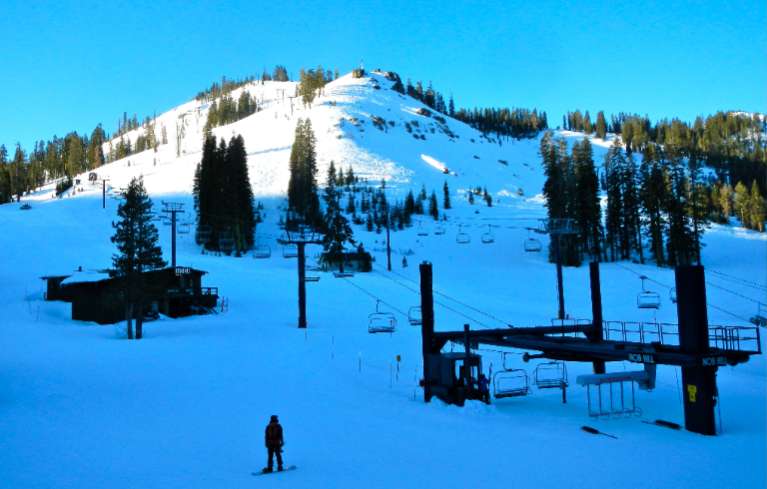
Workers start at day break to get Sugar Bowl ready for the day. Photos/Kathryn Reed

Workers start at day break to get Sugar Bowl ready. Photos/Kathryn Reed

The lodge is a mix of rustic and contemporary. The upstairs rooms are not fancy, but they have what a skier needs – comfortable bed, hot shower and view of the mountain to get you going, and plenty of space to put the trappings of a winter getaway. Downstairs are the lockers for skis and boots.

It didn’t matter that the wireless didn’t extend upstairs. Working in front of the roaring fire in a comfortable chair or on the couch made it feel less like work. This lounge area is only for hotel guests or homeowners.

The exclusivity of it makes us feel a bit like it’s our living room – with a few friends over for the weekend. No TV made it even more relaxing. Games are being played, books being read, people sipping Mt. Vernon wines on Saturday night (throughout the season different vintners sponsor tastings), some people are having a meal.

The dining room is adjacent the lounge. And it’s not typical ski resort fare. This is fine dining. We weren’t super hungry, so one night Sue and I opted for appetizers as our meal. I had the Baked Polenta and Brussel Sprouts: Gratineed with Blue cheese and toasted pine nuts finished with white truffle oil ($11) and a cup of the special mushroom soup ($5). Both were outrageously good. Sue had the French Onion Soup: Flavored with Port wine, and fresh thyme with a French bread crouton and Gruyere cheese ($9) and Pan Seared Diver Scallops: Garnished with Pancetta crumbles on a butternut squash mash with a beurre noisette, ($12). Both were so rich and yummy that she didn’t even look at the dessert menu.

On the other side of the lounge is the Belt Room Bar. I highly recommend the mixed green salad ($9) and jalapeno fries ($6) – best to share the fries. Sue barely spoke between bites of her cheeseburger ($11.50).

It requires a gondola ride to get to the lodge. During the season it runs 24 hours a day to accommodate guests and residents. When the resort closes, access is through the Judah parking area.

Both routes are the main ways to access the mountain.

Sugar Bowl calls itself the only snowbound village in the United States. It is definitely ski-in, ski-out.

Sugar Bowl’s future

The foundation has been poured for the Sugar Bowl Ski Academy that will house 70 athletes. It will be the only ski-in, ski-out academy on the West Coast. Some of those skiers and boarders have the Olympics as a goal.

With Daron Rahlves calling Sugar Bowl home and often seen on the slopes, they know this resort has what it takes to make an Olympian.

The academy building is part of the $7 million in improvements the resort plans to make in the next few years.

Crows Peak is a new lift that will likely go in the ground this summer. This will give riders a bit more vertical in the Disney area.

A sport house is in the design phase. It will be a fitness and aquatic center for hotel guests, academy students and homeowners. It will include weights, sauna and a lap pool.

The Summit Chair near the top of Mt. Judah opened in 2009. This lift accesses the backcountry. With it the resort opened a backcountry center to take people into the remote terrain and teach them how to ride it safely – including avalanche rescue training.

ngg_shortcode_0_placeholder (Click on photos to enlarge.)


Kings Beach utility work to impact roads

The Kings Beach Commercial Core Improvement Project utility relocation work along Highway 28 through Kings Beach is scheduled to resume this week and continue throughout the spring.

Listed below are dates and corresponding locations slated for this work:

March 19-22: Expect work to be conducted by the Log Cabin Caffe, eastbound Highway 28.

March 22-27: Expect work to be conducted by The Front Porch at the intersection of Fox Street and Highway 28, westbound Highway 28.

April 1-3: Expect work to be conducted by the Tahoe Forest Hospice Thrift Store at the intersection of Coon Street at Highway 28, westbound Highway 28.

April 8-12: Expect work between Coon and Bear streets.

Additional work areas will be added.

A minimum of one traffic lane will be open in each direction at all times while the utility relocation work takes place.

In addition to the Kings Beach CCIP utility relocation work, Southwest Gas will also be performing relocations in the vicinity. Most of the work conducted by Southwest Gas will be in the Kings Beach neighborhood “grid” area.

Click on the link below to view the utility exhibit which shows where relocations will be taking place.


Letter: CTC needs to come clean about its parcels

To the community,

Because the California Tahoe Conservancy is experiencing challenges funding the agency and managing its 4,400-plus parcels, the CTC has begun the process of selling off “asset lands”: potentially 400 parcels. Why should the public care?

Property owners on the California side and California Realtors should be concerned. Often a buyer’s or seller’s main motivation and price decision is based on whether or not the property is adjacent to “protected” conservancy lands.

When the public is encouraged to buy license plates, approve bonds or donate in support of the CTC, the general understanding is that the CTC buys up and retires property from development in perpetuity to protect the environment. Their original mission was to “preserve, protect, restore, enhance and sustain the natural resources”.

But the sad new reality is the CTC has bought property, stripped off non-existent coverage “rights” and potential entitlements and, in the case of these 400 parcels, can now resell these environmentally sensitive sites to anyone — including big development. One of their new guiding principles includes “cultivating partnerships with the private sector” … “to recoup a portion of the public’s capital investment in these acquisitions for future high-priority projects through the sale of the banked development rights”. Translation: the CTC now wants to buy up old motel rooms (TAUs) and become the TAU Broker for the Lake.

Does this sound like preservation, protection, restoration to you? It sounds more like a cash-strapped agency trying to justify its existence.

Since its inception in 1984, that’s 28 years ago, the CTC has only transferred 32 properties. Mostly for public utility easements and public access. The sale of “asset lands” is a totally new direction that should stop immediately until there is full public understanding of the implications from using the public’s money to further development. The public spent $108 million through the CTC to purchase 4,600 parcels to “reduce development”.

Another kicker: the CTC plans to trade 1,200 acres to California State Parks (900-plus acres at Burton Creek) and an additional 1,900 acres to the Forest Service.

Who knows how many private parcels will be affected with this massive land swap? (Contact Executive Director Patrick Wright: pwright@tahoe.ca.gov.)

What can we do? The agency should produce a public list of addresses and parcel numbers of the 400 alleged “asset lands” parcels. The CTC owes it to every California citizen to have a full comparison and review of the CTC’s old and new missions, as well as the significant change in course under its current leadership. The CTC owes the public an explanation of the sharp turn it has taken with regard to Tahoe’s protected lands.

Ann Nichols, North Tahoe Preservation Alliance


Beaver Creek burger event

Beaver Creek and celebrity chefs demonstrate how diverse the iconic American hamburger can be at the January Food + Wine event.


Meeting set to address Hwy. 89 roadwork

Caltrans and Southwest Gas are hosting two meetings March 20 to talk about the roadwork that will happen this year on Highway 89 between Tahoma and Tahoe City.

Caltrans will resume a stormwater project to help protect Lake Tahoe’s water quality. In conjunction, Southwest Gas will continue work on its natural gas pipeline system.

One meeting is from 10:30-11:30am and the other from 6-7pm. Both are at the Tahoe City Public Utilities District Board Room, 221 Fairway Drive, Tahoe City.

For more info, call Southwest Gas at (702) 365.2044 or Caltrans at (530) 701.9459.


California may extend last call for alcohol

By Patrick McGreevy, Los Angeles Times

If Los Angeles ever wants to join the ranks of Las Vegas or Miami in attracting tourists who want to party, it needs to free its night spots from having to make the last call for alcohol by 2am, according to one state lawmaker.

State Sen. Mark Leno, D-San Francisco, has introduced legislation that would allow California cities to seek permission from the state Department of Alcoholic Beverage Control to allow their nightclubs, restaurants and bars to sell drinks until 4a,.

“Many cities in California have dynamic social activities that are vital to their economies, but they lack the flexibility to expand their businesses,” Leno said. “This legislation would allow destination cities like San Francisco, Los Angeles and San Diego to start local conversations about the possibility of expanding nightlife and the benefits it could provide the community by boosting jobs, tourism and local tax revenue.”

A bill would allow alcohol sales until 4am in California. Photo/LTN

A bill would allow alcohol sales until 4am in California. Photo/LTN

Currently, the state allows the sale of alcohol between 6am and 2am for bars, nightclubs and restaurants.

The top 100 grossing social and nightlife venues in the country last year generated $1.5 billion, and 15 of them are in the Los Angeles area, according to Leno’s office.

But all of the top 10 venues are in cities that have extended hours, including Las Vegas, New York and Miami, the senator noted.

Senate Republican leader Robert Huff of Diamond Bar said Leno’s proposal raises a lot of questions and needs more study.

“What impact will this have on families who live around these establishments?’’ Huff asked. “Will changing the time impact drunk driving rates? These are the questions I would ask before coming to a decision.”

Some of the same concerns explain the initial opposition by Los Angeles County Sheriff Lee Baca, according to spokesman Steve Whitmore. People, he said, “don’t need to have two more hours for drinking.”

SB635 is supported by industry groups including the California Restaurant Association and the San Francisco Council of District Merchants.


Polar plunge to raise money for Special Olympics

On March 23, more than 300 Californians and Nevadans will plunge into the winter-chilled waters of Lake Tahoe at Zephyr Cove – all in the name of Special Olympics.

Donned in costumes but without the protection of wet suits, Special Olympics athletes and their supporters will jump into Tahoe’s icy waters for the South Lake Tahoe Polar Plunge, a fundraiser for Special Olympics Northern California and Nevada.

It was 22 degrees outside at the 2012 South Shore plunge. Photo/Provided

It was 22 degrees outside at the 2012 South Shore plunge. Photo/Provided

Plungers include UNR mascot Wolfie Jr., the Reno Bighorns mascot Bruno, Miss Nevada Teen, Carson City Mayor Bob Crowell, South Lake Tahoe Mayor Tom Davis, radio personalities Meghan Burk and Howie Nave, the illusionist from Illusion Fusion Alex Ramon, Nevada Director of Public Safety Chris Perry, Highway Patrol Chief Troy Abney, Carson City Sheriff Ken Furlong and others.

To register, go online.

Plungers, which include individuals, companies, law enforcement, families and schools, are asked to raise a minimum of $125 – which provides one season of sports instruction and competition for a Special Olympics athlete at no cost to the athlete. The Polar Plunge raises funds that directly allow a Special Olympics athletes to participate in regional, national and international competitions all the while promoting acceptance, building bonds of friendship and unity and creating lifelong memories.

Check in is at 10am, costume contest at 11:30am, the plunge at noon and the party at MontBleu at 1pm.


Wineries focusing on younger consumers

By Los Angeles Times

Increasingly, Chardonnays, Pinots and Cabernets are sharing shelf space at your local store with some unusual names – such as Bodacious Brunette red and Buxum Blonde and Angel Food whites.

Veteran wine collectors might turn up their well-trained noses. But the wineries promoting such brands aren’t targeting those buyers. With many of their best customers nearing retirement age and starting to cut back, American vintners are going after younger consumers in a bid to keep their $33 billion industry growing.

That means more irreverent labels, easy drinking wines, singles events and laid-back tastings – all aimed at demystifying the elite atmosphere surrounding wine while grooming the next generation of oenophiles.

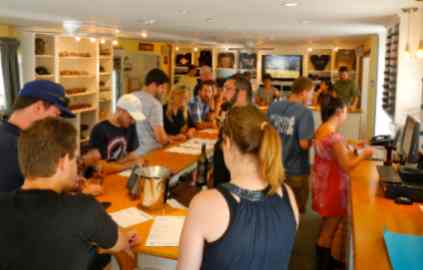
People line up at Peachy Canyon Winery. Photo/LTN

People line up at Peachy Canyon Winery. Photo/LTN

“The battle is on” for younger drinkers, said Danny Brager, an alcoholic-beverages expert for global measurement company Nielsen. “Everyone’s being aggressive.”

The courtship was on display last fall in a former bank building in downtown Los Angeles, where event organizing company Second Glass hosted one of its Wine Riot parties.

To bass-heavy tunes mixed by a disc jockey, more than 1,200 young patrons paid $60 each to wander by booths set up by wineries and get unlimited pours from a selection of about 250 wines.

A free smartphone app helped the guests, mostly in their 20s – resplendent in their jeggings and plaid – navigate the event and remember the wines they liked. They flocked to the temporary tattoo station and photo booth, noshing on French fries from food trucks and sipping Rose d’Anjou, touted by posters as pairing well with Thai food and burgers.

“It’s fun socializing and getting tipsy,” said Ellie Yi, 26, an advertising account executive who attended the Los Angeles event with eight friends. “Nobody’s judging you if you don’t appreciate the ‘complex blends.'”

Second Glass founders Morgan First, 29, and Tyler Balliet, 32, launched Wine Riot in Boston in 2009 to educate and engage young drinkers and took the events nationwide two years later. Their typical guest: novice drinkers, averaging 27.5 years old. The vibe: unpretentious.

Wineries love the events too. In Wine Riot’s early days, First and Balliet drew participants from wineries owned by friends and acquaintances. Now, spots for booths sell out six months in advance, creating a waiting list of labels.

Baby Boomers have been the main driver of the U.S. wine market for years, making up 40 percent of the customer base today. They tend to have more sophisticated tastes and are more inclined to buy expensive fine wines. West Coast wineries depend on the demographic for 44 percent of their sales, according to a survey by Silicon Valley Bank.

But Boomers born right after World War II are starting to retire. As they adjust to fixed incomes, they are downsizing their wine spending and the amount they drink, according to research group IBISWorld.

Meanwhile, the youngest drinkers, 21- to 34-year-olds known as Millennials, are looking more appealing.

For starters, there are a lot of them – roughly 70 million. But many young drinkers already are being wooed by the craft beer craze and the rise of cocktail culture, conditioned by celebrity endorsers and targeted marketing to gravitate toward sudsy brews and hard liquor.

The wine industry wants to convert Millennials to Malbecs and Moscatos while they’re still young, hoping to create a lifelong clientele.

Young drinkers are enthusiastic wine students, having been more exposed to wine at an earlier age than their parents. And more than half said they’re boosting their wine consumption, according to a report from the Wine Market Council trade group.

“The take-away is that while Baby Boomers are still technically our best customers, Millennials as a group … are the single most dynamic target for wine marketers,” said John Gillespie, the council’s president.

Wine companies also are churning out promotions with an eye toward being less stuffy and more sassy.

Newcomer Calendar Girl Wines dubs its red and white wines Bodacious Brunette and Buxom Blonde. Constellation Brands, owner of old-guard label Robert Mondavi, is trying out feisty brands such as Primal Roots and Simply Naked.

Hot celebrities are lending their names to labels. Early this month, Brad Pitt and Angelina Jolie said they were releasing a vintage rose wine called Miraval from their French estate, Chateau Miraval in Correns, for shipment to the United States.

Pop star Stacy Ann Ferguson, better known as Fergie of the Black Eyed Peas, unveiled her Ferguson Crest label in Santa Barbara County last fall. Barrymore Pinot Grigio, created last year by actress Drew Barrymore, reflects her “fresh, dynamic and fun” personality.

Wine magazines are doubling the number of young writers and reviewers. Napa wineries are creating special tours for young guests clad in jeans, yoga gear, flip flops and even Mohawks.

“Top-tier brands that used to be untouchable are, for the first time, realizing that they can’t just rest on their laurels,” said Lara Sailer Long, wine director for the Los Angeles Food & Wine Festival. “They’re trying to dust off their images and appeal to the young drinkers, not just the collectors.”

Event company Rock N’ Roll Wine organizes tasting parties in Las Vegas, such as one last fall featuring indie band Young the Giant. Some 3,000 guests paid $65 a head to participate in the festival at the Mandalay Bay beach resort.

There, said co-founder Chris Hammond, “no one’s scared to drink rosé.”

Though Millennials tend to be more price sensitive and less knowledgeable than older buyers, they still want to be treated as serious wine consumers and not dollar bin divers, said Mike Veseth, a wine expert and economics professor at the University of Puget Sound.

“Young people are looking for value, but not a cheap buzz,” he said.


Tahoe Donner Marina plans in circulation

Truckee has released a the draft initial study-mitigated negative declaration for the Tahoe Donner Marina Facility Improvement Project.

For additional information and to view the public draft, click here. Public comments will be accepted until April 16.

For additional information on this project, contact Jenna Endres at (530) 582.2922 or jendres@townoftruckee.com.


Placer County has money to contend with Indian gaming

By Ed Fletcher, Sacrament Bee

A Placer County committee charged with distributing funds aimed at mitigating the effects of Indian gaming has been allocated $66,694 to distribute to local government agencies.

The Placer County Indian Gaming Local Community Benefit Committee receives the money from a special state Controller’s fund aimed at offsetting the impact of Indian gaming.

Agencies impacted by gaming must apply to the committee by April 4 for grants.

Separately, Thunder Valley casino gives $100,000 annually to local charitable organizations, said Doug Elmets, a spokesman for the United Auburn Indian Community, which own and operates the casino. Additionally, the tribe’s community giving fund has contributed $9 million since 2004, Elmets said.