Ski report: It’s wet outside
 It’s a Gore-Tex kind of day. There is fresh snow in the upper elevations and mixed precip down below.
Wind may be an issue for upper lifts.
Here is the March 20 ski report.
— Curtis Fong
It’s a Gore-Tex kind of day. There is fresh snow in the upper elevations and mixed precip down below.
Wind may be an issue for upper lifts.
Here is the March 20 ski report.
— Curtis Fong
The Taylor Creek Visitor Center is looking for motivated people to help in the gift shop.
Located on Highway 89 just north of Camp Richardson, Taylor Creek is home to the popular Stream Profile Chamber and Kokanee Salmon Festival. The center offers several guided and unguided interpretive trail hikes and hosts many summer programs at the Lake of the Sky Amphitheater. Volunteer from one to three days of your time each week.
For more info or to sign up, call (530) 543.2672 or email tsafrica@fs.fed.us, after May 15 call (530) 541.5227.
By Kathryn Reed
South Lake Tahoe is balking over the $35,000 connection fee the water district is imposing in order for there to be ample water to irrigate Linear Park.
This stretch along Highway 50 isn’t really a park, but instead a paved path with landscaping from McDonald’s to Holiday Inn Express in front of the gated Tahoe Meadows neighborhood. It once looked better than it does now, but plants died without enough moisture and then the lights got kicked in, which contributed to the dilapidated look of the area.
In 2004, the now defunct Core 24 Charities had landscape plans drawn up for the area and secured a free connection for the 2-inch waterline from South Tahoe Public Utility District.
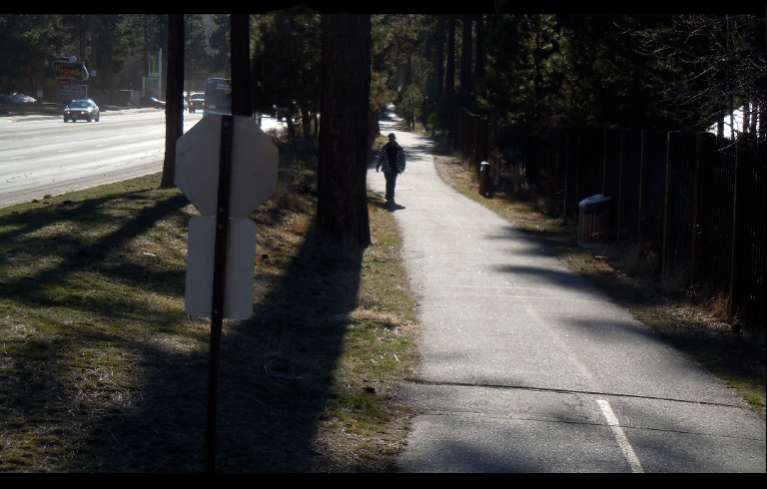
Linear Park in South Lake Tahoe will get a makeover this summer. Photo/LTN file
South Tahoe PUD saw this as a demonstration project to show how native landscaping can work in Tahoe with minimal water use and a way to promote its turf buy-back program.
(Core 24 morphed from the inaugural Leadership Lake Tahoe class that at the time was a product of the two chambers of commerce that later merged to become the Lake Tahoe South Shore Chamber of Commerce. Duane Wallace was the head of one of the chambers and on the STPUD board, STPUD spokesman Dennis Cocking was in LLT and Core 24, as was this reporter. When Core 24 dissolved, it gave the city $22,000 to be used solely for Linear Park.)
Former City Manager Dave Jinkens later traded that free connection for water at city facilities.
And with the current landscape design by Brett Long, the same person who did Core 24’s plans, the city wants lots of grass. This is not what the nonprofit had proposed or what was endorsed by STPUD. This requires larger water lines to accommodate all of the irrigation.
It also means the city now must pay a $35,000 connection fee. (The whole project will cost about $770,000.) The City Council on March 19 entered into an agreement with Herback General Engineering to do the work.
The California Tahoe Conservancy paid for most of the work the first time, but they aren’t allowed to use taxpayer money on do-overs.
Mayor Tom Davis pulled the item from the consent agenda and then went on a rant about how horrible STPUD is for charging connection fees.
The district, which was not at the meeting, told Lake Tahoe News afterward the connection fee is about buying into the nearly $1 billion South Shore water system.
“When people say waive this or that, they are saying all the ratepayers should help pitch in and waive this for project X,” STPUD’s Cocking said.
The money goes toward future improvements and replacement costs to the system.
“We are bound by law to charge what are real costs and what the costs of infrastructure are down the road,” Cocking said.
He added that the last time the rates were looked at – 2009 – the consultants recommended an increase. The board keeps saying stick with what’s in place.
But for Davis, he said the fees are “excessive” and “a job killer”.
He said the city doesn’t charge STPUD a fee to have the water and sewer lines under city streets.
When told this, Cocking said the city has altered its rules when it comes to STPUD crews doing repairs and that now more streets are paved by the district than anytime in the past – so the city is charging a fee of sorts.
At the end of the council meeting the five decided to create a new position, where Councilwoman Brooke Laine will be the city’s rep who will go to STPUD meetings and report back what is going on.
In other action:
• City Manager Nancy Kerry was given an “excellent review” by the council, according to the mayor. No changes were made to her contract.
• Aaron Abrams and Michael Adlard were awarded the concessionaire contract at Lakeview Commons and Regan Beach. Donna Rise (Aloha Ice Cream) will be the concessionaire at Bijou Park. Both contracts are expected to be for three years.
• The council approved guidelines for special events at Lakeview Commons.
• The five agreed to issue a request for proposals for signature events at the Commons.
• Councilmembers Davis and JoAnn Conner will work with city staff, Lake Tahoe Community College and the business community to keep SnowGlobe in town. The North Shore is wooing the music promoters. The college board on April 9 will have a debriefing on the 2012 New Year’s weekend music festival.
Last summer and fall, with three Canadians and four Indian climbers, Andy Selters went to an area at the northern tip of India that, due to border disputes, had been prohibited and unexplored. The team discovered high passes and wildlife, and climbed and named several peaks over 20,000 feet high.
After climbing, Selters stayed on in an isolated village that had not hosted a Westerner before. He befriended the people and documented much of their vanishing, traditional way of life.
Now he is sharing his experience. Mixing photographs, recorded audio, and live narration, Mountains of the Blue Sheep portrays the expedition and the village people, and tells the hidden history of one of the world’s most remarkable yet least known mountain areas in the world.
The show is sponsored by LTCC’s Wilderness Education Department. It is in part a benefit for the Sierra Avalanche Center. The center will have drawings and giveaways for outdoor gear too. Admission is $10 at the door.
The event is April 12 at 7:30pm at Lake Tahoe Community College’s Duke Theater, One College Drive, South Lake Tahoe.
For more details on the show content and Selters, go online.
By Joanne Marchetta
The recent South Shore economic forum gave a sense of what’s possible when we come together around a vision to improve our Tahoe communities and the region’s environment. Recognizing that “planning” means little without implementation, let’s review some of the on-the-ground improvements accomplished under the Lake Tahoe Regional Plan just this last year.
Many of these achievements stem from the fact that the agency today is different than it was 20 years ago. We have made changes to be more effective, to partner with other organizations, and to institute a science-based vision for environmental restoration efforts at Lake Tahoe.
Joanne Marchetta
The first notable accomplishment is the recent clarity data released jointly by TRPA and UC Davis scientists. The average clarity reading for the lake in 2012 was the best it’s been in 10 years and the loss of clarity, which had been on a path of steady decline for several decades, has stopped. Clarity gains in 2011 and 2012 are especially significant because high levels of precipitation measured in both years were expected to diminish lake clarity. We are still working with scientists to discover new strategies to improve summer clarity and the near shore, which remain a concern. The science is showing that restoration efforts, through the environmental improvement program (EIP), are on the right track.
The EIP is the capital investment strategy designed to achieve Lake Tahoe’s environmental targets, which are called threshold standards. Private property owners, the federal government, both states and local governments all contribute to the restoration program and together, we have hit some major milestones in the past year:
Aquatic invasive species
• 5 acres of the lake bottom treated for Asian clam removal
• 7 acres for invasive weed removal
• 30,000 watercraft launches were overseen by inspectors to prevent other invasive species from being introduced
• 3,700 boats decontaminated
Recreation
• Lakeview Commons in South Lake Tahoe
• Lakeside Trail in Tahoe City
• Nevada Stateline-to-Stateline Bikeway, Kahle Drive to Elks Point Road in Round Hill
• Sawmill Bike Trail Section II near Meyers.
Forest health and fuels
• The 10,000-acre U.S. Forest Service South Shore Fuel Reduction Project started last season with the thinning operation along Highway 89 near Camp Richardson
• 19 homeowners in Logan Creek partnered with Tahoe Douglas Fire Protection District to complete fuel reduction and defensible space work in their neighborhood by matching the district’s costs with a $20,000 private contribution.
Along with these high-profile projects, significant stormwater improvements were completed on roadways last year — many were years in the planning stages. These accomplishments are meaningful for Lake Tahoe. A recent evaluation of the thresholds found that 63 percent of measurable standards were in attainment or improving. The scientifically peer-reviewed report also showed the areas where we need to accelerate progress, and the recently adopted 2012 Regional Plan focuses on those areas.
TRPA is working at full steam to implement the updated plan, which includes streamlining permit processes for property owners through the new area plan framework. Local governments have already set to work developing their area plans and community members are participating in the process. TRPA is maintaining its regional role by collaborating to ensure the plans help attain Lake Tahoe’s thresholds. This is a significant priority because it allows the community’s vision to become an on-the-ground reality. If you aren’t already, I encourage you to become involved in the area plans of your community by going online.
While we are facing litigation on the plan from the Sierra Club, we remain confident the court will uphold the plan. It not only meets our mandate to achieve and maintain regional standards, but is also a 21st Century model of sustainability. Far from being a growth strategy, the plan cuts the rate of residential allocation in half, eliminates 10,000 vehicle miles traveled in the basin annually, and anticipates an additional 1,200 parcels will be protected or restored. No other set of proposals analyzed comes close to this level of restoration. The challenge at Tahoe today is not stopping runaway growth, it’s stopping the decline in our environment and communities.
The 40-year-old bi-state Compact that created TRPA is working to deliver meaningful results for Tahoe. This year’s accomplishments alone show what can be achieved when public organizations and the private sector work together to increase environmental restoration and support our communities. We need more accomplishments like this next year and beyond to realize those images of a better future for Tahoe we collectively applauded at the South Shore forum. For more information, our website.
Joanne Marchetta is executive director of the Tahoe Regional Planning Agency.
Who is monitoring the water quality in your local creeks, rivers, lakes and ponds? Don’t know? It could be you.
The World Water Monitoring Challenge kicks off March 22, coinciding with the United Nations’ World Water Day, and runs through Dec. 31.
The Challenge is designed to build public awareness and involvement in protecting water resources around the world by engaging citizens in the monitoring of their local water bodies.
Participants sample local rivers, creeks, lakes, ponds and reservoirs, and test them for four key water quality indicators: dissolved oxygen acidity level, temperature and turbidity. Sampling kits are available online.
For about $21 including shipping, or $15 if 10 or more kits are ordered. Classroom kits are available for about $60.
Water Environment Federation and the International Water Association are the coordinators of the event. Major sponsors include Xylem Inc., Smithfield Foods and the U.S. Geological Survey.
Last year, groups and individuals from 66 countries from Albania to Zimbabwe participated, monitoring 5,978 sites, including 2,971 sites in the United States. In California, 105 sites were monitored, ranking the state sixth among the 50 states.
There is plenty of opportunity to monitor water in California, noted Erick Burres, who coordinates the state Water Resources Control Board’s volunteer water monitoring program, called the Clean Water Team. The Clean Water Team is a more formal program of water monitoring that relies on non-profit groups and individuals to regularly sample and test California water bodies. The state Water Board’s Surface Water Ambient Monitoring Program provides training and support for the volunteers, whose work helps state scientists track the health of California’s water resources.
The primary goal of the World Water Monitoring Challenge is to educate and engage citizens in the protection of the world’s water resources. Conducting simple monitoring tests teaches participants about some of the most common indicators of water health, and encourages further participation in more formal citizen monitoring efforts.
For more information about the World Water Monitoring Challenge, go online.
Colorful costumes, resounding voices and contagious songs will soon fill the Truckee High School theater as the hard work of 30 students comes to fruition on May 10, the opening night of “Best of Broadway!”
Since February, performers in the Truckee High School Drama Club have been rehearsing 15 hours per week.
Barbara Wilkinson is this year’s producer.
Dancers from InnerRythms Dance Centre will be performing in a number of songs including “Cell Block Tango” from “Chicago.” Inner Rhythms’ director Elizabeth Archer is the choreographer for the musical.
The show’s volunteer vocal coach Linda Saxton, youth program director at the Nevada Opera, brings more than 35 years of musical expertise to the production. Costumes, designed by volunteer Jennifer Boehm, will
vary from one scene to the next as the eras depicted in the various featured musicals – expect to see everything from flapper style dresses to bohemian and hippie outfits to present day street wear.
Tickets will be available beginning April 10 at Truckee Community Recreation Center located off the
Pioneer Center round-a-bout at 8924 Donner Pass Road. Tickets will also be available each night of performance at the door if they have not already sold out.
Performances will take place at 7pm on May 10, 11, 16, 17 and 18 and there is a special Mother’s Day matinee at 2pm on May 12.
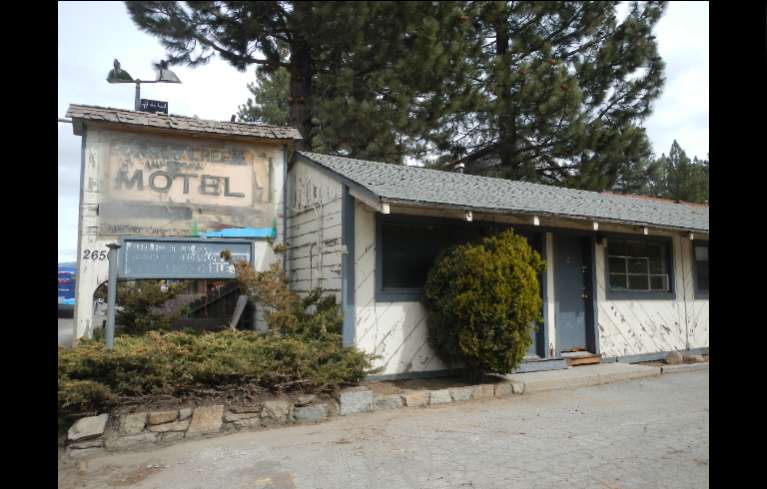
Trout Creek Motel’s new owner promises upgrades. Photo/LTN
By Kathryn Reed
One of South Lake Tahoe’s rundown hotels on Highway 50 is about to undergo some much-needed rehabilitation.
“By April 30 it will be looking good from the road,” Robert Durward said of the Trout Creek Motel.
He is the new owner of the 11-room lodging facility near the Town and Country Center. Durward also owns the Sky Lake Lodge next door and the El Nido down the road. He has refurbished both.
“My plans are not to tear it down, but have more curb appeal from the street and revamp the whole thing,” Durward told Lake Tahoe News.
The former owner had been cited and fined by the city numerous times for never making any of the improvements to the blighted facility.
Bill Potts, senior housing inspector for South Lake Tahoe, said Durward has promised to do what the former owner never did — remove the sign, rehabilitate the roof, paint the building and remove the foundation that is in the driveway.
In a letter from Durward to the city, he says he also plans to upgrade the rooms.
The three tenants have been given eviction notices. Once the place is renovated, Durward plans to keep it a weekly rental facility. He said it’s too hard to make it a tourist hotel because of the spring and fall shoulder seasons would mean too many nights with no heads in beds.
Durward said if the weekly rentals don’t work, he’ll think about converting the property into apartments.
By Cathy Locke, Sacramento Bee
Agents from the California Department of Alcoholic Beverage Control, in cooperation with more than 100 law enforcement agencies, conducted a record-setting statewide decoy “shoulder-tap” operation.
The task force operation was conducted Friday and resulted in 506 arrests statewide, surpassing last year’s record of 435 arrests, according to a department news release. More than 400 individuals were cited for furnishing alcoholic beverages to minors, and at least 50 were arrested for other crimes such as illegal drugs, illegal gun possession, public drunkenness, parole violations and outstanding warrants, officials said.
Arrests in the Sacramento region included nine in Sacramento, four in Rancho Cordova, two in Folsom, six in Marysville, 11 in Placer County and 16 in Nevada County, according to the news release.
This was the second time the operation had been conducted statewide.
A decoy shoulder tap operation can lead to the arrest of adults who purchase alcohol for people younger than 21. Under the program, a minor under the direct supervision of a peace officer stands outside a liquor or convenience store and asks patrons to buy alcohol for him or her. The minor indicates in some way that he or she is underage and cannot purchase the alcohol.
If the adults agree to make the purchase, officers arrest and cite them for furnishing alcohol to the minor. The penalty is a minimum $1,000 fine and 24 hours of community service.
The program is intended to reduce the availability of alcohol to minors.
Officials cite American Medical Association findings that underage drinking can increase chances of risky sexual behavior and teen pregnancy, juvenile delinquency, compromise health and result in unintentional injury and death.
By Jonathan Zimmerman
Upon today’s 10th anniversary of America’s war in Iraq, a critical question with serious ramifications has been little explored: What are our children being taught in schools about the conflict, as it passes from “current events” into history?
To answer this question, one obvious place to start is school textbooks. I looked at several of them, and was happily surprised. The books present a fairly complex and balanced view of the war in Iraq, avoiding the falsehoods and sugarcoating that has so often marred American history instruction. But textbooks only tell part of the story.
Just as important is what is actually emphasized in the classrooms, and the ability of teachers to engage in real inquiry. Unfortunately, a combination of school policies and judicial decisions have made it so that many kids learn little or nothing about what we have done in Iraq, or why we have done it.
I’m a professor of education and history, and wrote a book examining conflicts over history in American public schools. But for me, this probe is more than theoretical: My daughter is an 11th-grader in a suburban public high school, where she takes Advanced Placement U.S. History.
Her textbook, “The Enduring Vision: A History of the American People,” has a 2009 edition that carefully examines the Iraq and Afghanistan wars. It includes lengthy passages about controversial issues, including prisoner abuse overseas and domestic surveillance at home. Ditto for the 2009 edition of another textbook, “Out of Many: A History of the American People,” co-authored by Yale’s John Mack Faragher, which is also used in many high schools around the country. Its new section on the Iraq War leads off with a picture of George W. Bush’s now-infamous “Mission Accomplished” photo op in May of 2003, when Bush declared that “the United States and our allies have prevailed.” But they hadn’t, of course, and the book pulls no punches about that. Parts of Iraq “plunged into chaos” after the U.S. invasion, which “strengthened a new generation of terror networks now drawn to do battle with American forces,” the book declares.
It also disputes American claims about weapons of mass destruction in Iraq, citing critics who charged that Vice President Dick Cheney and Secretary of Defense Donald Rumsfeld had “manipulated Pentagon intelligence estimates, selectively emphasizing data based on ideology rather than dispassionate analysis.” The section concludes with a long passage about prisoner abuse and torture at Abu Ghraib. Although Bush expressed “deep disgust” at photos of the abuse, the book notes, White House memoranda revealed that legal counsel Alberto Gonzales had urged Bush to declare the treatment of suspected terrorists exempt from Geneva Convention accords on war prisoners.
So our textbooks aren’t simply spouting pro-American propaganda, like they once did, and that’s certainly reassuring. But Cheney et al needn’t worry about a new generation of MoveOn.org protesters (who also get an approving nod in Faragher’s book) streaming out of American high schools. You wouldn’t sense much controversy about America’s wars in Iraq and Afghanistan if you walked through the halls of my daughter’s school, or if you sat in on her classes. Indeed, you might not know we’re at war at all.
That’s partly because these conflicts have gone on so long. She was 5 years old when we attacked Afghanistan (which is described at the end of her textbook). Now she’s 17, and we’re still there. How can you take note of something that’s always been around you? It’s all the kids know, which means they often know next to nothing about it.
Then there’s the absence of conscription, which means that almost none of these kids will go abroad to fight. In America, we leave that to the lower-middle-class and the poor. In a few inner-city high schools, teachers have raised hackles about military recruiters and have invited “counter-recruiters” to visit. Overall, though, there’s often even less critique of the wars in our poorer school districts than there is in our wealthier ones. The teachers have their hands full already, keeping order in overcrowded classrooms, and the kids often see the military as their only route into the middle class.
Let’s be clear: There was never a democratic golden age in America’s schools, when students and their teachers engaged in full-throated debate about the events of the day. During both world wars, teachers were fired for raising questions about them. And in the Vietnam era, as anti-war protest drifted from colleges into the high schools, many teachers tried to muzzle it. Some of them threatened to fail or downgrade students who wrote or talked about the war. And a 1971 survey found that over half of American social studies teachers spent less than 10 percent of class time on “controversial issues,” including the conflict in Vietnam.
But today, in many classrooms, there’s literally no time for any of that. Starting in the 1980s, with the “Back to Basics” movement, states began to mandate minimum-competency examinations for high school graduation. The 1990s brought another round of state-level tests, seeping into middle and elementary schools. And then came No Child Left Behind, the 2002 federal law requiring yet more exams — and tying various sanctions, positive and negative, to the outcomes. More than at any point in the past, schools would be judged by how their students performed on standardized tests.
Increasingly, then, anything that didn’t promise to raise the kids’ scores got left by the wayside. As always, the best teachers continued to question students about current affairs. But it took real courage to do so, in the face of ever more oversight and pressure from test-minded principals and superintendents.
Then there were the lawyers, and the judges. During these same years, American courts significantly reduced the speech rights of teachers in their own classrooms. So discussing the war in Iraq wasn’t just a diversion from your most urgent job, which was preparing the kids for the test. It could also mean the end of your job, period.
Just ask Deborah Mayer. In January 2003, as a first-year elementary school teacher in Monroe County, Ind., Mayer taught a lesson from Time For Kids — her district-approved student current-events magazine — on the looming American invasion of Iraq. The article contained a report on an anti-war demonstration in Washington, D.C., which prompted a student to ask Mayer if she would ever attend such a protest. Mayer replied that she had recently driven by a “Honk for Peace” march in nearby Bloomington, and had honked her own horn in support. She also said that people should seek peaceful solutions to their conflicts, noting that her own school trained student mediators for exactly that purpose.
After parents got wind of this exchange and complained, Mayer was told that her contract would not be renewed. A district court upheld the school board’s decision, and then a federal appeals court did the same. It drew on the Supreme Court’s 2006 Garcetti v. Ceballos ruling, which held that public employees do not have free-speech rights at work; instead, their words belong to their employer.
“The school system does not ‘regulate’ teachers’ speech as much as it hires that speech,” the appeals court underlined. “Expression is a teacher’s stock in trade, the commodity she sells to her employer in exchange for a salary. The teacher hired to lead a social-studies class can’t use it as a platform for a revisionist perspective that Benedict Arnold wasn’t really a traitor, when the approved program calls him one.”
So if the “approved program” says that we should “Support our Troops” — and that we shouldn’t say anything else about the war in Iraq, or in Afghanistan — well, that’s what the teacher has to do. Never mind that she has a mind of her own, or is enjoined with helping her students make up theirs. She is a civic ventriloquist, paid to repeat the words that the state puts in her mouth.
To be sure, we’ve all had teachers who tried to impose their own opinions upon us. That’s indoctrination, not education. But the best guard against it is not removing controversial questions from discussion, which is what authoritarian states have historically done. Instead, we need to prepare teachers who can model the skills of democracy: inquiry, reason, tolerance and dialogue. And we need to give those teachers the space to practice them.
I’m not optimistic, on either count. I teach at a school of education, where the students are imbued — if not indoctrinated — with the gospel of “social justice.” Too often, though, that means teaching a single truth instead of encouraging our students to find their own. And when they become teachers, you can bet they’ll repeat the same error.
In the fall of 2003, after the war in Iraq had begun, I flew to Chicago to give a speech about it to local school teachers. I told them that their duty was neither to get kids to support the war, nor to oppose it; it was to provide students with the information and the skills to arrive at their own, reasoned judgments about it. Afterward, a very nice young teacher thanked me for my talk. “You’re right,” she told me. “If we can get the kids talking and thinking, they’ll realize that the war is a great imperial misadventure.”
That’s a near-perfect embodiment of what my own students have learned to call Zimmerman’s Fallacy: If everyone actually reasoned from the facts, unencumbered by cant and deception, they’d agree with me. But they won’t, and they don’t, and they shouldn’t. Democracy depends upon a shared faith: that people of equal intelligence can reason from the same facts to different conclusions. If you don’t believe that, you don’t believe in democracy. And you shouldn’t be a public school teacher.
Since 2003, to be sure, there has been plenty of cant and deception about the war in Iraq. And there are lots of good reasons, in retrospect, to call it a misadventure. But there’s still a case to be made for it, too. Our kids need to hear that. Instead, in many schools, they hear almost nothing. And the silence is deafening.
So, how much are our children learning about the war today? It’s only one example, but my daughter’s experience may be instructive. Remember that textbook I described to you, with its passages about American torture and surveillance? It turns out her class isn’t using that 2009 edition, but still using the one from 2002. It came out right before the U.S. invaded Iraq.
Jonathan Zimmerman is a professor of education and history at New York University. He is the author of “Small Wonder: The Little Red Schoolhouse in History and Memory” and three other books. This article first appeared in Salon.