South Tahoe devising plan for state line area

By Kathryn Reed

Remove development on the lake to provide better views. Have hotels near bike-pedestrian paths. More access to public transportation. Boardwalks. More kayaking. Decrease the number of driveways at Bijou Center. Make Lakeside Beach public.

Those are some of the ideas the public came up with at a meeting Wednesday night in regards to the tourist core area, aka the state line section of South Lake Tahoe. The plan goes from Ski Run Boulevard to the Nevada border.

The city is on a mission to have the area plan for this part of town go to the Planning Commission in May, the City Council in July and the Tahoe Regional Planning Agency Governing Board in August.
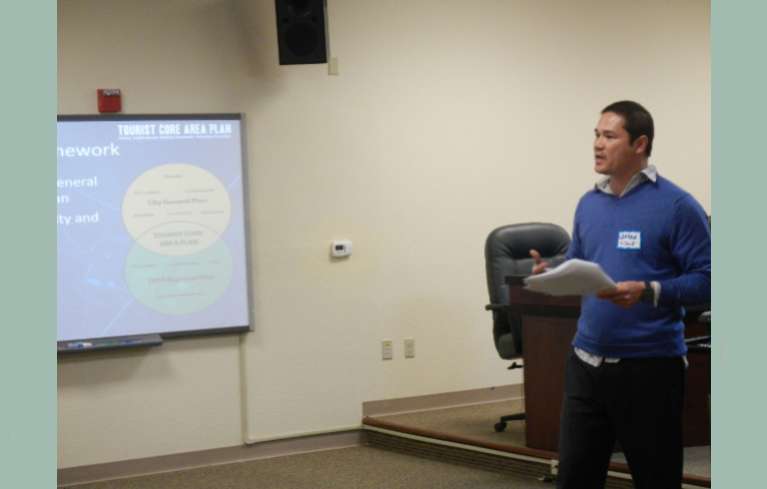
South Lake Tahoe planner John Hitchcock talks March 20 about the Tourist Core Area Plan. Photo/LTn

South Lake Tahoe planner John Hitchcock talks March 20 about the Tourist Core Area Plan. Photo/LTN

“The intent of the area plan is not a vision plan, it’s an implementation plan,” John Hitchcock, planner for the city, told the approximately 40 people who were at the March 20 meeting at Lake Tahoe Airport.

Hitchcock went over how area plans are TRPA’s latest version of community plans, but with the goal of being more functional. With a new TRPA Regional Plan in place, area plans come with redevelopment incentives, increased height allowances in town centers and the goal of revamping what’s in place for environmental gain.

South Shore resident Jerome Evans is concerned no one has asked business owners if they want to move to what are being called town centers; and wonders why an economic study to prove or disapprove this approach to planning is good or bad was not done.

One goal of the plan will be to harness and capitalize on the recreation areas that exist – Heavenly Gondola; Van Sickle Bi-State Park – including access to the Tahoe Rim Trail; Edgewood Tahoe Golf Course – and the beach that will be public after the lodge is built; the lake; and Ski Run and Lakeside marinas.

After the nuts and bolts were talked about, the mass of people went into the lobby area to write on maps, fill out comment cards and ask officials questions. The three main areas were land use planning and community design; conservation-water quality; and transportation-recreation.

Sharon Doughty, co-owner of the Ski Run Center that is anchored by the Red Hut Café, told City Manager Nancy Kerry after the group session that she is worried the plan will eliminate mom and pop businesses. Doughty fears the town centers will be high rent districts.

“Our goal is not to get rid of anything except something that is on very sensitive land,” Kerry said. “We don’t want to plan for the outcome, but instead plan for the opportunity to occur.”




A glimpse into the sheriff’s department

By Ted Long

On March 19, I completed my first session of the El Dorado County Sheriff’s Citizens Academy. Of the 30 participants, I was the only one from South Lake Tahoe, and like many other things I have done in Placerville, it seems that Lake Tahoe is in a different world.

And with the new lines for supervisor we will soon lose a resident supervisor.

Ted Long

Ted Long

I am participating in the program for several reasons, one is just something to do, but more important as a former attorney who has seem his share of police abuse, former grand jury member who has investigated and reported on the sheriff’s office several times and as a curious citizen. In an effort to encourage more South Lake participation in county affairs I would like to share with you my weekly adventure.

The class, 14 in all, meets every Tuesday at the government center and according to Sheriff John D’Agostini, is done as an effort to inform and educate the public on the operation of the sheriffs’ office. The sessions will cover all aspects of the sheriff department from hiring to actual hands-on operations and include a ride along.

Session one was about the hiring practices and training of a new sheriff’s deputy. The class was run by Bob Ashworth, a captain with 25 years of service in the department. A very likable guy who answered everyone’s questions. He used his path as an example of the process, starting with his teen-age desire to be a cop, his military service while he waited to be old enough, 21, to apply for a job with a police department. After five years in Birmingham, Ala., he came to El Dorado County where he has worked his way up to captain.

While his presentation is homey and interesting, the best part for me was the questions. He explained how certain issues in your past might or would disqualify you for the job, such things as drugs, prior criminal behavior, questionable events dealing with sex and other behavior, all of which seemed to make sense, except when asked if there were any real research on the truth of these conclusions, he said no.

There is a strong military influence as you might suspect. The problem as I see it is that through years of “inbreeding” the department reflects a certain lack of diversity. A large group of similar thinking individuals, hiring others. In explaining the interview process I noted there was no citizen input. Ashworth seemed to think that it might not be useful. He did note that the use of marijuana is not as much a barrier as it use to be, especially medical use. It just seemed to me that seeing such a change might open the department to consider other issues. For example, a non-violent criminal record as a youth, might just be the lesson that would make someone a good cop? Just a thought, which a citizen participant might bring?

Next week is a tour of the communications center and the jail.

Ted Long is a resident of South Lake Tahoe, former City Council member and has been on the El Dorado County Grand Jury.


Opinion: CTC comes clean about its parcels

By Patrick Wright

Lake Tahoe News recently published a letter from Ann Nichols (CTC needs to come clean about its parcels, March 17) sounding an alarm that the Tahoe Conservancy is on the verge of selling 400 environmentally sensitive parcels. Let me assure your readers and the community that the Conservancy has no plans to sell or leave unprotected any of the thousands of environmentally sensitive parcels that we have acquired since 1985.

In fact, the Conservancy board recently approved a set of guidelines to strictly limit sales of Conservancy-owned land. Under the guidelines, we will consider selling parcels only where they are not needed to achieve our conservation or recreation goals, or where state ownership is no longer necessary to achieve the goals of the original acquisition.

Patrick Wright

Patrick Wright

To date, the Conservancy has been proceeding cautiously, and the board has authorized staff to market the sale of just four properties, all in South Lake Tahoe. Two of these properties are currently listed for sale. One is a former clubhouse and conference center site adjacent to Heavenly Mountain Resort known as Tallac Vista. The Conservancy acquired this parcel in a settlement agreement to prevent the development of 150 condos and protect the environmentally sensitive area of the parcel. The Conservancy can no longer afford to maintain or upgrade the old clubhouse on the developed area of the site, and continued ownership of this residential-zoned parcel does not serve our mission.

The other parcel for sale is the former drive-in movie theater site on Glenwood Avenue. The Conservancy recently acquired this parcel through a land exchange with the city of South Lake Tahoe. We removed nearly 80,000 square feet of asphalt and restored the sensitive stream environment zone on the property, which also includes a potential home site on the less sensitive upland area of the parcel. Having achieved our goals of removing the coverage and restoring and permanently protecting the sensitive stream zone, we are now making the property available for sale to recover our costs and invest in other high priority projects and programs.

The Conservancy may also consider selling a small number of other parcels on the South Shore, including several parcels in downtown Meyers that we purchased for a visitor center that is no longer planned, and a couple of highly urbanized parcels at the Y. Sales of these commercially-zoned parcels would not only provide revenue to the Conservancy to invest in high priority projects and programs, but would support the development of sustainable, walkable and bikeable town centers.

The Conservancy takes its commitment to restore and maintain its conservation and recreation lands very seriously, and we encourage the public to read our guidelines and responses to frequently asked questions on our website.

Patrick Wright is executive director of the California Tahoe Conservancy.


Tourist Core Area Plan meeting

John Hitchcock, planner with South Lake Tahoe, talks March 20 about the plans for the Stateline-tourist core area.


CVS demanding to know how fat workers are

By Christine McConville, Boston Herald

A national data privacy group is seeing red over a new CVS policy that requires workers who use company health insurance to report their weight, and body fat and glucose levels to the insurer — or pay a $600-a-year penalty.

“This is an incredibly coercive and invasive thing to ask employees to do,” said Patient Privacy Rights founder Dr. Deborah Peel, adding that mounting health care costs have made these policies increasingly common.

“Rising health care costs are killing the economy, and businesses are terrified,” Peel added. “Now, we’re all in this terrible situation where employers are desperate to get rid of workers who have costly health conditions, like obesity and diabetes.”

Rhode Island-based CVS Caremark, which has 200,000 employees, told all workers who use the company insurance plan to have a doctor determine their weight, height, body fat, blood pressure and glucose and fasting lipid levels by May 1.

The company has dubbed the request “a health screening and wellness review so that colleagues know their key health metrics in order to take action to improve their numbers, if necessary.”

CVS says it will pay for the weight, body fat and blood screenings.

But in exchange, workers must sign a form saying the screening is voluntary, and that the insurer can give test results to WebMD Health Services Group. The firm provides health management programs and benefit support to CVS.

If workers don’t sign up, their medical coverage will jump by $50 a month.

Peel said the $600 noncompliance penalty shows the program isn’t voluntary.

“How is it voluntary if you are a low- or medium- wage person?” she said.

CVS spokesman Michael D’Angelis defended the policy, saying, in an email, “Our benefits program is evolving to help our colleagues take more responsibility for improving their health and managing health-associated costs.”

He said CVS bosses won’t be able to access workers’ personal health records.

“All personal health data is kept private by our wellness program’s third party administrator and is never shared with CVS Caremark,” D’Angelis said.

Peel said workers should be wary. “There’s no chain of custody for health data,” she said, “so there’s no way to verify that they don’t really look at it.”

MIT health economics expert Jonathan Gruber said he’s not sure where he stands on the effort.

“There is an important line here between a valid method of incentivizing wellness versus discriminating against sick workers, but I’m not sure where that line is,” he said.


TRCD receives $1.5 mil. for stormwater monitoring

Tahoe Resource Conservation District has received two grants that will be used to implement a basinwide stormwater monitoring program. The first is for $750,000 and the second is $760,000; for a time period of four years.

The regional stormwater monitoring program will not only serve to fill scientific gaps, and provide a means by which jurisdictions can assess the cumulative effect of environmental improvement programs in specific watersheds, but it will help to track basinwide progress toward achieving lake clarity goals, TRCD said in a press release.

One grant funded through the U.S. Forest Service and will be used to solidify a partnership between the Tahoe RCD, Nevada Tahoe Conservation District, South Lake Tahoe, Placer, El Dorado, Washoe, and Douglas counties, and the California and Nevada departments of transportation. This project will monitor several watersheds and stormwater treatment facilities around the Lake Tahoe Basin in order to assess the effectiveness of pollutant load reduction efforts.

The second grant is funded through the state Water Quality Control Board, and will be used to unite university scientists, environmental agencies, and private contractors who have developed various methods for monitoring stormwater in the Tahoe basin over the last decade with the goal of agreeing on a collaborative, scientifically sound, cost-effective regional stormwater monitoring approach. The long-term goal will be to establish a lake wide monitoring effort that contributes to our understanding of stormwater treatment benefits.

“Developing the administrative and scientific structure to implement a Regional Stormwater Monitoring Program is a new role for the Tahoe RCD, but has been a long term planning effort for many Basin partners,” Andrea Parra, monitoring coordinator for the Tahoe RCD, said in a statement.

A second major goal for the Tahoe RCD is to establish a comprehensive web-based database for housing all Lake Tahoe stormwater data in one location.


FRC selling tamales to raise money

The Family Resource Center will be making and selling tamales in early April. Pork, chicken, cheese, and pineapple tamales will be available.

Fill out the order form and fax to (530) 542.0397 or email to cristina.luquin@yahoo.com by March 29 at noon.

One dozen tamales cost $15. Orders may be picked up on April 4 from noon-5pm.

For more info, call (530) 542.0740.


Kiwanis pays for STHS concussion tests

Kiwanis Club of Lake Tahoe wrote a $500 check for concussion impact testing for South Tahoe High School athletes.

Every athlete in every school sport is given this baseline test and then retested every two years, or sooner if they are injured.

Typically the school will test 250 students per year. Because of this donation, Kiwanis Club of Lake Tahoe is ensuring all students are tested at no charge.

Visit the Kiwanis website for ways to participate in this and other community programs.


Incline racer sets pace at performance camp

By Lisa O’Daly

On March 15-17, 50 of California and Nevada’s fastest under 14 ski racers were invited to spend a weekend racing and training at Sugar Bowl for the 2013 Far West Performance Camp.

Olympian Daron Rahlves, a World Cup alpine race champion and the most decorated American downhill and super G skier in history, was on hand to offer advice to the young racers.

The three-day weekend consisted of training each morning with coaches from throughout the Far West division and racing each afternoon in slalom, giant slalom, and super G. Diamond Peak Ski Team qualified six of its 20 U14 athletes — Casey Delaney, Noah Clearly, Corey Huber, Payton Norton, Winston Pretti, and Madison Idso — to attend the invitation-only event.

Winston Pretti dominates at Sugar Bowl. Photo/Provided

Winston Pretti dominates at Sugar Bowl. Photo/Provided

Pretti slayed the competition to become the top point-getter, taking first overall for the weekend’s events. Delaney was right behind him with an impressive display of Diamond Peak’s strength. Pretti took first in Friday’s GS race, fourth in Saturday’s SL competition, and seventh on Sunday in SG. Delaney took second in GS, third in SL and sixth in SG.

Huber had his best race weekend of the season (4th, 15th and 8th). Cleary (9th, 5th and 19th) and Norton (6th GS and 10th SG) rounded out the men’s field of the Diamond Peak Performance Camp athletes.

Idso was Diamond Peak’s only female Performance Camp qualifier, with a 12th, 13th and 14th over the weekend.

The whole squad of Diamond Peak’s U14 racers will return to Sugar Bowl April 4 for the four-day Far West Championships.The North meets the South and Central divisions to compete in all four ski racing events (SL, GS, SG, and the Parallel).

Lisa O’Daly is a parent volunteer for the Diamond Peak Ski Team.


Report: California lousy about posting healthcare costs

By Chad Terhune, Los Angeles Times

California consumers don’t have easy access to actual prices for medical care, according to a national report card that gave the state a D for its dismal showing.

Overall, 36 states received a D or F in the report issued Monday by two nonprofit healthcare groups that analyzed government efforts to make pricing information widely available to consumers. This issue has taken on added importance in recent years as patients shoulder a growing share of healthcare costs from higher deductibles and other insurance changes.

The two organizations, the Catalyst for Payment Reform and Health Care Incentives Improvement Institute, looked at state laws on requiring doctors and hospitals to share prices, whether the data was available on public websites and the ability of patients to request estimates prior to a hospital admission.

Only two states, Massachusetts and New Hampshire, earned an A on the report card.

“Without price transparency, consumers will continue to pay widely ranging amounts for the same exact services with no difference in quality,” said Suzanne Delbanco, executive director of Catalyst for Payment Reform, an employer-backed group based in San Francisco.

“Consumers want to know what are they going to pay out of pocket if they pick one provider over another. We hope this report card spurs states to act to help consumers further,” Delbanco added.

Policy experts say greater disclosure of medical prices would enable patients to comparison shop and force healthcare providers to compete more on cost and quality.

“It should be concerning to every lawmaker in the country that 18 percent of the U.S. economy is shrouded in mystery,” said Francois de Brantes, executive director of the Health Care Incentives Improvement Institute.

Under a state law that took effect in 2006, California hospitals must publish their average charges for the most common procedures on a state website. But relatively few take the extra step of listing prices on their own websites.

The other problem, Delbanco said, is that no one actually pays those charges reported to California officials, not even the uninsured. Insured patients would be responsible for a reduced price negotiated by their insurer, and the discount would vary based on the company.

Some insurers and employers have tried to assist patients by creating new online tools that show a range of prices among network providers. Other sites such as fairhealthconsumer.org and healthcarebluebook.com offer consumers average prices by ZIP Code for many common services.