Study: Californians don’t drive many miles

By Tony Bijzak, Sacramento Bee

Californians don’t drive much, a new report suggests.

What, that’s not what you’ve heard? You’ve heard California is a car-loving society where Joe Average spends more time behind the wheel each day – sipping coffee, talking on his cell, listening to CDs – than he does in his own family room at home?

Wrong, according to a national study released this week by the American Society of Civil Engineers.

The group assessed roads, bridges and levees nationally, and found America’s functional backbone quite weak. Like a ruler-snapping teacher, ASCE gave the country as a whole a D-minus grade and California a C grade. It called on government to invest far more money in roads and other infrastructure.

What we found most interesting in the report, though, was this tidbit: California ranks only 40th in average miles driven annually per person.

The typical Californian drove 8,647 miles last year. Wyoming residents did the most driving, 16,948 miles per driver. (Where were they all headed? We’ll never know.) Alaskans drove the least, 6,719 miles. (It’s hard to roam when it’s winter in Nome.)

So why do Californians drive less each year than residents of most states? Transportation planners have pointed out that most Californians live in dense, urban areas, where many jobs are close to homes and where a higher percentage of people find public transit useful, especially in the core Bay Area and in central Los Angeles.

Those who drive to work may spend more time in congestion but don’t travel as many miles as suburban or rural commuters.


Bowers Mansion earns national significance

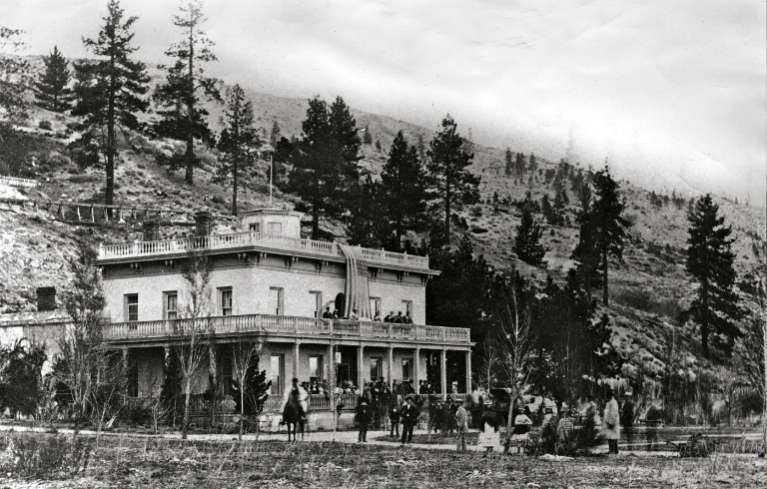
Bowers Mansion in the Washoe Valley is now on the National Register of Historic Places.

In 1976 it was listed as a local historic place, but this month it was given national significance. The National Register is the nation’s official list of cultural resources worthy of preservation.

Constructed between 1862 and 1863, Bowers Mansion is located on Old Highway 395 in Washoe City. The mansion conveys the story of its owners, Sanford (Sandy) and Eilley Bowers, and the successes and failures associated with the wealth they amassed and lost as the West shifted from placer to hard rock mining. Notably, the Bowers’ home is an early example of how wealth acquired from hard rock mining enabled impressive mansions to be built away from the mine sites.

Bowers Mansion becomes nationally recognized. Photo/Provided

Bowers Mansion becomes nationally recognized. Photo/Provided

The elevated historical recognition provides a national context for hard rock mining as well as an opportunity in the future to evaluate the Mansion as a National Historic Landmark.

Bowers Mansion retains excellent historic integrity in its interior and exterior. Despite changes in ownership and declines in maintenance, the mansion was restored and rehabilitated during the 1960s. Today, the expansive home and grounds are maintained as the Bowers Mansion Regional Park where views both to and from Washoe Valley remain much as they did during the days of the Bowers.

For additional information about Bowers Mansion, go online.


Diminished paychecks equal fewer nights eating out

By Caroline Fairchild, Huffington Post

Far fewer Americans dined out last month as many adjusted to smaller paychecks, according to new data released from a closely watched index of restaurant sales.

Sales at casual-dining restaurants fell 5.4 percent in February, according to this month’s Knapp-Track Index, which records monthly sales at casual dining restaurants like Applebee’s and Red Lobster. The big drop far exceeded a 0.6 percent month-over-month decline in January.

The decrease shows that many Americans are dealing with the new reality of a 2 percent pay cut Congress passed in January when it declined to extend the 2010 payroll tax holiday. The move affected roughly 160 million Americans. Workers earning $50,000 a year, for example, started taking home $80 less a month.

“A lot of people had feelings of betrayal on taxes,” Malcolm Knapp, the consultant who created the Knapp-Track Index, told The Huffington Post. “By Jan. 15, when everyone looked at their paycheck and it was smaller … it felt like someone stole their money. And this happened all over the country.”

The hit in sales will affect the industry largely responsible for roughly three-fifths of new jobs created after the recession. Food services, retail, and employment services account for 43 percent of low-wage jobs created during the recovery, according to a recent study by the National Employment Law Project.

Knapp, who has been analyzing the restaurant industry since 1970, said fast food restaurants like McDonald’s and Taco Bell have also seen declining sales. An increase in gas prices and bad weather also contributed to February’s dip in restaurant sales, he added.

Although American diners eating more meals at home may have a negative impact on the economy in the near-term, Paco Underhill, founder of New York-based consumer-behavior research and consulting firm Envirosell, said that the trend could be a positive indication of growth in the long-term. Americans may be increasing their confidence to invest in larger purchases like houses and cars, he said.

“Casual dining is about near-term, inexpensive indulgences,” Underhill told HuffPost. “As the recession winds down, there is pent-up demand for more expensive durable goods — be that cars, computers, or whatnot. As they manage their pocketbook, they have to cut back on where they are spending on a day-to-day basis.”

Recent reports of increased consumer confidence may also indicate that the money diners previously were spending at casual dining restaurants may be going toward other purchases. In March, the Bloomberg Consumer Comfort Index, which tracks personal finance confidence, increased to its highest level since April, linked to an improving job market and a decline in Americans seeking unemployment benefits.


Wounded Warriors to spend a week in Tahoe

Wounded Warriors from around the country will descend upon North Lake Tahoe in April for the Ability Challenge Snowsports Camp.

The week starts with the Ability Camp for 20 soldiers and Marines disabled in Iraq and Afghanistan. They will receive specialized instruction in adapted snow skiing and snowboarding at the Disabled Sports Program Center at Alpine Meadows Resort.

From April 2-7 they will also participate in other winter recreation designed as part of their therapy and re-integration into the community.

On April 5 at Squaw Valley and April 6 at Alpine Meadows the Ability Challenge will feature donors, sponsors and disabled skiers for a day of on-hill activities. An awards presentation is scheduled at the end of the day.

The Ability BASH on April 6 has been one of North Tahoe’s premier fundraising events for 19 years. This dinner, dance and silent auction is an uplifting evening for all in attendance.

For more information, contact Doug Pringle at (916) 532.3564 or doug@disabledsports.net


Sierra’s salsa judges ready for grand tasting

Do you make best Sierra salsa? Photo/LTN file

Do you make best Sierra salsa? Photo/LTN file

Sierra’s Salsa Showdown is Sunday starting about noon at West Bowl.

There are two categories – Traditional and Fruity — with a maximum of 30 salsas between the two.

Lake Tahoe News Publisher Kathryn Reed is one of the judges. Tip: she likes spicy salsas.

Deliver at least 2 cups of homemade salsa to the Baja Grill between 8:30-10am on March 24.

A winner from each category will receive a 2013-14 Unlimited Season Pass, which is now good at 10 mountains across the West. And the winning salsa maker must be present to win.


Ski report: Plenty of events

ski report logoIt’s not just about the skiing. So many resorts are having special events this weekend.

Here is the March 23 ski report.

— Curtis Fong


Class teaches paddleboard building

The Tahoe Maritime Museum is offering a wooden paddleboard building course starting in June.

The course will use Chesapeake Light Craft Paddle Board Kits to construct either 12-foor-6-inch or 14-foot paddleboards. The boards are built from marine plywood using a stitch and glue method.

Space is limited, so register soon by emailing katena@tahoemaritime.org. The cost is $2,100.


Officials work to make travel in basin more functional

By Kathryn Reed

STATELINE – How to move people around the East and North shores in a more pleasant and manageable manner dominated Friday’s discussion of the Tahoe Transportation District board.

Stephanie Grigsby with Design Workshop presented a video of Highway 28 showing how it could be possible to make parking less treacherous while at the same time providing information for people who are new to the area.

Although this stretch of East Shore roadway from the junction of Highway 50 at Spooner Summit to Crystal Bay was designated a National Scenic Byway in 1996, improvements have been lacking. At that time it was called America’s Most Beautiful Drive. Efforts are under way to make the drive complement the natural beauty.
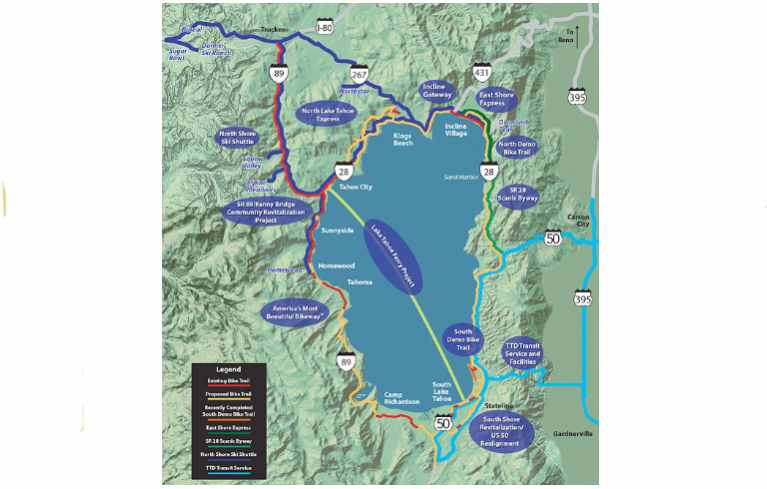
This shows Tahoe Transportation District projects throughout the basin.

This shows Tahoe Transportation District projects throughout the basin.

Access to the lake is also a big goal of the project. This should eliminate people needing or wanting to climb over guardrails and walking down steep embankments to reach Lake Tahoe.

Plans came about after the public gave input last fall. Safety, transportation, environment, recreation, scenic and economic needs are being woven into the plans.

The draft Highway 28 Corridor Management Plan is expected to be finished in the next two weeks. Three alternatives, plus a do nothing, are being created. In May, officials are expected to decide on the environmental review process.

This is a cooperative plan that has buy-in from the Nevada Department of Transportation, state parks, state lands, Nevada Highway Patrol, Incline Village General Improvement District (IVGID), Tahoe Regional Planning Agency, U.S. Forest Service, Federal Highways Administration, Washoe County, Carson City, Douglas County and Washoe Tribe.

“All of the scenarios include shared use paths, emergency pull-outs, vista points, and various levels of transit service providing connectivity between parking nodes and access to recreational areas,” the TTD staff report from March 22 says.

Tied into this is better public transit, which started last summer with the inaugural East Shore Express. More than 12,000 passenger trips between Incline Village and Sand Harbor were tallied. The goal was to eliminate walk-ins at the popular state park beach because of the dangers parked vehicles and pedestrians create in that area.

It is estimated that 2.6 million vehicles are on this highway every year.

While not part of the Corridor Management Plan, the Nevada Stateline to Stateline Bikeway was also on agenda. In some ways it is a companion piece to the greater transit discussion for the area.

TTD and IVGID are looking at whether six miles of the route can be placed on top of the sewer line; some of which is scheduled for replacement.

“If this works, we will be years ahead of where we would have been with the bike trail,” TTD Executive Director Carl Hasty said.

The bikeway when completed will go from Nevada’s two state lines in the Lake Tahoe Basin.

Board member Ron Treabess spoke about the changes that will take place this summer with the North Lake Tahoe Water Shuttle. It’s possible the Hyatt in Incline will be integral in future years as a marina stop; creating another tie-in to the bike route and scenic highway improvements.

This is the second of a three-year pilot program that transports locals and tourists to various marinas – Captain Jon’s Restaurant in Tahoe Vista, Gar Woods in Carnelian Bay, Tahoe City Marina and West Shore Café in Homewood. Captain Jon’s will be substituted for the North Tahoe Marina this summer because it is better protected.

Other changes include charging a flat $10 fee no matter the marina one departs at, allowing walk-on travelers and not just reservations, running from June 27-Sept. 22, and increasing hours to 10am-11:30pm.



Opinion: CalFire needs to go further with fire tax

By Ted Gaines

While I am pleased CalFire has decided to apply the brakes in order to sort this mess out, I will not give up the fight to repeal the fire tax altogether.

I just heard from a constituent this week telling me they were billed for two structures on a parcel of land that only had one home and the resulting battle it took to get CalFire to realize their mistake. It is absolutely unacceptable and another example of absurd government inefficiency.

Ted Gaines

Ted Gaines

According to news reports, CalFire has confirmed receipt of 87,000 petitions for reconsideration from homeowners who said they were billed in error. The agency plans to delay this year’s fire tax bills while the challenges are investigated.

I have introduced three pieces of legislation this session that will provide relief for rural Californians forced to pay the fee.

Senate Bill 17 would altogether repeal the collection of the $150 tax.

Senate Bill 125 would exempt a property owner of a structure that is located both within an SRA and within the boundaries of a local fire protection district from having to pay the $150 tax.

Senate Bill 147 would exempt any property owner located within an SRA who has an income of less than 200 percent of the federal poverty level (as determined by the U.S. Department of Health and Human Services Poverty Guidelines) from paying the $150 fire tax.

This fire tax has been imposed on the owners of more than 825,000 properties in the state. According to Census and CalFire data, my largely rural district includes nearly 25 percent or approximately 200,000 of the properties whose owners are subject to the fee.

The billing is in complete disarray and CalFire has been accused of stashing away millions in a secret fund. I hope my legislative colleagues realize that charging rural Californians a $150 illegal fire fee specifically to support CalFire operations, at the same time they are inappropriately billing for the tax and hiding millions provides enough justification to support my legislation.

I also strongly support the lawsuit filed this month against the state by the Howard Jarvis Taxpayers Association challenging the fee on constitutional grounds.

Property owners who believe they were billed in error have 30 days to appeal. Owners are encouraged to pay the “fee” while going through the appeals process. If the fee is late, steep penalties and interest are compounded monthly. Moreover, the fee is a lien on property, and failure to pay can result in foreclosure. For more information, call CalFire at 888.310.6447.

Ted Gaines represents the 1st Senate District, which includes all or parts of Alpine, El Dorado, Lassen, Modoc, Nevada, Placer, Plumas, Sacramento, Shasta, Sierra and Siskiyou counties.


States look for ways not to pay for ER visits

By Nancy Shute, NPR

Cash-strapped states are coming up with an appealingly simple fix for soaring Medicaid costs: Don’t pay for emergency room visits for people who aren’t sick enough to be there.

There’s a problem, though. It’s almost impossible to figure out who’s sick enough and who isn’t at the moment they walk in the door, researcher says.

“People don’t come to the ER with diagnoses, they come to the ER with symptoms,” says Maria Raven, an assistant professor of emergency medicine at UC San Francisco. She’s the lead author of the study published in the latest JAMA, the Journal of the American Medical Association.

Almost a dozen states have come up with plans to refuse to pay for ER visits or require copays from Medicaid patients if they have a health problem that could have been treated in a doctor’s office. They’re operating on the widely held premise that people without private health insurance use emergency rooms for minor complaints that would best be treated elsewhere.

To find out if that’s true, Raven and colleagues looked at the discharge records for almost 35,000 people who visited emergency rooms in 2009. They identified which people had problems that were “primary care treatable,” and then looked back to see what symptoms brought them to the ER.

Just 6 percent of the people had a problem that could have been treated in a doctor’s office. But it was impossible to identify them based on symptoms when they walked in the door, because they were the same as those for 89 percent of all emergency room visits. The hundreds of symptoms included toothache, skin rash, abdominal pain, earache, fever and chest pain.

Looking at the people with those symptoms, 11 percent were triaged as needing immediate care, and 12 percent were admitted to the hospital. The three most common diagnoses were abdominal pain, respiratory infection and chest pain.

“If you have a 65-year-old person who wakes up in the middle of the night with chest pain, the only logical thing for him to do it to go to the emergency room,” Raven says. “Then the doctor comes in and says, ‘Good news, you’re not having a heart attack. Maybe you have indigestion.’ We certainly don’t want people to be discouraged from getting primary care, especially because in many cases it could be a heart attack.”

The idea of identifying “primary-care treatable” cases was not to kick them out of the ER, but to make sure they got good primary care so they didn’t have to go to the ER, says Arthur Kellermann, an ER doctor and policy analyst for the Rand Corporation.

“If you’re going to apply this logic to reduce support to the emergency department, I suppose we should shut down fire departments because sometimes the public calls with a false alarm,” Kellermann told NPR.

“These visits are not happening because people are dumb or lazy or indifferent,” Kellermann says. “They’re symptoms that primary care is not adequate to meet the acute care needs of the population.”

The Affordable Care Act requires that Medicare and private insurers pay for emergency care that a “prudent layperson” would consider necessary. In other words, they can’t stick you with the bill if you go in with chest pain and it turns out to be heartburn. But Medicaid patients didn’t get the same protection.

In 2011, Washington state said it would stop paying for emergency department visits by Medicaid patients if they were “not necessary for that place of service,” but the plan was overturned by the governor.

If similar measures are enacted in other states, hospitals would end up paying the tab for emergency room patients the state refused to cover.