Opinion: Harassment among El Dorado County grand jurors

By Ryan Donner

I served as a member of the 2011-12 El Dorado County Grand Jury and began serving a second term on the 2012-13 El Dorado County Grand Jury.

Judge Stephen Bailey was the supervising judge during both of these jury sessions. At the end of the 2011-12 jury session, the presentation of a report on one of our investigations met with court censorship. I was very vocal regarding my opinion that the report should be issued as originally written.

It became apparent to me early in my second term that the foreman, Ray Van Asten, was not following proper jury protocol (Robert’s Rules of Order/Parliamentary Procedure) in conducting meetings and conducting votes on organizational activities within the full body of the jury. Further, he failed to appoint a pro tem or a secretary prior to statewide training meetings.

Each week Van Asten would appoint a member of the body to take meeting minutes which were then submitted to him. Upon our next full body meeting we would occasionally discover that votes taken or committees formed during the previous meeting had been changed in the meeting minutes and Van Asten would assert that the vote was invalid as a result of how the discussion was categorized, or he would deny any recollection of what had transpired with respect to the discrepancies.

I was very vocal about these breaches of protocol during the meetings, often stopping the proceedings to identify that procedure had not been followed. I was also vocal about the seemingly altered meeting minutes and the impropriety of not selecting officers prior to training meetings that would give those officers a guideline for managing oversight in the full body. As a result of my outspokenness, Van Asten became frustrated with me and began loudly contesting anything I had to say, ignoring me during discussions, and asking me to step back from commenting at all. A pattern of harassment began to develop.

Becoming more and more frustrated about the way the foreman was treating me, and about the breaches of protocol which I felt bordered on illegality, I made a complaint of harassment to El Dorado County Human Resources and was told that they had no purveyance over the jury body and suggested I contact the Superior Court instead. I was told by the court that Human Resources was the county’s responsibility, and that in any case, grand jurors were volunteers and really had no standing from an HR perspective.

Nevertheless, I then took my complaint to the district attorney, Vern Pierson. He listened to my complaint and told me he would look into it.

Within two weeks of my complaint, I received an email from Judge Bailey’s clerk requesting that I meet at the judge’s office with the judge. No explanation for the meeting was given, and I received no physical/formal written notice of the meeting. Upon arriving at the meeting I was told that it had been moved from the judge’s office to his courtroom. Present in the courtroom were the judge, Van Asten, the clerk, a court stenographer, and a sheriff’s bailiff. What ensued was not a meeting, but rather a hearing, during which I was essentially threatened with contempt of court unless I “got along” with Van Asten in the grand jury meetings (Here are the GrandJuryLogo court transcripts.) I took this to mean that I should simply do what Van Asten told me, period. During a previous term as grand jury foreman, Van Asten also acted to have a juror with whom he disagreed removed.

Now understanding that my attempts to establish order during meetings was simply not going to be allowed, and suffering increasing harassment from Van Asten (threatening emails, public humiliation during meetings, etc.), I decided that my best course of action was to resign from the jury to avoid a kangaroo court issuing a contempt order against me for doing my job as a grand jury member – identifying oversight, even amongst the full body itself.

It is my belief that the problems I experienced during the early months of this grand jury continued even after my departure, and that the result was an unprecedented dissolution of a civil grand jury in El Dorado County prior to the completion of their term, and without issuing a single investigative report, even on the state mandated inspections of detention facilities in the county.

Ryan Donner is a resident of El Dorado County.


Multiple prescribed fire operations by USFS in Tahoe

U.S. Forest Service fuels management crews will conduct prescribed fire operations in the Cold Creek area on the South Shore again beginning March 25.

The Forest Service may also begin operations in the area of North Upper Truckee on the South Shore, Slaughterhouse Canyon or the Meeks Bay area, depending on weather and fuel conditions. Operations will continue throughout the week if conditions are favorable.

Crews expect to complete operations on approximately 10 acres.

Smoke will be visible from this prescribed fire project area. The Forest Service strives to minimize the impacts of smoke on local communities. Smoke-sensitive residents should consider staying indoors and keeping doors, windows and outside vents closed.

To directly receive prescribed fire updates, send an email to pa_ltbmu@fs.fed.us.


Sierra salsa winners not divulging ingredients

By Kathryn Reed

TWIN BRIDGES – Sierra’s Salsa Showdown is shrouded in secrecy. The winners are not revealing their recipes. And the judges need more to eat than just a tiny tasting cup in order to dissect the edibles.

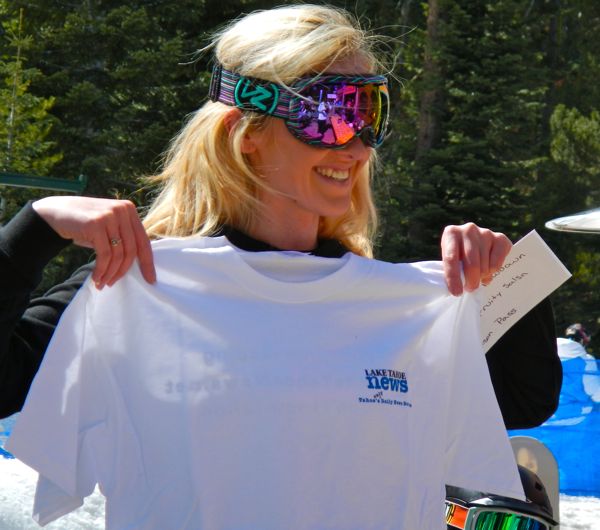
Lara Weiss of Incline made the best fruit salsa. Photo/Kathryn Reed

Lara Weiss of Incline made the best fruit salsa in the March 24 competition at Sierra. Photo/Kathryn Reed

“I can’t share all the secret ingredients,” Lara Weiss of Incline Village told Lake Tahoe News on Sunday after winning the fruit contest.

She is no rookie to this sixth annual competition. Three years ago she also won. Her efforts earned her a season pass to Sierra-at-Tahoe for 2013-14.

Weiss did reveal that grilled pineapple, mango, habaneros and jalapeños go into her award-winning salsa.

Judges in both categories rated each salsa from 1 – being weak to 5 – being bomb-diggity! Each was judged on appearance-color, aroma, flavor-taste, spice blend, originality and overall impression.

Marking the judge’s sheet on March 24 were this reporter, Mike from Lake Tahoe TV, Dennis the lift operations supervisor, Munchie who is the on mountain food and beverage manager, Jeff who supervises security (and is a past salsa winner), and Evan the risk manager.

I gave Weiss the most number of points out of any contestant for her Fire Fruit Fusion. I kept wanting more. From the start it was great – the aroma, look and then that kick of spice at the end blended perfectly with the fruits.

Kopa’s Fruit Salad, which came in second on my scorecard and with all the judges, was named after Sierra’s avalanche dog. It’s hard to know if that may have won over some of the Sierra judges.

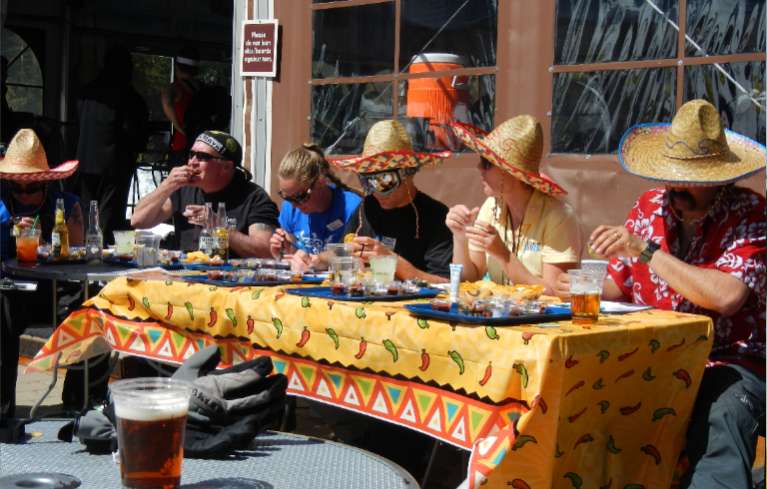
It was a tough day of work for the judges of the Sierra Salsa Showdown. Photo/Susan Wood

It was a tough day of work for the judges of the Sierra Salsa Showdown. Photo/Susan Wood

The concoction was definitely the prettiest of all submitted. The strawberries added a great sweetness. Another nice thing about this fruit salsa is that is had no spice – just fruit to make it so yummy.

I was not in sync with my fellow judges when it came to the traditional category.

The Gringo came in third, but was first with my taste buds. The smoky aroma was unique and the avocado brought balance.

The judges, though, awarded the season pass to No BPA made by Allen Evangelista of Antioch. This was the first time he has competed in this contest.

“It’s all fresh ingredients … cilantro, onions, tomatoes, garlic,” he said. The recipe is his mother-in-law’s and because Evangelista wants to stay on her good side, he’s not giving out any more details.

This was my No. 3 pick in this category.

Later there was a taco eating contest. Aaron Hughes of Manteca won a Burton Bud Light snowboard for being the fastest to finish the five spicy tacos.

A couple contestants walked away from the table shaking their heads about how spicy the tacos were. Hughes was just all smiles and didn’t care that sauce covered his cheeks.


Taco eating contest at Sierra

Aaron Hugehes of Manteca defended his taco eating contest title at Sierra-at-Tahoe on March 24 by being the fastest to wolf down five spicy tacos.


Unusual veggies find a home in French Laundry’s organic garden

By Debbie Arrington, Sacramento Bee

While visiting France, restaurateur Thomas Keller nibbled a crunchy blue-leafed spinach that he’d never seen before. It tasted faintly like oysters – and Keller immediately texted his staff.

The French Laundry’s garden got another addition.

 Debbie Arrington / darrington@sacbee.com Adam Keefer shows off baby carrots.

Adam Keefer shows off baby carrots. Photo/Debbie Arrington/Sacramento Bee

“It took us a little while to track down the seed, but we got it,” said chef-turned-garden manager Adam Keefer, who oversees the French Laundry’s large organic garden. “It’s actually a succulent and only grows on the moors of Scotland.”

Now, the appropriately named oyster-leaf spinach is occasionally part of the menu at the famed Yountville restaurant, known for its nine-course meals with no repeats among the named ingredients. It’s usually used to complement oysters or other seafood, accenting its own unusual flavor.

“It has a delicate blue flower in late summer,” Keefer noted. “It’s actually become one of my favorites.”

It’s just one of more than 300 varieties of vegetables, herbs, berries and edible flowers grown for Napa’s farm-to-fork landmark. With chefs just steps away, it’s the ultimate kitchen garden.

“How many people get to grow vegetables in a location like this?” said Keefer as he marveled at the Napa view.

With deep farming roots, Keefer came to the French Laundry to cook, but transitioned outdoors about four years ago.

“I started working out in the garden and just loved it,” he said. “My grandfather had a berry farm, so it’s in my genes. Gardening and culinary (work) are both part of the same genre; it’s the flip side of food.”

Located on 3 1/2 acres on Washington Street, the garden is open daily to the public. It supplies about 40 percent of all produce used by Keller’s three Yountville restaurants: French Laundry, Bouchon and Ad Hoc.

“People ask us if they can buy some, but we use it all up,” Keefer said. “If we tried to grow everything we used, we’d need all 3 acres just for onions.”

Instead, Keefer concentrates on unique taste sensations – such as the oyster-leaf spinach – or vegetables that lose flavor rapidly after harvest.

“Taste this arugula,” he instructed after sampling some himself. “It’s got this wonderful peppery bite you only get with fresh-picked. That totally disappears after only a few hours. Tomorrow, that bite is gone. But there are lots of other examples. Celery tastes different straight out of the ground.”

The manicured garden’s wide grass paths between the vegetable beds accommodate restaurant patrons who wander over.

“We’re educational as well (as producing food),” Keefer said. “People come for dinner, then come back in the morning to the garden to see what they ate.”

Also getting an education are chefs.

“They learn seasonality,” Keefer said. “Chefs are always planning for the next hour, the next service, the next day. In the garden, you plan months ahead. A big part of what we do in the garden is teach chefs. They harvest with us, so they can truly appreciate what it takes to grow this food. It’s not just a commodity; it’s back-breaking hard work.”

Among the unusual vegetables growing this spring is cardoon, an artichoke cousin valued as a harbinger of spring. Celtuce, also known as stemmed Chinese lettuce, is just reaching its peak. A vast swath of fava beans replenishes the soil as well as flavors recipes.

White strawberries, which will ripen by summer, attract bees from nearby hives. A large bed of golden, black and red raspberries, brought by Keefer from his own garden, begins to bud out.

Twenty varieties of gourmet leaf lettuces and microgreens are trimmed by hand from raised beds.

“I love a new one, Salanova,” Keefer said. “It’s a beautiful lettuce, like a chrysanthemum. It’s a stunning look.”

White Satin carrots, which look like edible icicles, mix with familiar baby Nantes and Chantenay. Cherry Belle radishes grow near heirloom baby beets and Tokyo turnips.

“In the summer, we’ve got 14-foot-tall sunchokes,” Keefer said. “The tomatoes are in 6-foot cages. You can’t see across the garden; everything is so big and lush.”

A movable enclosure allows the French Laundry’s flock of little bantam hens to feast at different locations. The chickens produce small but flavorful eggs that are served at the French Laundry.

Inside the hoop house, seedlings await transplanting. This summer, Keefer will grow 46 varieties of tomatoes, 20 different peppers and 10 kinds of eggplant.

“I’m really excited about the Shisito peppers; they’re the new hot thing,” Keefer said. “They’re similar to Padron.”

As for tomatoes, Keefer prefers Brandywine and Amish Paste as his personal favorites. He knows his chefs will want something different.

“Chefs are funny,” he said. “They’ll get really excited about something new, but after five days of cooking with it, they’ll want something else.”


Roe v. Wade ruling casts shadow over gay marriage

By Adam Liptak, New York Times

WASHINGTON — When the Supreme Court hears a pair of cases on same-sex marriage on Tuesday and Wednesday, the justices will be working in the shadow of a 40-year-old decision on another subject entirely: Roe v. Wade, the 1973 ruling that established a constitutional right to abortion.

Judges, lawyers and scholars have drawn varying lessons from that decision, with some saying that it was needlessly rash and created a culture war.

Justice Ruth Bader Ginsburg, a liberal and a champion of women’s rights, has long harbored doubts about the ruling.

“It’s not that the judgment was wrong, but it moved too far, too fast,” she said last year at Columbia Law School.

Briefs from opponents of same-sex marriage, including one from 17 states, are studded with references to the aftermath of the abortion decision and to Justice Ginsburg’s critiques of it. They say the lesson from the Roe decision is that states should be allowed to work out delicate matters like abortion and same-sex marriage for themselves.

“They thought they were resolving a contentious issue by taking it out of the political process but ended up perpetuating it,” John C. Eastman, the chairman of the National Organization for Marriage and a law professor at Chapman University, said of the justices who decided the abortion case. “The lesson they should draw is that when you are moving beyond the clear command of the Constitution, you should be very hesitant about shutting down a political debate.”

Ginsburg has suggested that the Supreme Court in 1973 should have struck down only the restrictive Texas abortion law before it and left broader questions for another day. The analogous approach four decades later would be to strike down California’s ban on same-sex marriage but leave in place prohibitions in about 40 other states.

But Theodore J. Boutrous Jr., a lawyer for the two couples challenging California’s ban, said the Roe ruling was a different case on a different subject and arose in a different political and social context. The decision was “a bolt out of the blue,” he said, and it had not been “subject to exhaustive public discussion, debate and support, including by the president and other high-ranking government officials from both parties.”

“Roe was written in a way that allowed its critics to argue that the court was creating out of whole cloth a brand new constitutional right,” Boutrous said. “But recognition of the fundamental constitutional right to marry dates back over a century, and the Supreme Court has already paved the way for marriage equality by deciding two landmark decisions protecting gay citizens from discrimination.”

The author of the majority opinions in those two cases, Justice Anthony M. Kennedy, seemed to address the new ones in wary terms in remarks this month in Sacramento.

“A democracy should not be dependent for its major decisions on what nine unelected people from a narrow legal background have to say,” he said.

In Justice Ginsburg’s account, set out in public remarks and law review articles, the broad ruling in the abortion case froze activity in state legislatures, created venomous polarization and damaged the authority of the court.

“The legislatures all over the United States were moving on this question,” Ginsburg said at Princeton in 2008. “The law was in a state of flux.”

“The Supreme Court’s decision was a perfect rallying point for people who disagreed with the notion that it should be a woman’s choice,” she added. “They could, instead of fighting in the trenches legislature by legislature, go after this decision by unelected judges.”

That general view is widely accepted across the political spectrum, and it might counsel caution at a moment when same-sex marriage is allowed in nine states and the District of Columbia and seems likely, judging from polls, to make further gains around the nation.

“Intervening at this stage of a social reform movement would be somewhat analogous to Roe v. Wade, where the court essentially took the laws deregulating abortion in four states and turned them into a constitutional command for the other 46,” Michael J. Klarman, a law professor at Harvard, wrote in a recent book, “From the Closet to the Altar: Courts, Backlash and the Struggle for Same-Sex Marriage.” Klarman was a law clerk to Justice Ginsburg when she served on the federal appeals court in Washington.

But an article that will appear in Discourse, an online legal journal published by The UCLA Law Review, proposes a different account. “The Roe-centered backlash narrative, it seems, is the trump card in many discussions of the marriage cases,” wrote Linda Greenhouse, a former New York Times reporter who covered the court and now teaches at Yale Law School, and Reva B. Siegel, a law professor there.

“Before Roe,” they wrote, “despite broad popular support, liberalization of abortion law had all but come to a halt in the face of concerted opposition by a Catholic-led minority. It was, in other words, decidedly not the case that abortion reform was on an inevitable march forward if only the Supreme Court had stayed its hand.”

After the decision, they added, “political realignment better explains the timing and shape of political polarization around abortion than does a court-centered story of backlash.”

In an interview, Siegel said court decisions concerning same-sex marriage had played a valuable role.

“It is nearly two decades since courts in Hawaii, Massachusetts and other states began a national conversation about marriage,” she said. “There has been over the course of this long period a dramatic, revolutionary change in popular understanding of marriage equality. Courts can inspire resistance but also can teach.”

Klarman said it was not clear that a decision requiring same-sex marriage throughout the nation would give rise to the kind of sharp opposition that followed the abortion ruling.

“For abortion opponents, abortion is murder, which means the intensity of their commitment to resisting Roe was considerable,” he said in an interview. “For the gay marriage opponent in, say, Mississippi, how will their lives change if the openly gay couple living down the street can now obtain a marriage license?”

There is a range of possible outcomes in the case on California’s ban on same sex marriage, Hollingsworth v. Perry, No. 12-144. The court could uphold the ban; reject it on grounds that apply only to California or only to eight states; or establish a nationwide right to marriage equality. Or the court could say it is powerless to render a decision on the merits.

That last option would follow from the odd path the case took through the courts. After a trial judge struck down the California ban, from the voter initiative Proposition 8, and entered judgment against state officials, the officials declined to appeal. Supporters of Proposition 8 did appeal, but it is not clear that they have suffered an injury direct enough to give them standing to appeal.

The trial court’s judgment came in 2010 from Judge Vaughn R. Walker of the Federal District Court in San Francisco. During closing arguments in the case, Judge Walker made it clear that he, too, was working in the shadow of the abortion ruling. He said the Roe case “has plagued our politics for 30 years” because “the Supreme Court has ultimately constitutionalized something that touches upon highly sensitive social issues.”

“Isn’t the danger,” Walker asked Theodore B. Olson, a lawyer for the two couples challenging the ban, “not that you are going to lose this case, either here or at the court of appeals or at the Supreme Court, but that you might win it?”


Stormwater workshop in Truckee

Truckee in cooperation with the Placer County Stormwater Division will be hosting a stormwater workshop April 17.

The focus will be on providing business owners, contractors, engineers, and local agency staffs information on the new municipal permit requirements. The new permit starts July 1.

The free workshop is from 9-11am at 10183 Truckee Airport Road, Truckee.

In addition, there will be a refresher segment on temporary and permanent erosion control best management practices, sediment control BMPs, good housekeeping BMPs, and their proper installation and maintenance.

For more information or to register, contact Jessica Thompson at (530) 582.2938.


Report: South Shore transit reliable, financially stable

By Kathryn Reed

STATELINE – Buses are in better shape, they run on time more often, the yard is cleaned up, and the whole system is operating in the black. Those are the changes to BlueGo since the Tahoe Transportation District took over in November 2010.

And today, not a dime of the budget is coming from the casinos.

Curtis Garner, who is charge of the transit system on the South Shore, updated the TTD board March 22 about what has happened in the two plus years since the change in operator.

“The baseline is improving. We project to have the highest level of ridership since the 2009-10 season,” Garner said. Projections are for the non-skier rides to top 500,000 this fiscal year.

This is what the fare cards will look like.

This is what the fare cards will look like.

Weather plays a large role in BlueGo’s numbers because many of those on board are headed to Heavenly Mountain Resort. The ridership was up significantly in 2010-11 on the ski shuttles because that was the winter that would never end.

When BlueGo offered free rides on its main Highway 50 route during the Christmas-New Year’s span the ridership spiked.

Angela Swanson, who is South Lake Tahoe’s rep to the TTD board, said she would like staff to show what it would take to offer free ridership year-round.

Because a free bus system isn’t likely to happen any time soon, BlueGo staff is going forward with creating six magnetic passes that will be used by riders in lieu of cash. As soon as the devices are installed on the entire fleet, the cards will be sold to riders.

Garner said the big thing Tahoe needs to do is create a regional transit system. He added, that until it does so, bringing in events like the X Games or the Olympics would not be possible.

TTD board chairman Steve Teshera said funding is the big stumbling block when it comes to that regionwide system.

The next goals, Garner said, are to conduct a travel impact study of people going from the Bay Area to the Lake Tahoe Basin, a regional facilities alternatives analysis and long-range transit plan, and define a preferred local alternative for a passenger ferry.


Tomato producers use grafting for higher yields

By Chuck Raasch, USA Today

Tomatoes, the kings of U.S. home gardens, are undergoing a revolutionary change, according to breeders and growers.

Producers are grafting disease-resistant and insect-resistant roots onto familiar heirloom and hybrids, and seed catalogs are featuring a varied selection of grafted plants for the first time this year. Tests in the U.S. have shown that even notoriously stingy but good-tasting tomato plants become super producers when grafted to more vigorous roots.

“It is the biggest thing to happen in gardening, probably in 20 years,” says John Bagnasco, host of “Garden Life” radio show and president of the Vista-based GardenLife, which sells the grafted “Mighty Matos” on its website.

He is in a partnership — called SuperNaturals — that sells through several popular seed catalogs and hopes to triple sales over last year, to more than 1 million plants sold in the U.S. this year.

Andrew Mefferd goes further. A self-described “talent scout for plants” and the technician in charge of tomatoes at Johnny’s Selected Seeds, a global supplier based in Winslow, Maine, Mefferd calls grafting “the single biggest thing to advance tomatoes, I would say, since tomatoes were first hybridized” over a century ago.

The grafting push comes at an intersection of economic, environmental and health trends. Some home-garden wholesalers and retailers have had robust years during the economic downturn because more people are growing their food to take pressure off household budgets. Meanwhile, health-conscious consumers are seeking more naturally homegrown products, but have limited garden space.

The National Gardening Association’s annual survey found that while overall gardening activity, which includes everything from landscaping to potted plants, fell from $36 billion in 2008 to $29 billion in each of the last three years, vegetable gardening sales were up by roughly 20 percent to about $1.7 billion annually.

“It’s really an economic and an environmental story,” says Alice Doyle, a grafting pioneer in the U.S. and co-owner of the wholesaler Log House Plants in Cottage Grove, Ore. “There is a triple bottom-line profit — more yield, less expensive chemical usage, no environmentally negative outputs.”

Grafting involves attaching the top of a popular plant onto a root that has demonstrated resistance to the diseases and microscopic pests, called nematodes, that have killed many a home-grown tomato.

Some home gardeners have reported double or triple yields from grafted tomatoes that bear longer and in greater volumes than normal heirlooms or hybrids. Vines can shoot a dozen feet or more. Because grafting is labor-intensive and requires special growing conditions, grafts are pricey, going for $7.95 or more a plant, twice the price of normal plants. They are also fussy growers and must be carefully planted.

But producers are hoping to demonstrate that the extra cost and work is worth it to farmers market producers, outdoor tomato farmers and urban gardeners. Besides tomatoes, grafted eggplants and peppers are showing up in this year’s seed catalogs.

Grafting vegetables has been common for decades in countries where land is scarce and where soils have become disease-laden over centuries of farming. Commercial growers have grown them for years in this country, but this is the “roll-out year” nationally in the home-garden market, says says Mary-Kate Mackey, who writes a garden blog.

Doyle was introduced to grafted plants during a trip to Crete in 2000, and she began working on getting them more widely used in the U.S. Bagnasco had been working separately on the same idea, and the two ran into one another at a gardening symposium in Dallas a few years ago.

They formed SuperNaturals with Tim Wada, president of the Vista, Calif.-based Plug Connections, which grafts most of the tomatoes sold under the Mighty Matos label.

Dick Zondag, the president of Wisconsin-based J.W. Jung Seed Company, says his company tested the grafted tomatoes last year and decided to feature them this year.

“That was my first question, ‘why would you even consider paying seven or eight dollars for a tomato plant when you can plant a seed that costs 10 or 15 cents?’” Zondag says. “The reason you do it is because the yield is sometimes three to four times as much. The fruit comes earlier. … Some of these really tasty heirloom varieties can really take off.”

Heirlooms are often the tastiest tomatoes, but can be prone to disease and meager producers. Hybrids can boost production, but often sacrifice taste. Grafting is a detour around both challenges.

Nature “never gives it all” in the quest to boost production, Mackey says. “It holds back something, and the first thing it often holds back is taste.”

But with grafting, she says, “you get yield, you get taste, and you get disease resistance.”

Harry Olson, 69, a retiree from Salem, Ore., last year conducted a grafted vs. non-grafted test on five tomato varieties in his community garden. All five grafts produced more, and he says his grafted Brandywines had three times the yield of their nongrafted step-cousins.

The self-described “Doubting Thomas” says he saw a “profound difference” resulting in plants that produced weeks after normal plants and from root systems that were 10 times larger than non-grafted ones.

“People would just stand there and look” at his prolific plants, he says.

Jim Myers, an Oregon State University horticulture professor who specializes in developing plants that can thrive in the Pacific Northwest, created a purple tomato high in anti-oxidants called the Indigo. Last year, he and graduate assistants tested grafted vs. non-grafted Indigos, and the grafted plants produced three times more.

Grafting “could make heirlooms very productive,” he says. He predicts that the price will come down as demand grows, as producers seek more rootstock, and if grafting becomes more mechanized.


Letter: Heavenly gang helps at Bread & Broth

To the community,

“Heavenly Mountain Resort loves supporting the work of Bread & Broth. It is so popular among the staff that there is a waiting list to come and volunteer. I enjoy helping on occasion and seeing firsthand what a difference a great meal has on the needy of South lake Tahoe. Thanks for the opportunity,” commented Heavenly’s envirnonmental manager, Frank Papandrea, at the end of his volunteer shift at Heavenly Mountain Resort’s March 11 Adopt A Day of nourishment.

Papandrea, along with Wren Buxton, dispatch supervisor; Tom Maugeri, security manager; and Jessica Sota, dispatcher represented Heavenly in supporting Bread & Broth’s efforts to serve the evening’s hot, nutritious meal.

Jessica Sota, from left, Frank Papandrea, Wren Buxton and Tom Maugeri of Heavenly. Photo/Provided

Jessica Sota, from left, Frank Papandrea, Wren Buxton and Tom Maugeri of Heavenly. Photo/Provided

The Heavenly crew bagged and distributed giveaways from local merchants and helped served the main meal, desserts and drinks. The B&B volunteers enjoy the hardworking and energetic sponsor volunteers from all staff levels of Heavenly Mountain Resort.

The B&B volunteers and the Monday evening guests feel fortunate and appreciate the monthly partnership that exists between Heavenly Mountain Resort, Heavenly employees and the Bread & Broth program. Feeding the hungry in our community is the goal of B&B and Heavenly Mountain Resort is a major time and monetary contributor to the program.

Carol Gerard, Bread & Broth