Ski report: Snow possible at 7,000 feet
 Isolated and scattered showers today, with snow level above 7,000 feet.
Here is the March 28 ski report.
— Curtis Fong
Isolated and scattered showers today, with snow level above 7,000 feet.
Here is the March 28 ski report.
— Curtis Fong
Lake Tahoe South Shore Chamber of Commerce’s monthly Tech Tuesday covers the hottest trends in technology. The series takes place the first Tuesday of the month, from 8-9:30am in the chamber conference room in Stateline.
Workshops are free for chamber members and $15 for prospective members.
On April 2, Jay Kapp from Sterling Buying Group will present the basics of using Excel for your business. Reserve a spot by calling (775) 588.1728.
By Ted Long
I attended the second session of the Citizens Academy on Monday where we were introduced to the county jail and the communications center. For those of you just joining the discussion, I have been accepted as a member of the El Dorado County Sheriff’s Citizens Academy, a 16-week program to inform and enlighten county residents of the operation of the sheriffs’ department.
This week, as with our last instructors, were very friendlily and longtime county employees; average time 25 years. The county jail session lead by Tim McClain and the communication section by Kathy Jacobs, both, as I have said very nice people.

Ted Long
In the communication we heard about the 911 system and the county’s emergency number, which should be used for police emergencies within the county – (530) 626.4911. If you call 911, your call is first sent to the highway patrol in Sacramento then rerouted to the county system. By law your call may only be transferred once to protect you from hang-ups or other technical problems that may be encountered during a failed transfer.
The more interesting discussion was about the changes in the county jail. While the building is not new, it is in fine condition, all concrete and stainless steel and very clean. While it does not extend a particularly strong welcoming feeling, it does look secure, a place where someone could disappear forever if it were used to silence dissent or disagreement, and a good reason to make it available for inspection by the public and organizations such as the grand jury.
The population problem is very large and growing. With the state system under federal control, many serious offenders are now being sent to county jails. It used to be that a one-year term was the maximum. For the county system, know they have prisoners serving as much a 15 years.
McClain told us that while most of the intimates are in for various crimes the real reason is drugs, and the need to raise the money to support their habit. It seems the “war on drugs” has filled our jails. One can only wonder if some drugs were legal, and the crime taken out of them, would we all not be better off? The addicted not subject to the high cost that illegality forces on them, and perhaps more important, the reduction in crime to the rest of us. Sounds a lot like the unexpected consequences of attempts to make alcohol illegal and cure societies woes with laws of the ’20s to me. A lot of average people suffering while a lot of criminals got rich.
Everyone should experience the impact of jail. It’s one of those areas where we need to remain vigilant, as most have no idea of the possibility and the impact of isolation within this concrete structure.
Ted Long is a resident of South Lake Tahoe, former City Council member and has been on the El Dorado County Grand Jury.
To the community,
Thank you for being the first paper to report the Liberty Utilities transmission line upgrade project that will significantly impact Lake Tahoe’s North Shore as the site of the project and all Liberty Energy customers who are currently expected to pay for the $50 million project.
The project application was first submitted to the California Public Utilities Commission by Sierra Pacific Power Company (SPPCo.) in August 2010. The cost was estimated at about $23 million to be added to rate base and spread over 2.5 million customers. The increase in rates would have been insignificant. Since the original application much has changed.
The cost estimate of the transmission upgrade project doubled to $46 million, and SPPCo. sold their California customers to CalPeco, which also does business in California as Liberty Energy. CalPeco (California Pacific Electric Company) purchased SPPCo.’s distribution system and about 49,000 customers (80 percent are in the Lake Tahoe Basin) effective Jan. 1, 2011. The latest transmission upgrade cost does not incorporate their requested cost of phasing the project, but it approaches $50 million to be spread among only 49,000 customers. This will result in a significant rate increase for all of us.
CalPeco also applied for a general rate increase in February 2012 which was approved in December 2012. CalPeco was granted a 46 percent increase in admin/operating expenses, but this increase was offset by their over collection of reduced cost of wholesale power. Rather than passing along these significant reductions to ratepayers, residential rates increased about 1 percent, while small commercial increased about 7.6 percent.
The quote from Liberty’s Sam Rohn, “We will increase the voltage lines are able to carry, handle additional build-out at Martis Camp, Squaw Valley, and Northstar…” points right to the problem. They justify meeting future resort development loads outside of the Tahoe basin, by building new 120 kV lines inside the Tahoe basin — Tahoe City to Kings Beach and from Kings Beach to Truckee — when the biggest load demand is from Northstar. CalPeco sources their power from major transmission lines in Truckee.
Not only are the environmental impacts unnecessary in the Lake Tahoe Basin, but the huge cost is expected to be paid by Liberty Energy ratepayers instead of the few resort development customers causing the load demand.
There’s much more to Calpeco’s generalizations about single contingency reliability, load demand for build-out, and who is going to foot the bill. This story deserves the attention your paper has given it as this infrastructure issue unfolds.
David McClure, North Tahoe Citizen Action Alliance president

The Upper Truckee River near Cove East is part of the California Tahoe Conservancy project. Photo/LTN file
By Kathryn Reed
STATELINE — How the roughly 500 acres known as the Upper Truckee Marsh will be restored remains to be seen.
Once public input is completed next month, the California Tahoe Conservancy will begin the environmental analysis process. The final documents are expected to be out by the end of the year.
On Wednesday the Tahoe Regional Planning Agency Governing Board heard a presentation on the project. Ultimately that board will have to certify the environmental impact statement and then approve a project in order for permits to be issued.
While there is money in the bank to complete the planning phase, actual construction dollars are elusive. These days, though, dollars aren’t forthcoming until the CEQA (California environmental rules) and NEPA (federal regs) are all met.
Scott Carroll with the CTC told the TRPA board the soonest improvements would begin on this South Shore parcel would be 2015-16.
The state agency has yet to pick a preferred alternative. Of the five on the table, one is the customary no action. The others are 50-50 channel for the Upper Truckee River, No. 2 is to create almost an entirely new channel, No. 3 is a natural-distributary channel, and No. 4 is an inset floodplain.
This acreage is in the middle of South Lake Tahoe – with the Tahoe Keys and Cove East on one side and Al Tahoe and the former Barton Meadow on the other.
According to CTC, the benefits are:
• Restoration or enhancement of more than 500 acres of stream environmental zone
• Enhancing aquatic and terrestrial habitat
• Improving meadow and riparian vegetation
• Raising groundwater levels
• Reducing fine sediment reaching Lake Tahoe
• Enhancing sensitive species habitat
• Reducing impervious coverage in the stream zone
• Providing appropriate public access.
—-
Notes:
Public meeting: March 28, 6-8:30pm
Lake Tahoe Community College, boardroom
No presentation will be given, but questions will be answered.
More info:
Scott Carroll
Scott.carroll@tahoe.ca.gov
(530) 543.6062
Vitals:
CEQA-TRPA comments due April 8
NEPA comments due April 26.
By Tom Knudson, Sacramento Bee
DEATH VALLEY NATIONAL PARK – The first sign says: “Private Road – Authorized Vehicles Only.” A short distance later, at a locked white gate, another reads: “Borax – Do Not Enter.”
Ahead, less than a mile from Death Valley National Park, is one of the most well-preserved historic mining camps in America: Ryan, California.
Here, for select tour groups, scientists and guests, history comes alive. At a one-room schoolhouse, you can ring a bell that called students to class 90 years ago. Near the dining hall, you can step into a meat locker and, in the thick wooden walls, smell the slabs of beef that fed miners in the 1920s.
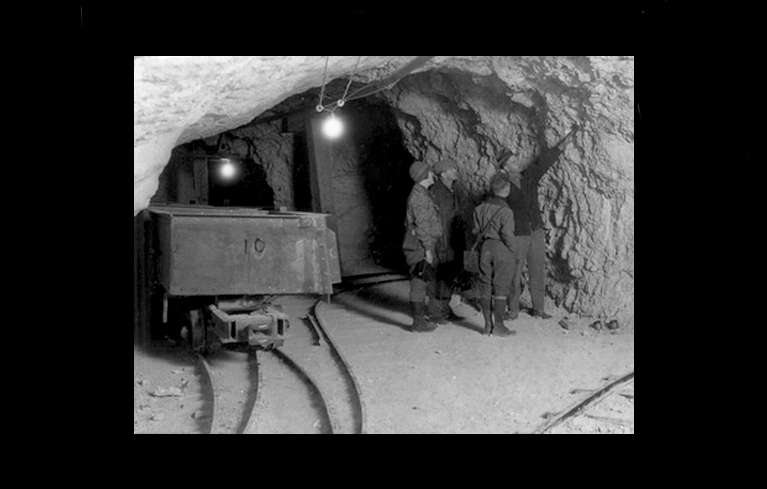
Pacific Coast Borax Widow Mine in Ryan, circa 1928. Photo/Burton Frasher
In dorm rooms, you can peer through cracked, tattered window shades that have held back the sun for generations. Outside, you walk by rusty ore carts, wheelbarrows, picks, shovels and other relics. Up a steep hill is a rare treasure: a much-weathered weather vane once photographed by Ansel Adams.
Four years ago, all of this nearly became part of Death Valley National Park as a gift from London-based Rio Tinto, the third-largest mining company in the world.
But in a surprising turnabout, Rio Tinto chose instead to give Ryan to an entity it felt could better care for the site: a fledgling nonprofit – the Death Valley Conservancy – headed by one of the company’s own executives.
Park visitors who long had dreamed of touring Ryan were dismayed. So, too, were park managers.
“I was very disappointed,” said J.T. Reynolds, a former Death Valley superintendent who worked with Rio Tinto in 2007 to make Ryan part of the park. “It would have served many people, many organizations and the best interests of historic preservation.”
What’s unfolding here is more than a story about the curious fate of a remote mining camp in the hottest, driest corner of America. It is part of a wider debate about how best to protect historic resources across the West in an era of limited and declining government resources.
Already much has been lost. One example lies inside Death Valley National Park, where someone has chiseled into a rock wall in an attempt to steal American Indian petroglyphs, defacing the area forever.
In one of the most brazen cases, thieves used power saws, ladders and generators last year to steal centuries-old petroglyphs from federal land north of Bishop. Although the rock art has been recovered, no arrests have been made.
“It’s akin to someone defacing part of the Vatican or damaging an important artistic piece, like the Mona Lisa,” said Greg Haverstock, an archaeologist with the U.S. Bureau of Land Management. “A few greedy, self-minded individuals destroyed an amazing, finite resource.”
His budget to monitor and protect such sites across 750,000 acres of public land is $52,000 – seven cents an acre. “It is just not a lot of money,” Haverstock said. “It forces me to seek outside sources of funding.”
Many historic mining sites are at risk, too – and that’s one reason Preston Chiaro, president of the Death Valley Conservancy, cited in explaining why he believes Ryan should remain private.
“The fact that it’s been in private hands rather than part of the national park has been one of the things that has helped to preserve it,” said Chiaro, Rio Tinto’s group leader for technology and innovation. “There is a proven model here. It works. Why would you want to change it?”
But private ownership of historic treasures also raises questions: Who will have access? Under what conditions? What will it cost? How will tax-deductible contributions be spent?
“Once a site gets into private hands, there is really no control of it,” said Michael Newland, past president of the Society for California Archaeology. “You are at the good graces of the (owners). Some people are fantastic. Some may not be.”
As the donation nears completion, some have asked the conservancy tough questions, in writing, about its budget, management and plans. They have learned little.
“I got one reply to four letters saying they have every right to do with this property whatever they want to do and furthermore, they have no time to talk to me,” said Steve Bruce, member of a group called Save Ryan.
“As a public charity taking public money, they have a responsibility to respond to the public,” Bruce added. “It’s very frustrating.”
An outpost in the wilderness
There is one thing on which all agree: In a region peppered with old mine shafts, shacks and diggings, Ryan is a remarkable place, an outpost of culture and rustic comfort in a harsh, unforgiving wilderness.
It began humbly, with a cluster of cabins, lean-tos and dugouts at the base of a dark cliff overlooking Death Valley. “A stranger would have been amused to see the heads pop up all over the place like prairie dogs when the warning whistle blew before breakfast,” wrote mine superintendent Harry Gower in a memoir: “50 Years in Death Valley – Memoirs of a Borax Man.”
But like the cactus that clings to canyon walls, Ryan would blossom into something special.
Down a narrow, winding rail line came the heavy timber, wood stoves, concrete, bed frames, mattresses, wash basins, electrical wire, tools, windows, medical supplies and other building blocks of civilization.
Ryan was never large – just a few dozen buildings that housed 150 to 200 people, including some wives and children. But for a company town – it was owned by Pacific Coast Borax – it was surprisingly well furnished.
There was a hospital, schoolhouse, post office, general store, two bunkhouses, even a community hall where residents gathered to watch silent movies – a vast improvement from the early days when miners scraped borax off the Death Valley floor and hauled it to market in mule-drawn wagons.
After mining stopped in 1928, Pacific Coast Borax retooled Ryan into a tourist attraction: the Death Valley View Hotel. Visitors rented rooms, played tennis and rode the “baby-gauge” rail with its jaw-dropping views of the valley.
Pacific Coast Borax didn’t just promote Ryan, it protected the site with a full-time caretaker, a practice continued by U.S. Borax and Rio Tinto. Though some buildings are deteriorating, others are in great shape. Even the train engine that once carried tourists is kept in working order, though it is no longer used.
“It’s just like going back in time,” said Linda Greene-Smith, former chief of resources management at Death Valley National Park. “This place has really been lovingly cared for. It’s a treasure.”
Two Pacific Coast Borax executives, Stephen Mather and Horace Albright, even joined the National Park Service. As its first two directors from 1917 to 1933, they called for protection of Death Valley, which was declared a national monument by President Herbert Hoover in 1933. It became a national park in 1994.
Albright’s daughter, 91-year-old Marian Schenck, said that before her father died in 1987, he told her he felt Ryan belonged in the park.
“It would be ridiculous not to bring it in,” Schenck said. “The whole (park) concept came from borax. When you don’t include Ryan, it’s eliminating a big part of it.”
Decision stunned park officials
In 2008-09, a donation to the park was close. Rio Tinto officials met with Death Valley officials. Park officials prepared planning documents and a legislative plan for Sen. Dianne Feinstein, D-Calif.
Rio Tinto put together a color fact sheet titled “Public benefits of the Ryan Camp donation.”
“Donating Ryan Camp is a natural step in the long partnership between Death Valley National Park and the company who was instrumental in its creation,” the fact sheet reads.
“With the addition of Ryan Camp … the complete historic continuum of borax mining within Death Valley would be preserved.”
But in 2009, the plan was dropped after Chiaro met with Rio Tinto officials, including its CEO, and persuaded them to donate Ryan to the Death Valley Conservancy.
“We believe that the DVC shares our vision to preserve this unique facility,” said Rio Tinto’s spokesman, David Outhwaite, by email from London.
Asked recently about the decision, Death Valley spokesperson Cheryl Chipman said by email: “It is always up to the property owner whether they want to donate property to the park.”
At the time, though, officials were stunned.
“Very disappointing,” wrote Sarah Craighead, then superintendent of Death Valley, in a July 2009 email. “Lots of people, including the folks at Rio Tinto, worked a long time to get Ryan to the park service.”
Since then, the park and Rio Tinto have remained quiet, kindling interest, speculation and numerous requests for information from the conservancy.
“If you go to them asking for details, asking for facts – one of my questions is, where is their money actually coming from? – their response is ‘we don’t have the time to deal with you,’ ” said Bruce with the Save Ryan group.
Chiaro said his organization’s reticence is rooted in online speculation and criticism from Bruce and others that he feels are ungrounded.
“The human reaction when you are being attacked is to defend yourself,” Chiaro said. “I suppose we did some of that. That’s not maybe our proudest moment. But I think that’s a bit of human nature.”
The real reason for keeping Ryan private, Chiaro said, is that he believes the conservancy can better protect it.
“It’s not that the Park Service wouldn’t care about the site and treat it with respect,” he said. “I don’t think they have the vision for it. I don’t think they have the money.”
Reynolds, the former superintendent, disagreed.
“The Park Service is the caretaker of the country’s cultural history,” he said.
“You could have had a world-class historic preservation training program,” Reynolds said. “We could have employees in historic and period dress. It was endless. You could have that whole area as your classroom.”
Chiaro said the conservancy has similar goals and plans to work with the Park Service on ways to achieve them.
“We want more people to be able to share in this incredible piece of history that’s been preserved at Ryan, but we don’t want to damage it,” he said.
For now, Ryan remains closed to the public. And for Kathleen Knowler – whose grandfathers were Harry Gower, the man who helped carve Ryan out of bare rock, and Horace Albright, who was director of the National Park Service from 1929 to 1933 – that is unfortunate.
She recalled visiting Death Valley a few years ago with her daughter, hoping to see Ryan, only to discover it was off-limits.
“It was very disappointing not to be able to get there,” said Knowler, a first-grade teacher in Arizona. “That’s family history we can’t appreciate. It’s a really neat little mining town that should be part of the park service.”
Need help with your resume? A job application? Want to brush up on your interviewing skills?
Lake Tahoe Community College’s Library is hosting a free drop-in career clinic with consultant Michael Donahoe. The clinic is open to everyone.
The clinics will be from 1-3pm every Wednesday starting April 10 and lasting through June 26.
By John Branch, New York Times
SOCHI, Russia — The biggest worry among organizers for next year’s Winter Olympics is not whether the sites will be in order, or that the 30-mile road and the new railroad tracks and the thousands of hotel rooms all being built from scratch will be complete, or that the stands will be full of fans despite this city’s remote location.
The biggest worry is the one the Russians cannot control: the weather.
And they have plenty of reasons to worry.
The last Winter Games, in Vancouver in 2010, were bedeviled by unseasonably mild temperatures in British Columbia. Alpine ski races were persistently postponed because of fog and slushy conditions. Hidden hay bales took the place of snow to build mounds for various courses. A lasting image of those Games is that of helicopters ferrying buckets of snow to the snowboarding site.
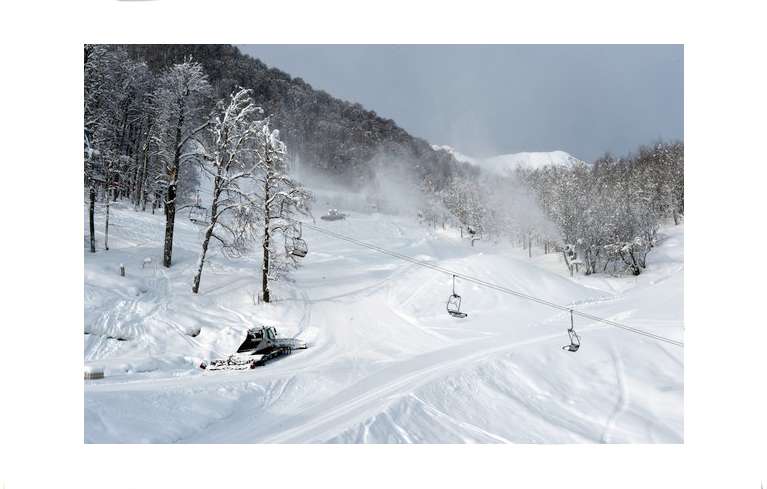 Sochi is more worrisome. This city of nearly 500,000, filled with palm trees and year-round flowers, hugs the shore of the Black Sea. Unlike Vancouver, where most of the outdoor mountain events were 90 minutes away around Whistler, the venues in the Caucasus Mountains are about 30 minutes away, up a winding canyon.
There is a plan, and it does not include helicopters and hay bales. Sochi organizers, fully aware of the problems in Vancouver, have installed what they say is the biggest snowmaking operation in Europe. More than 400 snowmaking cannons, each looking a bit like a jet engine, are continually spitting streams of crystals for next year’s Olympics.
On the advice of a Finnish company called Snow Secure, the goal this season is to stockpile 500,000 cubic meters of snow into 10 shady pockets above the venues. The massive piles will be covered by insulated blankets, not unlike giant yoga mats, to protect them from the heat of summer.
Up to half of the saved snow may melt by next winter, but the site managers said they could conduct the Olympics even in the unlikely event that no natural snow falls next winter. The stockpiled snow can be shoved down the mountain with snowcats or guided onto steep slides — pipes, a meter in diameter, cut in half — aimed at where the snow is most needed.
“Each venue in the mountains has its own peculiarities,” said Valeriy Lukjanov, whose job is to forecast the weather at the Sochi Games, perhaps the least appreciated task of them all. He sat in his office recently in the mountain valley where more than half of the events will take place.
“Last year, there was a meter of snow outside this window,” Lukjanov said.
One year from the start of the Sochi Games, there was none.
The places hosting the mountain competitions — not only the five Olympic sites, but also the ski resorts surrounding them — are mostly new, constructed since Russia was awarded the Games six years ago. Sochi has little experience in hosting world-class sports events, and little historical climate data is available to fully appreciate the weather possibilities.
With few exceptions, the weather stations have been in place only since 2010. What the Russians have learned since then is that the weather in the mountains above Sochi can be wildly unpredictable.
In February, World Cup snowboard cross and ski cross events were canceled because of a lack of snow, and other competitions at the Extreme Park were held amid criticism of slushy conditions.
Two years earlier, part of the European Cup Alpine skiing championships was canceled because of too much snow. Low clouds rearranged the schedule for last month’s Russian Alpine ski championships, an official test event. During the World Cup luge event in late February, it rained.
At the Olympics, unlike at test events, competitions cannot be canceled.
“During the Games, we will have more snow and we will have all the events,” Dmitry Chernyshenko, the president of the Sochi 2014 organizing committee, said in an interview last month. “We didn’t expect that the amount of snow we collected was not enough. So now we learned this lesson and paid the price.”
Chernyshenko and other Russian leaders boast of the compactness of the Sochi Games. The venues are divided into two clusters: “coastal” and “mountain.” The Coastal Cluster, next to the sea, is a ring of five arenas for indoor events, like figure skating, speedskating, hockey and curling. A sixth site is an outdoor stadium, intended for the opening and closing ceremonies.
The average high temperature in Sochi in February is about 50 degrees. An overcast sky is likely, and snow falls only occasionally. As if to demonstrate how unwintery Sochi is, in February the city hosted a national racewalking event — a rare sport from the docket of the Summer Olympics, contested at the time and place of next year’s Winter Olympics.
The weather in the city of Sochi is not the major concern of Lukjanov, the deputy director of the Russian meteorological service, who was assigned last year to be the chief meteorologist of the Olympics. He oversees a team of 50 dedicated to analyzing and predicting weather in the region through next February. The team includes 37 meteorologists. Most others are data technicians, helping assess the 50 remote weather stations that have been installed across the valley in the past three years.
Their primary job is to explore and forecast all possibilities, particularly in the sites that hang on high plateaus and dot the mountains above the valley floor, which is at an elevation of roughly 1,800 feet, or 500 meters. Although the new sites are so close as to look like a constellation on a map — getting from the valley floor to any of them takes no more than about 15 minutes — they sit at widely varying altitudes. Each has its own climate vagaries.
In February, whether one stood at the valley floor or took a gondola up to the highest reaches of the jagged, frosted peaks, the quandary was thrust into sharp relief: the mountains looked striped, horizontally, as if with giant paintbrushes. There was a white ribbon sweeping across the upper regions above timberline, a brown swatch closer to the valley floor, and an earthy mix between, where rain and snow and fog mingled daily in a climatic tug of war.
The RusSki Gorki Jumping Center, easily spotted near the valley road, sits at about 2,000 feet (610 meters), between two ridges that protect the two jumps from wind. But last month, no snow had accumulated there, and some training was canceled by heavy rain. Part of the surrounding slopes was being reinforced because of problems with mudslides.
Nearby, the Sanki Sliding Center, the home of luge, bobsled and skeleton, rests on a plateau at about 2,300 feet (700 meters). Most of the track is covered, so weather may not hamper competition. But it seems to sit in a transition zone. Last month’s World Cup events took place amid mostly fog and rain. A year earlier, the track was smothered in deep snow.
The Extreme Park, for snowboarding and free skiing events like the halfpipe, moguls and slopestyle, is an intimate place snuggled into a hillside at 3,280 feet, or 1,000 meters. Above-freezing temperatures can play havoc with the halfpipe, and a lack of snow can hamper the long, winding courses for snowboard cross and ski cross.
Across the valley is the Laura Cross-Country Ski and Biathlon Center, two stadiums on a shelf at 1,500 meters, about 4,920 feet.
“Starting from 1,500 meters, there is always snow,” Lukjanov said. “Always.”
The most vexing site, as usual, will be for Alpine skiing at the new Rosa Khutor resort. The men’s downhill will begin above timberline, at roughly 2,000 meters (6,560 feet), and end at the common finish area, at 940 meters (3,084 feet). The worry, as with most courses on the World Cup circuit, is that there will be too much snow at the top, low visibility because of clouds along the way, maybe some rain and too little snow at the bottom.
“Vancouver had problems with snow,” said Sergei Estrin, the venue manager for Alpine skiing. “We try to analyze the experience of the previous Games. That’s why we have the backup plan with snow in storage. That’s why we give a lot of attention to the possible problems and we try to solve it in advance.”
A few miles and about 1,800 feet below, on the second floor of a small house in the valley, the Olympic forecasters are monitoring the weather with a series of computers.
Asked if he has been told that he better supply good weather to the Games, Lukjanov smiled.
“Sometimes, they don’t like the weather, so they blame the forecaster,” he said, describing a universal problem for meteorologists. “For us, the most important thing is to give the right forecast.”
The Commission on Aging is looking for additional members.
The commission acts in an advisory capacity to the Area Agency on Aging and the El Dorado County Board of Supervisors on matters concerning senior residents.
The commission focuses its efforts on such issues as the following:
Applicants are being sought from all areas of the county. Preference will be given to those applicants who are 60 years and older.
The deadline for submitting an application is May 10.
For additional information, and/or to obtain a membership application, contact Janice Haney at (530) 642.7276 or janice.haney@edcgov.us.
Chevy’s Taco Bar & Easter Egg Hunt on March 28 from 4:30-7:30pm benefits CASA El Dorado.
The $10 tickets are available in advance and at the South Lake Tahoe restaurant. CASA-kids are invited to attend for $5; children under 3 are free. To reserve a ticket in advance, call (530) 573.3072.
Wear your Easter Bunny Best and bring a basket to gather goodies.