Opinion: A challenging economy in California

By Dan Walters, Sacramento Bee

Coincidentally, three otherwise unrelated events last week framed California’s somewhat clouded economic situation.

One was a revelation that the state now is tied with Rhode Island for the nation’s highest unemployment rate, 9.8 percent.

Although employment surged in California last year, with about a quarter-million new jobs, and the jobless rate had dropped by more than two percentage points from its high-water mark, more than 1.8 million workers are still without jobs. And outside the immediate Bay Area the picture is especially grim, with jobless rates hitting nearly 30 percent in some rural counties.

Dan Walters

Dan Walters

The second event was release of a study by researchers at USC on the state’s potentially huge deposits of shale oil that, they said, could spark an economic boom in the state, as it has in other states.

Exploiting shale oil could create from a half-million to more than 2 million jobs, increase personal income sharply and spark a multi-billion-dollar surge in tax revenues, the study said.

The third was release of the latest annual update of the Tax Foundation’s state-by-state comparisons of tax burdens, indicating that Californians are bearing some of the nation’s highest taxation loads.

We were fourth highest at 11.2 percent of personal income in 2010 and since then, we’ve hiked sales and income taxes that would add nearly another half a point to that rate. Yet, despite those heavy taxes, state and local governments continue to struggle with chronic budget deficits and long-term obligations for pensions, retiree health care and bonded debt.

And there it is.

After three booms (defense, technology and housing) and three busts in the last three decades, California’s economy continues to sputter. Two new economic forecasts, one from UCLA’s Anderson School and another from California Lutheran University, see only incremental and slow recovery from what had been the worst recession since the Great Depression, with relatively high joblessness for years to come.

Meanwhile, we’re seeing a strong outflow of job-seeking Californians to other states, especially those whose economies are humming, such as Texas, thus reducing our stock of educated and high-skill workers.

It’s not a pretty picture, and while Gov. Jerry Brown dismisses those who question the state’s prospects as “declinists,” he and other Capitol politicians pay nothing more than lip service to making the state a more attractive venue for job- creating investment.

The oil shale situation is a big test. Are we willing to exploit – albeit with appropriate environmental safeguards – our vast reserves of oil, or will we continue to cross our fingers and hope that somehow, some way, California will recapture prosperity by osmosis?


Tourism forum to focus on international and young travelers

Because tourism is a constantly evolving industry each year, the Lake Tahoe South Shore Chamber of Commerce and Lake Tahoe Visitors Authority strive to keep the business community up to date on developing trends by hosting an tourism forum.

This year’s forum is April 18 from 3:30-6pm in the Cabaret Theater at Harveys in Stateline.

Building off last year’s presentations on local demographics, the 2013 Trends in Tourism Forum will cover the international guest along with service philosophies and what these culturally sophisticated visitors expect and demand.

The forum guest speakers are Caroline Beteta, president-CEO of Visit California and board chairwoman of Brand USA, who will speak to international expectations. Beteta is responsible for implementing Visit California’s $50 million marketing plan.

The second guest speaker, Denise Pirrotti-Hummel, will be building on Beteta’s presentation to heighten the awareness of the changing visitor – one who is younger, as well as one who is more diverse ethnically and culturally.

After the forum, guests will have the opportunity to mix and mingle at the Cabo Wabo Cantina inside Harveys. The Business After Hours Mixer will take place from 6-8:30pm and will feature appetizers, drinks, raffle prizes and relationship building opportunities.

Tickets to the forum are $15 for members and $25 for prospective members and include entrance to the BAHM. Reserve a space in advance online, or email Emily@tahoechamber.org, or call Emily Abernathy at (775) 588.1728, ext. 303.


No. 1 tenor sax player in state from North Tahoe High

Shasta Tresan, along with freshman John Humphreys, both of North Tahoe High School, received the great distinction of being accepted to play in the California All State Honor Band in Fresno.

They were chosen based on their auditions. Of 1,600 who auditioned, 300 students were chosen to participate with the best of the best in the state.

In Fresno, they auditioned and were picked to play in one of three bands, seated by ability. Tresan earned the honor of playing first chair tenor sax player in the top band at All State Honor Band.

Tresan started playing baritone saxophone in 8th grade. Tresan was accepted into the Honors Performance Series Honor Band, a national honor band that played in New York at Carnegie Hall, playing the bari sax. She just switched to tenor saxophone her junior year.

Recently, Tresan received a large scholarship offer to attend Ithaca College in New York.

Tresan said in a statement, “I’m so excited to see how supportive Truckee and Tahoe are being of my musical achievements. It’s truly exhilarating.”


Feds trying to help wildlife adapt to climate change

By Neela Banerjee, Los Angeles Times

WASHINGTON — The Obama administration Tuesday announced a nationwide plan to help wildlife adapt to threats from climate change.

Developed along with state and tribal authorities, the strategy seeks to preserve species as global warming alters their historical habitats and, in many cases, forces them to migrate across state and tribal borders.

Over the next five years, the plan establishes priorities for what will probably be a decades-long effort. One key proposal is to create wildlife “corridors” that would let animals and plants move to new habitats. U.S. Fish and Wildlife Service Director Daniel M. Ashe said such routes could be made through easements and could total “much more than 1 million acres.” The plan does not provide an estimate of the cost.

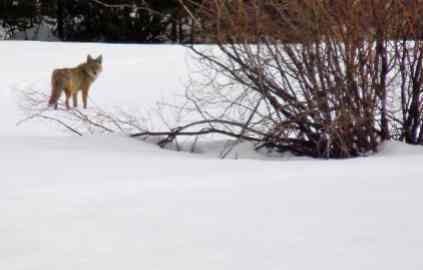
A Tahoe coyote. Photo/LTN file

A Tahoe coyote. Photo/LTN file

The effects of climate change are already apparent, the plan notes. Oyster larvae are struggling off the Northwest coast. In the Atlantic, fish are migrating north and into deeper waters. Geese and ducks do not fly as far south. In the West, bark beetles destroy pines because winters are not cold enough to kill infestations.

The plan, called the National Fish, Wildlife and Plants Climate Adaptation Strategy, does not prioritize species to target, although “the polar bear is the poster child” of wildlife threatened by global warming, Ashe said.

But efforts have already begun to protect wildlife. The lesser prairie chicken in the Great Plains, for instance, also faces threats from mining, oil production, farming and ranching. Climate change models estimate that the chicken’s habitat could undergo a 5-degree Fahrenheit rise in temperature and a drop in precipitation by 2060.

The federal government already pays ranchers and farmers to remove land from production to create wildlife refuges. If native prairie were restored to 10 percent of that land, according to one analysis, that could offset the prairie chicken’s projected population decline.

Recently, some state-level efforts to adapt to global warming have been stymied by politicians who reject climate science. In North Carolina, for instance, planning to build infrastructure along the coast that could withstand storm surges worsened by sea-level rise has been delayed. State politicians dismissed scientific models that predicted the rise by the end of the century.

But efforts to help wildlife adapt have not provoked a backlash so far, state and administration officials said in a conference call.

“With coastal communities, there are challenges with coral populations, with changing dynamics in fish population,” said Eric Schwaab, assistant administrator for fisheries at the National Oceanic and Atmospheric Administration. “So people are less focused on why and more focused on what’s next.”


Writers group sets April meetings

Tahoe Writers Works, a local writing group, will be hosting writing workshops throughout 2013. The workshops will be at Bona Fide Books, 1069 Magua St., No. 4 in Meyers.

Beginning and established writers are welcome. There is no obligation other than an exceptional love of the written word.

April workshops will be April 2 at 6:30pm, April 16 at 6:30pm, and April 30 at 6:30pm.

Tahoe Writers Works, established in 2006, is a nonprofit organization based in Lake Tahoe and Reno. The group publishes EDGE, an annual literary journal that features provocative fiction, poetry, essays, and art, from artists both local and global. Volume 7 is due for release in 2013. TWW also organizes events to create a stronger literary and arts community, including the Murder Mystery Dinner Theater at Valhalla and Celebration of Writers Around the Lake.

For more information about Tahoe Writers Works, go online.


Heavenly fined for hazardous waste infraction

By Kathryn Reed

A 2010 state inspection of Heavenly Mountain Resort’s upper shop facilities determined the ski resort was not in compliance with hazardous waste regulations.

“There was no accident, spill or release that triggered this. It was about the containment facility not being up to code,” Russ Pecoraro, spokesman for Heavenly, told Lake Tahoe News.

Violations included:

• Lack of controls to prevent spillage and overflow of the used-oil tank.

• Failure to have a tank holding used oil assessed and inspected.

• Failure to provide refresher training to the emergency coordinator managing hazardous waste.

• Failure to maintain secondary containment for the used oil tank, and failure to provide secondary containment to pipes connected to the tank.

At no time was Lake Tahoe threatened or any other water source on the mountain, according to Pecoraro.

The infractions resulted in the resort paying the Department of Toxic Substance Control $94,000 in fines and $26,000 to reimburse the state for its costs.

Prior to the fall 2010 inspection Heavenly had not been advised that it needed to make changes to the waste oil containment section of the site. The other part of this site is a fuel station. But the two have different overseers from the state.

“We did not know we were out of compliance,” Pecoraro said.

When the facility was built in the early 1990s it met the regulations of the day set by El Dorado County, Lahontan Regional Water Quality Control Board and the U.S. Forest Service.

But rules change.

Besides now being in compliance, Heavenly says it has a better, open dialog with the state so something like this should not happen in the future.

—-

Here is a copy of the Heavenly settlement.


Barely any snow to measure in Sierra

By Kathryn Reed

PHILLIPS STATION – No snowshoes or skis needed. Unable to make the final measurement because the snow stopped and the stream began. Dirt and grass.

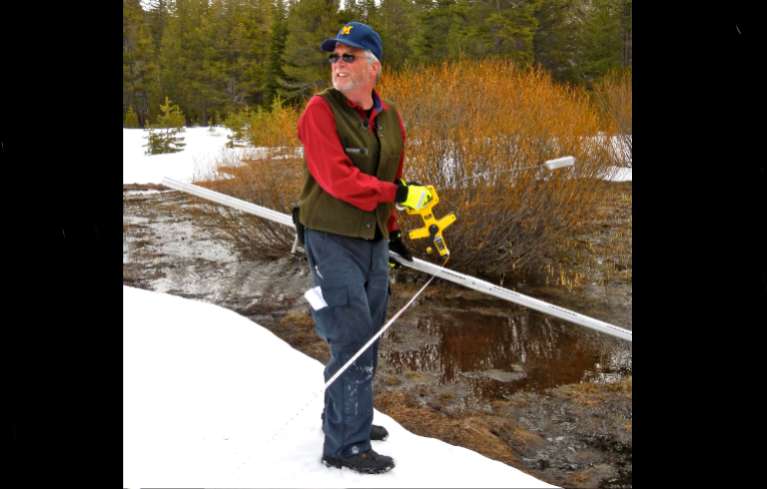
The combination of the above conditions made the results of Thursday’s snow survey near Echo Summit anticlimactic. Frank Gehrke with the state Department of Water Resources walked through the snowfield that in places didn’t contain snow.

He came up with an average snow depth of 13 inches that accounted for 6.1 inches of water content. This makes it 32 percent of average for this time of year.

Frank Gehrke runs out of snow to measure on March 28 near the entrance of Sierra-at-Tahoe. Photo/Kathryn Reed

Frank Gehrke runs out of snow to measure on March 28 along Highway 50 just west of Echo Summit. Photo/Kathryn Reed

Statewide, the snowpack is 52 percent of normal.

Snowpack is supposed to be at its peak right now. Instead, it has been diminishing since the December storms.

Holes from last month’s survey of where the metal device is plunged into the snow were still evident.

With the lack of precipitation throughout the state, this makes for the driest first quarter on record. And while it’s not unusual to have one month that is dry, to have three consecutive months is what is alarming.

“We can’t rule out there will be a good April. But it would have to be a deluge,” Gehrke said.

And to get the numbers to historic averages, it would mean 22 inches of rain for April. This equates to about 220 inches of snow.

“You probably don’t want that to happen,” Gehrke said.

The dim bright spot in news coming out March 28 is that the reservoirs on average are 95 to 97 percent full.

Most water users – ag and domestic purveyors – look two years out when it comes to figuring out how to meet their needs. These users were notified last week that their deliveries would be cut.

The runoff from the Sierra snowpack is what fills the reservoirs around the state. That water is then sent downstream to be used as irrigation for crops and drinking water for others.

And reservoirs that aren’t full impact recreation as well as fisheries.


Fire danger in Sierra increasing?

Frank Gehrke with the Department of Water Resources talks March 28 about whether the lack of snow this winter will bring a greater threat for wildfires this summer in California.


Squaw, Alpine use Green Bucks to help environment

Squaw Valley and Alpine Meadows have joined with Tahoe Fund and Truckee River Watershed Council to help launch the Green Bucks program.

Green Bucks is a dollar donation program designed to harness the passion of visitors and residents in order to help care for the region’s environment. Squaw and other local businesses have committed to collecting dollar donations on room nights, season passes, lift tickets, golf rounds and other items to help improve the area’s natural environment.

“In conjunction with our company’s commitment to the environment, we have made two $25,000 donations to both the Truckee River Watershed Council and the Tahoe Fund, and we are asking guests to contribute one dollar on the purchase of lodging reservations or a season pass via the new Green Bucks program,” said Andy Wirth, president and CEO of Squaw Valley and Alpine Meadows.

Proceeds from Green Bucks support the Tahoe Fund, the Truckee River Watershed Council and other public and nonprofit organizations in the region. These organizations fund projects that will improve, enhance and restore watersheds, hiking and biking trails, and environmental stewardship programs.

Green Bucks will support:

  • Miles of hiking, biking and ADA-accessible trails
  • Access for swimming, kayaking, canoeing and stand-up paddle boarding
  • Open spaces for wildlife habitat and scenic views
  • Restoration of rivers, lakes, meadows, wetlands, forests
  • Protection of fish and wildlife habitat
  • Boating and fishing access
  • Landscaping and trail re-alignment to prevent runoff
  • Signage and interpretive displays to guide visitors
  • Monitoring of water quality.

Local businesses may call (530) 550.8760, ext. 7 to sign up to participate in the Green Bucks program.


Controlled burn next week in Hunter Creek area

North Lake Tahoe Fire Protection District’s fuels crew will continue the hazardous fuels reduction project in the Hunter Creek area the first week of April, weather permitting.

This project is a cooperative effort between North Lake Tahoe Fire Protection District, Reno Fire Department, Truckee Meadows Fire Protection District and Washoe County Parks Department.

This 8-acre slash pile project was created as a result of a hazardous fuels reduction and defensible space project over the last year, to help minimize the risk of wildland fires in the area.

The project’s safety plan calls for cancellation of the controlled burning based on weather conditions each day, such as significant wind activity or precipitation. The burning piles are expected to produce smoke that may be visible throughout the area. Smoke resulting from the pile burns will affect the surrounding areas for approximately 24-36 hours.

People that are smoke sensitive are advised to please stay inside and close their windows and doors as much as possible until the smoke dissipates.

For further information, call (775) 831.0351, ext.0.