Climate change will increase extreme precipitation levels

By Bettina Boxall, Los Angeles Times

Rainfall or snowfall dumped by the most intense storms could grow significantly heavier in most of the United States by the final decades of the century, according to a climate change study.

The paper, written by a research team led by scientists from the National Oceanic and Atmospheric Administration, examines the effects of rising greenhouse gas emissions on factors that influence maximum precipitation.

The authors concluded that increasing atmospheric moisture will play the dominant role in ramping up rainfall intensity, which they projected using climate models.

As the Earth warms, sea surface temperatures rise, accelerating evaporation and increasing the amount of water vapor in the atmosphere. If greenhouse gas emissions continue at high levels, atmospheric water vapor levels will jump 20 to 30 percent in the final decades of the century, the researchers found.

That will push up maximum precipitation by a corresponding amount, with increases in the Western U.S. falling in the high end of that range, according to the paper, which has been accepted for publication in the journal Geophysical Research Letters.

“We have high confidence that the most extreme rainfalls will become even more intense, as it is virtually certain that the atmosphere will provide more water to fuel these events,” said lead author Kenneth Kunkel of the National Climatic Data Center.

Although the study focused on the U.S., the researchers said their conclusions applied to most areas of the globe.

They warned that the projected increases would raise the risk of damaging floods. “The long lifetimes of dams and similar structures ensures that they will experience the impacts of future climate change,” the authors wrote.

Ignoring the expected effects of climate change, they added, “is likely to lead to a false sense of security.”


Snow Golf Tourney at Alpine Meadows

Alpine Meadows’ 30th anniversary Snow Golf Tournament will tee off at 9am April 13 at the top of the mountain off the Summit Express chairlift.

As featured on the Golf Channel, this highly anticipated spring event is the only mountaintop snow golf course around. It’s skiing or snowboarding combined with golf.

The nine-hole course starts at the top of the Summit Express chairlift off of Sunspot and weaves its way down the mountain to the bottom of Alpine Bowl Chair. Players are provided scorecards, pencils, clubs and tennis balls. All competitors must be wearing skis or a snowboard to navigate from hole to hole, but are allowed to remove one foot to drive, chip and putt. Winners will receive prizes including golf rounds at Tahoe Donner Golf Course, Old Greenwood and Resort at Squaw Creek, in addition to Oakley goggles, a GoPro, Alpine swag and more.

Registration starts at 9am at the top of the Summit Express chair and is free (with a lift ticket or season pass). All scorecards will be entered into a raffle beginning at 3pm on the Sundeck. A live performance by Peter Joseph Burt & The King Tide will also take place on the Sundeck from 1-4pm.


NV Energy moving from coal to renewables

By Andrew Doughman, Las Vegas Sun

CARSON CITY — NV Energy rolled out a major policy initiative Wednesday, announcing that it will shutter its coal-fired plants, increase investment in renewable energy and create thousands of construction jobs over the next 12 years.

Under the plan, Nevada’s coal plants would begin closing by the end of next year, and the company would accelerate investment in wind, solar, geothermal and natural gas to replace the coal energy going offline. The company estimates the plan could result in a nearly 4 percent increase in rates over the next 20 years, and the proposed legislation would limit the Public Utilities Commission’s ability to approve the increases.

The utility unveiled the proposal it’s calling “NVision” on Wednesday at the Legislature as an amendment to Senate Bill 123.

 Sam Morris The coal-fired Reid Gardner Generating Station near Moapa is shown April 5, 2007. The spots near the smokestacks are “ghost” reflections of the lights on the plant, which can occur in digital cameras while shooting a point light source.

The coal-fired Reid Gardner Generating Station near Moapa. Photo/Sam Morris/Las Vegas Sun

“This does three things: it retires coal from Nevada, builds renewables, and it creates jobs,” said Tony Sanchez, NV Energy senior vice president.

The amendment calls for the accelerated closing of three of the four units at Reid Gardner, the controversial 553 megawatt coal plant in Moapa, by 2014. It leaves the fourth unit operating until 2017, after which the utility would have no coal plants operating in Southern Nevada.

Sen. Harry Reid, D-Nev., has relentlessly called for the closing of the plant, most recently during an address to the Nevada Legislature last month.

(Under the plan, the utility would not divest from its share of ownership in the Navajo and Valmy coal plants until 2017 and 2025, respectively.)

A state legislator familiar with the proposed amendment said NV Energy’s plan could position Nevada as a leader in renewable energy development in the wake of its divestment from coal.

“I applaud the utility in having the foresight and the courage to try to answer the questions about the future of coal in Nevada and their willingness to recognize that coal needs to be exiting stage left,” said Assemblyman David Bobzien, D-Reno, who chairs the Assembly Commerce and Labor Committee that could hear the bill if it passes the Senate.

Bobzien tempered his praise of the proposal with a cautionary note that legislators still need time to investigate the plan to see how the Legislature can achieve the goals of getting Nevada out of the coal business and firmly into the renewable energy business without adversely affecting industry and consumer interests.

“In the coming weeks the Legislature is going to have some questions about how we get there so that it’s done in a way that’s going to be predictable and stable for ratepayers,” he said.

In place of coal, NV Energy wants to invest in a 60-40 split of natural gas and renewables.

NV Energy would construct, acquire or contract for 600 megawatts of renewable energy in Nevada during the next five years.

The bill mandates that the utility own or operate 25 percent of that renewable energy.

This would be the first time the utility would own and operate renewable energy power plants, Sanchez said.

The company would also construct or acquire and own 1,000 megawatts of natural gas during the next five years and 1,000 more megawatts in the next 10 years with construction or acquisition intended to be in-state.

The amendment also calls for the construction of natural gas pipelines and transmission lines to hook the new power plants into the grid.

The construction projects would bring about 4,700 construction jobs to Nevada and would result in about 200 permanent operations and maintenance jobs at the facilities.

NV Energy said it does not anticipate any layoffs from Reid Gardner because employees will be involved in ramping down the plant and could transition to new jobs at new facilities, said Rob Stillwell, spokesman for NV Energy.

All this comes at a cost to the ratepayer.

“NVision has an estimated compound annual growth rate in electricity prices of 1.65 percent, which includes the effects of inflation,” according to an NV Energy statement released to the Las Vegas Sun on Tuesday.

The utility’s amendment would call for the Public Utilities Commission of Nevada to review the plan upon legislative approval. The commission would have 210 days to review the plan, considering among other things that the cost is “just and reasonable in light of the elements of the plan,” according to a copy of the amendment obtained by the Las Vegas Sun.

The commission does not appear to have the ability to reject the plan; the amendment instructs the commission to “approve or modify” the utility’s proposal.

The utility would also charge ratepayers to recover all “just and reasonable” costs of renewable energy construction, maintenance, and operation.

NV Energy would also be able to recover costs for closing coal plants, including charging for unused coal inventory, contract termination, and decommissioning and remediation costs.

Such rate hikes would automatically begin on the first day of the next financial quarter after they were enacted.

The Public Utilities Commission could retroactively review rate hikes permissible under the plan during the next general rate case, a reversal of the current practice in which it reviews such rate increases before they take effect.

The wide-ranging amendment also covers several significant changes to the state’s Renewable Portfolio Standard, its renewable demonstrations programs and its net metering program.

The bill also mandates that the Nevada Department of Environmental Protection oversee the closure and remediation of its coal plants, a job that would have gone to the Southern Nevada Health District under current law.


Scholarships available from Liberty Utilities

Liberty Utilities has established annual academic scholarships for eligible high school and college students within its service territory.

The seven schools participating in the new scholarship program are South Tahoe High School, Loyalton High School, Douglas High School (students residing in Alpine County only), Coleville High School, North Tahoe High School and Portola High School, as well as Lake Tahoe Community College.

High School seniors must have a minimum unweighted GPA of 2.5 and be accepted to an accredited four-year or two-year university or college or an accredited vocational school. They also must have some community service experience in the community which they reside. The scholarship amount is $250.

Lake Tahoe Community College students are eligible for the scholarship if they have a current 2.5 GPA or higher, and have completed at least 18 quarter units at LTCC. They must be enrolled in LTCC’s upcoming fall quarter, and have demonstrated leadership through school and/or community service experiences within the community they reside. The scholarship amount is $500.

Interested students should contact their school’s financial aid office or counselor to find out more about the scholarship and to obtain an application. The individual schools have different deadlines, but all scholarships will be awarded mid-May through the end of June.

Liberty Utilities representatives will attend the school’s awards ceremonies to present the deserving students with their scholarships.


Ski report: It’s a goggle day

ski report logoThere is a chance of isolated snow showers above 6,500 feet. Winds will be light to moderate.

Take good goggles today.

Here is the April 6 ski report.

— Curtis Fong


CHP driving class for teens at STHS

Start Smart is aimed at helping newly licensed and future licensed teenage drivers become aware of the responsibilities that accompany the privilege of being a licensed California driver. The program was created in an effort to preemptively reduce the incidence of teen injuries and deaths resulting from motor vehicle collisions.

Teen drivers and their parents/guardians are invited to attend and participate in Start Smart class.

The next class will be April 23 from 6-8pm at the South Tahoe High School Student Union. All classes are free and last approximately two hours.

To reserve a space, contact the California Highway Patrol at (530) 577.1001.


Chateau project team being reassembled

By Kathryn Reed

Joe Stewart with SMC Contracting put in the concrete and rebar at the convention center project in South Lake Tahoe. His crew is ready to resume work.

Pete Joseph was ready six years ago to move his McP’s Pub into a much larger building that would sit near the corner of Highway 50 and Stateline Avenue. He’s still ready to move.

MBA Architecture and Design in Reno came up with the original plans for what is still being called the Chateau project and they are back in the game today figuring out what the next phase will look like.

Randy Lane with the now bankrupt Lake Tahoe Development Company was to develop the $400 million project. Today he is offering advice to Bill Owens, who now owns the majority of the 29 parcels that make up the nearly 11-acre site.

The original rendering of the Chateau project by MBA Architecture and Design.

The original rendering of the Chateau project by MBA Architecture and Design.

Lew Feldman, the attorney who represented Lane, is now advising Owens.

It was the South Lake Tahoe City Council of Hal Cole (he was mayor), John Upton, Mike Weber, Ted Long and Kathay Lovell who on July 11, 2006, approved the owner participation agreement. This was the contract for what was to be the largest development in the city limits. It included two condo-hotels, a 93,000-square-foot convention center and about 57,000-square-feet of retail space.

Next week city officials and the latest project proponents are going to have a sit-down about the next steps. The Owens group has submitted plans the city keeps calling incomplete.

While council members would not normally have to sign off on modifying the number of phases when a permit has already been issued for a project, they have requested to do so after the planning commission takes action. Cole will get to vote again. Joining him are electeds Tom Davis and Brooke Laine, who with their pasts, are well versed on projects in that area. New to voting on items in this location are Councilwomen Angela Swanson and JoAnn Conner.

The plan is to develop about 20,000-square-feet of retail and 9,000-square-feet of food and beverage that will mostly span Highway 50, but will go down Stateline Avenue a bit, too. The section is a bit triangular, with the point being at the west side before McP’s Pub. It will be divided on the highway by a driveway that will access the underground parking.

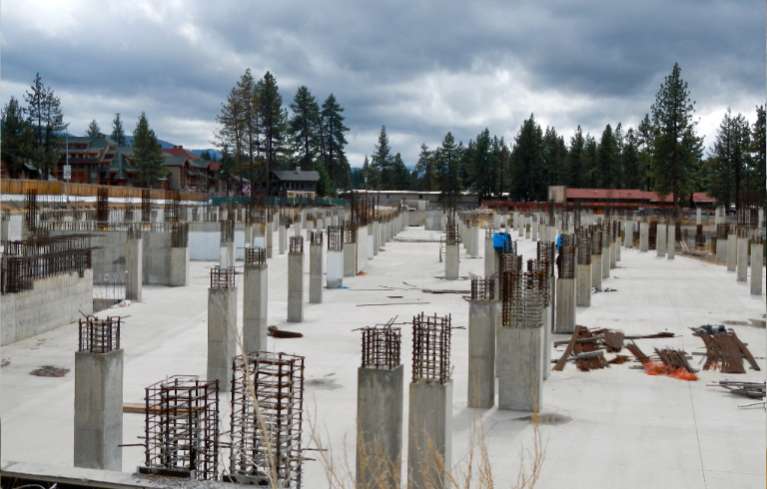
The concrete that is there is the floor of the garage. While the original plan never had enough parking spaces for the entire project, a bit of irony is that this phase being proposed would have more parking than should ever be needed.

Back in the day, Jim Marino who is now capital improvements project manager for the city, and Hilary Roverud, who now runs the planning department, told the council it should not approve the project because the parking plan was inadequate. The electeds ignored the professional advice.

On the day the OPA was signed then Redevelopment Agency Manager Gene Palazzo said a performance bond was still needed.

The official city minutes from that meeting say, “Palazzo explained that in the event the developer were unable to finish the project, the performance, labor and materials bond provide the ability for the city to step in and get the project completed. Palazzo noted that this item was not included in the agreement and required resolution.”

Someone dropped that ball and was never held accountable for never securing that performance bond.

Also in the minutes from that meeting is talk about the Highway 50 tunnel.

The minutes say, “Palazzo remarked that per the OPA, the developer was required to construct the underpass tunnel connecting Project 3 to the Park Avenue Project; however the OPA only required that the developer maintain onsite improvements, of which the tunnel was not a part. Palazzo noted that this item was not included in the agreement and required resolution.”

Promises evaporate with redevelopment agency

While the OPA is a rather thick document, it is now useless. City Manager Nancy Kerry explained because it was an agreement between the developer and the city’s Redevelopment Agency it ceased to exist as a legally binding document when the state dissolved the Redevelopment Agency.

So, while the permits from the city and Tahoe Regional Planning Agency are in effect, there is no contract. This means inadequate parking will be an issue at full build-out and that there is no way other than crosswalks at Stateline and Friday avenues to get from the Chateau site to Heavenly Village. This means crossing a five-lane state highway.
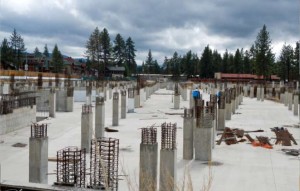
Work on the hole could begin in three months. Photo/LTN

Work on the hole could begin in three months. Photo/LTN

It also means what was supposed to become a city-owned convention center is now likely to be a privately operated conference center. Through the Redevelopment Agency and tax increment the city was going to have money invested in the original Chateau project. It was guaranteed to have access to the convention center for a predetermined number of days. That is out the window even though Kerry would like it to be a negotiating point when appropriate.

She doesn’t understand “how any city manager could allow this to get to the condition it is because a consolidated parcel map would have been standard.” (Dave Jinkens was city manager when the OPA was signed, when construction began, when work ceased and when LTDC filed bankruptcy.)

Going forward

Construction is expected to begin in July, sources told Lake Tahoe News.

Before any of that happens, though, the city needs to receive a plan from the developer that is complete.

Kerry said she isn’t going to cut corners. She isn’t going to let work resume without these seven affected parcels being consolidated into one map. She is going to insist on a performance bond.

“Nothing occurs until we see documents of ownership,” Kerry told Lake Tahoe News.

Stewart, the contractor, has been talking with Owens, but as of today a contract has not been signed. That would be a bit premature without having received the city’s OK to start again.

“Rumors have been going on since the day they shut that down. I’ve never felt very confident anything would happen on that job until now,” Stewart told Lake Tahoe News.

In addition to putting in the foundation for the Chateau project, SMC built most of the retail at Heavenly Village as well as the transit center next door. SMC also built the Tamarack Lodge at Heavenly, Zephyr Lodge at Northstar and all of the new buildings at South Tahoe High School.

Stewart said it wouldn’t be weird to work on a small portion of what will be a larger project. He likes the idea of having a large area for staging.

“The hardest will be along Highway 50 that we would be doing this year. Being able to focus just on that is nice from a contractor’s standpoint,” Stewart said.

McP’s also doesn’t have a signed contract in place. But Joseph said he’s been in touch with Feldman about his continued desire to occupy a much larger plot of real estate.

The two-story building that is proposed would be on the street level and below ground.

Joseph is familiar with change. Eminent domain forced him out of his spot across the street to make way for Heavenly Village. He was ready to move into the same spot that could be under construction this summer, but instead has been operating on an island of sorts for six years. McP’s is at the west end of the fence that surrounds the concrete and rebar.

He’s been in business for 10 years and wants to stay in Tahoe. If he isn’t part of the Chateau project as originally planned, he told Lake Tahoe News he doesn’t know what the future holds for him.

Joseph is banking on another move – just down the street.

“The building would have a lot more character and that would be helpful. There would be outdoor dining, fire pits, sliding windows from indoors to out,” Joseph said.

The roof design makes it look like a freestanding building.

In addition to the city, the developer needs to work out issues with Caltrans still.

Sidewalks and a streetscape that match what is at Heavenly Village are planned.

The city is going to insist the entrance from Cedar Avenue be more than driving through a construction site. It must be a safe, finished driveway.

“As you pull in off Cedar there will be some sort of wall treatment. You won’t have the sense you’ve been turned loose in an underground construction site,” Feldman said. Improvements to Cedar Avenue will also be made.

Feldman would not disclose the amount of investment Owens plans to make in this initial restart phase, but said it would be eight figures.

The theory is having something usable in the ground will spur someone to come in to develop the rest of the project.

The original project was supposed to be a hotel-condo project, but condos are not a sellable product today. But what the market may bear when someone comes in to build future phases remains to be seen; as well as what that person would want to do.

“There may be plan revisions. That’s not uncommon for a larger scale project to amend the permit to reflect changes in the marketplace,” Feldman said.

While there are ideas about the types of businesses that might occupy the retail, negotiations will not begin until the green light for construction is given. Nor is it being disclosed how many storefronts there might be.




Nevada putting on WWII site stewardship workshop

The State Historic Preservation Office, Nevada Archaeological Site Stewardship Program is sponsoring a workshop May 4 from 9am to noon at the Churchill County Museum in Fallon.

That program will highlight some of Nevada’s WWII resources from an archaeological perspective. Jeffrey Wedding from Nevada Desert Research Institute will discuss the types of resources remaining, how to identify them, techniques on recording them and things to consider when determining their significance in light of the criteria for National Register of Historic Places eligibility.

nevadaMillions of men and women joined the armed forces during World War II, moving to huge, newly constructed and rapidly expanded military bases for training. American industry geared up to build those training facilities and provided almost two-thirds of all the Allied military equipment produced during the war including 297,000 aircraft, 193,000 artillery pieces, 86,000 tanks and 2 million army trucks. In four years, American industrial production, already the world’s largest, doubled in size. The output of the machine-tools to make weapons tripled in three years.

The workshop will also present information about Nevada’s Site Stewardship Program. Increased visitation to public lands has overwhelmed archaeologists and law enforcement officers. The Bureau of Land Management, U.S. Forest Service, Bureau of Reclamation, Fish and Wildlife Service, and the National Park Service have joined with the Nevada State Historic Preservation Office to create a statewide volunteer site stewardship program.

The state office trains site stewards to become vital “eyes and ears” for public land management agencies.

Site stewards are crucial to the preservation of the archaeological, historic, and paleontological resources that are abundant throughout the state. Adults who enjoy being outdoors, like to hike, are willing to collaborate with state and federal agencies and have a love for the past may want to consider attending this workshop.

For more info, contact Rayette Martin at (702) 486.5011 or ramartin@shpo.nv.gov.


Opinion: Know where shut-off valves are

By Tracy Franklin

This is the fourth of a series of articles highlighting emergency preparedness. Use these tools to prepare yourself for an emergency. More information is available in the city’s website.

Utility Safety

sltNatural Gas

Natural gas leaks and explosions are responsible for a significant number of fires following any major emergency event. It is vital that all household members know how to shut off the natural gas.

Preparing to shut off the natural gas:

Locate the shut-off valve. Make sure this valve will turn. To shut off the gas, turn the valve 90 degrees, or one-quarter turn, so that it crosses the pipe.

If your valve is rusted open, do not put WD-40 lubricant on it. It may corrode the O-rings that allow the valve to turn.

Attach a wrench to the meter or to the wall directly behind the meter.

Choose a crescent wrench that is at least 12-inches long.

Adjust it to fit your valve before hanging it behind the meter in case it rusts.

Shutting off the gas after an earthquake or emergency:

Shut off the gas immediately only if you smell the characteristic odor of gas, you hear a hissing sound, and/or you notice the meter dials spinning more rapidly than normal.

Do not use matches, lighters, open flame appliances, or operate any electrical switches until you are sure no gas leaks exist. Sparks from electrical switches could ignite the gas.

If you smell natural gas, immediately get everyone out of and away from the house. Open the windows and doors to provide ventilation. Shut off the gas at the meter.

Water:

Water quickly becomes a precious resource following many emergencies. It is vital that all household members learn how to shut off the water at the main house valve.

Cracked lines may pollute the water supply to our house. It is wise to shut off your water until you hear from the authorities that it is safe for drinking.

The affects of gravity may drain the water in your hot water and toilet tanks unless you trap it in your house by shutting off the main house valve (not the street valve in the cement box at the curb — this valve is extremely difficult to turn and requires a special tool.)

Preparing to shut off water:

Locate the shut-off valve for the water line that enters your house.

Make sure this valve can be completely shut-off. Your valve may be rusted open, or it may only partially close. Replace it if necessary.

Label this valve with a tag for easy identification, and make sure all household members know where it is located.

Electricity:

Electrical sparks have the potential of igniting natural gas if it is leaking. It is wise to teach all responsible household members where and how to shut off the electricity.

Preparing to shut off electricity:

Locate your electricity circuit box.

Teach all responsible household members how to shut off the electricity to the entire house.

Tracy Franklin is the public information officer for South Lake Tahoe.


Family survives plunge into American River

By Richard Sharp, KCRA-TV

A Livermore family traveling through the Sierra on Friday is lucky to be alive after their SUV veered off the road, hit a concrete mile marker, a large tree, a boulder and landed in the middle of the South Fork of the American River.

“It was fortuitous that they didn’t actually land on me,” said Mark Devittorio, a kayaker who was in the river when the crash happened. “I was kayaking right there moments before they plunged off the cliff.”

Devittorio rushed to help.

Mark Devittorio was kayaking in the American River when an SUV went off a cliff and landed near him in the river. Courtesy: Mark Divittorio

Mark Devittorio was kayaking in the American River when an SUV went off a cliff and landed near him in the river.
Photo/Mark Divittorio via KCRA

He found three children standing on the vehicle. They had managed to unbuckle their seat belts.

He helped the children to the side of the river and went back to help the driver and his wife.

Devittorio found the driver pinned upside down with his head partly underwater. His wife was helping hold his head up.

“I was afraid that if I would have cut the seat belt, he would have died in front of me and his wife and his three kids,” Devittorio said.

By chance, a fire engine with swift-water trained firemen was nearby after returning from another call.

What would have been a 15-minute response was reduced to 3 minutes. They were able to stabilize the driver while they worked to free him.

“We actually used a life jacket to put under the driver’s head and shoulders to hold his head up out of the water, while we were cutting the roof off the vehicle,” said Mike Pott, the fire marshal of the El Dorado County Fire Protection District.

All five family members were taken to area hospitals, Pott said.

Only the driver had major injuries, the rest of the family only had bumps and bruises, Pott added.

Another factor that worked in the families favor was the river level.

“The lack of rainfall this year actually worked in favor of this family. The water wasn’t as high as it normal is and it wasn’t as swift as it normally is,” Pott said.