Helping rehab wild animals — a joy and honor

By Deborah Thompson

I have been an animal lover all my life. I have always had pets and love wildlife. When my husband and I moved to the North Shore a few years ago, we did so for the environment and activities.

In the Lake Tahoe Basin I feel in my element and am often blessed with wildlife sightings, be it lake, land or air. It was only a matter of time before I became aware of Lake Tahoe Wildlife Care, and the fact that I had just missed their scheduled open house to the public. I literally put on my calendar to check the website the following spring for the next scheduled open house so that I would not miss it.

I immediately signed up to participate in the adventures to come.
ltwcThe training

The training was two full days over a weekend in May. When I arrived the first day, I was impressed with how organized the setup was, how friendly the folks were and the baby birds in the back of the room. As we took seats, Cheryl began her lecture with Tom working the video for visual on the overhead screen. I noticed these were folks who enjoyed what they were doing and were ready to educate and welcome us in.

My attention was locked from the start.

Cheryl lectured from both experience and the heart. She spoke of how she started in wildlife rehabilitation and described a person with interests that were not far from my own. She exhibited such knowledge depth and passion that I felt encouragement and excitement about my decision to attend. Through the day I learned about LTWC’s mission, how to care for the tiny wildlife, regulations around the larger wildlife, how to create a “bird-purse” to carry hatchlings in for the frequent feedings, and how to make mush-mouse. I was hooked.

The second day was on site at the wildlife center. With the various sessions on rabbits, ducks and procedure on wildlife pick up and transportation, I began to understand that I might get more wildlife volunteer opportunities than I thought possible. Everyone I spoke to assured me that, as a trainee, I’d get out of it what I put into it. Any size commitment was mine to give and no size was too small.

I was afraid of mistakes.

The trainers talked of their own mistakes. It was clear that from both mistakes and successes came knowledge depth. The sign-up sheets went around and my name went on them. I signed up for assisting with fundraising booths at local events, I signed up for on-call transportation out of North Shore. I signed up for cleaning shifts at the center. Eagle flight exercise training.

The experience

Two days later I attended the orientation. That was the first step before I could start shifts. This one was hard as there was a not so healthy resident in a cage in the room where part of the orientation was held. Normally this sight would distress me, but what I learned in the previous week was that the center was the right place for this creature to be, and that we were there to help. I already felt part of a team and that I could get past the hard parts, as the good parts outweigh them.

The orientation session was filled with many process details that, as I look back, are now second nature to me. They walked us through the basics from training, how to log our hours and closed the orientation by simply cutting us loose to sign up for shifts.

I did, but was disappointed to find that the first available shift at the center was a week out. No worries, it was great to see folks eager to help. Although my first center shift was a week away, I was also signed up to work the bike race booth that next weekend. So my experience began right away.

Here is some of what I experienced in my first year:

1. Fundraising booth volunteering – Here I learned how much the community appreciates LTWC and all it stands for. I met board members and other volunteers who share the same passion and had great stories to share. I learned of the Kokanee festival – a wonderful treasure right in my back yard.

2. Many, many evening shifts at the wildlife center. While any number of shifts is appreciated, I got so hooked on what I was learning and participating in each time, that I averaged two, sometimes three shifts a week.

a. I cleaned bear cages and learned how to corral wide-eyed cubs from one den to the other for a dinner of fish and fruit.

b. I cleaned bobcat cages and fed bobcats, not once getting grossed out by what they eat.

c. I cleaned raccoon cages, while they washed their marshmallows in their pool and stared at my every move.

d. I helped teach a river otter to swim and be happy again. She was then transferred to another facility with a lone otter in need of a buddy. She, in turn, taught him to swim.

e. I fed a bat, and wanted to tickle his little head as he was so cute in his own way, but Cheryl said no.

f. I fed swallows mealworm “toothpaste”. Probably not as fresh tasting as it sounds, but a very interesting feeding technique.

g. I held a cottontail rabbit and bottle fed it until it fell asleep on my lap.

h. I hand fed stellar jays in the aviary while their buddies swooped my head to get in line for their turn.

i. I watched and assisted Cheryl in a Canada goose wing repair.

j. I observed up close, with instruction, a feeding of a Saw-whet owl mush-mouse. With a frightened and stubborn owl, feeding can be a negotiation process and Cheryl has the skills for success.

k. I bottle fed baby raccoons that like to hold your hair until you put them down. This is cute until they are bigger.

l. With hands-on training from Tom and Cheryl, I tube-fed a red-tailed hawk that refused to eat.

m. I learned a bit about the center’s on-site policy and procedures, helped organize equipment and was entrusted to come back at the end of the season and help winterize the property.

3. Eagle flight exercise – I held a golden eagle in my arms and tossed it for flight to help exercise its wings. I did the same for a bald eagle. There are no words for this so I will leave it at that.

The joy and honor

If the list above doesn’t illustrate the joy in experience while volunteering at Lake Tahoe Wildlife Care, let me summarize in closing with a story about a house guest I was honored to have. In October after the snow season started, a call came into the wildlife center from my neighborhood on the North Shore. A red tailed hawk had hit a window and was down, but alive. Cheryl called me in for action. I went to the house. With my knowledge that I had gained in the past four months, I was able to handle the hawk, assess its condition and report back to Cheryl my findings. She had determined the hawk simply needed a quiet dark place to rest, as it could not be left out if it was not ready to fly, and shake off its dizzy spell.

The roads were wet so I agreed to secure the hawk at my house. It was then when Cheryl stated to me, “You now have the hawk in your possession on behalf of Lake Tahoe Wildlife for care and recovery.” A chill of went up my spine. I felt privileged.

I felt knowledge in something I respect. I felt confident because of the experiences and training I had received so far. The next morning, with Cheryl’s coaching over the phone, I was able to assess if the hawk could fly adequately, and it was sent flying out my garage and high over my neighbor’s house. There was that chill again. Joy and honor.

For anyone who loves wildlife, appreciates the advocacy behind LTWC’s mission, but is not sure if, or how, to get involved, I invite you to contact the center and talk to any of the volunteers, board members or the Millhams directly. Then, register for training and simply begin.

Deborah Thompson lives in Incline Village and has been an active volunteer with Lake Tahoe Wildlife Care since May 2012.

—-

Note:

LTWC’s next training is May 18-19. More info is online.



Newspaper revenues — more bad news than good

By Dean Starkman, Columbia Journalism Review

The Newspaper Association of America takes some comfort, and with some reason, in the news that newspaper revenues declined only 2 percent in 2012, to $38.6 billion, from $39.5 billion the previous year.

That’s indeed something to cheer about when you consider that for the better part of a decade, industry revenues were plummeting from $57.4 billion in 2003, with some years showing declines near and above 20 percent.

Another bright spot is subscriptions. In its report, a detailed survey of 17 newspaper companies that combined make up 40 percent of the industry’s circulation, found that circulation rose — that’s right, rose — to about $10.5 billion from about $10 billion.

Any growth at all is big news, and half a billion dollars in new revenue is nothing to sneeze at.

It should be noted that all subscription growth is on the digital side — in a word, paywalls, which, as we’ve been saying, are a reasonable, ameliorative step that can slow (not stop) overall revenue declines and help to preserve newsroom assets while the shakeout continues. It’s digital subs that are saving the day.

That said …

The ad picture has nothing encouraging to offer. First, digital ads remain basically stuck in neutral, rising 4 percent over the previous year from a low base of $3.4 billion. Digital ads make up 11 percent of overall revenue on average (though the figure varies widely from paper to paper), and appear to be stuck at the level for the foreseeable future. This is particularly true given that digital ad rates generally themselves are falling materially.

And there is nothing good to be said about a 9 percent drop in print ad revenue, to $18.9 billion. Put it this way, for the $500 million the industry gained in subscription revenue last year, it lost more than three times that much in print ads. That’s the number to watch, and that’s the trend that doesn’t seem sustainable.

Further, it’s hard to know how far and fast digital subscription revenue can grow. The NAA numbers show robust growth in two kinds of digital subscriptions — a whopping 499 percent growth in subscriptions that combine digital and print editions, and 275 percent in digital-only subscriptions.

The first might be seen as more or less one-time pop as more and more newspapers adopt paywalls and begin levying new charges for the digital edition of their papers. This can be seen basically as a price increase, and there’s no telling how much more the market will bear. Partly as a result of bundling, print-only and newsstand revenues are way down — 14 percent.

The hope is in the digital-only subs. But while 275 percent growth is very nice, NAA doesn’t break out the raw numbers and it’s safe to assume that the growth, like digital ads, is also from a low base.

And this is where we say, “But the New York Times (!)…” And it’s true, the Times continues to astound not just with the success of its paywall, but that it continues to add new subscribers at a healthy clip of 50,000 or so a quarter, and at the year end stood at 640,000, far beyond most expectations.

Of course, the Times is sui generis in some ways, and other papers can’t expect that kind of growth. On the other hand, many predicted paywalls wouldn’t work at all, and they were wrong. So it’s not unreasonable to hope for some further growth in digital subscriptions to offset print ad declines. The question is how much and how fast.


Ski report: Closing weekend for some resorts

ski report logoTake advantage this weekend of last runs of the season at some Tahoe resorts.

Here is the April 13 ski report.

— Curtis Fong


USFS meeting centers on water rights at ski resorts

The U.S. Forest Service has scheduled three public meetings next week, including one in South Lake Tahoe, to discuss ski resorts and water.

The water rights center on ski resorts and snowmaking.

This article provides some background on the topic.

The Forest Service open houses are April 16 in Lakewood, Colo., April 17 in Salt Lake City, and April 18 from 4-6:30pm at the Forest Service at 35 College Drive, South Lake Tahoe.


5 loop road alternatives to be studied

By Kathryn Reed

STATELINE – With a near unanimous vote, the Tahoe Transportation District on Friday selected five loop road alternatives to study in the environmental documents. But what that assessment will look like is not expected to be released in draft form until January 2015.

Angela Swanson, South Lake Tahoe’s rep to the TTD board, voted the council’s preference April 12 when she was the lone dissenter. While she expressed the city’s desire for a loop road and to work with the partners to make it happen, she said because the majority of the council takes issue with one of the alternatives, she had to vote no.

Fellow TTD board member and Douglas County rep Nancy McDermid gave her a bit of schooling in policy and procedure; saying how it’s normal to not like all alternatives in any document, but that this is the democratic practice and it’s how prejudices get ironed out.

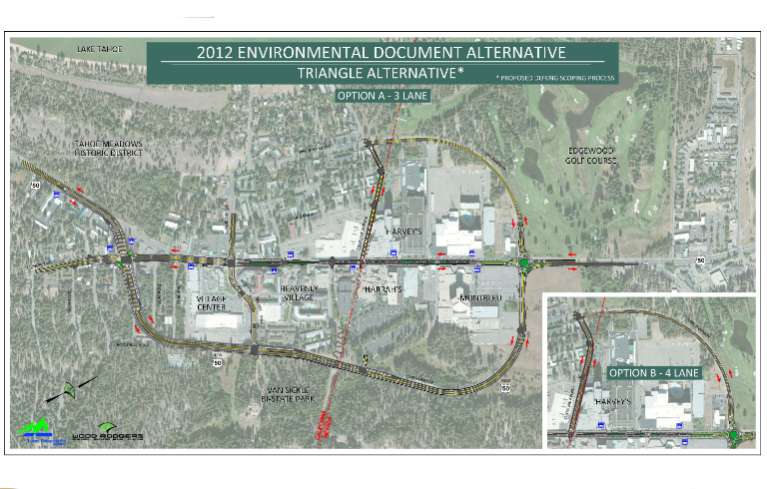
This triangle alternative is the preferred route for the loop road on the South Shore.

This triangle alternative is the preferred route for the loop road on the South Shore.

But McDermid doesn’t attend South Tahoe council meetings to know that this board wants to act united and not fractionalized. It also has no problems telling other entities how to do their job.

The Tahoe Transportation District – not the city, not Caltrans, not NDOT – drives the loop road.

This summer fieldwork will be done to help gather information that will be used for the environmental analysis. Then in 2014 the analysis will be done, with a draft coming out in early 2015.

The contentious alternative for the city is what is now called Alternative 2 with options. It would still take out the buildings to the west of the intersection of Highway 50 and Pioneer Trail near the state line.

The triangle alternative is deemed the preferred alternative. It would start about 500 feet west of that intersection at the two vacant lots on the highway that the city owns. Fewer businesses are likely to be demolished with this scenario.

Both of these alternatives require right-of-way acquisitions and displacement of businesses and residents.

The differences and impacts will be part of the environmental analysis, which looks at the environmental, social and economic effects of each alternative.

Both of these routes have Highway 50 going behind the Village Center, Harrah’s and MontBleu, with a two-lane roundabout at the intersection where it connects with present-day Highway 50 on the eastern side in Stateline.

In the analysis consultants will look at how narrow the current highway through the casino corridor could be, how wide sidewalks could be, and what median landscaping would work. That road would then be a city street – maintained by South Lake Tahoe and Douglas County where applicable.

The goal of the loop road is to create a complete street design to replace today’s highway, move the highway out of what proponents want to become a more pedestrian friendly area, create an area where events could be staged, and have an aesthetically pleasing area for locals and tourists.

McDermid said she would like planners to look at the possibility of separating cyclists from motorists as is done in many parts of the world, but is not common in the United States. This would mean a lane of car traffic, then a curb, then a bike lane, then another curb with sidewalk, and the businesses.

The other alternatives include a skyway that would be an elevated area near the casinos. This was included to show a route with less right-of-way needed to be secured.

McDermid asked about clearing snow and where the run-off would go. The concept was not taken seriously by the consultant or those in the room, as laughter accompanied any talk of this suggestion. Still, though, what the board voted on was that the alternatives were worth studying and represented diversity and input from the public via a series of meetings.

Another alternative is the one-way triangle that has traffic going in a circle, but creates more state highway coverage and does not create much of a streetscape.

As is customary, a do nothing alternative is included.

Having the loop road go on the lake side is not being considered, nor was it part of the economic analysis.

A business group was convened to study that economic report. It was originally tasked with providing peer review, but that did not happen. Instead, the outcome was the parroting of the project’s goals – create a more walkable, bikeable community, where people want to linger, spend money and events can be put on.

Going forward a citizens’ committee will be created with the preliminary desire to get input from people not just in the state line area. This is because whatever does or does not happen with the loop road will impact everyone who lives on the South Shore in terms of driving through the area, shopping, dining, increased-decreased tax dollars, construction delays, and the overall future of that section of the community.


Randy Hilliard Acevedo — 1949-2013

On April 5, our deeply loved husband, father and grandfather left us unexpectedly. He was 63.

Randy Hilliard Acevedo was born Nov. 23, 1949.

Randy graduated from USC Dental School in 1974. After practicing dentistry in Switzerland for a year, he opened his dental practice in South Lake Tahoe.

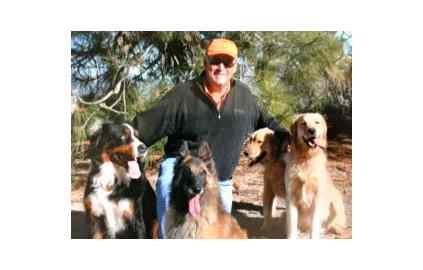
Longtime South Lake Tahoe dentist Randy Acevedo died April 5. Photo/Provided

Longtime SouthTahoe dentist Randy Acevedo died April 5. Photo/Provided

He enjoyed the outdoors. If not working, he could be found on the golf course, the lake, in the mountains or anywhere life’s beauty could be experienced.

He cared deeply for the patients he treated over the years, many of whom remained lifelong friends.

His humor, compassion and kind heart will forever be with us. He will be remembered as the best husband, father, grandfather and friend anyone could hope for.

Randy was preceded in death by his parents, Arthur and Mary Acevedo.

He is survived by his wife of 37 years, Monique, their two sons, Jason and Eric, and his granddaughter, Makenna. He also leaves his only brother, Scott Acevedo (Richard) from Tustin, as well as his loving extended in-law family in the Netherlands.

A celebration of life will be April 14 from 4-6pm at Edgewood Tahoe in Stateline.


Opinion: Time is now for marriage equality

By Janice Eastburn

A recent column written by Tiffany Miller takes as its basic premise that marriage equality “should not be solved in court.” She justifies her argument, in part, by saying, “Most of us simply believe that no government can define marriage because God has already defined it as a sacred union between a man and a woman.”

I will leave the theological debate on the definition of marriage to the clergy and religious scholars, as it has no bearing on the legality of marriage. Our country is founded on the separation of church and state. Marriage is, by legal definition, a binding contract between two people and the state in which they reside. As such, it is subject to state laws; not religious tenets.

gay marriageMarriage involves the filing of a marriage license with the county clerk and entitles the parties to a variety of legal protections and requirements. Some of these legalities include rights to property, inheritance, immunity from testimony, support, and presumed parentage to name a few. Divorce requires the involvement of the legal system.

If a particular church does not sanction the joining of any two people as a marital union that is their prerogative. Whatever the Supreme Court decides about marriage equality this will not require a given church to change their policy or practice of performing marital rites. Churches will not be required to perform marriage rites for same gender couples if doing so is in violation of their church doctrine, just as certain churches are entitled to refuse marital rites between people of different faiths or when there is a history of marital dissolution via divorce.

I do not deny or disparage the passion and conviction that people of faith feel. The line must, however, be drawn where those beliefs are used to justify the mistreatment of others or to deny others their civil rights. Gay and lesbian people are entitled to basic civil rights and protections. We pay taxes. We work. We raise children. We vote. We are your family, friends, co-workers, fellow congregants, and children.

In the fight for equality, we do not demand that anybody change his or her religious beliefs. What we do demand is that we are treated equally under the law, as any American, as defined by the equal protection clause and the fourteenth amendment of our constitution. This is a civil rights issue and, therefore, it is entirely appropriate that the Supreme Court hear the issue of marriage equality. What is not appropriate is for civil rights to be decided by public opinion (as in the case of Proposition 8 for example).

Civil rights cannot be determined by popular vote. What would be the effect on history if the right of women to vote had been determined by popular opinion? If the right to own slaves were decided in this manner? If the right to interracial marriage had been thus determined?

Miller attempted to make the case that the rights of gay and lesbian Americans should not even be considered a civil rights issue because, according to her, gay and lesbian people have not suffered the severity of indignities that African Americans have suffered. In our country’s history I have never encountered the argument that the rights of minority people must be held to a litmus test to determine whether that group has “suffered equally” nor is that argument appropriate here. Gay and lesbian people have suffered, and continue to suffer, not only various indignities (i.e. bullying, violence, rejection from families, friends, and religious institutions), but also loss of legal stature throughout this great country.

In 30 states it is perfectly legal to fire somebody on the basis of sexual orientation. In only 13 states is adoption by gay and lesbian parties clearly legal (and three of these states do not allow joint adoption). The decision to overturn the arbitrary discharge of military personnel based on sexual orientation happened only two years ago. As for marriage equality, even in the handful of states that do recognize the legality of same gender marriage, gay and lesbian married couples are denied more than 1,138 federal rights that the married (heterosexual) couple who lives next door enjoys (and likely takes for granted). Rights that, when denied, carry real consequences for real people.

Marriage equality is not an issue of religion. It is a matter of basic fairness and justice. I am optimistic that our supreme court will do the right thing by deciding the matter of marriage equality in favor of liberty and justice for all.

Janice Eastburn is a resident of South Lake Tahoe.


Tool erases online data post-death

By Hayley Tsukayama, Washington Post

You may be a stickler for keeping control of all the data in your many online accounts, but what will happen to that data after you die?

It’s a question that Google’s addressing with the announcement of a new tool, the Inactive Account Manager, that gives Google users the option to have information from inactive accounts wiped from the system.

Those who use the Inactive Account Manager can choose to have their data deleted three, six, nine or 12 months after it becomes inactive. Users can also select “trusted contacts” to receive information from various Google services such as Blogger, Gmail, Picasa Web Albums, Google Voice and YouTube.

Accounts become inactive when users haven’t logged in for a certain amount of time, meaning that events other than death could trigger the notifications. According to Google, users can set their own “timeout” period, and then will receive a text message and email to a secondary account when the company deems the account is no longer active.

Users can find the tool on their account settings page, under the heading “Account Management.”

Finding a way to deal with social networking and other data has been a much-discussed topic as people put more of their data online.

Facebook, for example, allows users’ family members or friends to memorialize Facebook pages of those who’ve died. Once an account is memorialized, no one can log into it and the account will not accept new friend requests. Facebook also removes the profiles of deceased people from its suggested lists of “People You May Know.”

Content on the profiles of people who’ve died remain open using the privacy settings users set when they posted the information. To obtain other information from these accounts, Facebook requires a court order.

Family members, the company has said, can request for profiles to be removed.

As ABC News reported, some states have proposed legislation to deal with data after death. A New Hampshire state representative has introduced legislation specifically dealing with social networking data, while other states such as Rhode Island and Connecticut have legislation that deals with what should happen to users’ e-mail data after their death.


Governor promotes Calif. wines in China

By Napa Register

During Gov. Jerry Brown’s trade mission to China this week, Golden State wines were served at an event in Shanghai titled, “California Winemaker’s Dinner Meets Chinese Banquet” as well as a VIP reception at the U.S. Embassy in Beijing.

Sales to China helped grow California wine exports to a record $1.4 billion in sales last year, according to Wine Institute, the trade association representing 1,000 California wineries and affiliated businesses.

According to a press release, China is the state’s fifth largest export market with $74 million in wine sales in 2012, up nearly 20 percent from the previous year.

“Wine is a signature industry for California and one of our state’s top agricultural exports,” said Robert P. Koch, president and CEO of Wine Institute, who is part of the governor’s delegation in China this week. “Our exports to China have nearly doubled in the past two years and the country represents a great opportunity for California wineries.”

Napa Valley vintners will present “Taste Napa Valley” April 12–20 in Shanghai, Beijing, Hanghzhou and Xi’an.

The Wine Institute will travel with a delegation of 50 vintners from regions around the state May 20–27 with stops in Shanghai, Beijing, Ningbo and Hong Kong for consumer events, tastings and educational seminars for trade and media.

The California Wines Master Class, a new initiative for trade and media covering history, climate, regions, varietals and food pairing, will debut in cities throughout China during the governor’s visit this week.

Since 1985, Wine Institute’s International Department has served as administrator of California wine export programs by the USDA’s Foreign Agricultural Service. About 150 California wineries participate in the Wine Institute’s International program.


Nevada contemplating redefining marriage

By Cy Ryan, Las Vegas Sun

CARSON CITY — By a party-line vote, the Senate Committee on Legislative Operations and Elections has approved a proposed constitutional amendment to permit same-sex couples to marry.

The resolution passed April 11 would repeal the state’s ban on gay marriage and sets out that Nevada would recognize marriages, regardless of gender.

The resolution would have to be approved by this session of the Legislature and again in 2015 before the proposed change could placed on the 2016 election ballot for voters to decide. It now goes to the full Senate.

“All people in Nevada deserve the freedom to marry,” said Laura Martin with Progressive Leadership Alliance of Nevada.

The original proposal sought only to repeal language in the state constitution that defines marriage as between a man and a woman. But a late amendment adopted by the committee adds that the state “shall recognize marriages and issue marriage licenses, regardless of gender.”

“We felt it would be cleaner to both eliminate the current prohibition and make it clear Nevada does not discriminate in any way,” said state Sen. Tick Segerblom, D-Las Vegas, who introduced the bill.

The amendment drew opposition from Republican Sen. James Settelmeyer of Minden. Settelmeyer said he gave Segerblom his word that he would vote for the original bill, but withdrew his support because of the new wording.

“I don’t think the subject of marriage should be in the Constitution,” Settelmeyer said. “This is adding something else in, and I can’t support that.”

He was joined by state Sen. Barbara Cegavske, R-Las Vegas, in opposing the measure, SJR13.

In support were Las Vegas Democrats Patricia Spearman, the committee chairwoman, and Mark Manendo and North Las Vegas Democrat Kelvin Atkinson.

Voters in 2002 approved an amendment to the Constitution that “only a marriage between a male and female person shall be recognized and given effect in this state.” The vote was 337,197 to 164,573.

The Legislature later approved a law allowing same-sex couple to register as domestic partners with the Secretary of State’s Office but did not convey the full benefits of marriage.

As of April 1, there were 4,157 registered domestic partners in Nevada, but a spokeswoman for the office said some of them were male-female couples.

Janine Hansen, president of the conservative group Nevada Families for Freedom, called the committee’s vote a “kick in the teeth” of voters who approved the Protection of Marriage Act in 2000 and 2002, defining marriage as between a man and a woman.

“It makes same-sex marriage the standard in Nevada,” she said.

The Associated Press contributed to this report.