Day of winter to interrupt spring in Tahoe

Measurable snow is on its way to Lake Tahoe.

Snow levels will start just below 6,000 feet and continue to fall to valley floors throughout Monday and into the evening, according to the National Weather Service in Reno. One to 3 inches are predicted for lake level.

Drivers should be prepared to deal with slick roads for Tuesday morning’s commute.

With the cold front comes a dramatic drop in temperatures. The high Monday will be 40 degrees, 38 on Tuesday. Lows for most of the week will be in the 20s.

By the time Thursday rolls around the high is supposed to be 56 degrees in the basin.

— Lake Tahoe News staff


Gun enthusiast embraces craftsmanship

By Thomas Curwen, Los Angeles Times

CARSON CITY — For Terry Tussey, a gun is the perfect marriage of form and function, a carefully crafted machine that can contain an explosion delivering 20,000 pounds of pressure per square inch and drive a bullet through a barrel at 1,000 feet per second.

Every spring, catch, plunger, plug, pin and cap must work for it to fire properly. Dirt, rust and abuse lead to jams, misfires and parts breaking.

This morning, he’s holding a .45-semiautomatic, popularly known as a 1911. Built in the 1970s with military surplus parts, it has a plastic opalescent grip and a slide engraved with what looks like the tendrils of a climbing rose.

 Brian van der Brug / Los Angeles Times Gunsmith Terry Tussey checks details on a 1911 pistol barrel at his bench, March 26, 2013, in Carson City. Tussey moved to Nevada when he realized that gun legislation in California would affect his business. At 73, he is one of the most reputable gunsmiths in the West, practicing a vanishing craft.

Gunsmith Terry Tussey checks details on a 1911 pistol barrel  in Carson City. Photo/Brian van der Brug/Los Angeles Times

The design’s too garish for Tussey, but right now looks don’t matter. He drops the magazine, pulls back the slide to make sure there isn’t a cartridge in the chamber and soon has the gun in three pieces: barrel, slide and frame.

Like a puzzle cast in three dimensions, a 1911 has almost 50 parts, and each needs to fit together with a tolerance of less than a hair’s breadth. Any play leads to the inaccuracy that Tussey found at the range this morning.

The best measure of a pistol’s worth, he believes, comes at 20 yards when he tries to group five shots within the space of a nickel. This .45 didn’t come close.

He goes to his workbench and grabs a magnifying visor for a closer look.

Tussey, 73, began working with guns more than 50 years ago in Southern California and can restore or repair most any firearm brought to him. He describes himself as a gun mechanic and has a reputation for the 1911s that he builds from scratch.

“This isn’t a job,” he says. “This is who I am.”

He calls his business Tussey Custom, and it sits on the outskirts of Carson City on a road that leads to a brothel known as the Moonlite Bunnyranch and a stone marker that honors the Pony Express route that passed nearby.

Lawmakers in Washington and in state capitals across the country are arguing over gun control legislation, but at Tussey Custom, there is no debate.

Instead there is an appreciation — aesthetic, mechanical and even constitutional — for these machines that have become such an intrinsic part of American life.

A warm afternoon breeze blows through the roll-up door. Dvorak’s New World Symphony is playing as a lathe purrs through the inner circumference of a barrel bushing. Workbenches are crowded with tools, parts and yellow plastic trays holding guns in need of repair.

The front door chimes, and Tussey maneuvers his wheelchair to the office. A mountain bike accident eight years ago left him paralyzed from the chest down.

Rodney Ricks, a 56-year-old construction manager, has stopped by to pick up a 1911 that Tussey restored. A few new parts, rust and pitting sanded down, bluing added, and the gun, which dates to World War I, looks almost new.

Tussey specializes in 1911s, named for the year the Army approved the pistol as standard issue. “The best handgun ever made,” he says with the conviction car enthusiasts save for their favorite ride.

Just a few weeks ago, he finished building a new 1911 for Ricks, who placed the order last summer.

“Terry is putting out work that no one can compete with,” Ricks says. “In this day and age of instant gratification, it’s nice to have someone to put the time and effort into making something like this.”

The pistol, which cost $4,000, is made of stainless steel and has a black trigger and hammer, blued safety and slide stop, and a grip made of mastodon ivory. It gleams in the light.

Tussey builds only about four of these guns a year. The parts come from across the country: frame and slide from Vermont, trigger from California, barrel from North Carolina, hammer from Missouri and grip from Carson City. He then makes sure everything fits.

“There are guys who can make them pretty, and there are guys who can make them shoot,” Tussey says. “But there are not too many who can make them pretty and shoot.”

He is one of 61 gunsmiths registered with the American Pistolsmiths Guild. The trade group promotes the work of elite customizers, whose pistols must pass standards for accuracy and artistry established by senior members of the guild.

Enrollment in the guild has held steady through the years, says its president, Marc Morganti, but most of the members are in their 60s.

It takes time to learn the craft, he says, and it’s hard to make a living on the wages of a pistolsmith.

“It’s a sign of the times,” Morganti says. “The old-school guys are getting left behind.”

There are 86 guns in Tussey’s shop awaiting repairs or modifications. Nearly 20 percent of his customers are from Southern California.

Like the clock, sewing machine and typewriter, the mass-produced gun was a triumph of the Industrial Revolution: dependable, reliable and manufactured in quantities that amaze Tussey.

He points to an 1863 Colt revolver that he’s restoring. The model came out in 1861, when only one gun was manufactured; two years later, the factory had churned out 15,000 of them.

History flows through these firearms. The owner of the Colt traces it to his great-great-grandfather, a surgeon for the Union Army, who learned his profession in Chicago before heading south after the siege of Vicksburg.

Once, one of Tussey’s apprentices was taking apart a 1911, and black sand poured out of the grip. Its owner explained that the pistol belonged to his father, a Marine who had fought on the beaches of Iwo Jima.

After World War II, workmanship began to decline. Too often, Tussey says, manufacturers today favor dependability over accuracy.

“What makes a good gun?” he wonders. “Good sights, good triggers and good reliability — and none of the guns on the market today hits all those marks.”

He is often asked to make new guns better, and when a customer stops by with two revolvers purchased online, Tussey can’t make any promises.

The complaint is common: The trigger springs are too heavy, making it too difficult to pull the trigger and stay on target.

Tussey tries not to be dismissive, but the revolvers cost less than $400 apiece. Made of polymer and metal, these types of guns are flooding the market, and their owner knows they’re cheap, referring to them as “Tupperware” or “plastic” guns.

A well-made gun of steel and of similar caliber would cost twice as much.

“Assault rifles and plastic guns are machines that shoot bullets,” Tussey says. “There is a big difference between machines that shoot bullets and firearms that shoot quickly, accurately and are beautiful.”

Tussey took apart his first pistol when he was a teenager growing up in Orange, not far from where the Crystal Cathedral would be built.

As a boy, he would go into the groves and practice on oranges, leaving his mother to wonder how juice stains got on his trousers.

He wanted to master the quick draw and entered competitions at Big Bear Lake. He is a southpaw and is deaf in his left ear from having shot, by his estimate, a million rounds by the time he turned 35.

He worked for a gun store in Culver City, then a sporting goods store in Orange County, and eventually became a representative for Colt and Smith & Wesson. During the recession in 1982, he opened his shop on Main Street in Santa Ana.

In 1999, he and his wife, Teresa, left California. Gov. Gray Davis had signed legislation requiring handguns — made, imported or sold in the state — to pass a safety test. Once approved and listed with the Department of Justice, the firearm cannot be altered in any manner other than cosmetic.

The law was meant to protect consumers from poorly made guns — Saturday night specials — but it had a chilling effect on custom manufacturers who could not afford to build the extra guns needed for testing.

“It gave the advantage to inexpensive, mass-produced pistols,” says Gary Smith, sales manager for a Vermont-based company that provides Tussey with parts.

Tussey is sympathetic to efforts to restrict gun ownership, but he doesn’t believe any legislation would stop gun violence.

He favors background checks and hunter safety courses, and he can’t see a purpose for assault weapons or large-capacity magazines, but he is a passionate supporter of the Second Amendment. He keeps a loaded 9mm Glock on his workbench and a 9mm Rohrbaugh in his pocket.

If owning a gun wasn’t important, he argues, it wouldn’t have been listed second in the Bill of Rights.

“Guns,” he says, “keep you free.”


Winter athletes sound climate change alarm

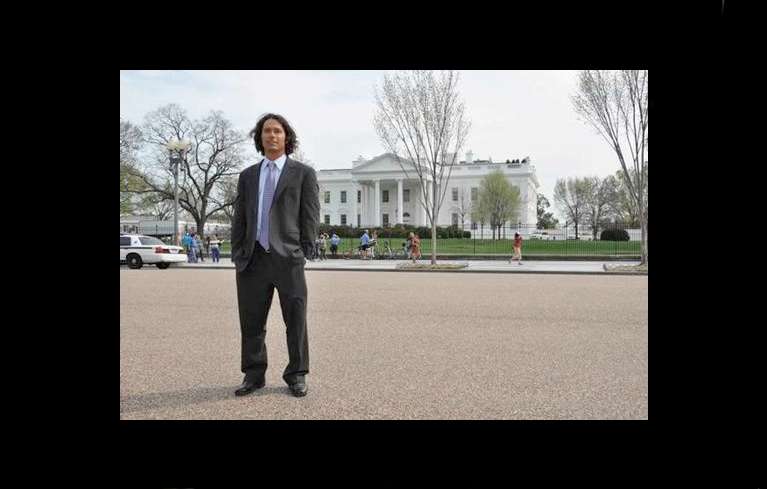
Jeremy Jones of Truckee takes his cause to the White House. Photo/Protect Our Winters

Jeremy Jones of Truckee takes his cause to the White House. Photo/Protect Our Winters

Warning that “winter is in trouble,” 75 Olympic medalists and other winter sports athletes – including White House “Champion of Change” awardee and pro snowboarder Jeremy Jones of Truckee – sent a letter to President Obama urging him to take action on climate and clean energy.

Jones was in Washington on April 11 with other 11 Champions of Change to be honored as “ordinary Americans doing extraordinary things in their communities to out-innovate, out-educate, and out-build the rest of the world.” Obama created the Champions of Change program as part of his Winning the Future initiative.

Jones was being recognized Thursday for his contribution to raising awareness about the impact of climate change on the winter sports industry by creating Protect Our Winters, a foundation established in 2007 to unite and mobilize the global winter sports community against climate change.

“This nomination is an absolute honor for me and the work we’re doing at POW. But it’s now my responsibility to take this recognition and help secure a place in the climate discussions in Washington. The letter that’s been enthusiastically signed by so many amazing athletes is a strong showing of solidarity from the leaders in snow sports on climate action, so together, we have to keep that momentum going,” Jones said in a statement.

The letter to the president references a December 2012 report published by Protect Our Winters and the Natural Resources Defense Council highlighting the economic impact of inconsistent winters on the U.S. snow sports community and tourism-dependent states.

The athletes’ letter calls on Obama to follow through on the promise he made in the State of the Union address to fight climate change.

“Mr. President, it’s time to force our transition to clean energy, and we need your leadership,” the letter states. “…on behalf of 23 million of us who love winter and depend on it for our economic livelihoods, please take the action on climate change you have promised.”

Julia Mancuso of Squaw Valley and Hannah Teter of South Lake Tahoe were among those who signed the letter.

“Without a doubt, winter is in trouble,” the letter states. “… at risk are the economies of tourist-dependent states where winter tourism generates $12.2 billion in revenue annually, supports 212,000 jobs and $7 billion in salaries. Those are the jobs and businesses owned by our friends and families, generators of billions in federal and state income.”

 — Lake Tahoe News staff report


Nevada excels at ‘patient dumping’

By Cynthia Hubert, Phillip Reese and Jim Sanders, Sacramento Bee

Over the past five years, Nevada’s primary state psychiatric hospital has put hundreds of mentally ill patients on Greyhound buses and sent them to cities and towns across America.

Since July 2008, Rawson-Neal Psychiatric Hospital in Las Vegas has transported more than 1,500 patients to other cities via Greyhound bus, sending at least one person to every state in the continental United States, according to a Bee review of bus receipts kept by Nevada’s mental health division.

About a third of those patients were dispatched to California, including more than 200 to Los Angeles County, about 70 to San Diego County and 19 to the city of Sacramento.

In recent years, as Nevada has slashed funding for mental health services, the number of mentally ill patients being bused out of Southern Nevada has steadily risen, growing 66 percent from 2009 to 2012. During that same period, the hospital has dispersed those patients to an ever-increasing number of states.

By last year, Rawson-Neal bused out patients at a pace of well over one per day, shipping nearly 400 patients to a total of 176 cities and 45 states across the nation.

Nevada’s approach to dispatching mentally ill patients has come under scrutiny since one of its clients turned up suicidal and confused at a Sacramento homeless services complex. James Flavy Coy Brown, who is 48 and suffers from a variety of mood disorders including schizophrenia, was discharged in February from Rawson-Neal to a Greyhound bus for Sacramento, a place he had never visited and where he knew no one.

The hospital sent him on the 15-hour bus ride without making arrangements for his treatment or housing in California; he arrived in Sacramento out of medication and without identification or access to his Social Security payments. He wound up in the UC Davis Medical Center’s emergency room, where he lingered for three days until social workers were able to find him temporary housing.

Nevada mental health officials have acknowledged making mistakes in Brown’s case, but have made no apologies for their policy of busing patients out of state. Las Vegas is an international destination and patients who become ill while in the city have a right to return home if they desire, the state’s health officer, Dr. Tracey Green, told Nevada lawmakers during a hearing last month.

She and others insist that the vast majority of patients they are discharging to the Main Street bus station are mentally stable and have family members, treatment programs or both waiting for them at the end of their rides.

That was not true in Brown’s case. His papers from Southern Nevada Adult Mental Health Services read: “Discharge to Greyhound bus station by taxi with 3 day supply of medication” and provided a vague suggestion for further treatment: “Follow up with medical doctor in California.” Brown said staff at Rawson-Neal advised him to call 911 when he arrived in Sacramento.

Nevada Health and Human Services Director Michael Willden told lawmakers last month that while health officials “blew it” in their handling of Brown, an internal investigation found no pattern of misconduct.

But an investigation by the Nevada State Health Division documented several other instances from a small sampling of cases in February in which the state hospital violated written rules for safely discharging mentally ill patients.

Other apparent violations surfaced during the Bee‘s investigation.

At least two patients from the Nevada system arrived in San Francisco during the past year “without a plan, without a relative,” said Jo Robinson, director of that city’s Behavioral Health Services department.

“We’re fine with taking people if they call and we make arrangements and make sure that everything is OK for the individual,” Robinson said. “But a bus ticket with no contact, no clinic receptor, anything, it’s really not appropriate.”

Robinson said she viewed the practice as “patient dumping,” and has reported it to federal authorities. “It’s offensive to me that they would show this lack of care for a client,” she said.

Practice called risky

Nevada mental health officials did not respond to repeated requests for phone interviews for this story, nor would they address a list of emailed questions about the origins of the busing policy and the safety protocols in place.

Southern Nevada Adult Mental Health Services, the agency that oversees Rawson-Neal, maintains detailed written policies for transporting patients “to their home communities,” with the stated goal of providing more appropriate care by the most economical means possible.

The policy includes a special section on “Travel Nourishment Protocol,” specifying the number of bottles of Ensure nutritional supplement the patient should receive for the bus trip – essentially six per day.

Staff members are supposed to fill out a “Client Transportation Request” form, which includes questions about whether the patient is willing to go, whether housing or shelter has been verified, and the cost of the trip.

The written policy calls for staff to confirm that a patient has housing or shelter available “and a support system to meet client at destination.” They are to provide information about “mental health services available in the home community.”

Interviews with health officials in California and numerous other states indicate Nevada’s practices are unusual. None of the 10 state mental health agencies contacted by the Bee said that placing a psychiatric patient on a bus without support would be permissible. And none recalled being contacted by Rawson-Neal to make arrangements for a patient coming from Nevada.

In California, where most public mental health treatment is overseen at the county level, agencies contacted by the Bee said they rarely bus patients and that Nevada’s practices seem out of step with the standard of care.

Several described the practice as risky, even if patients have someone waiting for them at the end of their journeys.

“Putting someone whose mental illness makes them unable to care for themselves alone on a bus for a long period of time could be absolutely disastrous,” said Dorian Kittrell, executive director of the Sacramento County Mental Health Treatment Center.

Patients could suffer relapses during their trips and potentially harm themselves or other people, said Kittrell and others. They could become lost to the streets or commit crimes that land them in jail.

“The risk is just too great,” said Dr. Marye Thomas, chief of behavioral health for Alameda County.

Southern Nevada Adult Mental Health Services has had an ongoing contract with Greyhound since July 2009, said bus company spokesman Timothy Stokes.

Stokes said he was unaware of any serious incidents involving mentally ill patients from Nevada. He said Greyhound has contracts with “a number” of hospitals around the country, but declined to identify them.

“We take it on good faith that the organization is going to make certain that patients are not a risk to themselves or others,” he said.

Still, officials in several of California’s largest counties said they rarely, if ever, bus patients out of state.

“We don’t do it, we never will do it, and we haven’t done it in recent memory, meaning at least 20 years,” said David Wert, public information officer for San Bernardino County. Rawson-Neal has bused more than 40 patients to that county since July 2008.

Los Angeles County officials said they have not bused a single patient out of state during the past year, and when they have done so in the past they have supplied chaperones. In the past five years, L.A. County has received 213 people from the Nevada hospital, according to the Bee‘s review, more than any place in the country.

Likewise, in Riverside County, sending patients out of state “happens very infrequently upon request of the family,” said Jerry Wengerd, head of the county’s Department of Mental Health. “A staff member accompanies the client and it is usually by air.” Nevada bused 20 patients to Riverside in the period reviewed.

Sacramento County bought bus tickets for five patients during the past year, Kittrell said. In all cases, he said, facility staff confirmed before patients departed that a family member or friend would meet them at their destinations, and provided referrals for treatment.

Organizations that advocate for mentally ill people said Nevada’s busing numbers seem unjustifiably high.

DJ Jaffe, executive director of Mental Illness Policy Org., a nonprofit think tank, said his group often hears anecdotally about patients being “dumped” from one county to another.

“Discharging severely mentally ill patients inappropriately is policy in this country,” Jaffe said. “But getting rid of them altogether by busing them out of state is, I think, rare. I am shocked by these figures. It seems to be almost routine in Nevada.”

After California, Arizona has received the most patients by bus from Nevada, at more than 100 over the five years.

But Cory Nelson, acting deputy director for the Arizona Department of Health, cautioned against drawing conclusions about Nevada’s practices based solely on number of bus tickets issued. In many cases, Nelson said, relatives could have agreed to house patients or made treatment arrangements before the clients left Las Vegas.

In rare cases, Nelson said, a hospital can find itself in a Catch-22 situation when a patient no longer needs to be in a hospital but refuses to cooperate with a discharge plan. “It kind of leaves a hospital in a tough situation,” he said.

Still, the sheer number of patients bused from the Nevada hospital “does seem pretty high,” he said.

‘A tsunami situation’

Several people interviewed said the numbers might be explained in part by the unusual nature of Las Vegas.

“As the whole country no doubt knows, Vegas is a pretty unique place,” said Dr. Lorin Scher, an emergency room psychiatrist with UC Davis Health System.

The city’s entertainment and casino culture draws people from all over the world, Scher noted, including the mentally ill.

“Many bipolar patients impulsively fly across the country to Vegas during their manic phases and go on gambling binges,” he said. “Vegas probably attracts more wandering schizophrenic people” who are attracted to the warm weather, lights and action, he added.

“I am by no means defending their practices,” he said. “It certainly gives cause for concern. But it’s one possible explanation.”

Stuart Ghertner, former director of Southern Nevada Adult Mental Health Services, cited other possible reasons.

He said Rawson-Neal has been under siege for years because of state budget cuts, a steady increase in poor people needing mental health services in the Las Vegas area and a revolving door of administrators.

He noted the city had a disproportionate number of people displaced by the housing and mortgage meltdown of a few years ago.

“The casino boom was over, people were losing their jobs and their homes. They were stressed and they wound up in a mental health crisis,” Ghertner said.

Between 2009 and 2012, Nevada slashed spending on mental health services by 28 percent to address budget deficits, according to data collected by the National Alliance on Mental Illness. Even before those cuts, Nevada fell well below the national average in spending on mental health services: In 2009, it spent $64 per capita on such services compared with a national average of about $123, according to the study.

“You’re looking at a tsunami situation,” said Ghertner, a psychologist who resigned last year after five years as agency director. “There is more pressure to turn patients over faster, and fewer programs (in which) to place them. Perhaps busing them became the easier solution.”

It also is cheaper, he noted. Southern Nevada Adult Mental Health Services spent a total of $205,000 putting patients on Greyhound buses during the past five years, according to the Bee analysis. The state hospital admits about 4,000 patients a year to its inpatient unit, and inpatient care runs around $500 per day per client, Ghertner said.

He said he was aware during his tenure that Rawson-Neal was busing patients out of state but that he thought the practice was rare.

At the time, “I had 800 employees and a $106 million budget,” he said. Ghertner regularly reviewed numbers pertaining to admissions, length of stay and other issues at the hospital, but patient busing was never on his radar, he said.

“I’m embarrassed to say that this practice was going on to this degree under my leadership,” he said. “I had no idea. It just never came up.”

Ghertner said the state mental hospital has been under stress since it opened in 2006, turning over five hospital directors since that time. That instability has taken a toll, he said.

“This busing issue is a symptom that reflects that the care there is not quality care,” he said. “Things clearly are being missed.”

Willden, Nevada’s Health and Human Services director, said during last month’s legislative hearing that policies have been tightened and disciplinary actions taken to ensure that patients are discharged only after the hospital confirms care and treatment at their planned destinations. The hospital administrator, Chelsea Szklany, now must approve all bus discharges ordered by medical staff, he said.

“Southern Nevada Adult Mental Health Services is committed to providing quality mental health services to its patients,” said spokeswoman Mary Woods in an emailed statement.

But investigations continue into the agency’s practices.

Rawson-Neal could lose vital federal funding pending an ongoing probe by the federal Center for Medicare and Medicaid Services. California state Senate President Pro Tem Darrell Steinberg has written a letter expressing outrage to U.S. Secretary of Health and Human Services Kathleen Sebelius.

The hospital’s discharge practices also have prompted a call for action by a member of the U.S. Commission on Civil Rights. Commissioner David Kladney called for a broad investigation by Nevada’s governor and Legislature.

“As a Nevadan, I am ashamed that my state is failing in its duty toward the neediest residents,” Kladney said. Nevada, he said, appears to be “simply hoping that other states will shoulder the responsibility.”



Spring is time to check for winter property damage

Now that the snow has melted, it is a good time to take a walk around your house to look for any damage that icicles may have caused.

Be sure to check the gas meter and any other utility lines that may have been damaged.

It’s time to begin cleaning up any loose debris on your roof, gutters, and around your property, such as pine needles, pine cones, and dead vegetation.

Be sure to properly store any snow removal equipment properly, and get your chimney and your furnace cleaned.

— Sallie Ross-Filgo, South Lake Tahoe Fire Department


Nevada defends tourism slogan

By Richard N. Velotta

The director of the state Tourism Commission said that while many critics have pounced on Nevada’s new tagline, she’s confident the slogan will be embraced by residents and help attract tourists and businesses to the state.

Gov. Brian Sandoval unveiled “Nevada: A World Within. A State Apart” Tuesday.

“People are saying they like what the brand says about Nevada, and, for the most part, they’re saying, ‘Let’s give this the time it requires to really take a strong foothold and to grow,’” tourism executive Claudia Vecchio said.

Vecchio said she anticipated some criticism.

“There will always be detractors,” she said. “The moment you start a brand process, you know there are going to be people who don’t like it or for whatever reason think it’s not the right direction. We expect that. I hope we’ll be able to convince people through the way we execute it that it’s worth considering and it will become a brand that really does signify what Nevada is all about and drive business.”

Nevada is trying to embrace all segments of the Silver State. Photo/LTN file

Nevada is trying to embrace all segments of the Silver State. Photo/LTN file

In addition to the slogan, the state created a new tourism website and mobile application. Budget Travel praised the site last week.

“TravelNevada.com sets a new standard for state tourism sites and will certainly enjoy the sincerest form of flattery in the coming months and years as other states learn to package their travel and hospitality assets in beautiful and engaging new ways,” magazine editors wrote. “Visitors can assemble their own vacations, learn about destinations and share their findings via social media. The site also puts an emphasis on accessing partner sites for additional information, travel deals and even trip booking.”

Critics, however, ripped both the slogan and the cost of developing the brand and campaign.

The state paid $218,000 of a $250,000 two-year contract to Seattle-based GreenRubino, the first firm hired to research and develop a tag line for the state. That was in 2011.

The company failed to deliver a slogan the Tourism Commission liked.

Then New York-based Berson-Marsteller was hired to rebuild the state’s website, develop a mobile app and do public relations for the tourism campaign as part of a two-year, $3.2 million deal.

Berson-Marsteller decided to develop its own tag line, Vecchio said. The result was “A World Within. A State Apart.”

“Their contract was to do public relations, the website and new creative materials,” Vecchio said. “It was a fully integrated marketing program. And they said, ‘Because we’re committed to this state, we will do the branding also.’”

Television ads featuring the new tag line will begin airing Monday in Los Angeles, San Francisco and Phoenix. The ads include a soundtrack from Las Vegas rock band the Killers singing “Don’t Fence Me In” by Cole Porter.

The state budgeted $2.4 million for commercials during its summer campaign and $1.5 million for commercials during its winter campaign. The money comes from room tax paid by tourists.

Vecchio said she expects the marketing plan will have a high return on investment. State officials estimate Nevada generates at least $20 in tax revenue for every dollar it spends on marketing and advertising.

“Everything we do, we do to drive business, and we drive investment back into the state,” she said. “This brand is something that we believe is going to only help to increase that return on investment.”

Vecchio said she hopes to learn from the criticism but isn’t going to let it dampen her enthusiasm for the project.

“I think it’s such an opportunity to celebrate the potential,” she said. “Instead of attacking, we’ll look forward to something that has a possibility to take the state to new heights of success.”


Placer County helps Tahoe residents with planning issues

Steve Buelna

Steve Buelna

Placer County recently created the position of an ombudsman for the Community Development Resource Agency’s Tahoe office to resolve problems.

The idea came about from discussions between North Tahoe business leaders and county staff. They wanted to improve customer service and business development in the Lake Tahoe Basin. Lake Tahoe, with its numerous overlapping layers of regulatory authority, can be a difficult path to follow for those wishing to start, expand of change a business, the county said.

Steve Buelna, a 13-year county employee and a supervising planner in the Tahoe office, will be the ombudsman/facilitator for all Tahoe projects. He acts as the county’s single point of contact and communication, and has the authority to work with, and provide direction to, all agency division staff.


Opinion: Leave Yosemite alone

Publisher’s note: Rep. Tom McClintock on April 12 submitted this letter commenting on the Merced River draft Comprehensive Management Plan and Environmental Impact Statement to Don Neubacher, superintendent of the Merced River Plan.

Dear Mr. Neubacher:

I am writing to provide comments on the National Park Service’s (NPS) Draft Environmental Impact Statement (DEIS) for the Merced River Comprehensive Management Plan. Yosemite National Park is a national treasure that must be available for the American public to access and enjoy in the same manner that Americans have for decades. The 1864 Act authorizing the original Yosemite land grant to the state of California stated that the “premises shall be held for public use, resort, and recreation” and “shall be inalienable for all time.” The draft plan in question directly contravenes the authorization, and I am firmly against NPS taking any action that would limit public access and enjoyment of Yosemite.

Tom McClintock'

Tom McClintock

Congress enacted the Wild and Scenic Rivers Act to protect free-flowing rivers from dams and other development. Congress did not intend for NPS to use the act to justify limiting visitation, closing facilities and eliminating or curtailing historic uses that pre-date passage of the Act and the Merced River designation under the act. In designating the Merced River, Congress understood that Yosemite National Park had a multitude of existing facilities that served river users, that Yosemite was widely visited and that the Merced River was extensively used for recreational pursuits by park visitors. See S. Rep. No. 96, 100th Cong, 1st Sess. 1987 (the river is an “outstanding and heavily used recreation resource in the areas of easy accessibility”).

The Merced River’s designation was based upon the river’s value as a popular recreation resource in a highly-visited National Park that was supported by the extensive facilities that existed at the time of the River’s designation. Congress could not have intended for NPS to limit visitation or do away with the existing facilities and the recreational activities that support the values that caused the Merced River to be designated in the first place. Congress also did not intend its designation to drive planning of the larger park and force the closure of facilities that pre-date the act, enhance visitor experiences, and are located outside of the Merced River.

It is equally troubling that NPS is proposing to close a number of facilities within Yosemite Village and reduce recreational activities in the Yosemite Valley. NPS claims that camping will be increased to 640 campsites but that figure is still less than the 830 campsites that existed before the 1997 flood. NPS is also proposing to close the Curry Village ice skating rink, bike rental facilities, snack stands, swimming pools, tennis courts, retail stores and horse stables and stock use. These facilities are not located in the Merced River, do not impede its flow, and many existed and historically served Yosemite visitors for decades prior to Congress passing the act.

It defies logic that NPS is proposing to close these facilities not because they degrade the Merced River, but instead because in NPS’s eyes, these longstanding facilities do not benefit the River. What about the benefits that the American public will lose under NPS’s proposal? NPS is also proposing to eliminate commercial rafting on the River. Like the existing facilities, commercial rafting is a service that was offered before the Merced River’s designation under the act.

I am also concerned about the proposed destruction of the Sugar Pine Bridge. This historic stone bridge was built in 1928 (40 years before enactment of the Wild and Scenic Rivers Act) and was entered into the National Register of Historic Places in 1977. The National Historic Preservation Act directs federal agencies to preserve the historic properties under their control and the legislation designating the Merced River as Wild and Scenic does not require the bridge’s destruction. I do not believe that the Park Service may simply ignore its responsibilities under the National Historic Preservation Act to protect the Sugar Pine Bridge and find no justification for robbing Yosemite of this iconic landmark.

Finally, I am aware that NPS has received a number of requests for an extension of the public comment period on the Merced River plan. This is entirely understandable given that the plan and its exhibits are over 4,000 pages long, and that the comment period overlaps with the comment periods of two other major Yosemite Park plans. To ensure that the public has an adequate opportunity to provide its input, I concur that an extension is necessary, and therefore have requested that NPS extend its public comment period on the Merced River Plan by 90 days to ensure full public opportunity to comment on this important issue.

I submit these comments greatly troubled by the adverse and lasting effects this would have on Yosemite and the many visitors who enjoy the park.

Sincerely,

Tom McClintock, R-Granite Bay


More kids in court system with cops in schools

By Erik Eckholm, New York Times

HOUSTON — As school districts across the country consider placing more police officers in schools, youth advocates and judges are raising alarm about what they have seen in the schools where officers are already stationed: a surge in criminal charges against children for misbehavior that many believe is better handled in the principal’s office.

Since the early 1990s, thousands of districts, often with federal subsidies, have paid local police agencies to provide armed “school resource officers” for high schools, middle schools and sometimes even elementary schools. Hundreds of additional districts, including those in Houston, Los Angeles and Philadelphia, have created police forces of their own, employing thousands of sworn officers.

In the wake of the Newtown, Conn., shootings, a task force of the National Rifle Association recommended placing police officers or other armed guards in every school. The White House has proposed an increase in police officers based in schools.

The effectiveness of using police officers in schools to deter crime or the remote threat of armed intruders is unclear. The new N.R.A. report cites the example of a Mississippi assistant principal who in 1997 got a gun from his truck and disarmed a student who had killed two classmates, and another in California in which a school resource officer in 2001 wounded and arrested a student who had opened fire with a shotgun.

Yet the most striking impact of school police officers so far, critics say, has been a surge in arrests or misdemeanor charges for essentially nonviolent behavior — including scuffles, truancy and cursing at teachers — that sends children into the criminal courts.

“There is no evidence that placing officers in the schools improves safety,” said Denise C. Gottfredson, a criminologist at the University of Maryland who is an expert in school violence. “And it increases the number of minor behavior problems that are referred to the police, pushing kids into the criminal system.”

Nationwide, hundreds of thousands of students are arrested or given criminal citations at schools each year. A large share are sent to court for relatively minor offenses, with black and Hispanic students and those with disabilities disproportionately affected, according to recent reports from civil rights groups, including the Advancement Project, in Washington, and the NAACP Legal Defense and Educational Fund, in New York.

Such criminal charges may be most prevalent in Texas, where police officers based in schools write more than 100,000 misdemeanor tickets each year, said Deborah Fowler, the deputy director of Texas Appleseed, a legal advocacy center in Austin. The students seldom get legal aid, she noted, and they may face hundreds of dollars in fines, community service and, in some cases, a lasting record that could affect applications for jobs or the military.

In February, Texas Appleseed and the Brazos County chapter of the N.A.A.C.P. filed a complaint with the federal Education Department’s Office for Civil Rights. Black students in the school district in Bryan, they noted, receive criminal misdemeanor citations at four times the rate of white students.

Featured in the complaint is De’Angelo Rollins, who was 12 and had just started at a Bryan middle school in 2010 when he and another boy scuffled and were given citations. After repeated court appearances, De’Angelo pleaded no contest, paid a fine of $69 and was sentenced to 20 hours of community service and four months’ probation.

“They said this will stay on his record unless we go back when he is 17 and get it expunged,” said his mother, Marjorie Holmon.

Federal officials have not yet acted, but the district says it is revising guidelines for citations. “Allegations of inequitable treatment of students is something the district takes very seriously,” said Sandra Farris, a spokeswoman for the Bryan schools.

While schools may bring in police officers to provide security, the officers often end up handling discipline and handing out charges of disorderly conduct or assault, said Michael Nash, the presiding judge of juvenile court in Los Angeles and the president of the National Council of Juvenile and Family Court Judges.

“You have to differentiate the security issue and the discipline issue,” he said. “Once the kids get involved in the court system, it’s a slippery slope downhill.”

Mo Canady, the executive director of the National Association of School Resource Officers, defended placing police officers in schools, provided that they are properly trained. He said that the negative impacts had been exaggerated, and that when the right people were selected and schooled in adolescent psychology and mediation, both schools and communities benefited.

“The good officers recognize the difference between a scuffle and a true assault,” Canady said.

But the line is not always clear. In New York, a lawsuit against the Police Department’s School Safety Division describes several instances in which officers handcuffed and arrested children for noncriminal behavior.

Many districts are clamoring for police officers. “There’s definitely a massive trend toward increasing school resource officers, so much so that departments are having trouble buying guns and supplies,” said Michael Dorn, director of Safe Havens International, in Macon, Ga., a safety consultant to schools.

One district in Florida, Dorn said, is looking to add 130 officers, mainly to patrol its grade schools. McKinney, Texas, north of Dallas, recently placed officers in its five middle schools.

Many judges say school police officers are too quick to make arrests or write tickets.

“We are criminalizing our children for nonviolent offenses,” Wallace B. Jefferson, the chief justice of the Supreme Court of Texas, said in a speech to the Legislature in March.

School officers in Texas are authorized to issue Class C misdemeanor citations, which require students to appear before a justice of the peace or in municipal court, with public records.

The process can leave a bitter taste. Joshua, a ninth-grader who lives south of Houston, got into a brief fight on a school bus in November after another boy, a security video showed, hit him first. The principal called in the school’s resident sheriff, who wrote them both up for disorderly conduct.

“I thought it was stupid,” Joshua said of the ticket and his need to miss school for two court appearances. His guardian found a free lawyer from the Earl Carl Institute, a legal aid group at Texas Southern University, and the case was eventually dismissed.

Sarah R. Guidry, the executive director of the institute, said that when students appeared in court with a lawyer, charges for minor offenses were often dismissed. But she said the courts tended to be “plea mills,” with students pleading guilty in the hope that, once they paid a fine and spent hours cleaning parks, the charges would be expunged. If students fail to show up and cases are unresolved, they may be named in arrest warrants when they turn 17.

In parts of Texas, the outcry from legal advocates is starting to make a difference. Jimmy L. Dotson, the chief of Houston’s 186-member school district force, is one of several police leaders working to redefine the role of campus officers.

Perhaps the sharpest change has come to E.L. Furr High School, which serves mainly low-income Hispanic children on the city’s east side. Bertie Simmons, 79, came out of retirement 11 years ago to try to turn around a school so blighted by gang violence that it dared not hold assemblies.

“The kids hated the school police,” said Simmons, the principal. They arrested two or three students a day and issued tickets to many more.

Simmons searched for officers who would work with the students and build trust. She found them in Danny Avalos and Craig Davis, former municipal police officers who grew up in rough neighborhoods, and after years of effort, the campus is peaceful and arrests and tickets are rare. Discipline is usually enforced by a principal’s court with student juries, not summonses to the criminal courts.

“Writing tickets is easy,” Avalos said. “We do it the hard way, talking with the kids and coaching them.”

With new guidelines and training, ticketing within the Houston schools was reduced by 60 percent in one year. Citations for “disruption of classes,” for example, fell to 124 between September and February, from 927 in the same period last year.

“Our role is not to be disciplinarians,” Dotson said in an interview. “Our purpose is to push these kids into college, not into the criminal justice system.”


Ski report: Time for a new sport

ski report logoThis is the final daily ski report for the season because many resorts close this weekend.

Here is the April 14 ski report.

— Curtis Fong