Expect delays today on I-80

Caltrans is alerting motorists that delays are expected on Interstate 80 today from 10am-1pm due to rock removal operations.

The California Highway Patrol will be intermittently holding westbound traffic near Yuba Gap and eastbound traffic near Emigrant Gap. Delays of approximately 15-20 minutes can be expected.

The work was originally scheduled for Tuesday but was delayed a day because of the weather.

The removal operations will include employee rock scaling, blasting, slope stabilization and debris removal.

This work is part of the $105 million Emigrant Gap project on I-80 from Carpenter Flat to Hampshire Rock. This project is designed to remove and replace the worn roadway pavement, replace the existing median barrier and guardrail, improve drainage and increase shoulder widths. Completion is scheduled for fall.


Cake has birthday girl going back for seconds

By Kathryn Reed

One would think my reading comprehension would be better than it is at times. Well, at least my memory isn’t so good. And skimming is not a good thing to do when reading a recipe.

Had I remembered reading the first paragraph of the recipe, I would not have made the frosting for the cake when I did. (Too early.) And it would not have gotten hard. (Bad for spreading.) And I would have had enough to cover the cake and not have it look like something I decorated when I was a kid. (Good thing mom didn’t see this.)

k's kitchenSo, that is a warning to others. Pay attention to what the recipe says about the frosting.

Besides how it looked, this cake is outstanding. A ritual started by my parents is the birthday girl gets to pick what she wants to eat on her special day – including dessert. I’ve carried this tradition with me into adulthood.

With Sue having a thing for maple syrup – she’s from Vermont – I thought the recipe below might appeal to her. She said bring it on.

It’s a definite keeper.

It is from the November 2010 Cooking Light magazine.

 Pecan Spice Cake with Maple Frosting

Work quickly to spread the warm frosting over the first layer, stack the second on top, and then spread the remaining frosting over the top and sides before it sets. If you prefer, you can substitute walnuts for the pecans in this luscious cake.

Cake:

Cooking spray

2 tsp all-purpose flour

9 ounces all-purpose flour (about 2 cups)

½ tsp baking soda

½ tsp salt

½ tsp ground cinnamon

¼ tsp ground nutmeg

Dash of ground cloves

1 C packed brown sugar

½ C butter, softened

3 large eggs

1 tsp vanilla extract

1 C buttermilk

1/3 C chopped pecans, toasted

Frosting:

½ C packed brown sugar

¼ C heavy whipping cream

¼ C maple syrup

1 T butter

Dash of salt

2 C powdered sugar

½ tsp vanilla extract

2 T chopped pecans, toasted

Preheat oven to 350 degrees.

To prepare cake, coat 2 (8-inch) round metal cake pans with cooking spray. Line bottoms of pans with wax paper; coat with cooking spray. Dust each pan with 1 teaspoon flour. Weigh or lightly spoon 9 ounces flour (about 2 cups) into dry measuring cups; level with a knife. Combine 9 ounces flour, baking soda, and next 4 ingredients (through cloves), stirring well with a whisk.

Place 1 cup brown sugar and 1/2 cup butter in a large mixing bowl; beat with a mixer at medium-high speed until light and fluffy (about 3 minutes). Add eggs, 1 at a time, beating well after each addition. Beat in 1 teaspoon vanilla. Add flour mixture and buttermilk alternately to butter mixture, beginning and ending with flour mixture and beating just until combined. Fold in 1/3 cup pecans. Divide batter evenly between prepared pans.

Bake at 350 degrees for 24 minutes or until a wooden pick inserted in center comes out clean. Cool in pans 5 minutes on wire racks. Invert cake layers onto racks; cool completely. Discard wax paper.

To prepare frosting, place 1/2 cup brown sugar, heavy whipping cream, maple syrup, 1 tablespoon butter, and dash of salt in a heavy saucepan over medium-high heat; bring to a boil, stirring just until sugar dissolves. Cook 3 minutes, without stirring. Scrape brown sugar mixture into a bowl. Add powdered sugar; beat with a mixer at high speed 2 minutes or until slightly cooled and thick. Beat in 1/2 teaspoon vanilla. Place 1 cake layer on a plate. Spread about 3/4 cup frosting evenly over 1 layer; top with second layer. Spread remaining frosting over sides and top of cake; sprinkle with 2 tablespoons pecans. Let the cake stand until frosting sets.


Snippets about Lake Tahoe

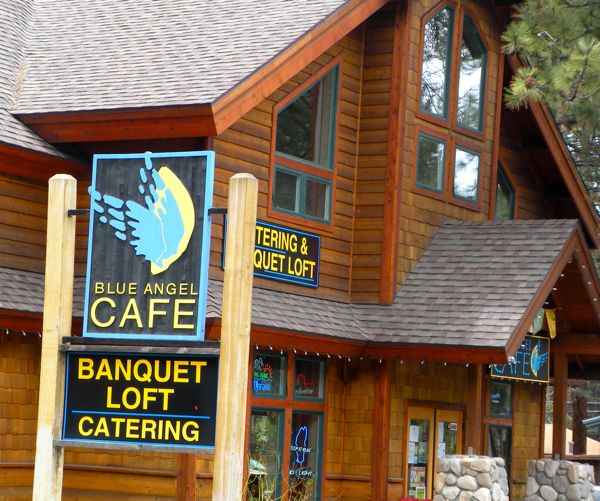
blue angel• Blue Angel Café in South Lake Tahoe is celebrating its 10th anniversary. There’s a party April 19 from 7-10pm.

• Minden-based International Network in Advance Gaming is now a member of the Association of Gaming Equipment Manufacturers.

• The Friday Evening Farmers Market at Kahle Community Park in Stateline starts May 3. The market is open from 4-7pm every Friday through Oct. 25.

• Tahoe Youth & Family Services has started a mentoring program in the Minden-Gardnerville area. For more info, call (775) 782.4202.

• Elegant Evening is April 20 from 5:30-10:30pm at Harrah’s Lake Tahoe. Proceeds benefit Soroptimist International Tahoe Sierra. Tickets are $50. For more info, email sitahoesierra@gmail.com.


Medicinal pot deliveries cropping up in S. Tahoe

By Kathryn Reed

Three businesses that are delivering medicinal marijuana in South Lake Tahoe may be violating the city’s laws.

City Manager Nancy Kerry told Lake Tahoe News she found out about the illegal operations on Monday.

“If it turns out they are operating a dispensary, they will be shut down,” Kerry said.

A man answering the Truckee number for Hip Joynt said his boss has been in South Tahoe since late last summer and in Truckee for a couple months before that. He, however, deferred all comments to his boss, who has not returned a call.

The woman answering the South Tahoe telephone for Hip Joynt said, “I’m not sure my boss is ready to be in the newspaper.” (The main number is out of the East Bay, as are most of the cities the company delivers to.)

The company’s website says, “We provide prompt, professional, discreet delivery of clinically tested cannabis and gourmet edibles throughout California, in strict compliance with state law.”

South Tahoe Police Chief Brian Uhler told Lake Tahoe News, “Transportation (of medicinal marijuana) is not covered in any provision of the law – state or federal.”

Pony Express, a company that tried to establish itself in South Lake Tahoe as a medical pot delivery service, was busted a little more than a year ago. The two defendants pleaded guilty to felony charges.

Uhler said he also recently became aware of the latest delivery services operating in town. He will be working with South Lake El Dorado Narcotics Enforcement Team to reel these ones in, too.

An Internet search of these types of services comes up with a handful on the South Shore and in the Truckee area.

A call to High Tides Medical Delivery went unanswered with no ability to leave a message. That business, according to its Yelp page, operates seven days a week from 9am-noon in South Lake Tahoe.

Chef Jenn’s Delivery Service has been operating in South Lake Tahoe since November. Jenn, who lives in town but would not give her last name, said she spoke with Kerry briefly on April 16.

“I don’t think I’m violating the law,” Jenn told Lake Tahoe News. “If there is a law I’m not following, please someone tell me so I can fix the problem. I’m more than willing to cooperate. I’ve never been a person who wants to break the law. I don’t want to cause problems.”

She deliveries the medicine to people who have medicinal marijuana cards. Some are shut-ins, some want privacy. It’s all by donation.

Jenn said 10 percent of what is collected is returned to the community. Lake Tahoe Wildlife Care has received a donation and the Boys & Girls Club of Lake Tahoe is next.

“I have real jobs. This is not how I make my money,” Jenn said.

In her kitchen she makes some of the edibles.

This, though, is in direct violation of the city’s medical marijuana ordinance. No one is supposed to be producing edible products in their homes.

Kerry said more time is needed to find out what the businesses are doing exactly and how they may or may not be complying with local, state and federal laws.


Alcohol Awareness Month focuses on preventing teen drinking

“Help for Today. Hope for Tomorrow” is the theme of this year’s National Alcohol Awareness Month.

The April campaign encourages individuals and families to get help for alcohol-related problems and to take steps to prevent alcohol use among youth.

“Alcohol remains the drug of choice for young people and is something we are concerned about in our communities,” said Shirley White, manager of the El Dorado County Alcohol and Drug Programs, said in a press release.

According to the most recent California Healthy Kids Survey, alcohol is the most frequently used substance among youth in grades 9-12 in El Dorado County.

“Our mission is to work with youth, schools, parents and community groups to help give youth the skills and opportunities to prevent alcohol use and to choose healthy behaviors,” said White.

ADP supports numerous substance abuse prevention projects throughout the County including a local community substance abuse prevention coalition, Club Live/Friday Night Live, Police Activities League programs and Teen Court. ADP offers substance abuse educational materials, assessments and referrals to local resources.

Data from the National Council on Alcoholism and Drug Dependency show that the sooner a child starts drinking, the more likely he or she is to develop a dependency and to graduate to other drugs. Children who begin drinking before the age of 15 are five times more likely to develop alcoholism than those who start at the age of 21.

According to White, parents have a profound influence over their children’s decisions about alcohol use. “Parental attitudes and messages around alcohol use make a lasting difference in their children’s lives,” said White. “While it may be common to think of drinking as a ‘rite of passage’ for youth, it is important for parents to emphasize that underage drinking is not only illegal and but often results in dangerous and life altering consequences. Alcohol use places teens at very high risk for developing chemical dependency, being involved in motor vehicle crashes, and other serious issues such as depression and increased risk of suicide.”

These tips can help prevent teen drinking:

• Know where your children are and who they are with. Teens are less likely to get into trouble if parents are aware of what they are doing.

• Don’t allow teens to drink in your home. Coordinate with parents to make sure parties and other social events your teen attends are alcohol- and drug- free.

• Lock up liquor cabinets at home. Some kids may drink after school when adults are at work.

• Try to get your child involved in school or recreational activities, and work with other parents and community leaders to provide safe alternatives for fun in the community.

• Provide consistent rules and boundaries, and enforce them.

• Talk with your child early about the importance of making good choices, not just for you but for themselves. Help them understand that the choices they make today can affect them for the rest of their lives.

More information, call (530) 621.6146.


Opinion: Questioning community colleges’ mission

By Warren Swil

The California budget crisis of recent years – which mercifully seems to be lifting – has been an excuse for many fundamental changes in the way our state serves its citizens.

One of these is the California ommunity college system – with 112 colleges serving 2.4 million students – that is in the midst of a subtle, unannounced shift from its historical twin missions of workforce training and offering affordable continuing education for lifelong learners.

community collegesIn fact, various legislative actions in recent years are gradually removing the “community” from the entire college concept.

Those who simply seek an affordable class in ceramics or art history for self-improvement, and those with post-secondary degrees who need retraining, are being shunted aside as the system narrows its focus to basic skills, vocational training and preparing students for transfer to four-year schools.

Its mission, increasingly, seems to be: “get ’em in, and get ’em out.”

Emblematic of this is SB1440, the Student Transfer Achievement Reform Act, signed into law in 2010.

While its intent – to foster closer cooperation between the two-year schools and the California State University system – is noble, largely due to the budget situation, its effect is to reduce the resources available for lifelong learners.

According to the joint website of the Community Colleges Chancellor’s office and CSU, SB1440 requires that by next year, the two systems negotiate new associate in arts degree and associate in science degree transfer programs.

“Upon completion of the associate degree, the student is eligible for transfer with junior standing into the California State University system,” it says.

While the focus on preparing students for transfer is laudable, it is having unintended consequences.

One of these was the September 2012 regulation approved by the California Community Colleges board of governors that established systemwide enrollment priorities “designed to ensure classes are available for students seeking job training, degree attainment or transfer to a four-year university and to reward students who make progress toward their educational goals,” according to an announcement from the chancellor’s office in March.

If you are just looking for a class to learn something about the history of the movies or want to burnish your computer skills, you go to the end of the line when it comes to class availability.

“In addition, students who have accumulated 100 or more units – excluding most basic skills English and math and English as a Second Language classes – by fall 2014 will lose priority enrollment,” the announcement said. Tough luck if you already have a bachelor’s degree.

Every student in the system will attest how difficult it already has become to get into a class, whether it is needed for graduation or completion of a certificate program or for any other reason.

Since the real estate crash and economic downturn, state funding for community colleges has been cut by $809 million, or 12 percent, according to the chancellor’s office.

Carla Rivera reported in the Los Angeles Times that, according to a report by the Public Policy Institute of California released last month, the system has endured funding cuts of $1.5 billion since 2007.

“Enrollment in California’s community colleges has plunged to a 20-year low as budget-strapped campuses have had to slash classes and instructors,” she wrote.

The report from PPIC notes that between the 2007-08 and 2011-12 budget cycles, courses were cut and class sizes increased. “Academic year course offerings fell 21 percent and summer offerings fell 60 percent in these years,” according to the report.

“While non-credit courses – those for remediation or enrichment – were cut dramatically, courses taken for credit toward a degree, certificate, or transfer sustained the bulk of the cuts because these classes make up 90 percent of all offerings.”

If Proposition 30 had not passed in November, the system would have faced another $338 million in cuts in the middle of the academic year, which translates into 180,000 fewer students. Since it was approved by a slim margin, colleges will now receive $210 million in additional funding and be able to serve 20,000 more students.

The trend is clear.

The mission of one of the pillars of California’s world-renowned two-year college system is being dramatically narrowed.

It seems to be abandoning its traditional role as an institution offering affordable continuing education and enrichment to those residents who need it the most.

This would be a tragic loss. Surely we can do better.

Warren Swil is an assistant professor of journalism at Pasadena City College. This column first appeared in the Sacramento Bee.




West Slope residents arrested on drug charges

By Cathy Locke, Sacramento Bee

A three-month investigation by the El Dorado County Sheriff’s Office has led to the arrest of a 51-year-old parolee from Placerville accused of selling heroin to undercover detectives.

The investigation began in January when sheriff’s patrol deputies received a report of a man threatening the life of another person. The man accused of making the threats was identified as parolee Ronnie Chambers, according to a sheriff’s office news release.

While investigating the threat, detectives discovered that Chambers wanted to sell cocaine, sheriff’s officials said.

Lauren Bond and Ronnie Chambers

Lauren Bond and Ronnie Chambers

During January, undercover detectives called Chambers and arranged to purchase $200 worth of cocaine from him.

They arranged to meet Chambers in Placerville, where Chambers reportedly sold them a substance that appeared to be cocaine.

The substance, however, was later determined to be crushed pills that contained morphine, sheriff’s officials said.

Undercover detectives later phoned Chambers and complained that they were not happy with his product. They told him they wanted their money back or the cocaine he originally promised them.

In February, while still investigating the threats, undercover detectives met with Chambers. At that time, Chambers provided them with $100 of the original $200 and a small amount of crystal methamphetamine, sheriff’s officials said.

Earlier this month, Chambers contacted the undercover detectives and offered to sell them heroin, which the detectives subsequently purchased from him, according to the news release.

At that time, Chambers was arrested along with a passenger in his vehicle, Lauren Bond, 22, of Shingle Springs.

Bond is accused of being in possession of narcotics paraphernalia at the time and having an active narcotics warrant for her arrest. Both were booked into El Dorado County jail on Thursday.

Sheriff’s officials said Chambers was on unsupervised parole and was also arrested on suspension of five drug-related felony offenses. He is being held without bail.


Vineyards are coming alive

Buds on vines are starting to pop out throughout the Sierra foothills in anticipation of the next crop. Passport weekend continues April 20-21 in El Dorado County. More info is online.


Wildlife Service tightens dog policy

By Tom Knudson, Sacramento Bee

Stung by charges of animal abuse, Wildlife Services – the federal government’s animal damage control agency – has adopted new guidelines for how its employees are to handle dogs in the field.

The change comes after an agency employee’s photos surfaced on the web in November showing his hunting dogs attacking a coyote caught in a leg-hold trap. The March 1 directive outlaws such behavior.

Wildlife advocates say it does not go far enough. They say Wyoming-based Wildlife Services trapper Jamie Olson should be fired and are calling on the agency to disclose the results of an investigation of the incident.

“This is unacceptable behavior for anyone, but such brutality is particularly alarming when demonstrated by a government employee tasked with responsibly managing wildlife,” wrote Cathy Liss, president of the Animal Welfare Institute, and Camilla Fox, executive director of Project Coyote, in a March 15 letter to the agency.

An online petition sponsored by Project Coyote calling for Olson’s termination has gathered more than 54,000 signatures.

Wildlife Services deputy administrator William Clay responded on March 25, writing to Liss and Fox that the investigation by USDA’s Administrative Investigations Compliance Branch is still in progress.

“Inhumane treatment of animals, if confirmed by a thorough review of the facts, would discredit the hundreds of professional, caring and responsible Wildlife Service employees dedicated to serving the American people,” Clay wrote.

Agency employees trap, shoot and poison hundreds of thousands of birds and mammals a year that are deemed a threat to agriculture, the public or the environment. Dogs are used to track, detect and disperse animals and as live decoys to lure coyotes within rifle range.

A 2004 agency directive said such activities “must be in compliance with state and local laws” and “dogs must be controllable at all times.”

The new directive, dated March 1, is more explicit.

“WS personnel shall not allow their trained dogs to have physical contact or in any way attack, bite or kill animals that are restrained in a trap or any other device,” it reads. “If a trained dog makes contact with a restrained animal, WS personnel must immediately intervene.”


Hot dog king who once lived in Tahoe dies

By Scott Glover, Los Angeles times

John Galardi, a fast food entrepreneur best known for founding the Wienerschnitzel hot dog chain, has died of pancreatic cancer, his company announced. He was 75.

Galardi also had business dealings in South Lake Tahoe. He was a partner in the El Dorado Improvement Corporation and at one time owned the Rodeway Inn.

Galardi died Saturday, according to the company release.

John Galardi had ties to South Lake Tahoe.

John Galardi had ties to South Lake Tahoe.

Galardi opened the first Wienerschnitzel stand in L.A.’s Wilmington neighborhood in 1961 when he was 23, according to a company biography. It’s now the world’s largest hot dog chain, with 350 locations selling more than a 120 million hot dogs a year.

As his hot dog business took off, Galardi added the Original Hamburger Stand and Tastee Freez to his portfolio, all operated under the Galardi Group, based in Irvine, the bio said.

“He has touched countless lives through his generosity as a business leader and his legacy will forever live on,” Dennis Tase, who handles day-to-day operations of the company, said in a prepared statement.

“Galardi built a brand representative of a time when life was simpler, a brand that holds a special place in the hearts of so many families in America. He will be deeply missed.”

Galardi is survived by his wife, Judane, and his four children.