Sports, war transform artificial limbs

By James Dao, New York Times

John Kremer, a Navy explosives expert, lost both his legs below the knee after stepping on a mine in Afghanistan in 2010. In his San Diego hospital bed, he assumed he would be chained to a wheelchair for a year or more. Walking seemed a distant goal. Running? He could barely comprehend the concept anymore.

But with the encouragement of therapists at the Naval Medical Center, Kremer was walking in two months, running in five and skydiving after nine. He did his first 10-kilometer race, about six miles, one year after stepping on the mine. Today he runs, swims or bikes almost daily and competes for the Navy’s wounded warrior team in swimming, shooting, seated volleyball and wheelchair basketball.

“For me, being able to compete was a big morale boost,” said Kremer, 29, a former explosive ordnance disposal technician first class, who was medically retired from the Navy last year.
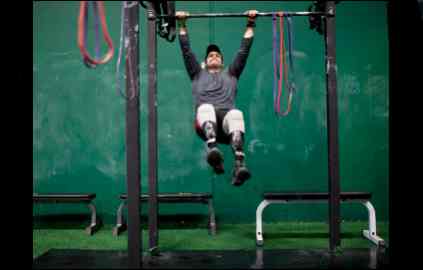
 Todd Heisler/The New York Times John Kremer, an explosives expert, lost both his legs below the knee.

John Kremer, an explosives expert, lost both his legs below the knee. Photo/Todd Heisler/New York Times

Like Kremer, more than 1,600 American service members lost limbs in Iraq or Afghanistan, mainly to homemade bombs not unlike the ones that maimed scores of people in Boston on Monday. Now, the vast body of knowledge gained from treating those troops is likely to help speed and improve the recovery of people whose limbs were amputated after Monday’s attack, experts say.

Over the past decade, prosthetic technology has advanced significantly, with computerized knees and ankles that adjust to terrain and activity. Lighter and more malleable materials have allowed amputees to wear synthetic legs longer — and even run marathons. And devices have been customized for a dizzying array of activities, from golfing and skiing to scuba diving, backpacking and even rock climbing.

Perhaps most significantly, doctors know more about treating and salvaging limbs, making recovery faster than a decade ago. Thousands of therapists have also been trained to care for wounds like those sustained in Boston. And groups that organize athletic events for disabled athletes have popped up across the country, serving both civilians and military veterans.

“What’s so great now is that there are literally thousands of trained instructors all over the country who know how to teach the disabled,” said Kirk Bauer, the executive director of Disabled Sport USA and a disabled Vietnam veteran.

“And there is state-of-the-art equipment that levels the playing field,” he said. “That’s been a revolution.”

Part of that revolution has been the view, now widely accepted, that athletic endeavor — whether competitive or recreational — helps amputees recover emotionally, psychologically and physically, even if they were not athletic before their injuries.

“It provides a sense of accomplishment and bonding,” said Richard Stieglitz, a physical therapist who is executive vice president at the Wounded Warrior Project, a nonprofit group created in 2003 to assist wounded veterans. “Very often doing something you never did before the injury is huge. It teaches people that life goes on.”

Seth D. Messinger, a University of Maryland anthropologist who has studied rehabilitation programs for the military, said training for athletics gives amputees a clear way of measuring the incremental progress of recovery.

“Rehab for traumatic limb loss is not a short thing, and patients want to know what they have to do next,” he said. “A sports model offers people a set of stages. You’ll walk between parallel bars, then walk with canes, then learn to run.”

But he and Stieglitz warned that athletics alone are not sufficient to address the less obvious problems that may accompany limb loss, like traumatic stress disorder or anxieties about employment.

“Dealing with those things could be more difficult than the amputations themselves,” Stieglitz said. “And just as they are for warriors, they may be hard to spot.”

For people not in the military, paying for care and prosthetic limbs may also be a major issue. The military provides almost unlimited therapy and multiple prostheses. Some wounded troops have three or four: one for walking, one for running, another for biking and other sports.

But private insurance, for those who have it, may limit visits to therapists and cover only a single, basic prosthetic leg. Buying an advanced device can cost more than $30,000; customizing them for various sports costs thousands more.

Still, Bauer, who lost his left leg above the knee to a grenade in Vietnam, says the world is far different from when he was injured in 1969.

Then, his first prosthetic leg was made of balsa wood with plastic laminate; today they contain carbon fiber, titanium and microprocessors. Then, orthopedic surgeons scoffed at the idea of skiing on an artificial leg. Today, his organization organizes expeditions to climb mountains and other strenuous athletic endeavors.

He has climbed Mount Kilimanjaro in Tanzania and attempted Mount McKinley in Alaska. He recently finished a grueling 26-mile hike through the desert of New Mexico and has completed marathons, including Boston’s.

“It was the greatest high in the world,” he said of finishing that race, in 2000. “This is what sports does for us, it gives us that confidence. You feel you can tackle the world.”




Auditor: Specialty license plate money not collected, misspent

By Torey Van Oot, Sacramento Bee

California’s state auditor has found shortcomings in management and oversight of special license plate programs meant to provide funding for causes like Lake Tahoe, anti-terrorism efforts and state parks.

The report, released today, found that the state has failed to collect more than $22 million in revenue that should be generated by the special plate holders in the 2010-11 and 2011-12 fiscal years. In some cases, agencies appeared to spend the money they did receive on “unallowable or unsupported” expenditures.

California motorists can elect to order special plates benefiting one of 11 causes. Revenue from the sales are supposed to go to state-run accounts like the Yosemite Fund, the California Arts Council, and a fund intended to “fight threats of terrorism in the Golden State.”

But that hasn’t always happened. The audit found cases where money generated by the special plates was not used for the designated purposes.

Fixing the problems, the Department of Motor Vehicles responded, may require such a costly computer upgrade that the program may not be financially viable.

The Department of Agriculture, for example, spent nearly $900,000 generated by one plate fund for expenses like employee compensation and building leases that they could not justify. The California Emergency Management Agency was unable to show that employees paid from funds generated by a special plate were working on the intended goal of preventing terrorism. In other instances, agencies failed to submit required reports on the funds to state lawmakers.

In some cases, the money was never collected in the first place. The audit found that the Department of Motor Vehicles, which issues the plates, missed out on $12 million in renewal fees it should have collected in the 2010-11 and 2011-12 fiscal years. The motorists who did pay were undercharged by an estimated $10 million. The DMV also overcharged Environmental Plate Fund more than $2 million to cover administrative costs.

The California Tahoe Conservancy collects about $1.2 million a year from the specialty Lake Tahoe plate. That money is then used on trails and other projects in the basin.

The audit, available here, calls on DMV to do a better job collecting and administering the funds and recommends a series of steps to increase monitoring and documentation of the spending.

In its response to the audit, the DMV pledged to conduct a review of whether it is charging the correct amounts for the plates. But the agency said efforts to do a better job tracking and collecting renewal fees could require a costly upgrade to its database systems.

“The costs associated with such an effort could be substantial and likely would result in severely reducing any net proceeds to the special plate funds or even eliminating the programs’ viability altogether,” Chief Deputy Director Jean Shiomoto wrote in a letter. “As a result, further study is warranted to identify alternatives and determine the true cost to implement necessary changes before a final decision can be made as to what is the most appropriate course of action for the State, taxpayers and special fund stakeholders.”


Letter: Freshies stands up against sexual violence

To the community,

Live Violence Free would like to formally thank Erik and Melodie Ulman, along with the whole Freshies crew, for the outstanding work and effort that they invested into this year’s annual Freshies Trading Places Fundraiser.

The fundraiser is hosted by Freshies every year in observance of Sexual Assault Awareness Month and Child Abuse Prevention Month. Freshies donates 100 percent of the proceeds raised through the event to Live Violence Free. This year’s fundraiser was a complete success and brought in over $1,400.

We greatly appreciate all the years of support and generosity that Freshies has continued to offer Live Violence Free and the survivors of violence in our community.

Support from local businesses like Freshies enables Live Violence Free to continue providing comprehensive, individualized assistance to all survivors of sexual assault, child abuse and domestic violence.

Diana Meza Cabrera, Live Violence Free


Loren Abbott — 1935-2013

Former Tahoe Daily Tribune Publisher Loren Abbott died April 9. He was 77.

Abbott was born in Eureka on Dec. 31, 1935.

He graduated from Humboldt State University with a bachelor’s degree in industrial arts. It was there that he met the love of his life, Shirley Samuelson. They married in 1957 and just recently celebrated their 56th wedding anniversary.

Loren Abbott

Loren Abbott

Abbott began his newspaper career at the Arcata Union at age 10. He was in the newspaper business for more than 50 years, having retired from the Tribune.

He spent most of his time at small papers, mostly owned by Swift Newspapers — Hanford Centennial, Herald Journal in Logan, Utah, Herald and News in Klamath Falls, Ore., Sierra Sun in Truckee, Greeley Tribune in Colorado and Nevada Appeal in Carson City.

His background was in advertising.

Most recently Abbott was living in Roseville, where he was a member of the Roseville Elks Club.

Abbott is survived by his wife, Shirley; his son, Loren Abbott Jr. and wife Didier of Lincoln; daughter, Lori Brown and husband Robert of Edwards, Colo.; his daughter, Lisa Smoot and husband Mike of Roseville; daughter, Leslie Coe and husband Dan of Rocklin; and several grandchildren.

A celebration of life will be April 28 at the Clubhouse at Diamond K Estates in Roseville. In lieu of flowers the family requests donations be made to the organization closest to your heart in remembrance of Abbott.


Lesson from Placer fire — don’t play with incendiary devices

By Ed Fletcher, Sacramento Bee

In a scene that might have made Smokey Bear cringe, on a 100-degree day last July, a Sacramento man – in full view of his family and other witnesses – tossed a 2-inch diameter firework into a remote Placer County swimming hole.

An ember from the explosion shot 25 feet into the air, beyond a sheer rock face around the swimming hole on Shirttail Creek, and ignited the 2012 Robbers Fire, court documents show. The fire engulfed 2,630 acres, injured an inmate firefighter and destroyed four structures.

Bryon Craig Mason, 28, admitted to throwing the illegal firework, but his lawyer successfully argued during Mason’s preliminary hearing that Mason wasn’t guilty of arson because the fire wasn’t started willfully and maliciously.

The 2012 Robbers Fire in Placer County is reminder of how dry conditions can rapidly ignite. Photo/Randy Pench/AP

The 2012 Robbers Fire in Placer County is a reminder how dry conditions can rapidly ignite. Photo/Randy Pench/AP

“There is no evidence to support the conclusion that a reasonable person would find it highly probable that the firework would explode in the water” clear a 25 feet high rock face and ignite a fire, said Placer Superior Court Judge Colleen Nichols in her ruling releasing Mason from custody earlier this month.

In her ruling, Nichols cited concerns about the credibility of the California Department of Forestry and Fire Prevention’s investigation of the fire.

The Placer County District Attorney’s Office has said it disagrees with the ruling but has not said whether it will make further efforts to prosecute the case. The District Attorney’s Office did not return calls for comment.

While prosecution of the incident may be in limbo, it does serve as a cautionary tale as fire season in Northern California approaches.

The region saw heavy precipitation early in the season but has been exceptionally dry since. Snowmelt is also ahead of schedule, pointing to an early start to fire season, said Tom Dang, a meteorologist with the National Weather Service.

“That basically prolongs the fire season for a month,” Dang said. “If we don’t see any precipitation between now and the end of the summer, fuels are going to be at exceptionally dry levels.”

He said the region may well see another storm before the end of May, but there are no significant storms on the immediate horizon.

Rui Cunha, assistant director of emergency services for Placer County, called for extra vigilance this summer.

“There is no question about it. The forest fuels are not getting the normal range of moisture. We are definitely going to feel the impact from that,” Cunha said. “It’s going to be even more important that we keep fire out of our forest land.”

Daniel Berlant, spokesman for CalFire, echoed the call for fire safety, saying: “We need to practice extra precaution.” He declined to talk about the case against Mason.

Placer County Supervisor Jim Holmes said the start of the Robbers Fire provides a fine example of why people shouldn’t play with matches. He said he could see how someone might think throwing fireworks into water was safe.

“I wouldn’t have done it, but I would have assumed it would be safe,” Holmes said. “It’s an unfortunate incident. I’m sure the gentleman had no malice. He wasn’t trying to set a fire. He was just trying to show off.”


Better to text than call during emergency

By Brad Stone, Bloomberg Businessweek

Toward the bottom of the list of disturbing aspects about Monday’s bombing at the Boston Marathon was this: Cellular networks in the area almost immediately slowed down and, for periods of time, appeared to stop working altogether. Runners and their loved ones could not connect, and victims had trouble communicating with emergency responders.

That frustrating scene has become familiar, evoking disasters from the Sept. 11 attacks in 2001 to Hurricane Sandy in 2012. We rely on cell phones to run our lives, but they tend to be useless – or at least far from useful – when we need them most.

Initial reports suggested that authorities deliberately shut down mobile networks in Boston to avoid the possibility that mobile devices could be used to trigger more bombs. The Associated Press reported this and then quickly reversed itself. The major wireless carriers denied it, saying that the networks were simply suffering from congestion: Too many people were trying to use their phones at the same time to get help or tell family and friends they were OK.

“Thinking of those at #BostonMarathon,” AT&T tweeted at around 5:30pm. “For those in the area, please use text & we ask that you keep non-emergency calls to a minimum.”

A Verizon Wireless representative also suggested that customers in the area use text messages or email to free up capacity for public safety officials.

The science behind these failures in wireless networks isn’t complicated. In every city, each mobile carrier operates hundreds or thousands of cell towers, which route calls and data to the carrier’s backbone network. Each tower is designed to accommodate a set number of calls per second, per a certain geographic area. In a crisis, when everyone naturally reaches for their phones, that limit is quickly surpassed and the radios on the tower get sluggish.

Mobile analyst Chetan Sharma, who estimates that a cell site can handle 150 to 200 calls per second per sector, said, “We’ve all had the experience of a fast-busy signal. That is the network telling you, ‘Sorry, but your cell is overloaded. There is no more space.'”

In these situations, sending texts or email is a better option because messages can be queued up and delivered as capacity becomes available. Twitter is especially efficient because information can be spread quickly and widely – one reason why the service has become increasingly important and reliable in a crisis. Google’s Person Finder, a central digital bulletin board for survivors and families of those in a crisis zone, has also proven invaluable.

Until it was debunked, the rumor that police deliberately shut down cell networks was an intriguing one. This is almost unheard of. When it has occurred, the practice has been controversial.

In August 2011, BART officials shut down underground phone service to prevent activists from coordinating their activities as they protested a shooting by BART police. The shutdown led to criticism that police were hindering the activists’ right to free speech, spurring a further round of protests. The police argued that they acted to protect the public.

Monday’s situation was different, of course. ABC News reported in a tweet that police were asking people on the scene not to use cell phones because they might set off other explosive devices. Still, it does not appear there was any widespread directive from law enforcement to shut down cell networks, and authorities appear to believe that cell phones do more to help than hurt in an emergency.

“The belief is that much more good comes from networks being available than the risk of them being utilized for bad intentions,” said Charles Golvin, an analyst at Forrester Research.

Can anything be done to improve network performance during tragedies such as Monday’s bombing? Probably not much. Carriers could engineer networks to handle these situations by adding radios and towers and amplifying connections from the towers to the network’s backbone. But a vast majority of that extra capacity would then be wasted.

“Over the years, a lot of research has gone into analyzing the trade-off between cost and capacity, and today’s networks are designed to provide enough capacity during the vast majority of ‘normal’ conditions,” Golvin said.

Just as landline networks were never meant to allow every person with a phone to place a call at the same time, wireless networks are designed to align resources with normal peak call volumes in the most efficient manner possible. As a result, hearing a loved one’s voice in the tense minutes after an emergency may always be difficult.


Clothing swap redefines spring cleaning

Tired of your wardrobe?

What is being billed as the biggest, baddest, best clothing swap in Tahoe is just around the corner.

The All Tahoe Clothing Swap at the American Legion in South Lake Tahoe is May 1 starting at 6:30pm.

The event is open to anyone and everyone.

Clothing donations will be accepted at Pearl Izumi in the Factory Outlets at the Y until April 26.

Entrance fee for the All Tahoe Clothing Swap is a canned or non-perishable food item for Christmas Cheer. Attendees do not need to donate clothing to attend, though it’s encouraged.

The event is the brainchild of the Girls Drinking Club social group, a group of local professional women who are collectively tired of their wardrobes.

More information may be found by contacting jenngleckman@gmail.com or going online.


Some California employers welcome immigration reform

By Shan Li and Diana Marcum, Los Angeles Times

Central Valley farmers, Southern California bankers and Silicon Valley executives have all struggled to find workers — and they say an outdated immigration policy has been to blame.

They’re all hoping that a bipartisan group of U.S. senators will have the answer when it unveils its plan, as early as this week, to overhaul federal immigration laws.

Their stance: Reform couldn’t come quickly enough.

“What’s at stake is the future of our economy, whether we can remain the most entrepreneurial nation,” said Steve Case, co-founder of America Online and now chairman of investment firm Revolution. He called immigration a “key reason why America has been innovative and entrepreneurial and has had the leading economy in the world.”

The danger of not having a viable immigration plan is evident to Steve Spate. The Central Valley raisin grower whose farm is just west of Selma said he has struggled with a perennial labor shortage.

“When you’re standing on the edge of your fields in the morning and the rains are coming and not enough workers show up, when your livelihood and your ability to make payments on your house and your equipment are on the line, you’ll take anybody you can find,” he said.

Foreign workers affect nearly every aspect of the state’s economy.

Those highly educated work in Silicon Valley start-ups and tech giants such as Facebook and Google. Low-wage workers toil in farms, serve food in restaurants and work in hotels. The construction industry employs a number of immigrants to build homes.

The sweeping bill tries to fix huge problems plaguing the U.S. and its inflow of foreign workers.

Crafted by four Democratic and four Republican senators known as the Gang of Eight, the bill is aimed at creating an immigration system for the 21st century.

It offers, for instance, a 13-year pathway to citizenship for many of the 11 million immigrants already living here illegally. And it allocates billions of dollars — including $3 billion for increased surveillance — to tighten border security.

Under the bill, more foreigners with in-demand job skills will be able to get visas; currently those with family members already here are heavily favored.

Part of the bill would create new guest worker programs for farmhands and low-wage workers. Another section raises the cap on temporary high-skilled visas and creates a “start-up” visa for entrepreneurs who want to found companies in the U.S.

“It will be a tremendous boost to California’s economy,” said Sung Won Sohn, an economics professor at Cal State Channel Islands. “We will be able to get the right people from overseas and utilize them for the benefit of the economy.”

But the bill still faces many hurdles, even after months of negotiations among the eight senators. Opponents of any reform that offers a road to citizenship for undocumented workers in the U.S. can kill the bill. An immigration overhaul attempt under President George W. Bush in 2007, the last time a serious effort was made to retool the system, died on the Senate floor.

But this time around, public opinion may be on the bill’s side. Nearly two-thirds of Americans support giving undocumented workers a way to attain citizenship, according to a recent survey by the Brookings Institution and the Public Religion Research Institute. Sixty-eight percent polled say that a combination of enforcement and a path to citizenship was the best cure for the country’s illegal immigration problems.

Many California businesses welcomed the outline of the bill released Tuesday.

Farmers already struggling with a slowdown in workers from Mexico — brought on by a border crackdown, faltering economic recovery and drug violence — were hopeful the bill could widen the pool of laborers.

“The ones from Mexico are here to work,” said Ken Shinkawa, a raisin grower in Caruthers. “They don’t fool around. They just want to make their money and go home.”

In the past, Shinkawa said, he was forced to hire mostly undocumented workers. He has tried hiring U.S. employees, but that has never worked out. One year, he said, the Fresno residents he brought on couldn’t pick and stole his air conditioner.

And lately, he’s had trouble finding anyone to work his fields.

High-tech firms, which have lobbied hard for immigration reform, say the bill would bring much-needed highly skilled workers and entice international students who attend U.S. colleges to stay after graduation. Mark Zuckerberg, chief executive of Facebook Inc., even joined forces with executives from Google, Yahoo and other tech giants to form a new initiative called Fwd.us to push for reform.

“Immigration is innovation,” said Dean Garfield, chief executive of the Information Technology Industry Council, an advocacy group for tech firms. “Every day that goes by without immigration reform is another day when new jobs and new industries start in a foreign country.”

Already, about 35 percent to 40 percent of Silicon Valley’s workers are foreign, said Stephen Levy, director of the Center for Continuing Study of the California Economy. He said guest workers can help plug a gap in California as highly skilled baby boomers retire.

The finance and banking industry is also eager to hire workers such as mathematicians and computer experts to create programs to maximize trading and fight cyber attacks, said Scott Talbott, senior lobbyist for the Financial Services Roundtable, which represents banks, insurers and investment firms.

Los Angeles-based City National Bank already employs immigrants from Russia, Mexico, India and elsewhere, said Chief Executive Russell Goldsmith. He said one of the bank’s biggest strengths is being able to attract “some of the best and brightest individuals from all over the world.”

“We need and do hire people born elsewhere in information services and technology,” he said. “But you’ll find people born elsewhere throughout the bank.”


Snippets about Lake Tahoe

slt• South Lake Tahoe is participating with much of the rest of the nation in honoring President Obama’s proclamation to lower flags to half staff until dusk April 20 in honor of the victims of the April 15 Boston Marathon bombings.

• Rep. Tom McClintock, R-Granite Bay, will participate in two events in Truckee on May 2. At noon he will speak at the Truckee Rotary Club lunch at the Truckee Recreational Center, 8924 Donner Pass Road. At 6pm he will have a town hall meeting at the Truckee Tahoe Airport Community Room, 10356 Truckee Airport Road.

• Starting June 6 there will be direct service on Allegiant between Reno-Tahoe International Airport and Bellingham, Wash.

• Meet at South Shore Bikes at the Y in South Lake Tahoe and then pedal to Mo’s Place on May 16 starting at 4pm. The spirit bike parade is put on the Slowrollers Bike Club. (Last year’s event did not set a Guinness World Record because cyclists could not stay in a straight line.)

• As the official training destination of Ironman for the Western United States, Squaw Valley will host official Ironman training weekends throughout the summer.


El Dorado County wine sales increasing

By Kathryn Reed

PLACERVILLE – Based on the number of cases leaving wineries and headed for vehicles, wine sales in El Dorado County are doing well.

Granted, buyers could have been lured by last weekend being the first of two weekends of the annual Passport where there are some special deals going on that aren’t seen the rest of the year. Still, winery officials told Lake Tahoe News that people are buying wine year-round.

The Wine Institute earlier this month said wine sales in the United States hit a record in 2012. The 360.1 million cases sold was an increase of 2 percent from 2011. The retail value of that wine was $34.6 billion.

Guy Herriott of Fenton Herriott provides a sample of the 2010 Merlot. Photos/Kathryn Reed

Guy Herriott of Fenton Herriott provides a sample of the 2010 Merlot. Photos/Kathryn Reed

California wineries sold 207.7 million cases – which accounts for 58 percent of the U.S. wine market.

“In the last six months there has been more of an uptick in wine sales,” Justin Boeger with Boeger Winery in Placerville told Lake Tahoe News. His parents opened the winery in 1974.

The lower priced wines continue to be the better sellers Boeger said, admitting this is an indication the economy has not completely turned around. His philosophy is to charge an appropriate price – not inflate the value.

Boeger said he likes to shop in the $20 bottle range so he tries to have many of the wines he sells be in that price point.

He is seeing a growth in Barbera sales.

“I think the Barbera grape is particularly situated to the foothills because of its natural acidity (in the soil),” Boeger said.

Fenton Herriott Vineyards has been seeing steady growth in its sales since opening in 2006.

Winemaker and owner Guy Herriott said one key to being successful is having a variety of wines for people to taste.

On this particular weekend he is pouring the 2009 Merlot from bottles and samples of the 2010 Merlot from barrels. This is not a varietal found in the foothills with regularity or one that is memorable. Fenton Herriott is proving Merlot and El Dorado County go together.

Herriott said with people forgetting the movie “Sideways” that dissed Merlot, the varietal is making a comeback.

To make sure his wines don’t sit in a warehouse, Steve Grace of Grace Patriot Wines recently hired two people who are savvy in social media and other marketing techniques that aren’t necessarily traditional for the wine industry.

Even so, the former plastic surgeon from Reno told Lake Tahoe News, “Direct sales are the best.” This means no middleman – instead putting the wines in customers’ hands as they leave the tasting room.

Their first vintage was 2004, with the tasting room opening in January 2011. As one of the newer wineries, Grace Patriot has not had to weather the farming and economic cycles like some of its neighbors.

Since the first crush in 2000, Aaron Hill – owner and winemaker at Illuminare – says sales have increased by the same percentage each year. The Petit Verdot is his best seller.

Illuminare produces almost 2,700 cases a year, with that number increasing a little each year.

Hill attributes the growth to having affordable wines, people choosing to take trips closer to home and wine tasting along the way, and people not wanting to give up wine no matter the economy.

At Jodar Vineyards, which has been bottling wine since 1990, the predominant change over the past few years is the age of the person visiting the winery. It’s people over 40.

This is particularly evident with the Passport crowd, which in years past was full of twentysomethings who rented limos and acted more like they were out to get drunk than on an outing to discover a new wine for the cellar.

Last weekend for Passport it was less party atmosphere and more talk of the wines and food being paired at the various stations. It was about buying something for down the road and not how much could be consumed that day.

It was about wine sales.

Notes:

• El Dorado County Passport Weekend continues April 20-21. Tickets and information are available online.

• Many of the winemakers praised the 2012 crop, saying what’s in the bottles could be outstanding.

ngg_shortcode_0_placeholder (Click on photos to enlarge.)