‘All the President’s Men Revisited’ — not just a nostalgia trip

By Hank Stuever, Washington Post

Around here, the offer of watching a two-hour documentary about how Washington Post reporters Bob Woodward and Carl Bernstein chased the Watergate story is about as appealing as taking the car into the shop to get the tires rotated. I’m looking at the calendar and not seeing what we like to call the peg. (The 40th anniversary of the middle of the Watergate saga? The 37th anniversary of the movie premiere of “All the President’s Men?” The 563rd anniversary of the printing press?)

Yet here I sit, thoroughly absorbed by executive producer/narrator Robert Redford’s “All the President’s Men Revisited,” a fresh and even stirring reminiscence airing this Sunday on Discovery.

Redford and his crew, including director Peter Schnall, stylishly manage what countless think tank and j-school panel discussions struggle to do — cut through the recollections of the major players (Woodward, Bernstein, their boss Ben Bradlee, Nixon White House counsel John Dean, etc.) and utilize their well-trod anecdotes and war stories in a way that seems new.

Because let’s face it: Watergate is fading before our eyes. For measuring distance, we in 2013 are now farther away from the events portrayed in “All the President’s Men” than the film “Bonnie and Clyde” was from the real Bonnie and Clyde. Richard Nixon himself is nearly 20 years gone. Mark Felt, the former FBI official who outed himself as Deep Throat in 2005, died four-plus years ago. And while the Post legends and ex-White House staffers (the film also talks to Hugh W. Sloan, Bud Krogh and Alexander Butterfield) come across as a relatively hale bunch in this film, it is in fact the younger interview subjects who do the most to revivify the entire saga as both a political and cultural watershed.

Thus Jon Stewart of “The Daily Show” shares a bit of the ubiquitous and jowly impression of Richard Nixon he used to do as a boy. (Any American who was a child during the Watergate years remembers how you could get the adults in the room to laugh and pay attention to you with a well-timed slouch and “I am not a crook.” You didn’t even really have to know what it meant.) “Ten years old [and] I had my Nixon down,” Stewart says in the film. “Now I have a much more complex view of the man and his presidency. The sad truth is, I think Nixon would by today’s standards be considered maybe a conservative Democrat, [and] maybe at some levels a radical leftist.”

And MSNBC’s Rachel Maddow, who was an infant during the Watergate hearings, is always good at giving history’s constitutional crises a relevant place in today’s conversation: “Richard Nixon is now the guy who, when you see photos of him even at his prime, you cannot believe he was ever president of the United States.”

It’s smart of Redford and company to acknowledge all this. But their “All the President’s Men Revisited” is no Watergate for Dummies, either; it is as concerned with the historical ramifications as it is with the imprint on popular lore and culture. Those who lived through it will find what they’re looking for, whether it’s a renewed sense of apoplexy or even just bemusement. Those who came along after won’t feel that familiar shame of being treated like a kid.

Through his narration, Redford, who portrayed Woodward in Alan J. Pakula’s still popular 1976 movie, makes clear that he’s working out a couple of things here: What is Watergate’s resonance? What do we — as a culture — remember most? What’s different about the world now when compared to the world of 1972? He’s as interested in talking to people like Sloan and Dean as he is in talking to his old pal (and co-star) Dustin Hoffman, who played Bernstein.

“I was amazed by Woodward and Bernstein’s resolve,” Redford tells the viewer. “There’s nothing glamorous about what they were doing, but I thought it was important to portray the tedium, the hard work. And the feelings about the film from the studio’s standpoint was [that the story was] noncommercial. ‘Newspapers, typewriters, phones? Hunh-unh,’ ” Redford characterizes the lukewarm-to-negative response in Hollywood. “‘Washington? Huh-unh.’”

It turned out that the trappings and tools and personalities of journalism were, for a glorious moment, in­cred­ibly sexy. Now Redford and his crew return with Woodward, Bernstein and ­Bradlee to the newsroom on the fifth floor of that brown, Brutalist property on 15th Street that is (you may have heard) currently for sale, probably as a teardown. With Vanity Fair photographer Annie Leibovitz there to document them, and Discovery’s cameras documenting that, and a newsroom full of Posties observing this A-list distraction with equal measures of admiration and weariness (“Watergate, again?”), an awkward vibe of cinema verité sets in. Working at the Post now, one feels a reverential obligation to the work that brought us here, while hurrying like mad toward a future no one has figured out.

“It sure is quiet in here,” Bernstein observes, surveying a plum- and chartreuse-schemed news operation that is centered around a starship bridge of high-def TV screens. Gone is the clatter of typewriters and jangling of phones; gone is the ability to chain-smoke at one’s desk, the way Bernstein did. (“Why did things have to change?” Woodward jokingly asks.)

Rather than revel in newspaperdom’s former glories, “All the President’s Men Revisited” asks a very good question: If a president’s re-election committee authorized the break-in of the other party’s campaign offices, how would the story unfold now? How would it be reported? How would it play?

Marcus Brauchli, who was the Post’s executive editor at the time of the film crew’s visit, gives an eloquent answer that takes into account the new media landscape and why things can never be like they were. As he describes how Twitter users and partisan watchdogs would pounce on the news of the Watergate break-in, the screen itself splinters into an effective chaos of sources, voices and information, which would simultaneously advance, spin and debunk the break-in and its impact. What took Woodward and Bernstein (and other news organizations and, lest anyone forget, prosecutors) weeks and months to piece together could come together in a day or two; the work would happen at those very cubicles Bernstein finds so unsettlingly quiet, as wonks wearing headphones dive deep into databases. Professional and amateur reporters would be following the money, in real time. “The tedium, the hard work” that Redford admired back in the ’70s are what remain. As then, the skill is in the sifting, the verifying.

“All the President’s Men Revisited” spends just enough time on this sort of thing without becoming one more ambivalent documentary about the future of news. Instead, it turns to the epic tragedy that was Nixon himself.

By the time the “smoking gun” tape brings the president down, the film struggles to maintain the artful distance it had so capably established for two hours; those who are old enough to remember their anger and outrage quickly rediscover it. The tape unspools and the paranoia takes hold. “It’s hard to get past the tapes,” political consultant Mary Matalin observes. “Just the insanity.”

“The real Nixon is on those tapes,” Bernstein says. “It is a road map of his mind, it is a road map of his presidency.”

Ben Stein, who is glimpsed as a young man in the footage of doleful White House staffers listening to Nixon’s farewell speech in the East Room (“My mother was a saint,” etc.), reflects on it once more: “It’s really sad. I don’t think any president has been more persecuted than Nixon. I think he was a saint.”

Then Stein breaks into tears, which comes off as both ridiculous and moving, depending on the viewer. This is the first project I’ve seen that seems to understand that, when it comes to Watergate, there is something about it that remains deeply personal, and not just for the people who experienced it firsthand. We live — and even thrive — in the crater it left behind.
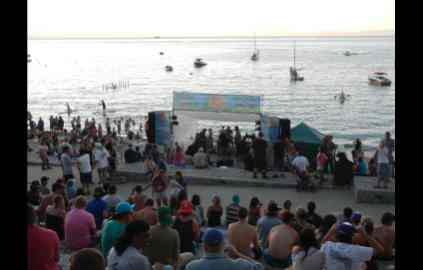
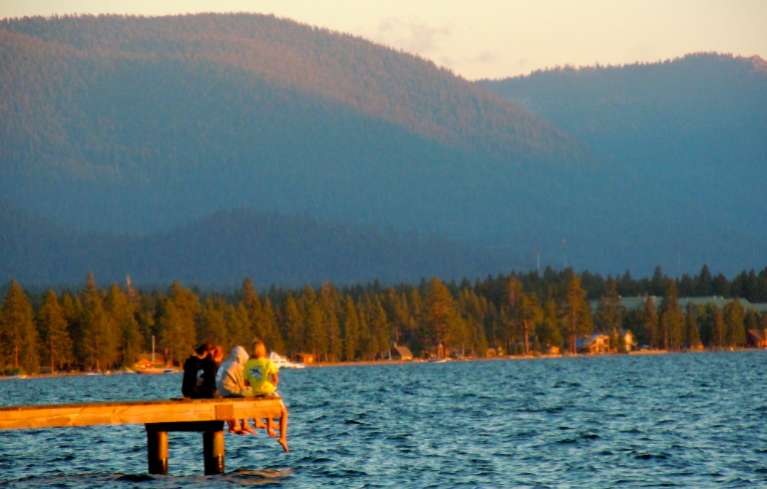
LTWC making progress to move, expand

Lake Tahoe Wildlife Care founders Tom and Cheryl Millham were honored at this week’s South Lake Tahoe City Council meeting for their 35 years of rehabbing wildlife.

Tom Millham spoke briefly with Lake Tahoe News after the recognition ceremony.

In the next two to three weeks the nonprofit will be looking for builders, surveyors, excavators and others who can help transform the 16-acre Echo Creek Ranch into a world-class wildlife care and education center.

The project is expected to go the Tahoe Regional Planning Agency Governing Board in June. A new special use permit from El Dorado County will also have to be obtained.

The wildlife center is currently operated on a half acre that is the Millhams’ back yard in what is now a residential area of the county.

“Once we get the approvals, then we will begin to negotiate to purchase the property,” Millham said.

It’s possible the underground infrastructure could be in place this fall.

A bridge will be built over Echo Creek so long-term cages can be put there for bears, bobcats, coyotes and other animals.

A building already on the property will become the education center.

Millham estimates it will cost $12 million to buy the land and make all the improvements. Most of the money still needs to be raised.

— Lake Tahoe News staff report


Tourism advice for Tahoe

Caroline Beteta, CEO of Visit California and chairwoman of Brand USA, left, along with Denise Pirrotti Hummell, CEO and founder of Universal Consensus, talk April 18 at Harveys in Stateline about Tahoe can do better to attract the international traveler.


Whales play to the tune of human chorus

By Robert S. Wood

BAJA, Mexico – Do whales seek human playmates?

The adventure company brochure didn’t quite claim they did, but it intriguingly reported that many a mama gray whale saw fit to bring her newborn 1 ton baby up to visit small open boats in a Mexican lagoon, even sometimes allowing the babies to be “petted.”

My wife, Deanne, and I had been in the ocean with dolphins and swam with sharks, manta rays, seals, turtles and schools of friendly toe-nibbling fish. So why not whales? We signed up.

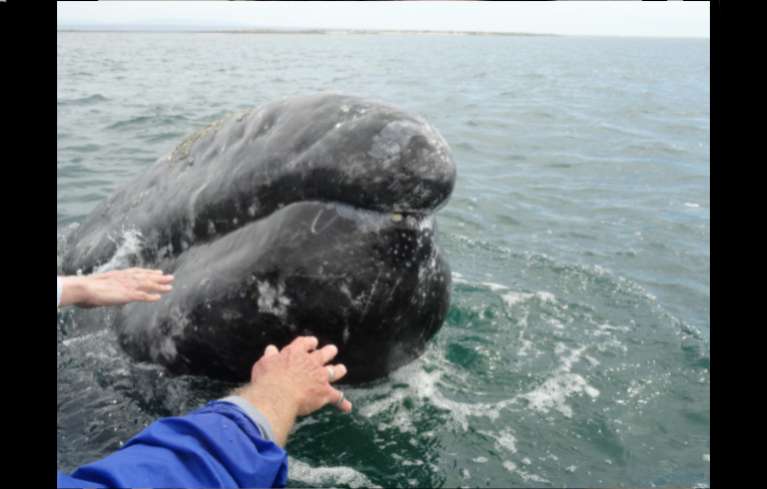
Reaching to touch whales near Baja, Mexico. Photos/Robert S. Wood

Reaching to touch whales near Baja. Photos/Robert S. Wood

After departing from San Diego, it took our old Mexican bus two days to descend the Baja peninsula of Mexico 500 miles to the salt company mining town of Guerrero Negro near Scammon’s Lagoon, halfway down Baja. The next morning we drove on roads paved with salt past evaporating salt ponds to the waiting boats. Twenty-four of us piled out of the bus, donned life jackets and climbed into two 18-foot open fishing boats called pangas, powered by big outboard motors. We then set off at high speed to look for playful whales, feeling a little silly about what we were doing.

The lagoon was nothing like I’d imagined. There wasn’t so much as a cactus in sight, never mind grass or trees, just salt, sea and gleaming white sand dunes sandwiched between blue water and sky. The glare was terrific. When we reached the whale watching grounds, the lagoon looked more like open ocean with only one distant shoreline in sight. But the whales were there – 1,600 of them had been counted the previous week, including a white whale, great-grandson of Moby. They were peacefully cruising at a respectable half-mile distance. We saw their spouts, we saw sleek black backs emerge for a few seconds when they came up for air. But the closest was probably 300 yards away. Big deal.

After two hours of bobbing, waiting and watching — our allotted viewing time almost up — some of us in frustration began to jokingly call out to them, “Come on, whaleys. Don’t be afraid. We’re your friends. We won’t bite. Look, no harpoons. Bring us your pretty babies!” We were feeling more foolish by the minute.

Then suddenly a huge black streaming back, twice the size of the boat, reared up from the deep, not 10 feet away, and looked us over. We gasped in awe. It was as big as our bus. As we gaped, the Mexican captain beside me tapped my shoulder, pointing down and said “Baby! Mama and baby.”

Not 3 feet from the boat lay the head of a 2-ton “baby” whale, also bigger than the boat.

I lunged to the rail, dropping to my knees, yelled “Baby here!” and reached out as far as I could. Incredibly, I touched smooth, soft wet whale forehead. It felt like hard wet rubber. Immediately, my 11 companions joined me at the rail, which tipped the boat alarmingly and we shipped a little water. I glanced at the captain but he just smiled and started bailing.

About half of us had touched at least once before the whales moved away and it was time to go. We rocketed back to the dock and our bus. The other boat, it turned out, had not even seen a whale up close, but its envious grumbling occupants admitted they hadn’t resorted to calling for them.

After a night in the date palm oasis of the nearby village of San Ignacio, we set forth for another lagoon favored by calving grays. This time conditions were less inviting. We rose in the chilly dark and rode the bus on a bumpy dirt road to San Ignacio Lagoon, a hundred miles south of Scammon’s. It was barely light when we reached the end of the road at a lonely shell beach. The sky was solid cloud and windy. There was no boat ramp or dock. The tide was out and there were white caps. Pangas were bobbing in the shallows a hundred yards offshore. So we rolled up our pants and waded out to the boats to begin another high-speed ride to the whales.

When we stopped, there wasn’t a whale in sight and our boat was lurching uncomfortably, so we promptly proceeded to get silly. We chanted nursery rhymes, sang songs from kindergarten, substituting whale lyrics. We rendered rounds of “Row, row, row your boat, gently down the lagoon.” We yelled, we begged, we laughed at each others puns and entreaties, we flattered and pleaded, called out endearing terms. Deanne in the bow delivered a continuous stream of melodious welcome. Even the Mexican captain, smiling at our antics, sang a whale song in Spanish.

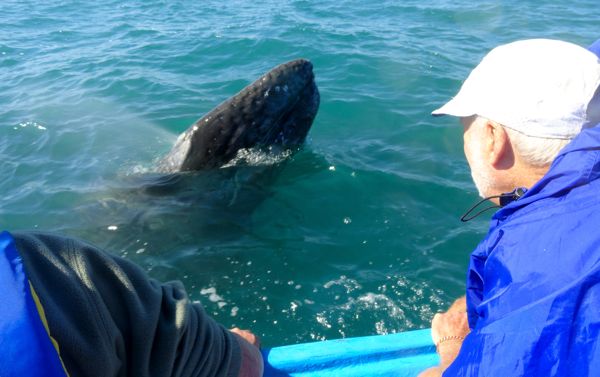
This time we didn’t have to wait. Whales have good hearing and they quickly appeared around us. Always mamas with babies, never males. It was a clear case of, “If you call, they will come.”

Before our two hours were up, three mama whales had brought us their babies, one brought a pair. Though we couldn’t help ridiculously personifying and judging their actions and intent, it seemed clear that the mamas somehow wanted their babies to meet us, to connect, to be touched, strange as that seemed.

Though these huge creatures often touched the boat, it was never more than a gentle nudge. They could easily have turned us over or sunk us with ease, with a flick of that gigantic tail, as the whalers of yesteryear well knew when their boats were smashed to splinters. I asked the captain if that ever happened. “Nunca” (never) he assured me.

When our time was up and we returned to shore, we again found the other boat had had only one brief encounter and were even more envious, vowing that tomorrow they were going with Deanne. Someone called her the Whale Whisperer.

For our third and final voyage we returned to Scammon’s Lagoon. On the way a lively young Mexican guide named Edgar verified our growing suspicions that whales wanted to interact with us but were highly sensitive to vibes given off by boaters, dependably drawn to the happy ones.

“Otherwise, why would they come to us?” he asked, “They seem to like excited children best, then expressive women. They seem to prefer higher voices. I’ve come to believe they love open, free independent creatures like themselves. Remember, they’re wild and unspoiled, unrestrained even joyful.

“So your best chance of making contact is to be happy like them. You can attract them from far away with a simpatico frequency of happy vibrations. I find they stay away from people who are angry, rigid or unhappy. Can you blame them? I often see the mamas actually push their babies up to the boats they like. They seem to want their calves to make human contact before they leave the lagoon to begin that 4,000-mile swim to the arctic to feed. Don’t ask me why.”

Whales come to boats -- once beckoned to do so.

Whales come to boats — once beckoned to do so.

He added, “But one thing I do know, if they didn’t want our company, you’d never see more than a distant spout. ”

Remembering that last voyage brings tears to my eyes, not just for the whales but for the wonderful group camaraderie that developed. Everyone wanted to be in the boat with Deanne who outdid herself in a continuous welcoming, loving out reach to the whales. Now that we knew how to attract them, they quickly came. Boy, did they come! We soon lost count of the numbers of touches we enjoyed. Baby whales were with us for most of our two hours.

Thirty-five ton mothers the size of locomotives swam directly at us and smoothly dove beneath the boat, missing it by inches, coming up on the other side, but we felt no anxiety. Instead we felt a wonderful sense of harmony, wellbeing, even love freely exchanged with our massive fellow creatures. Whales stood on their tails, 10 feet of their heads sticking out of water, in an amusing pose called “spyhopping,” recalling sentinel Meer cats or lookout prairie dogs. It was thrilling to make eye contact with a whale eye the size of a bowling ball.

In the course of two hours I looked down into blowholes, marveling at the workings of that intricate dinner plate sized muscle. Babies teased us by spouting in our faces. Mothers blew from just underwater, sending up gushing fountains of seawater. More than once a whale blew within 3 feet, sending rainbows of spray over us, wetting us and our cameras with an earthy smelling warm whale exhaust. But we didn’t care.

Everyone was laughing, exclaiming at the miracle taking place. We were torn between the desire to touch and rub and stroke — and taking pictures. Since whale movements were sudden and unpredictable, good pictures were rare. Before we were done I shook hands with a baby whale fluke the size of a car door, caressed soft whale lips, stroked whale backs, rubbed the rough looking but smooth rings of barnacles that already decorated the backs of two ton babies. I held my hand above a blowhole to feel the heat before it closed, all the while jabbering my appreciation of what was happening.

The whales seemed to reciprocate our glee. They seemed to be playing with us, teasing us, sometimes holding themselves 2 or 3 inches beyond our reach, as though laughing at us. I countered this gambit by reaching about 6 inches short of full extension to foil the tease, then suddenly extending to make contact, laughing when I succeeded. You could feel the mutual trust and deep enjoyment. It was a high-energy orgy of physical and emotional connection between two not so distant species. It was like playing with giant kittens or puppies. It was thrilling in ways hard to understand, much less convey. And we weren’t the only lucky ones. From a passing boat, a woman jubilantly called out, “I kissed a whale!”

Then suddenly it was time to go. We called and waved goodbye to our wild friends from the deep who promptly sank out of sight. Back in the bus for the long drive home — still high — we compared impressions. Even the most skeptical agreed the whales had indeed been playful, apparently enjoying themselves as much as we did. I found myself imagining them discussing the welcoming siren song of Deanne.

Looking back as we drove north we had come to them and reached out, and they had responded. They came to us because they wanted to, for whatever reason. Perhaps they had some dim racial memory of that distant time when they walked the land on legs and interacted with other creatures. Maybe that somehow stirred in them an urge to connect. Whatever it was, we were deeply grateful for the chance to frolic with descendents of our common ancestors, gaining a wider perspective on the kinship of life on earth.

Robert S. Wood and his wife spend half the year in Lake Tahoe and the other half in Sedona. He is the author of a dozen books, including the original trail guide to Desolation Wilderness.


Caltrans signs remind motorists to move over

Caltrans workers and the California Highway Patrol were be out in force Tuesday on highways throughout the state, installing “Move Over” signs intended to help save lives and increase safety for motorists, highway workers, CHP officers, and other law enforcement.

“Every day, highway workers put their lives in danger just by going to work,” Caltrans Director Malcolm Dougherty said in a prepared statement. “We’re asking motorists to slow down, watch out for highway workers and CHP, and safely move over a lane when they see flashing amber lights on Caltrans or other emergency vehicles.”

The new signs will display the messages, “Move Over or Slow for Stopped Emergency and Maintenance Vehicles” and “Move Over or Slow When Amber Lights Flashing.” In addition, more than 700 existing electronic highway message signs statewide will display, “Move Over or Slow for Workers, It’s the Law.”

The Move Over law, which took effect in 2007, was amended in 2009 to add Caltrans vehicles displaying flashing amber warning lights to the list of vehicles for which motorists must move over if safe to do so, or slow down.

Highway construction and maintenance work is one of the most dangerous occupations in the United States. Since the 1920s, 178 Caltrans employees have died while on the job.


Boston locked down; 1 bombing suspect dead, brother on loose

By Annie Gowen, Clarence Williams and Debbi Wilgoren, Washington Post

WATERTOWN, Mass. — A massive manhunt was under way Friday morning in Boston and its suburbs, after one suspect in the Boston Marathon bombings died in a confrontation with police and the second was identified as a 19-year-old immigrant from Kyrgystan who, a classmate said, attended high school in Cambridge, Mass.

The two suspects are brothers, authorities said, and are believed to have lived in the United States with their family for several years. State Department officials said the family appears to have arrived in the country legally.

Boston, Watertown and several other suburbs were in an unprecedented state of lockdown on Friday, with mass transit canceled, schools and business closed and residents ordered to stay indoors.

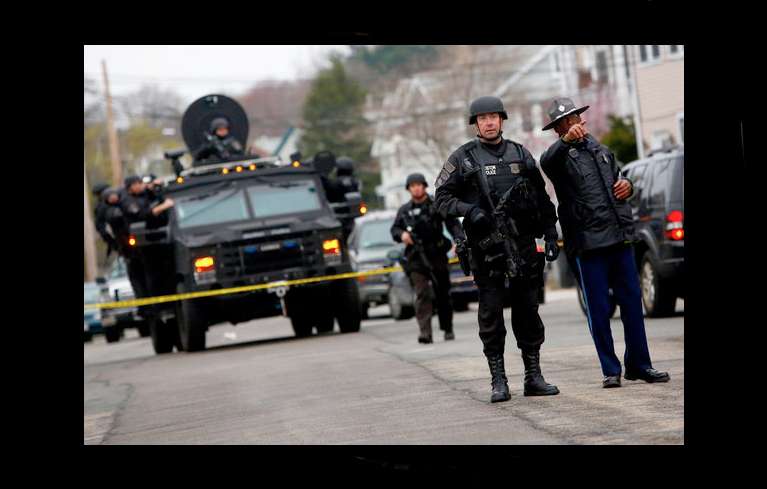
Boston is on lockdown as police look for the second marathon bombing suspect. Photo/Eric Thayer/New York Times

Boston is on lockdown as police look for the second marathon bombing suspect. Photo/Eric Thayer/New York Times

Law enforcement officials said they believed the at-large suspect, Dzhokhar Tsarnaev, may be strapped with explosives. They were taking extreme precautions in an effort to avoid further loss of life.

A campus security officer at the Massachusetts Institute of Technology was killed in a confrontation with the suspects Thursday night, and a transit officer was critically wounded.

“This situation is grave. We are here to protect public safety,” Police Commissioner Ed Davis said. “We believe this to be a terrorist. We believe this to be a man here to kill people.”

The suspects were introduced to the world via photos and video footage Thursday night. The one who was killed was identified as Tamerlan Tsarnaev, 26.

The brothers’ alleged motive in the bombings, which killed three people and injured more than 170, remains unknown, but their family appears to have immigrated from the Southern Russian republic of Chechnya, and two law enforcement officials said there is a “Chechen connection” to the bombings.

Dzhokhar Tsarnaev was born in Kyrgystan, law enforcement authorities said. He has a Massachusetts driver’s license. Tamerlan Tsarnaev was born in Russia and became a legal U.S. resident in 2007.

All public transportation was shut down in the greater Boston area Friday morning, officials said, and no vehicle traffic was permitted in or out of Watertown during the massive manhunt.

Residents of Boston, Watertown, Newton, Waltham and elsewhere were asked to stay inside, with their doors locked. Colleges and universities announced they would close for the day, and businesses were instructed not to open. Streets were ghostly quiet. Thousands of officers searched house-to-house, and some areas were evacuated.

A Massachusetts State Police spokesman says police closed down a stretch of Norfolk Street in Cambridge, where they think Dzhokhar Tsarnaev and his family lived. “We don’t know if he’s there. There is a possibility the suspect is there,” the spokesman, David Procopio, said.

Procopio said the manhunt was triggered after the brothers apparently robbed a 7-Eleven store on or near the MIT campus, about 10:20 Thursday night. They allegedly shot the MIT officer as he sat in his car.

A short time later, the brothers are believed to have carjacked a Mercedes SUV from Third Street in Cambridge. The driver of the car was forced to stay in the vehicle for about 30 minutes, police said, then released at a gas station on Memorial Drive. He was unharmed.

“The guy was very lucky that they let him go,” Procopio said.

Police were trying to activate the tracking device on the Mercedes when other patrol officers spotted the vehicle in Watertown and tried to do a traffic stop, Procopio said. The suspects fled, throwing what Procopio called “IEDs” at police. Shots were fired, and multiple explosive devices were thrown from the vehicle. Some exploded, which led to panic and concern in the town.

Richard J. Donohue, 33, a three-year veteran of the transit police force, was shot in the chase and is being treated at Mount Auburn Hospital, authorities said.

Tamerlan Tsarnaev — who was pictured in a black baseball cap in photos released Thursday evening— was fatally injured, law enforcement officials said.

He had been shot multiple times in the torso and also sustained injuries from some sort of explosives, said doctors at Beth Israel-Deaconess Medical Center, where he was taken. He was in cardiac arrest when he arrived at the hospital, and could not be revived.

Dzhokhar Tsarnaev — suspect No. 2, according to authorities — fled the vehicle on foot, which prompted the massive search.

“We have an active search going on by tactical teams. He’s considered armed and dangerous,” Col. Timothy P. Alven.

Procopio said that after the night of mayhem police have five active crime scenes around the Boston area. “We’ve got crime scenes we haven’t even been able to process yet,” he said.

A high school classmate of Dzhokhar Tsarnaev, Deana Beaulieu, described him as a quiet boy who had been on the wrestling team at Cambridge Rindge & Latin High School.

They attended school together since the 7th grade, first at Cambridge Community Charter School, then the high school, she said. He graduated in 2011.

Tsarnaev lived on Norfolk Street with his family, including an older brother and sister.

State Department officials said the Tsarnaev family appears to have arrived legally in the United States, though they did not specify when they arrived or the type of visas the family members had received.

Chechens have dispersed across the former Soviet republics and other countries in the region, but officials said there are not large numbers of them in the United States.

Chechnya has been racked by years of war between local separatists and Russian forces and extensive organized crime since the Soviet Union dissolved in 1991. The extent of the possible connection remained unclear.

Friday morning, the streets in and around Watertown were deserted, save for the enormous police presence. Outside the Arsenal Mall, hordes of reporters waited outside a staging area that was taking on the appearance of an armed camp, with State Police marching in formation, dozens of motorcycle police officers and the arrival of two large transit buses filled with police wearing neon safety vests. Agents with the Bureau of Alcohol, Tobacco and Firearms swept the area with a bomb-sniffing dog.

We’ve got every asset that we can possibly muster on the ground right now,” Gov. Deval L. Patrick said. “We are going to need the public to help us help them stay safe.”

Michael Demirdjian, 47, a postal worker from Watertown, said he was on his way back from Logan Airport early Friday when he suddenly found himself surrounded by police cars.

“It was amazing,” he said. “There were police cruisers all around. Thirty to 40 cruisers followed us to my house.”

He made it to his house, on Spruce Street, but “it was in the zone and they wouldn’t let us in.”

He said he saw police going from house to house with dogs, searching, the area blazing with flashing emergency lights. Heavily armed police told him he could not enter.

“They said ‘no way.’ I want to go home but it looks like it’s not going to happen,” said Demirdjian, who had been awake all night. “I’d like for them to get this thing under control as soon as possible.”


Snippets about Lake Tahoe

live at lakeview• Live at Lakeview concerts return to South Lake Tahoe starting June 20. The 4:30-9pm free concerts will run through Aug. 29, but not on July 4.

• Hyatt Regency Lake Tahoe in Incline Village has hired Carrie Clay as the general manager at the award-winning Lone Eagle Grille.

• Gary Romano’s “Why I Farm: Risking It All for a Life on the Land” will be released June 6. The release party is that night from 6-7 at Campo in Reno. Find out more about Roman and the book online — including purchasing the book. This is the latest book from Bona Fide Books in Meyers.

• Tahoe Donner anticipates opening the golf course May 24.

• Squaw, Kirkwood and Mt. Rose ski resorts will close April 21, and Alpine on April 28.


Lake Tahoe needs work to lure foreign travelers

By Kathryn Reed

STATELINE – Tahoe doesn’t have it. It could. But it’s going to take a concerted effort for that to happen.

That was the message delivered Thursday by two women who know tourism.

The it is what it takes to be on the list of places foreign visitors want to travel to.

Caroline Beteta, CEO of Visit California and chairwoman of Brand USA, along with Denise Pirrotti Hummell, CEO and founder of Universal Consensus, delivered their views about the future of tourism and what Lake Tahoe must do to capture a greater share of the market.

Lake Tahoe continues to struggle to be a destination that has it all. Photo/LTN file

Lake Tahoe continues to struggle to be a tourist destination that has it all. Photo/LTN file

In particular, the two spoke of the growing international market. Much of the focus was on China, where Beteta just returned. She was there with Gov. Jerry Brown on a mission to lure Chinese to the Golden State.

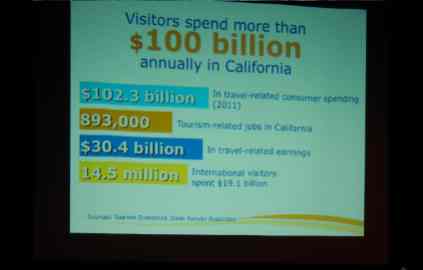
In 2012, Chinese travelers made more trips than people from any other country – 83 million. They spent $102 billion abroad last year.

Beteta said with the United States finally focusing on tourism, this should bode well for everyone. It used to take about 45 days for someone in China to secure a U.S. visa. Now it’s about five days.

But more needs to be done. Nikki Ekstein of Travel + Leisure magazine recently wrote, “According to a new survey conducted by the U.S. Travel Association, 43 percent of foreign travelers will tell their friends to avoid coming to the States. But it’s not cultural, culinary, or political differences that are turning off the international crowds—it’s our customs entry process, which 84 percent of visitors complain about and believe could be vastly improved. The survey polled 1,200 non-U.S. resident overseas travelers — of whom 1 in 7 missed a connection because of long customs lines.”

Even Beteta commented on how her travel plans were disrupted this week when American Airlines had to ground all of its planes because of a computer glitch.

For Tahoe, though, the advice is much simpler.

Hummell said how the sign Chocolate Nugget Factory would be confusing for the average international traveler. What’s a nugget? And how would they know shopping of some sort is available through those doors?

She showed pictures of the casino corridor and Park City.

“The center of town is not what I’m used to in mountain towns,” Hummell said of the South Shore.

The consultant suggested harmony with colors, installing quaint signs – even ones that are in English, Spanish and Mandarin, and putting in more lighting.

Guest relations need a drastic improvement, too, based on Hummell’s experience.

The speakers on April 18 also commented on how tourists want a locale where shopping is abundant – and that doesn’t mean multiple T-shirt shops. All one has to do is look at Las Vegas to see how shopping on The Strip is an activity unto itself.

The creation this summer of 20,000-square-feet of retail along Highway 50 as part of the stalled Chateau project is reportedly being marketed to businesses that would bring a different mix to the area compared to what exists today.

The state tourism agency is focusing on what it calls pillars. The five are: family fun, culinary, culture-entertainment, outdoor-adventure-recreation, and luxury-indulgence.

A series of commercials were shown, including the one filmed in 2011 featuring Olympians Julia Mancuso of Squaw Valley and Shannon Bahkre who grew up in Tahoe City.

“We should ride the coattails of outdoor adventure,” South Lake Tahoe City Manger Nancy Kerry told Lake Tahoe News after the forum. “When spending money on tourists you get a direct investment return.”

At the City Council’s first meeting in May the strategic plan will be discussed, which will include the topic of whether the city is doing its part to draw tourists to the area and working enough with the Lake Tahoe Visitors Authority.

“We know more tourists means more jobs,” Kerry said.

Hotel taxes in the city are up 26 percent from October through February compared to the previous year and sales tax for the last quarter of 2012 is up 13 percent from 2011.

The former number is definitely because of tourists, and the latter is partially tourists.

“Our job is to create a desire for the California experience,” Beteta told the group at Harveys.

After that, well, it’s up to the respective destinations to make it an experience people want to have again and one they want tell their friends about – in a good way. After all, word of mouth is still the best (or worst, depending on the message,) form of marketing.


Opinion: Tahoe’s abysmal service is inexcusable

What piece of this economic pie could be Tahoe's if people were treated better? Photo/LTN

What piece of this economic pie could be Tahoe’s if people were treated better? Photo/LTN

By Kathryn Reed

“Do unto others as you would want done to you.”

“If you can’t say something nice, don’t say anything at all.”

“You can never have too many friends.”

Those are just some of the words of wisdom from my mom that still resonate with me today. Sometimes I hear her screaming the phrases when I’m doing the opposite of what I was taught.

Who cares? – you ask.

Mom, like others of her generation who embraced the above quotes, knows how to get along with people. That is the first step to being good in the hospitality industry.

Mom was not a marketing person, though she could have been. She didn’t work in the tourism industry, but could have. But she did study hotel and restaurant management, so she knows something about the hospitality industry.

What if the frontline staff of every business in Tahoe took to heart those first three sentences?

Do you really want to be treated like crap? With disrespect? Like you don’t matter?

Those are the experiences Denise Pirrotti Hummel had in the past couple days. She is CEO and founder of Universal Consensus. She was one of the speakers of the 2013 Trends in Tourism forum at Harveys on April 18. She relayed a story of how she asked the concierge at her hotel where to go running. She was given a map that wasn’t accurate and told the concierge when she got back. The concierge’s response was she wasn’t responsible for the map. Hummel told the employee she might want to tell the mapmaker. “She looked at me like ‘whatever’,” Hummel said to the crowd full of Tahoe tourism gurus.

The lack of quality guest services is astounding here – especially on the South Shore. It starts with managers and owners, and quickly goes down the ranks.

I don’t know if these people all just go to other bad Tahoe businesses so they think lousy service is the norm or maybe they really don’t care.

I go to a handful of places in town because I know I will be treated well. Everyone at Blue Angel Café is outstanding. Rosie knows how to train her people. Bri at Pearl Izumi is so helpful. The staff at Les Schwab always seems to be running and smiling.

“It’s Tahoe, so they will come” doesn’t work anymore. Customers actually want to be treated with respect.

Locals often point to our dismal infrastructure for why people don’t come back. But I’ve had fun in funky towns with little or no infrastructure. Occidental in Sonoma County comes to mind. I love this little hotel, which is a true old-school motel. But it’s clean and the people are friendly. I would never go into the equivalent looking place here.

Across the street is a great breakfast spot and yummy Italian place.

People recommend places to go. I’m treated like they care if I have a good experience. (See quote No. 1 above.) They tell me to have a good time. (See quote No. 2.) They ask me how my day was when I return – as if we are friends. (See quote No. 3.)

It really isn’t hard to be nice. To be nice or mean – both a choice. To keep lousy employees – that’s a choice, too. To not train them – another choice.

We can build pretty buildings – hotels, restaurants, retail – but if the experience once inside is horrible, well, all the window coverings in the world can’t erase a bad experience.

Just look at Heavenly and Squaw. What were the first things the new owners did at the respective ski resorts? Work on guest relations. Look at their skier visits – yes, it’s the mountains they both have, but it’s the entire experience that makes you want to go back.

Tahoe – wake up. People want to be treated with respect and you are doing the opposite.

—-

Tips for those involved in Tahoe tourism:


Senators seek to allow electronics on planes

By Bart Jansen, USA Today

Several senators rekindled the debate Tuesday whether personal gadgets interfere with an airliner’s cockpit electronics and urged the head of the Federal Aviation Administration to allow more gadgets on planes.

Sen. Claire McCaskill, D-Mo. told FAA Administrator Michael Huerta there is no risk from personal electronics that are restricted near takeoff and landing on airliners because passengers use gadgets on general-aviation planes all the time.

McCaskill also rejected the idea that electronics were a distraction from safety lectures at the start of flights because flight attendants don’t insist that passengers put down their copies of “War and Peace.”

“I feel very strongly that this is an example of a rule that needs to go away,” McCaskill said of restrictions against personal electronics.

Sen. John Thune, R-S.D., said he would join her in changing the rules.

“It seems like these are rules for rules’ sake that sometimes go beyond what is even practical, let alone what is safe,” Thune said.

Personal electronics such as Kindles or iPads are prohibited from use when a plane is below 10,000 feet in the air. But the FAA has an advisory committee studying whether to allow electronics, which Huerta said “is of great personal interest to me.”

The study doesn’t cover cell phones because the Federal Communications Commission bans those phones on planes.

Huerta said plane manufacturers, flight crews and electronics makers are participating in the study, which is expected to make a recommendation in July. He said one complication is how could crew members could distinguish between restricted phones and other electronics while a plane is taking off or landing.

“The worst of all worlds for them would be if we made some determination that certain devices were OK while others are not because it becomes an extremely difficult thing for them to enforce,” Huerta said.

McCaskill said if the FAA doesn’t expand the use of electronics by the end of the year, she wants a written explanation for why not. And she asked Huerta to explain why personal electronics are allowed on Air Force One, but not airliners.

“If it’s safe enough for the president of the United States, it’s safe enough for the flying public,” McCaskill said.