Bighorn herd re-established in Sierra

By Julie Cart, Los Angeles Times

Sierra Nevada bighorn are a genetically distinct subspecies of bighorn sheep, with the rams tending to grow flared, curling horns.

The newly formed group of Sierra Nevada bighorn sheep barreled up rugged Olancha Peak last month, the 10 females and four males becoming the first new herd of the endangered animals reintroduced in California in 25 years.

Once abundant throughout the region’s alpine areas, the state’s population of Sierra Nevada bighorn had dwindled to two herds by the 1970s. Their numbers have been devastated by disease spread by contact with domestic sheep and goats and unregulated commercial hunting.

The new herd is a success story for the distinct population of Sierra Nevada sheep, which were listed as endangered in 2000. Since 2007, the California Department of Fish and Wildlife has been working to recover the animals by reestablishing herds in areas identified as containing suitable habitat — rugged, steep mountain slopes ranging from 5,000 feet to 14,000 feet in elevation.

The reintroduction program is designed to disperse the animals across a wide area to give them the best chance to thrive.

“When you recover an endangered species you want to restore as much of the historic range as you can,” said Tom Stephenson, a fish and wildlife bighorn recovery program leader.

“You don’t want small isolated populations prone to catastrophe. So our recovery goals are both numeric and geographic.”

The animals’ historic range is now largely protected within five national forests and five national parks, a factor that will provide a buffer and aid in the species’ recovery, Stephenson said.

The new herd was released at the southern end of the Sierra range in Inyo County, officials said.

The animals had already been through a lot, having been captured from two of the largest wild herds in the Sierra Nevada and transported by truck to the release site.

There, they were blindfolded to keep them calm, given a medical check and fitted with a wide leather radio collar.

Once the door slid up on the wooden holding crates, the rams bolted away and the ewes waited a moment before bounding out and scooting up the hillside.

There are now 10 herds of Sierra bighorn between Owens Lake and Mono Lake. The state has plans to establish three additional herds to meet recovery goals for the bighorn, which number about 500, up from a low of about 100 animals.

Sierra Nevada bighorn are a genetically distinct subspecies of bighorn sheep, with the rams tending to grow flared, curling horns. The animals are herbivores and spend their days grazing. Bighorn summer in alpine regions and come down to lower elevations in the fall.

Stephenson said that ideally each pack would contain include 20 to 30 females, meaning that in coming years more animals will be released in the same area.

Also last month, six female sheep were moved to become part of two small northern herds in Convict Creek and Mount Gibbs, according to wildlife officials.


Then and now: State line area grows

1951 South Lake Tahoe  Photo/ Lake Tahoe Historical Society

1951 South Lake Tahoe
Photo/ Lake Tahoe Historical Society

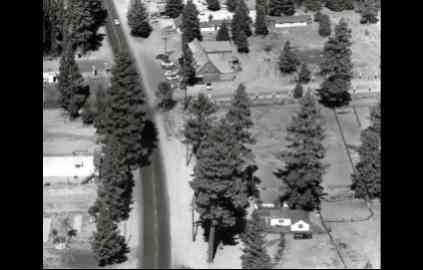
In 1951, Cecil’s Market (with the parked cars) was directly across the street from the “Flying A” gas station (left) on the two-lane Highway 50 at Stateline.

Today, that gas station is Tahoe Tom’s.

The historic Cecil’s remained until about 2000, replaced by the Park Avenue Project as seen in the 2011 aerial photo. Only the Tahoe Tom’s gas station still exists over these 60 years.

Also at left in 1951, below the gas station, was a quonset hut (looks long and white at the left margin) which was the Lakeside Theatre, owned and operated there from the 1940s to 1962 by (Judge) Rudy and Jeannie Buchanan. It stood where the Park Tahoe Inn is now on Highway 50. The small road between the gas station and movie theater has become today’s Park Avenue.

Below Cecil’s Market was a long driveway with vertical markers (going to the right margin).

2011/Google Earth

2011/Google Earth

Those markers actually were yellow illuminated driveway lanterns guiding customers to the original Tahoe Drive-In Theatre, owned and operated there from the 1940s to 1955 by Steve Myers in a pasture on the Van Sickle Stateline Stables property. It was approximately where the Heavenly Village Cinema is today. That driveway eventually became more of Park Avenue and now is named Heavenly Village Way.

Notice the private residences on Highway 50 at Stateline in the 1950s where today it is totally commercial.

The Lake Tahoe Historical Society Museum has an extremely clear enlargement of the 1951 aerial photo for free viewing, open Saturdays 11am-3pm.

— Bill Kingman


Lake Tahoe Basin lacks policy about beavers

Kathryn Reed

No one is counting the beavers in the Lake Tahoe Basin. No one knows if the population is growing, decreasing or has stayed stagnant through the decades. No one is even managing them.

But anyone who wants to touch the beavers’ habitat or potentially do anything to the water they are building dams in, well, there are plenty of agencies to take your money, delay your desires and bog down the process with paperwork.

While the meeting on April 19 hosted by the Lahontan Water Quality Control Board in South Lake Tahoe was civil, the message was – don’t mess with beaver habitat without first asking. Who to ask, well, that is a bit murky. The overriding response: Start with Lahontan.

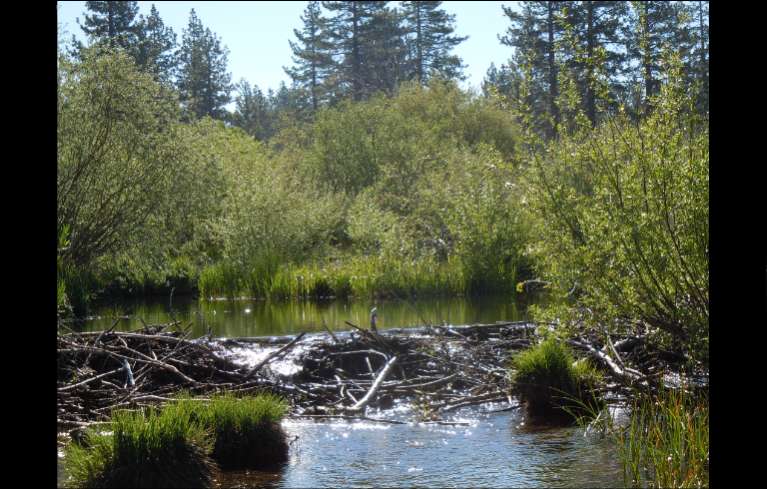
Beavers create dams like this one in Taylor Creek which then prevent the free flow of water. Photo/LTN file

Beavers create dams like this one in Taylor Creek which then prevent the free flow of water. Photo/LTN file

It was also abundantly clear that the officials – U.S. Forest Service, Lahontan, California Department of Fish and Wildlife, Tahoe Regional Planning Agency and U.S. Army Corp of Engineers – are not all on the same page as to what people should do, what the most effective means of dealing with problematic beavers is, and what can be done.

Data about beavers along the Upper Truckee River go back to the 1970s, Sarah Muskopf with the USFS said. But she didn’t provide any of that data.

“Regarding specific policies (for beavers), we don’t have any,” she said.

Muskopf said the Forest Service mostly cares about beavers in terms of public safety and infrastructure.

Sue Novasel, who has lived on the shores of the river for decades, said she has noticed a lot more beaver activity lately.

“I don’t want these beautiful animals harmed. I want more education,” she told the group.

Shelly Blair with Fish and Wildlife said, “We don’t have a formal outreach program.”

The Sierra Wildlife Coalition was in the audience and provided advice the panel didn’t have. Abrasive paint the color of a particular tree can thwart beavers from chewing it down. Sometimes wire-mesh fencing works. Removing dams is a short-term fix. Installing flow devices can get the water moving.

But those devices might require a permit from one or more of the agencies at the meeting – and maybe others.

It was pointed out it’s easier to get a permit to kill a beaver than it is to get a permit to extract a dam or put in a device that would alter the flow of the waterway. Blair with Fish and Wildlife agreed, but said all she can do is follow the law.

Edwin James with the Carson Water Subconservancy District was one of nearly 40 people at the Friday meeting. He lamented that maybe he should not have attended the discussion because now he knows he’s supposed to have a permit to remove a dam.

What he took issue with is that a dam could be discovered one day, needs to be taken out immediately, but permitting could take months. The water he is dealing with is going to farmers and ranchers in the Carson Valley. (Lahontan has jurisdiction there.)

Alan Miller with Lahontan said it’s possible a more general permit could be issued from his agency instead of needing one for each dam. No time line was provided.

Patrick Stone, senior wildlife and fisheries biologist with TRPA, admitted the fastest a permit would be issued is three months, but it’s likely an 18-month process.

The cows would have died of thirst by then, so it’s good cattle don’t graze in the basin any more.

Kris Hansen with the U.S. Army Corps of Engineers said her agency is looking into regional permits regarding beavers, but none would be available this summer.

Several people at the meeting wanted solutions for how to deal with beavers – something other than killing them.

Brendan Ferry with the El Dorado County Department of Transportation said beavers caused problems after his agency restored part of Angora Creek.

“We were forced into killing it. A lot of us in the office didn’t want to go that way. But we felt we had to,” Ferry said.

Blair with the state said relocation is not an option because of “biological reasons.”

TRPA’s Stone said putting a beaver in another habitat would be like dropping one of the people in the room in the middle of China. (This reporter has been to China, did fine, came back to the U.S. healthy, and still doesn’t understand his analogy.)

Stone said there is evidence beavers were native to the basin, were trapped to the point of not existing, and then intentionally re-introduced.


Holocaust survivor to talk at LTCC

Local author and Holocaust survivor Leon Malmed will share a short documentary film, discuss his story of survival, and sign copies of his book “We Survived … At Last I Speak” at Lake Tahoe Community College on April 26 at 7pm.

The free event sponsored by the LTCC Foundation will be in the Aspen Room.

Books will be available for purchase and signing, and $5 from every sale will go to the LTCC Foundation in support of student scholarships and academic success.

Malmed and his sister, Rachel, watched as their parents were arrested and taken away in 1942 Nazi-occupied France. Neighbors offered to watch the children, believing the parents would return in just a few days. Instead, their parents were taken to Auschwitz-Birkenau, and never returned. The two siblings were taken in by their neighbors. The couple provided a safe home to the children through roundups, threats, air raids, and the many difficulties and sacrifices of wartime.


5 backcountry snowboarders die in Colorado

By Electa Draper, Denver Post

Five backcountry snowboarders are confirmed dead in Colorado’s deadliest avalanche since 1962.

The avalanche at Loveland Pass on Highway 6 struck between 1 and 2:30, the Clear Creek County Sheriff’s Office announced late Saturday afternoon.

The sheriff’s office said there was one confirmed survivor.

Sheriff Don Krueger said the avalanche occurred near the Loveland Ski Area, but outside its boundaries.

“I believe that at this point in time everyone is accounted for, but I’m not sure,” Krueger said.

He said the survivor was up and walking around. No information has been released about the five victims. It was unclear whether they were still buried.

Colorado Avalanche Information Center forecaster Spencer Logan said there have been weak layers in Colorado’s snowpack since early January, and forecasters have said they’re seeing the worst avalanche danger in 30 years.

A snowboarder was killed in an avalanche Thursday in Avalanche Bowl south of Vail Pass. He was making runs with two friends after they were dropped off at the top of the bowl by a friend with a snowmobile.

“Our last series of storms made them more active again,” he said. “Over the last week and a half, that area got over 18 inches of snow, so if you melted that that would be 2 inches of water, so that is a heavy load.”

Highway 6 at Loveland Pass, elevation 11,990 feet, was closed by the Colorado Department of Transportation as many skiers were headed home from nearby Arapahoe Basin ski resort.

Lisa Clarke Devore, who was headed back to Denver from the resort, told the Associated Press she saw a fire truck and ambulance on the pass, as well two search dogs headed into the area of the slide. She says she saw several ambulances, including one towing snowmobiles, driving toward the pass.

U.S. avalanche deaths climbed steeply around 1990 to an average of around 24 a year as new gear became available for backcountry travel. Until then, avalanches rarely claimed more than a handful of lives each season in records going back to 1950.

In 1962, seven people were killed when an avalanche buried residences.


Tahoe building featured in green building book

When the Tahoe Center for Environmental Sciences building opened a few years ago at Sierra Nevada College it was immediately heralded as being extremely green.

The accolades for the Incline Village school continue with it being featured in the recently released book “The World’s Greenest Buildings” by Jerry Yudelson and Ulf Meyer.

book“(The book) provides the very first large-scale study comparing building performance data worldwide from the highest-rated large green buildings of the past 10 years, using actual energy and water operating data from 57 projects in 18 countries. It offers architects, engineers and project developers a new way to understand how high-performance buildings can be designed and constructed,” is how the authors describe their work.

TERC is a platinum LEED certified building from the U.S. Green Building Council. To achieve this designation, the project design had to achieve more than 52 credits in:

• Sustainable sites

• Energy and atmosphere

• Water efficiency

• Materials and resources

• Indoor environmental quality

• Innovation and design process.

The green building experts choose the Tahoe school as one of 16 buildings to include in the book. It was singled out for its high performance and energy efficiency. Collaborative Design Studio was the architect for the project.

In the six years it has been open, the building has used 9.6 kWh per square foot per year. This is less than one-tenth of the national average of about 100 kWh.

It also has a rainwater storage system, photovoltaics, solar thermal hot water, cogeneration, low flow fixtures and concrete with 25 percent fly-ash content.

— Lake Tahoe News staff report


USFS fire operations on West Shore

U.S. Forest Service fuels management crews will begin prescribed fire operations on the West Shore beginning April 22.

Crews expect to burn approximately 50 acres in the Ward Canyon area south of Tahoe City. Operations may continue through the week, weather and conditions permitting.

Residents and visitors can expect to see smoke from this prescribed fire project area. Smoke may be visible on Highway 89.

The Forest Service strives to minimize the impacts of smoke on local communities. Smoke-sensitive residents should consider staying indoors and keeping doors, windows and outside vents closed.

To directly receive prescribed fire updates, send an email to pa_ltbmu@fs.fed.us.


Youngster makes false statements to law enforcement

A South Lake Tahoe 9-year-old girl was not accosted last week as has been reported by some news outlets in South Lake Tahoe.

“We did more follow-up today and it was unfounded,” El Dorado County sheriff’s Sgt. Matt Underhill told Lake Tahoe News.

There were doubts all along about the girl’s story being completely accurate, which is why according to Underhill, the school district was never notified.

“Without calling her untruthful, her imagination played into it,” Underhill said of what the youth reported.

Then her story changed and never could be verified.

— Lake Tahoe News staff report


Cascade Falls

The water is flowing at Cascade Falls, snow is off the trail and songbirds are singing a welcoming song.


EPA: California not complying with Clean Water Act

By Matt Weiser, Sacramento Bee

California today was declared to be out of compliance with the federal Clean Water Act because it is sitting on $455 million that should be spent to improve local drinking water systems.

The U.S. Environmental Protection Agency submitted the notice after years of fruitless efforts to get the state to document its spending under the program, said Jared Blumenfeld, regional administrator for the agency.

The program is administered on behalf of the EPA by the California Department of Public Health, using funds allocated by Congress. Typically the money is used by cities, counties and other local agencies to improve drinking water treatment systems, usually to remove harmful chemicals or seek a cleaner supply.

“We certainly hear from communities that they need the money and they are not being able to access it,” Blumenfeld said. “The facts speak for themselves. The money is not going out the door as quickly as it should be.”

Blumenfeld said the problem is not unique to California, but the scope of the problem is far larger in California than elsewhere. As an example, he noted the second largest similar problem exists in Texas, which sits on $310 million in Clean Water Act funds. But Texas has provided the EPA with a satisfactory accounting of its spending under the program, unlike California.

A second problem, Blumenfeld said, is that when California does spend the money, it often chooses projects that are not “shovel ready.” So the money is allocated for a project, but it remains parked for years.

“If you had reprogrammed (the money) more effectively, there could be short-term projects that are ready now that could already be funded, as opposed to funding projects that are not ready to start,” he said.

The Department of Public Health did not respond immediately to a request for comment.

The EPA is giving the state 60 days to submit a corrective action plan. If the state does not or the plan is not acceptable, the EPA may suspend payments to the state under the program.