Massive fuels reduction project to resume

The 10,000-plus acres South Shore Fuels Reduction and Healthy Forest Restoration Project will start again in early May.

The first area scheduled for treatment this season consist of 280 acres between Golden Bear Estate off Pioneer Trail and the Sierra Tract.

Those who mountain bike, run, hike and walk their dogs in this area will need to temporarily find another playground. The U.S. Forest Service will officially close the area due to the hazards posed by heavy equipment operation and falling trees. The work should take about two months to complete.

Heavy equipment is needed for the South Shore fuels reduction project. Photo/LTN file

Heavy equipment is needed for the South Shore fuels reduction project. Photo/LTN file

Possible alternatives for recreational access include National Forest lands south of the Golden Bear subdivision and the reopened Railroad Grade Trail east of Pioneer Trail.

While the two treatment units are heavily crisscrossed with neighborhood trails, they have very few official roads and trails. After work is completed, the Forest Service will restore official trails. but will not restore user-created trails.

As the season progresses, mechanical thinning may occur in a number of other South Shore locations as conditions allow, including Christmas Valley, Fallen Leaf Lake, Meyers, the Highway 89 corridor, Gardner Mountain and the Pioneer Trail side of Trout Creek.

In addition to mechanical operations, the Forest Service also expects crews to complete at least 300 acres of hand thinning, which will include urban lots and areas near Hawley Grade in Meyers.

Early season work also will include removing log decks, slash and biomass from landings in units near Trout Creek and Fallen Leaf Campground and decommissioning them.

For local residents who’ve been wondering what will become of the very large deck of logs near Camp Richardson Resort, Forest Service staff expect to eventually remove the pile, potentially later this year.

The Forest Service will post closure orders for mechanical work online and provide periodic updates as work moves to new areas. For general information on the South Shore project, also go online.


Residential burning requires permit

In 2012, 23 percent of all wildfires in the Amador-El Dorado Unit of CalFire were caused by residential debris burning. The 47 fires burned 52 acres.

Residential burn permits will be required beginning May 1. These permits are issued to the public for free and are valid for three years from the date of issuance. Permits allow for the burning of dry vegetation (not household trash) that originates on the landowners property. Burn permits are available at most of the local staffed fire stations.

The use of burn barrels is no longer legal in Amador or El Dorado counties.

Safety tips for burning:

  • Make sure your pile(s) are no larger than four feet by four feet in size
  • Scrape a 10-foot wide ring around each debris pile down to bare dirt
  • Have a shovel and water supply (charged hose) close by to use in the event your fire escapes from the pile
  • Make sure an adult is in attendance until the pile is completely extinguished
  • You can only burn on “permissive burn days” so make sure to call your local Air Quality Management District immediately prior to lighting your pile(s).

For Amador County call (209) 223.6246, El Dorado County call (530) 621.5897 or 866.621.5897, Lake Tahoe area of El Dorado County call (530) 621.5842 or 888.332-2876 or Alpine County call (916) 445.0745.


Safeway’s revenues drop

By Tiffany Hsu, Los Angeles Times

Safeway Inc. — Northern California supermarket giant – facing competition from dollar stores and Wal-Mart – reported flat revenue in the first quarter.

The Pleasanton company said revenue for the period ended March 23 dipped slightly to $9.99 billion from $10 billion a year earlier – a dent that Safeway attributed to lower fuel sales and the sale of its Genuardi’s stores.

But same-store sales – a gauge that strips out volatility by only considering stores open at least a year and excludes the impact of fuel – rose 1.5 percent. Safeway also operates local chain Vons.

The measure got a boost by a calendar shift that pushed sales from the New Year holiday into the first quarter, according to Safeway. A new loyalty program called “Just for U” gained traction, as did a partnership with gas stations to offer fuel rewards.

A move to generic drugs, however, pinched results.

For the quarter, Safeway said it earned $119.9 million, or 49 cents a share, including a 14-cent-per-share tax benefit. During the same period a year earlier, the company reported $72.9 million in profit, or 27 cents a share.

Safeway also said its 1,638 stores in the U.S. and Canada gained market share for the fourth straight quarter, despite growing pressure from chains such as Wal-Mart and Target, which are expanding their grocery offerings.


Leadership Lake Tahoe scholarship available

Tahoe Regional Young Professionals will launch an ongoing scholarship/continuing educational program by offering one qualified member the opportunity to take part in Leadership Lake Tahoe for the 2013-14 term. This has a value of $900.

Leadership Lake Tahoe is put on by the Lake Tahoe South Shore Chamber of Commerce as a way to identify and develop current and future leaders through a comprehensive professional development program.

Go online or email tahoetryp@gmail.com to apply for the scholarship. To be chosen the individual must submit an application by May 1 and be a member of TRYP.


Endurance events not all fun and games

By Luna Shyr, National Geographic News

The first fatality in a Tough Mudder endurance event this past weekend raises a dire prospect that’s typically far from the minds of participants or buried in the fine print of contracts.

Such extreme activities, with names like Rugged Maniac and Warrior Dash, have surged in popularity. Their novelty challenges include crawling under live wires, plunging into an icy dumpster, and dangling from monkey bars coated with butter and mud.

At best, such obstacle courses push mental and physical stamina and build teamwork; at worst, people get injured or even die.
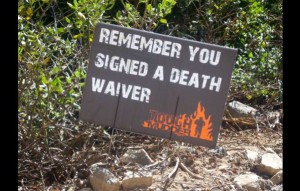
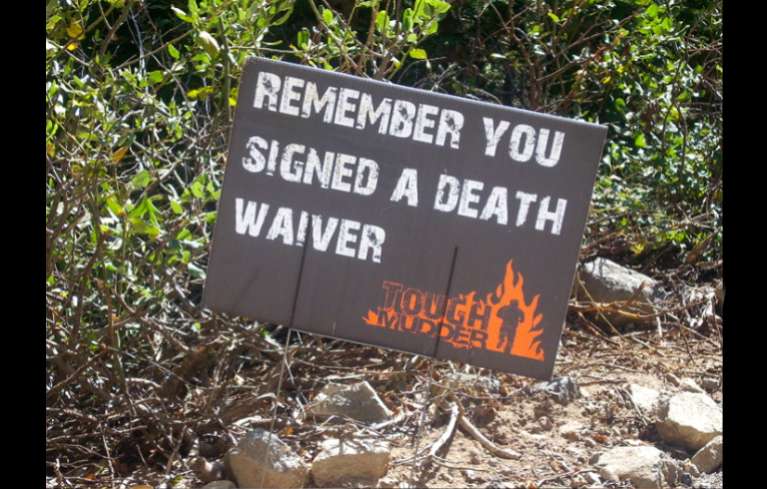
Tough Mudder may reconsider posting signs like this one that was on the Northstar course in 2012. Photo/Jessie Marchesseau

Tough Mudder may want to reconsider using signs like this one that was on the Northstar course in September. The event returns to the Truckee ski resort July 13-14 and Sept. 28-29. Photo/Jessie Marchesseau

After the Tough Mudder in Gerrardstown, W. Va., this past weekend, 20 participants were treated at the local hospital, including two people with heart attacks and several people with hypothermia, head injuries, and orthopedic injuries. Avishek Sengupta, a 28-year-old from Maryland, drowned. His death has been ruled an accident after he jumped from a plank into a pool of muddy water during the race.

In April 2012, a 30-year-old man died in Texas after a similar event called the Warrior Dash. Two men died in another Warrior Dash in Missouri later that summer.

Tough Mudder is a nine- to 12-mile (14- to 19-kilometer) endurance challenge that bills itself as “probably the toughest event on the planet.” An estimated 750,000 people have participated in Tough Mudder courses since 2010, running through mud and over obstacles. There are more than 50 Tough Mudder events planned for the rest of this year in the U.S., Australia, Japan, South Africa, and Europe. The company that puts on the events says that its courses are designed with safety experts, and that emergency personnel are present.

To reduce risk of competing in such events, sport psychologists and physicians emphasize preparation and awareness. We asked two experts—Justin Anderson of Premier Sport Psychology in Minneapolis/St. Paul and Dave Olson, a team physician for the Minnesota Vikings — to share their insights on extreme activities.

Justin Anderson, a sport psychologist, on extreme endurance events:

The term “extreme” has been applied to everything from Tough Mudder to Ironman to things like heli-skiing or BASE jumping. What makes a sport extreme?

It depends on whom you ask, but I think “extreme sports” include anything that’s on the fringe of the mainstream and can be incredibly grueling or incredibly dangerous. All of those activities fit those categories.

Why do you think endurance events like Tough Mudder have become so popular?

Humans always want to continue to push the envelope. People tend to feel most content when they’re growing and hitting or exceeding goals. Then there are additional gains like triggering dopamine in the brain—it acts as a natural high, and we can feel euphoric once we’ve completed one of these things.

There’s also this identity factor of being someone who’s tough and a go-getter. Finally there’s the community; we get to interact with folks like ourselves who are high achievers, and that can be a really attractive thing.

What should anyone who participates in an extreme activity consider before they go out there?

It’s important to be mindful of why we’re getting into these activities and see if it’s really worth it. When our dopamine levels get triggered, it becomes a natural high. What tends to happen is it takes more and more to get that psychological and biochemical effect, so we push and say we can go to this next level.

Also be careful not to be too caught up in the “rah rah” of the event. Once you jump into these things, it can be really seductive — that social persuasion of “let’s go,” even though your body and mind might be saying to slow down or take it back a notch.

Do people tend to overestimate their ability to do these endurance events? Underestimate the risks?

It depends on the person. Certainly a lot of people overestimate their ability. Ask yourself what you’re doing to get your body prepared. Pay attention to your body and mind, especially when it’s telling you to stop. That’s the beauty of endurance sports like Ironman — the athletes are incredibly tough and they’ve learned in training how to focus on other things when they’re running through cramps or their body wants to stop.

But the key is knowing which signals to pay attention to and which ones not to, and that comes from years of experience of knowing your body and its limits.

When you talk about the difference between pros and amateurs, we say pros practice far, far more than they play, and amateurs play far more than they practice. In the case of high-level athletes, they do a lot of training and understand what the extremes are. They know they have to build up to them. I recommend getting to know the process because these things are much more challenging than they appear, both mentally and physically.

Dave Olson, a team physician for the Minnesota Vikings, on preparedness:

What’s the minimum training you would recommend for an event like Tough Mudder?

These events are tricky for sports medicine doctors. With sports teams we really get to see the athletes and review their histories. With mass events like Tough Mudder or a marathon, pretty much the only requirement is to sign up and think you’re ready to do it.

Train smart for an event, ideally over a series of months to ramp up your activity, and get a medical checkup to make sure it’s safe for you to do so. Tough Mudder events can be tricky because with, say, marathons, people go online and can read about how to train. But with events like Tough Mudder being new and different, a lot of times we see people going because friends say, “You should come do this.” They may do some runs but often they don’t end up doing the training they need to prepare. People have to be realistic and look at their medical background.

How do you best avoid injury on the day of the event?

Hydration is big, and equipment — making sure you’re dressed properly and have good shoes that have been worn before so you don’t get blisters, that kind of thing. If it’s 100°F (38°C) out, have the proper shirt. And have an extra set of clothes for when you’re done — something warm to put on in case you’ve been through an icy stretch. Dress smartly, look at the weather, and plan ahead.

To Justin’s point about knowing which body signals to pay attention to and which to plow through, how do you know when you should stop?

It can be really tricky. I think it’s hard for an athlete who hasn’t been doing a lot of training — the first signal like chest pain might already be too late. You have to really listen to early signals like dizziness, cramping, and listen to them as warning signs. It’s hard in those events because it’s a group event — there’s a lot of cheering and pushing through — but you really have to be smart about it, especially if you’re not well trained.


Flying over Tahoe and Desolation

Flying with Reno Tahoe Helicopter Tour out of Lake Tahoe Airport provides for incredible scenery, more than 30 lakes — some still frozen this time of year — and views that are absolutely stunning.


2 people die in single-car wreck on Hwy. 50

By KCRA-TV

Two people died and another suffered serious injuries Friday in a crash on Highway 50, the California Highway Patrol said.

All the victims are young adults — likely in their late teenage years to mid-20s, a Placerville CHP officer told KCRA 3.

Police are still working to confirm their identities.

Only one car was involved in the wreck, which took place on the eastbound side of the highway, just east of the Red Hawk Parkway over-crossing.

The driver of a 1996 Toyota Corolla drifted into the center median, tried to get back on the roadway, then overcorrected and lost control of the car — smashing into a rocky outcropping, the CHP said.

The vehicle rolled and came to a rest on the highway, according to police.

Two women and one man were inside.

Emergency crews airlifted the female driver to Mercy San Juan, where she died.

A male passenger riding in the back of the car wasn’t wearing his seat belt, police said. He was ejected from the Corolla and declared dead at the crash scene.

An ambulance took another female passenger to the UC Davis Medical Center to be treated for serious injuries, the CHP said.

Both women were buckled in, police added.

The wreck closed eastbound Highway 50 at Shingle Springs for a short time. All lanes were blocked just after 11:15am.

No further details were released.


Taylor Creek Visitor Center going to the birds

The U.S. Forest Service Lake Tahoe Basin Management Unit and the Tahoe Institute for Natural Science are hosting the fourth annual Lake Tahoe Bird Festival on June 8.

This free family event from 10am-4pm is at the Taylor Creek Visitor Center, located three miles north of South Lake Tahoe on Highway 89.

The event includes guided bird walks along the Rainbow Trail every hour from 10:30am-1:30pm, a bird art contest for all ages, information on migratory birds and spotting scope use, and a presentation by Master Falconer Marie Gaspari Crawford that includes live birds of prey.

Art submissions (photography, sculptures, drawing, paintings, etc.) for the bird art contest may be submitted to Rena Escobedo at rescobedo@fs.fed.us or dropped off before June 4 at the LTBMU office at 35 College Drive, South Lake Tahoe.


Open source software topic of tech forum

Tech Tuesday will feature Dave Norton, who’s been working in the world of supercomputing for the past 30 years designing, building, and programming some of the world’s largest computers.

Norton will discuss open source software (free downloadable software) for Android operating systems; Chrome and Firefox web browsers, OpenOffice, LibreOffice, Google Docs, and challenges to Microsoft Office.

Attendees will learn the genesis of open source software, and where it might be appropriate to use. Different types of open source licenses and the different philosophies behind them will also be discussed. While there are several types of free software licenses, they commonly grant freedom to run the program, to study how the program works, to change the program to do exactly what you need (access to the source code is a precondition of this), and to distribute your modifications to the software.

Attendees will look at some of these programs, learn how to install them using common configuration options, and learn what a virtual machine is and who might benefit from using it.

This workshop put on by Lake Tahoe South Shore Chamber of Commerce is May 7 from 8-9:30am in the chamber’s conference room at 169 Highway 50. It is for members and $15 for prospective members. Reserve a space online.


Motorcycle deaths decline in Calif., increase in U.S.

By Tony Bizjak, Sacramento Bee

Motorcycle deaths rose nationally in 2012, a study found, and the culprits may have been warmer weather and economic changes.

Notably, though, California motorcycle fatality numbers were slightly down.

The Governors Highway Safety Association is estimating motorcycle deaths topped 5,000 across the country last year, a 9 percent increase from the previous year, in part because better weather lengthened the motorcycling seasons in many states, and also because higher gas prices prompted more people to drive motorcycles.

“With the economy improving in 2012 and further strengthening in 2013, more people have disposable income for purchasing and riding motorcycles,” the report concludes. “At the same time, high gas prices may cause more individuals to choose fuel-efficient vehicles like motorcycles as their preferred mode of transportation.”

California was among the handful of states were motorcycle fatalities dropped from the previous year. During the first nine months of 2012, the months for which data were available, the number of motorcycle deaths in California dropped slightly from 321 to 318.

Officials credited increased awareness campaigns in California as part of the reason. Highway officials last year launched an aggressive “share the road” campaign aimed at making car drivers more aware of motorcyclists.

The report notes that only 19 states have helmet laws that apply to all riders, down from 26 in 1997.