Snippets about Lake Tahoe

dogs• The California Tahoe Conservancy’s annual seasonal dog closure at the Upper Truckee Marsh in South Lake Tahoe begins May 1 and ends July 31.

• Katy Simon, who has been manager of Washoe County for 15 years, is retiring July 1.

• In 2012, Caltrans filled more than 10,00 garbage trucks with debris from state highways. This cost taxpayers $52 million.

• Reno’s Wayne Wong was inducted into the U.S. Ski and Snowboard Hall of Fame in Ishpeming, Mich., this month.

• Draft documents of Douglas County’s South Shore Area Plan are online.


Opinion: Revamped fire fee worse than current one

By George Runner

Better late than never, California lawmakers seem to be waking up to the reality that the illegal “Fire Prevention Fee” they enacted nearly two years ago is a complete fiasco. Even so, they are refusing to repeal it. Instead they are scheming up ways to replace the tax with yet another tax that’s even bigger than the first.

Where else but Sacramento would someone think the answer to a bad tax is to replace it with one even worse?

Assemblyman Wes Chesbro, who represents many rural taxpayers on California’s North Coast, is leading the charge to reinvent and expand the fire fee. His proposal (AB468) would replace the fire fee with a 4.8 percent “surcharge” on all insured homeowners and businesses in the state of California, regardless of location.

George Runner

George Runner

A similar concept was proposed by Gov. Arnold Schwarzenegger in 2009 but was rejected by the Legislature.

These payments, averaging $48 per policy and totaling an estimated $480 million per year, would find their way to a “Disaster Management, Preparedness, and Assistance Fund.” The fund would benefit bureaucracies, like CalFire, that are involved in the state’s disaster preparedness efforts.

If you want to discourage an activity, you tax it. Mr. Chesbro’s proposal would make it more costly for Californians to maintain insurance coverage on their property, punishing them for being responsible. Our laws should encourage good behavior, not discourage it.

Call it what you will, this new “surcharge” is really just the fire fee all over again — this time on steroids. It aims to repackage, rebrand and expand a tax that to date has been a colossal failure. Although the new tax will lessen annual payments for current fire fee payers, it will dramatically expand the number of overtaxed Californians who are forced to pay even higher taxes.

The original fire tax was supposed to bring in $84 million in revenue from more than 825,000 rural California taxpayers. Due in part to billing errors and bad addresses, the state has spent millions and only collected about $75 million.

This new tax would cost California property owners six times more money than the original. About 10 million people would be impacted—twelve times as many as right now.

The Legislature passed the original fire fee by a simple majority vote rather than the required two-thirds vote for new taxes. That’s why the Howard Jarvis Taxpayers Association, with my full support, has filed a class action lawsuit against the state of California.

As currently drafted, Chesbro’s legislation would also only require a simple majority vote, rather than the two-thirds vote clearly required by Proposition 26. It’s hard to imagine the Legislature would replace an illegal tax with an illegal tax, but stranger things have happened in Sacramento.

It remains to be seen what Gov. Jerry Brown will do if it passes the Legislature. Some also speculate the Governor will propose sweeping changes to the fire fee when he unveils his May budget.

Despite significant media coverage, to date the governor has mostly tried to brush off growing concerns about the fire fee and CalFire. In January, the agency was forced to admit the existence of a secret $3.66 million slush fund. In February, the agency was faulted by the Legislature’s attorneys for illegally diverting fire fee funds to pay for wildfire investigations. The governor dismissed these revelations as “boring.”

Since the original fire fee passed, Californians have voted twice to send billions of additional tax dollars to Sacramento. Some now believe the state’s budget is balanced and could even see surpluses in the next few years.

Public safety is the first priority of government. The heroic men and women who fight wildfires and respond to emergencies and natural disasters deserve our full support.

But that doesn’t mean they need new taxes. Public safety should be first, not last, in line for existing public dollars. If the state’s emergency readiness lacks adequate funding, we need to do a better job prioritizing the billions of dollars the state is currently spending.

With this in mind, the Legislature would do best to repeal California’s illegal fire tax and stop thinking about replacing it with a tax that’s six times worse.

George Runner represents more than 9 million Californians as a taxpayer advocate and elected member of the State Board of Equalization.


3-day basketball tournament on South Shore

Expect to see a lot of young basketball players on the South Shore during Memorial Day weekend.

South Tahoe Basketball Academy, a nonprofit run by people affiliated with South Tahoe High’s girls’ and boys’ basketball programs, is partnering with Hardwood Palace to put on the May 25-27 tournament.

Grades 3 through 12 will participate.

South Tahoe Basketball Academy will donate all of its proceeds back to the local youth programs.

Games will be played at STHS, South Tahoe Middle School, Kahle Community Center, Bijou Community School, Tahoe Valley Elementary, Sierra House Elementary, and possibly Lake Tahoe Community College and South Lake Tahoe Parks and Recreation Center.

More info is online.


Feds involved in Nevada patient-dumping case

By Lee Romney, Los Angeles Times

SAN FRANCISCO — Following state Senate President Pro Tem Darrell Steinberg’s call for an investigation, federal authorities have taken disciplinary action against a Nevada hospital in an alleged case of “patient dumping” in California.

In a letter dated Thursday, the Centers for Medicare & Medicaid Services gave Nevada 10 days to correct problems at Rawson-Neal Psychiatric Hospital following reports it may have improperly discharged patients and bused them out of state.

“If we do not receive an acceptable, timely submission, or if a resurvey finds that the hospital is not complying with any [conditions of participation], we will notify you that we are initiating action to terminate the facility’s Medicare provider agreement,” the letter stated.

Steinberg’s concern was prompted by a Sacramento Bee story about Flavy Coy Brown, who was discharged from the Las Vegas hospital with a one-way Greyhound bus ticket to Sacramento and a three-day supply of medication.

When he arrived at a Sacramento homeless shelter Feb. 13, staff described Brown as confused and scared. They said he had no money, medication or understanding of why he was sent to Sacramento.

The Bee followed with an investigative report that said Rawson-Neal had purchased one-way bus tickets for 1,500 discharged patients over five years, some of whom had been sent to locations where they had no contacts.

The revelations prompted the city attorneys of Los Angeles and San Francisco to announce probes into the matter earlier this week. Rawson-Neal patients were bused to both cities, according to the Bee’s findings.

Nevada Gov. Brian Sandoval said in a statement that his office had launched three separate investigations and that disciplinary actions had been taken. The governor’s office determined that policies were not followed in at least one instance. The new policy, he said, provides “additional oversight” to ensure the hospital follows proper discharge procedures.

“I take the concerns regarding Rawson-Neal Psychiatric Hospital very seriously and it is not the policy of the state of Nevada to engage in ‘patient dumping,'” he said in a statement.

The director of Nevada’s Department of Health and Human Services also issued a statement saying the problems were not systemic.

On Friday, Steinberg, D-Sacramento, said that Rawson-Neal’s administration and the state of Nevada “must be held accountable by federal regulators.”

“People with mental health disorders can recover with access to prevention, early intervention and treatment,” he wrote in a statement. “Instead, this man being treated for schizophrenia and depression was given a one-way ticket to a place he’d never been. Such actions are tantamount to abuse, and I’m relieved that CMS is taking action.”


Letter: Adventure Mountain slides into volunteerism

To the community,

Normally Adventure Mountain Lake Tahoe is providing loads of fun at their sledding and tubing winter recreation area. However, on April 22 their energy was directed toward seeing that the needy members of the South Shore community were being served a hot and healthy meal.

Through Bread & Broth’s adopt A Day of Nourishment program, Adventure Mountain Lake Tahoe sponsored and volunteered at the Monday evening dinner.

Linda Mueller, Jim Mueller, Chris Korves, Gin Mooney, Wes Snyder

Linda Mueller, Jim Mueller, Chris Korves, Gin Mooney and Wes Snyder

Adventure Mountain LT owners Jim and Linda Mueller brought their two sons, Luke and Max, employees Chris Korves and Wes Snyder and friend Gin Mooney to help the B&B volunteers with the dinner setup, serving and cleanup. While preparing the giveaway bags, Linda expressed her thanks to the community for their support of Adventure Mountain LT, stating that “sponsoring an Adopt A Day was a way of giving back to the community”.

The sponsor crew enthusiastically worked with the B&B volunteers and enjoyed their first time hosting an AAD. Wes Snyder, Adventure Mountain LT manager, wrote of his experience, “This is a wonderful group of people that provides a great service for the community. We had a great time helping and look to participating again in the future.”

Bread & Broth is very grateful to the generous Adventure Mountain LT owners and crew for their support of time and money to support B&B’s goal of feeding the hungry. B&B’s business sponsors are fine examples of how their community involvement strengthens the community.

Interested in finding out more about Bread & Broth, contact me at (530) 542.2876 or carolsgerard@aol.com.

Carol Gerard, Bread & Broth


Pain of adoptions can last a lifetime

By Anita Creamer, Sacramento Bee

Just before Christmas 1962, when she was 20 and unmarried, Freddie Stewart gave birth to a baby girl. At the hospital, she refused to hold her firstborn; she remembers thinking that if she saw her daughter, she couldn’t handle giving her up for adoption.

“I went away from this experience and tried not to look back,” said Freddie Stewart Lussier, now 70. “I thought I’d dealt with it. I just put it out of my head.”

She lives today on a 10-acre property in the El Dorado County foothills, where she has goats, chickens and dogs. Kelly Camber, a daughter she raised after a brief marriage in the mid-1960s, visits often, and Freddie’s grown twin granddaughters and their children spend time with her.

But as with many other mothers of her generation, the loss of her birth child was deep and lasting, a permanent wound. Over the next five decades, Freddie carried a burden of guilt and grief. She couldn’t even talk about her firstborn.

Not when her brother, Wendell Alderson, 60, tried to raise the subject.

“You could see the look on her face,” he said. “Her face would fall. It was hidden. It was a deep, dark secret in our family.”

And not when the family friend who helped arrange the birth daughter’s private adoption asked Freddie if she wanted to see photos.

“I’d say no,” said Freddie. “It was painful, but I was able to put it behind me. Dwelling on it, what was that going to do?”

And then, through happenstance and what Freddie Lussier calls God’s will, she and her birth daughter, Lori Fox, finally met.

During adoption’s age of shame – roughly the three decades beginning in 1945 – the practice was shrouded in secrecy. And young women from middle-class families paid a steep emotional price for pregnancy before marriage.

Often, they were sent to maternity homes where they gave birth to babies they immediately relinquished.

In many ways, Linda Orozco’s story is typical. Today, she’s a volunteer for support groups that help people touched by that era of adoption, but in 1967, she was pregnant and unmarried. She fled to Sacramento, Calif.’s maternity home, Fairhaven Home for Girls, where she gave birth to the son she gave up.

“Society looked down on an unwed mother,” said Orozco, now 67 and a retired state worker. “Your own family looked down on you. You felt like damaged goods.

“I didn’t start talking about it until 31 years later. I had so much shame and pain and sorrow and loss. I had grief I didn’t know was in me all those years, because it was locked up.”

And no one talked about the pregnant girls who vanished, except in whispers.

“The stigma was huge,” said Ellen Herman, a University of Oregon history professor who created “The Adoption History Project,” an online archive of adoption history.

“It’s difficult to convey that today to anyone under 30 or even 40. We don’t remember the degree of shame associated with nonmarital childbearing.”

Although statistics on legal adoption were gathered haphazardly on the state and federal levels in the 1950s and 1960s – and informal adoptions were never recorded – experts suggest that about 120,000 children were adopted each year during those decades, peaking at about 175,000 in 1970.

Research shows that today about 5 million Americans are adoptees, and only 3 percent of them are younger than 18.

For most of them, birth records remain sealed. Even today, adoptees in most states, including California, need a notarized request to receive basic information about their birth parents: age, height, weight and limited medical records. Their identities are not revealed as part of that request.

But in California and 30 other states, adult adoptees and birth parents can find each other through mutual-consent registries, which allow both parties to express their interest in getting in touch. Alternatively, online adoption search sites can also provide help.

On a practical level, what this involved process often means is that the past remains hidden, cloaked in silence.

“Closed adoption was done to protect the birth mother’s reputation and to protect the adoptee,” said Leslie Mackinnon, a spokeswoman for an Atlanta-based advocacy group, Concerned United Birthparents. “And it was done to protect adoptive parents from anyone coming back to claim their child.

“It really messed a lot of people up. Secrets and lies never do anyone any good.”

Freddie Lussier grew up in Roseville, Calif., when it was still a small railroad town, a place where everyone knew everyone else and neighborhood gossip flowed freely.

She worked in a local beauty shop, and she could hear the other women talk after she got pregnant. So she left town, going to live with an older sister in Sacramento until the baby’s birth.

“The man I’d been seeing was older than me, but there was no great love there,” she said. “I didn’t know what to do. I was probably four months along when I told my mother.

“She was mad and disappointed. You know.”

A family friend mentioned that she knew a local couple who wanted children but couldn’t have them. Freddie and her mother visited a Sacramento attorney, where Freddie signed the papers.

“I don’t remember having a choice,” she said. “My mother wanted to meet the people, but the attorney advised us not to.

“Everyone told me that (the birth child) would never know she was adopted. I never pursued a reunion, because I’d never disrupt her life that way. Really, I put that birth so far in the back of my head that it was almost like it hadn’t happened.”

The secrecy surrounding adoption created complicated parallel fictions: Not only was the birth mother expected to compartmentalize her past, but adoptive parents also sometimes felt the need to hide the reality of their circumstances.

Perhaps some of them worried that the stigma of unwed motherhood would tarnish the child they had adopted. Perhaps they feared that their families would be singled out as different.

“Secrecy of all kinds came into the open starting in the 1960s,” said Herman, the University of Oregon historian. “Secrets lose toxicity when that happens.

“Families now aren’t expected to keep up the pretense that adoptive families are exactly the same, because they’re not. Adoptive children have more than one mother and father. People in the 1950s and ’60s tried to pretend otherwise for very well-intentioned reasons.”

For some, the power of secrecy remains.

The woman who adopted Lori Fox, who raised her and loved her, is 81 now and a widow. She does not like the idea of a newspaper story and does not want her name used. Like many of her generation, she prefers that private matters remain private.

It was only by chance that she met Wendell Alderson at the funeral several months ago of the mutual friend who had helped arrange the adoption of his sister’s birth child.

The two began talking – and, he said, she helped put him in touch with Lori, her only child.

“She told me, ‘I’d like for Lori to know some of her family,'” he said.

Lori Fox is today a 50-year-old mother of three who lives in Manteca. She was 8 when her parents told her she was adopted.

“My parents sat me down and told me,” she said. “They cried. I felt bad for them. And I felt bewildered.

“I never wanted to ask questions. My mother didn’t want me to feel different, and I didn’t want her to cry.”

But she was intensely aware of the secrecy surrounding her adoption, which stemmed in part, she said, from her adoptive parents’ fear that the biological mother might want her back.

“It was hush-hush,” Lori said. “I was never encouraged to tell anybody I was adopted. If anybody asked questions, my mother was uncomfortable. It was really sad.”

Once she grew up and had children of her own, Lori wanted to know basic health information. She petitioned the state for a non-identifying report, but she didn’t want to pursue a full-fledged search.

“I didn’t want to disrupt her life,” she said, echoing her birth mother’s words. “But I always envisioned meeting her one day. I thought, ‘When it’s supposed to happen, it will happen.'”

After Wendell Alderson and her adoptive mother met at the funeral, he wrote a note, sending his email address in case Lori wanted to get in touch. Within days, she responded.

“I was excited,” she said. “I couldn’t wait.”

The adoption landscape changed with the times, altered by the sexual revolution, the women’s movement and widespread access to birth control and abortion. Sacramento’s Fairhaven maternity home, located near Tahoe Park, closed in 1979 and is now the site of a seniors’ community.

Today almost 27 percent of America’s children – 22 million kids – are raised by single parents, according to Census Bureau statistics. Almost 85 percent of custodial parents are women, and 35 percent of them have never been married.

Federal Centers for Disease Control figures show that less than 1 percent of children born outside marriage today are placed for adoption.

If unmarried motherhood has become routine, so has open adoption, the practice of birth and adoptive parents staying in touch through the exchange of photographs, cards and, in some cases, visits.

It developed for a simple reason: Baby boomer adoptees started asking questions.

“By the late 1970s, they started showing up at adoption agencies, wanting information,” said Mackinnon, the Concerned United Birthparents spokeswoman. “And birth mothers started coming back wanting to know that the child they’d given up was OK.

“We’re finally educating the public that with open adoption, it’s better for the child and everybody else. The kid does not feel abandoned. They feel loved.”

Over time, the secrecy and stigma faded. Even so, the reunions bringing together adoptees and their birth parents – these intimate strangers – can remain difficult.

“The public seems to think that people find each other and live happily ever after,” said Mackinnon.

“The reunion is just the beginning of another incredibly emotionally wrought chapter. People are not prepared.”

In the middle of the week, Lori Fox made chicken and pasta for Wendell Alderson and his spouse, Ken Nather, in their comfortable east Sacramento home. She works as a college English instructor in Sacramento, and as a break from her long commute home to Manteca, she spends the occasional weeknight in her newfound birth uncle’s home.

She has met Freddie only once. They text occasionally. But the two women are cautious and respectful of one another and their families.

“I texted Lori, ‘You have to reassure your mother that no one wants to take her place, and no one could,'” said Freddie.

Their reunion took place at Wendell’s home in late January, several months after he and Lori met. It was delayed because Freddie had been ill for much of the fall. She has chronic obstructive pulmonary disease and in November was hospitalized with pneumonia.

“I don’t know if this is a new chapter opening or an old chapter closing,” said Lori. “Freddie and her daughter, Kelly, walked in, and we all hugged. Freddie and I didn’t cry, but Kelly did.”

Then they stood looking at one another, trying to figure out family resemblances, as the secrets that froze their family in silence for 50 years began dissolving.

“We’re both looking forward to getting to know each other better,” said Freddie. “This is something I never thought would happen. It was kind of God’s will, you know.”



Firefighters to raise money for burn victims

The South Lake Tahoe Firemen’s Association and the South Lake Tahoe Fire Department are hosting the annual Fill the Boot for Burns fund raising event.

The event is May 3 from 5-9pm and May 4 from 10am-6pm. Local firefighters will be at the Raley’s shopping center at the Y and also at the intersection of Lake Tahoe Boulevard and Park Avenue near Stateline.

Look for the volunteers dressed in turnouts with their boots in hand collecting funds for burn victims. Donations will help support burn recovery programs, including Firefighters Kids Camp, and Little Heroes Preschool Burn Camp.

Similar “Boot Drives” are being held simultaneously throughout the nation.

Contact Mike Mileski for more information at (530) 542.6163.


South Shore ready to play new game — one focused on recreation, collaboration

By Kathryn Reed

STATELINE – Want to bring a sporting event to the South Shore? Then plan to make multiple calls to South Lake Tahoe, Douglas County, El Dorado County and Lake Tahoe Unified School District. And that’s just for starters.

A permit from the Tahoe Regional Planning Agency is needed for many things. If it were a water event, other entities would likely be involved.

Need roads to be closed? There’s Caltrans, NDOT, city and county departments of transportation, plus CHP, NHP, city cops and county sheriff’s departments.

And if you want a sign put up somewhere to advertise the event, more paperwork and not just one entity in most cases to get that done.

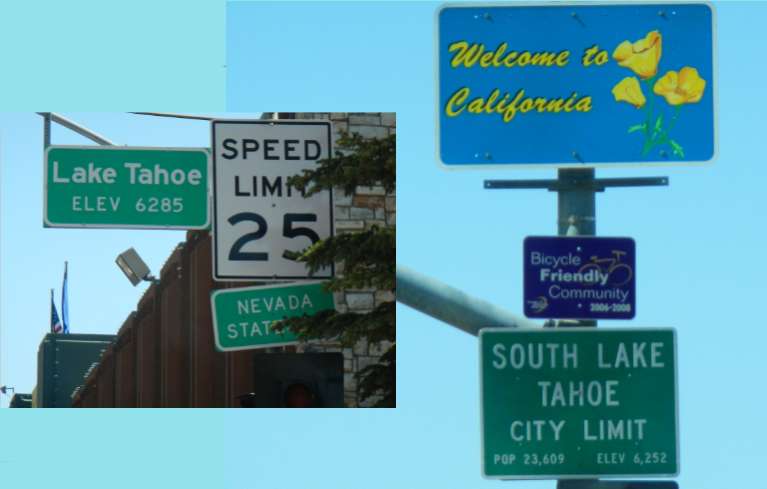
Signs at the state line welcome people to Nevada and California, respectively, but officials would like to focus on this being one community, one economy. Photo/LTN

Signs at the state line welcome people to Nevada and California, respectively, but officials would like to focus on this being one community, one economy. Photo/LTN

There is no one place to go to make it easy for locals or outsiders to attract athletic events to the region. But that is likely to change.

Through the recreation master plan that is being developed by the city and El Dorado County, a one-stop center could be a reality. It might even involve having a true visitors center in the area that would be operated by staff who is supported by various jurisdictions. Now that Douglas County is at the table and wants to be a player, it could make the rec plan a truly cohesive enterprise.

Recreation will be one of the main topics of discussion at the April 29 joint South Lake Tahoe City Council-Douglas County Commission meeting.

South Lake Tahoe City Manager Nancy Kerry and Douglas County Manger Steve Mokrohisky spoke with Lake Tahoe News at length Friday about how far the two jurisdictions have come since the inaugural joint meeting in November 2011. They also delved into the particulars about Monday’s agenda.

While Mokrohisky said the county’s recreation facilities exceed the basic standards, he added, “But we need better coordination with the city. We don’t do a good job of coordinating events. We need more event planning.”

When the consultant who is hired to do the rec plan comes for a visit, the team will spend multiple days on the South Shore experiencing the facilities. A rep from the firm will be at the April 29 meeting.

“I think the debate is long over. We are a tourist economy. Recreation is our economy,” Kerry said. “If we don’t invest, we don’t have anything to compete with.”

Mokrohisky described the South Shore as once being gaming dominant, with recreation as an amenity, now recreation is the dominant economic driver and gaming is an amenity.

Besides recreation, the area plans each body is creating for their respective sections of the state line will be discussed. Both are proceeding, with the electeds likely to vote on the respective plans later this spring or early summer before the TRPA Governing Board hears them later in the summer.

In some ways, this is an extension of the first joint meeting where much of the talk was about the South Shore Vision Plan. City and county staffs have been coordinating so design elements are similar and each knows what the other is working on.

This is one more way the state line is being blurred – by creating a visual connection between the areas.

Collaboration was the one word that was repeated most often by Kerry and Mokrohisky. While they, staff and local electeds are on the same page when it comes to wanting to focus on recreation and one economy, those in Sacramento and Carson City don’t see it that way.

The three bills floating around the two legislatures that could bring the dissolution of TRPA are on Monday’s agenda.

“It’s like an Old West standoff between the two states,” Mokrohisky said. “Our goal is to bring civility to the discussion. It is absolutely high stakes.”

It doesn’t mean everyone sees eye-to-eye on every detail, but locally compromise was found by being able to adopt the TRPA Regional Plan in December. No one got everything they wanted, but the outcome was something everyone but the Sierra Club, which has sued to stop the implementation of the plan, says they can live with.

Kerry and Mokrohisky say it is imperative locals move forward no matter what is going on around them.

“We plan in a state of ambiguity all the time,” Kerry said.

Mokrohisky added, “We are not going to cower in fear of the threat of a lawsuit.”

In the desire to work more closely, it’s possible the governments will share services. Douglas does this with its neighbors in Nevada. The city is looking at cooperative agreements with El Dorado County.

“You start by forming relationships, seeing what you have in common and who does what well,” Mokrohisky said.

Kerry added, “The movement is toward sharing resources instead of siloing.”

No action is expected by the electeds on Monday, though direction to staff of some sort is possible. Future joint meetings are likely.

—–

Note:

The South Lake Tahoe City Council-Douglas County Commission meeting is open to the public. It is April 29 at 1pm at Lake Tahoe Resort Hotel – the old Embassy Suites.


Bluegrass-country to echo through Virginia City

Virginia City turns over its Comstock roots to all things bluegrass and country at the Americana Music Festival on July 19-21.

Headlining the sixth annual festival is country star James Otto, known for his chart-topping hit “Just Got Started Lovin’ You.” The lineup includes national, regional and local musicians the Novelists, the Tuttles with A.J. Lee, Rita Hosking and more than 10 bluegrass and modern country bands performing more than 30 shows.

Concerts are at five locations throughout Virginia City, including First Presbyterian Church, Piper’s Opera House, Fourth Ward School, Delta Saloon festival parking lot located next to the Bucket of Blood, Virginia City Middle School and Red Dog Saloon. Headliner performances take place Friday and Saturday on the town’s main drag, C Street, which is closed for the event.

The event also plays host to the inaugural Americana Music Festival Beer Crawl. For $10 it includes one Coors Light, a commemorative cup and discounted brews at 10 of Virginia City’s historic saloons.

Tickets now on sale for $20 for general entry including access to each show throughout the festival weekend, excluding Friday and Saturday night headliners. The $30 all-inclusive pass includes access to every musical act including the headlining concerts Friday and Saturday night in downtown Virginia City. A $100 VIP pass includes access to all shows, a pass for the Americana Music Festival Beer Crawl and exclusive perks to be announced. Purchase tickets here.


Letter: Colleagues don’t condone Nutting’s actions

To the community,

As chairman of the Board of Supervisors for the county of El Dorado I feel compelled to react to recent statements made by District II Supervisor Ray Nutting during an April 18, 2013, interview airing on KOVR Channel 13.

On camera District II Supervisor Nutting admitted to taking over $70,000 of public monies to cut and clear wood from his personal lands. Furthermore, Mr. Nutting said he saw no wrong with his actions and plans to continue to seek and use future public money for his personal use.

edcUntil KOVR’s news segment, the Board of Supervisors was unaware of this activity and unaware of an open criminal investigation by District Attorney Vern Pierson.

On behalf of the Board of Supervisors it is imperative for the public to know we do not condone any conversion of public money to personal use, period. I will be asking for a special board investigation into Mr. Nutting’s activities.

Finally, the public is to be assured the Board of Supervisors and our county staff will work cooperatively with the district attorney. Should events unfold calling for our board to take unusual or appropriate steps to preserve the integrity of our board, county employees and citizens of the county of El Dorado, we shall do so in a swift and immediate fashion.

Ron Briggs, chairman El Dorado County Board of Supervisors

Here is another news report on the case.