California redefines ‘temporary’ when it comes to fees

By Jim Sanders, Sacramento Bee

Californians have paid tens of millions of dollars the past three years in state fees that had been scheduled to die – but never did.

The Legislature routinely has adopted fees as temporary but quietly extended them as expiration dates neared.

Nearly two of every three state fees scheduled to end between 2010 and 2012 have been kept alive for years to come, according to state records.

Thirteen of 21 fees received extensions, cumulatively raising more than $70 million annually for programs ranging from a missing persons database to an effort to fight auto insurance fraud.

Unlike general taxes paid by nearly all Californians, fees are targeted assessments to people who participate or benefit from a state program for the purpose of funding that service.

Perhaps the oddest Capitol trail left by a single fee involved five bills over the past decade to raise millions for California courts.

What is now a $40 court fee tacked onto all criminal convictions, including traffic violations, began as a $20 charge in 2003. It later was raised to $30, then to $40, then expiration dates were eliminated, leaving the charge permanent.

Republican Sen. Jim Nielsen of Gerber said that Democrats who dominate the Legislature routinely allow fees to go “on and on and on, particularly now when the call is out to fund government by every way that you possibly can.”

“The taxpayers, the citizens, deserve that there be certainty,” Nielsen said. “If fees are to end, they should end.”

But Sen. Mark Leno, a San Francisco Democrat who chairs the Senate Budget Committee, said that placing an expiration date – or “sunset” – on a newly adopted fee does not necessarily mean that legislators intend the charge to die automatically.

“Sunsetting” provides a mechanism for weeding out ineffective programs by creating a deadline for lawmakers to review the impacts of a fee and to keep it alive if they decide the public is getting its money’s worth, he said.

Democratic Assemblyman Bob Blumenfield of Los Angeles, chairman of the Assembly Budget Committee, said the state would be well served by placing sunsets on tax deductions and tax credits, too. Once signed into law, perhaps in a budget compromise, they become virtually impossible to remove, he said.

But Jon Coupal, president of the Howard Jarvis Taxpayers Association, said attaching sunsets to new fees tends to be more of a political gesture – a “legislative two-step” – than a genuine commitment to review.

“Sometimes legislators know that going for a permanent fee right out of the box is not politically palatable, so they say, ‘You know, it’s just temporary.’ And later, ‘Oh, now you’re used to paying it, so let’s make it permanent,'” Coupal said.

Nielsen said that extending a fee should spark substantive discussion but seldom does.

A check by the Bee of written legislative policy committee analyses of the 13 bills that have extended fees the past three years show they typically detail the origin and purpose of a fee, but not how funds have been spent, or drawbacks, or unintended consequences.

Nielsen also complained that it is not unusual for lawmakers to expand permissible uses when extending a fee’s life.

The $40 court fee, for example, began as a charge to support court security but now can be spent on court operations.

A fee on grape growers to fight Pierce’s disease and the glassy-winged sharpshooter – a leaf-eating insect – was changed in 2009 to be used against other grape diseases and pests, too.

Programs to protect the Dungeness crab population, oversee certified farmers markets, provide safety training to the food industry and handle consumer auto insurance complaints are among the beneficiaries of fees extended since 2010.

Several of the extensions involved fees that were more than a decade old and have been saved at least once in years past.

A fee on steelhead fishermen to restore and protect that trout population was extended in 2011 for the fourth time since its inception in 1991. The annual fee, initially $3.15 but now $7.05, has been given yet another date for expiration: July 2017.

Not included in the tally of extended fees was a law providing state authority for an administrative fee to oversee animal rendering and the transporting of inedible grease. It died, but quickly was revived by lawmakers.

Of the eight fees allowed to die the past three years, at least one is targeted for revival, though in slightly different form: Gov. Jerry Brown’s budget proposes a fee of up to 15 cents per homeowner’s insurance policy to help fund the state’s Seismic Safety Commission.

Passage of Proposition 26 in 2010 broadened the definition of taxes in a way that now requires a two-thirds vote of the Legislature to extend some assessments that were approved as fees years ago by a simple majority.

Jack Pitney, political science professor at Claremont McKenna College, said state government was mired in budget crisis for years so “it’s not surprising that most of the fees remain in place.”

Pitney said fees represent a logical way to support state services by targeting only users, not all families.

“Expecting a fee to go away is like expecting a warm day in Seattle – it happens, but it’s not the norm,” Pitney said.


Wine bar helping county arts programs

Après Wine Company in South Lake Tahoe is hosting The Arts Day of Giving on April 29 during happy hour from 4-7pm.

The El Dorado Arts Council is participating along with many other community arts organizations to raise money and awareness for the Arts in El Dorado County. Even though this is geared for online donations, adjustments are being made so checks will be accepted as well.

Intel has loaned the laptops to EDAC that will be at Après Wine Company to make the donation.

Local professional pastel artist Bonita Paulis will be exhibiting her work, and the Tahoe Art League’s Showcase Gallery next door to Après will have an open house featuring other area artists.

Après Wine Company is at 3668 Lake Tahoe Blvd.


Northstar to host 2 weekends of Tough Mudder

Tough Mudder returns to Northstar on July 13-14 and Sept. 28-29.

Tough Mudder events are 10-plus mile obstacle courses designed by British Special Forces to test all-around strength, stamina, mental grit and camaraderie. Tough Mudder’s courses have attracted 750,000 participants worldwide to date. Through Tough Mudder, these participants have raised more than $5 million for the Wounded Warrior Project.

Registration is open, with the summer event 77 percent sold. Rates for the summer and fall events are scheduled to increase May 3.

Spectator tickets will be available for sale online for $20 until noon on the Friday before the event weekends. They will be sold for $40 cash only onsite. Dogs are not permitted.

For more information about the Tough Mudder events at Northstar or to register to participate, go online.


Then and now: Car dealerships used to flourish

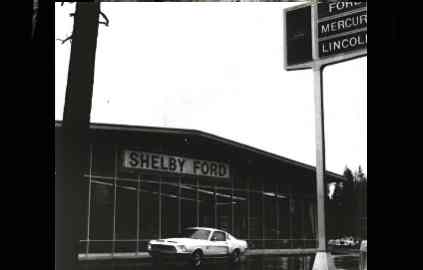
Shelby Ford

Shelby Ford

One of the early new car dealers in South Lake Tahoe was Bob Murnane Ford of Placerville which operated a one-person extension sales booth near the Y in the mid-1960s.

Springmeyer’s Garage (the old stencilled “martial arts” beige building on Highway 50, about to be razed) was an International Scout dealer.

Neddenreip of Minden/Gardnerville also tapped into the Tahoe market.

Pardee Volkswagen

Pardee Volkswagen

But achieving unique distinction in the 1960s was local Emil Pardee Volkwagen & Porsche, the South Shore’s first full-size new car dealership, with sales and service and its own new building. Reportedly, South Lake Tahoe at one time had more Volkswagens per capita than any other area.

Decades later, the building changed to a Chevrolet dealership before closing.

Today, the revamped building is part of the Les Schwab Tires facility.

Les Schwb

Les Schwb

Whiteside Chevrolet

Whiteside Chevrolet

Whiteside Chevrolet of the 1960s on Lake Tahoe Boulevard at Julie Lane later became Shehadi Motors Chevrolet & Toyota.

Today it is Cardinale Way, the lone remaining new car dealer in South Lake Tahoe.

Shelby Ford (of Carroll Shelby fame who also owned the Sky Terrace Motel and Restaurant on Highway 50) was between the Whiteside and Pardee buildings in 1969. It is DIY today.

Cardinale Way

Cardinale Way

No photos, but I should include that in the 1980s

DIY

DIY

South Lake Tahoe also had Vic Bates Oldsmobile & Buick on Lodi Avenue, which became the library and theater of Lake Tahoe Community College before its present incarnation as The Attic thrift store of Barton Auxiliary; Don Weir Dodge on Tata Lane is the Kmart Garden Center today; the large two-story Honda dealership of the 1980s on Highway 89 now houses El Dorado County offices for engineering and other services; Bob Bellemore sold used cars on the corner now occupied by Bank of the West; Terry Libbon sold used cars on the lot on Highway 50 at Winnemucca, now Auto Bazaar.

— Bill Kingman

Photo credits: David Borges took the older photos; Bill Kingman the newer ones.


Frozen oasis — just a helicopter ride away

By Kathryn Reed

Hover. Just hover. Go back. Lower, please. And then it was all over – and way too quickly.

If only I had been able to commandeer the helicopter or shout commands.

But the memory of flying over Emerald Bay and near Desolation Wilderness, that will last forever even if the 30-minute flight wasn’t long enough. (I’m not really sure how many hours would have been required before I would have been satiated.)

Three of the area’s most iconic waterfalls – Eagle, Cascade and Horsetail – at the same time lost a bit of their majesty and gained even more. All of this because of a helicopter ride.

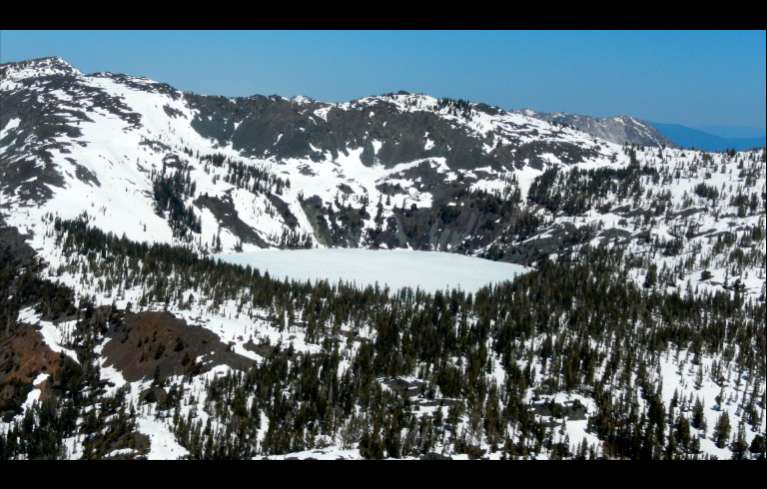
Helicopter tours reveal a frozen back country lake west of Lake Tahoe. Photos/Kathryn Reed

A helicopter tour reveals a frozen backcountry lake west of Lake Tahoe. Photos/Kathryn Reed

They were magnificent, but something about hiking to them – the time that it takes, the views, the sound – is such a classic way of viewing them. But this eagle’s view, well, it gives a different perspective to all that rushing water.

Water is flowing strong now down the falls. The whir of the blade replaces the thunder of the water.

The waterfall tour is one of six that Reno Tahoe Helicopters provides for those who want to see the Lake Tahoe area from a different perspective.

“I would have never known all of those lakes were there,” Cheryl Johnston of Atlanta said when touching down at Lake Tahoe Airport. The ride was one of the highlights of her first vacation to the area.

The pilot says there are about three dozen lakes to see on this trip. Some are recognizable to a local – Eagle, Echo, Cascade, Fallen Leaf.

Others are ones found on summer hikes – the Velmas, Susie, Heather, Aloha.

Oh, those frozen ones. That is a sight not seen on a hike. The icy blue looks like something out of Alaska. Mesmerizing, chilling, spectacular, otherworldly – find a superlative and it’s bound to fit.

With snow in abundance in the higher elevations, much of the terrain was a winter wonderland last Monday.

This is the slow season for the helicopter company, despite its being the height of waterfall season. Though, the waterfall tour is the most popular right now.

On a busy summer Saturday they could make 20 tours.

The pilot said there is no rule about how high they must be, but they are usually at 8,200 feet. The reason is to not be a noise polluter, so to speak, for those who are on the ground.

Claudio Bellotto, who has been flying out of the South Shore since 2005, gives a bit of history while flying over the Tahoe Keys, then Emerald Bay and beyond into the backcountry.

The Bell Long Ranger IV has a window seat for the five passengers it can seat. Three helicopters are in the South Tahoe fleet, with two others now operating out of the Truckee airport.

A fly fishing guide out of Truckee arranges for helicopter rides for his clients – landing at a resort near Markleeville so they can cast along the Carson River.

It’s not just tourists – or the occasional local – who buckle into the bird. Pilots have taken film crews around the area for various shoots. This winter a helicopter was in the air for five hours to film the Freeride ski event at Kirkwood. A cineflex was attached to the nose.

Range Rover hired a pilot to shoot aerial shots for a commercial. Boeing is coming up soon – but the helicopter company hasn’t been told the exact assignment. National Geographic has been a repeat client.

After the 2007 Angora Fire, a pilot took a crew up with infrared devices to look for smoldering hot spots.

In addition to the scenic and commercial flights, Bellotto operates a helicopter flight school. It’s the highest elevation flight school in North America.

More information about Reno Tahoe Helicopters may be found online.

ngg_shortcode_0_placeholder (Click on photos to enlarge.)


Time to weigh-in on El Dorado mental health services

The El Dorado County Health and Human Services Agency, Mental Health Division wants the public to review and provide comment on the 2012-13 Mental Health Services Act (MHSA) Plan Update.

The draft plan update is posted online or a copy may be obtained by contacting Stephanie Carlson at (530) 621.6315.

The update provides information on current MHSA programs and budgets for this fiscal year. MHSA components in the update include: Community Services and Supports; Prevention and Early Intervention; Workforce Education and Training; Innovation; and Capital Facilities and Technology Needs.

A public hearing hosted by the El Dorado County Mental Health Commission will be on May 29 from noon-1pm. The hearing will be conducted via teleconference at two locations: 1360 Johnson Boulevard, No. 103

South Lake Tahoe and 415 Placerville Drive, Suite K, Placerville.

Public comment may also be submitted through May 28 to MHSA@edcgov.us or Health and Human Services Agency, Mental Health Division, MHSA Project Team, 670 Placerville Drive, Suite 1B, Placerville, CA 95667.


Opinion: Plastic bags need to go away

By Marce Gutiérrez and Nathan Weaver

Imagine that you’re a sea turtle swimming off the coast of California. You see something that, to your eyes, looks like a jellyfish – a welcome sight, given your hunger. As you open your mouth, you realize, too late, that what you thought was dinner is, in fact, the remnants of a plastic bag. The plastic settles in your stomach, never to digest, telling your body that you’re full. Soon, you’ll starve and die.

The Legislature is considering two proposals to ban single-use plastic bags throughout California. Introduced by Sen. Alex Padilla, D-Los Angeles, and Assemblyman Marc Levine, D-San Rafael, in their respective chambers, the ban would be a major step forward in protecting our ocean. As a coastal state and nationwide leader, California can help protect sea turtles and other ocean wildlife.

All Californians have a deep connection to the beach and the ocean, including our Latino community. It’s the perfect place to host a family get-together, a pickup ball game or to enjoy fishing. For some of us, the ocean plays an important part of our family’s history: The same waves are crashing in our ancestral places of origin and the Golden State we call home. It is natural, then, that we all play a part in keeping the ocean healthy and vibrant. Reusable shopping bags, surprisingly enough, also recall long-standing traditions – long before single-use plastic bag bans were introduced, our grandmothers would unfailingly use their woven bags to shop in the “mercado.”

The U.N. Environmental Programme reports that each square mile of ocean contains more than 46,000 pieces of plastic litter, varying in size from tiny flakes to bags to enormous fishing nets. It will take hundreds of years for this plastic to break down, longer if we keep adding more. In some parts of the Pacific Ocean, the mass of floating plastic already outweighs plankton 6 to 1. All of this plastic harms at least 267 species of ocean animals, and plastic bags are especially dangerous.

California could help protect the Pacific by eliminating single-use plastic bags. Assume that our state’s 38 million residents each use seven plastic bags a week. That’s almost 13.8 billion bags each year. Some will roam our streets like urban tumbleweeds, many will take up scarce landfill space and only a few will be recycled. But too many plastic bags will enter the ocean through storm drains, creeks and rivers.

Banning plastic bags would be a huge victory for animals throughout the Pacific, like the leatherback sea turtle. These turtles consume hundreds of jellyfish each day and can easily mistake plastic bags for their favorite food. In fact, more than one-third of adult turtles may have ingested plastic, according to a recent analysis of dissection reports. Because sea turtles cannot vomit, any plastic they can’t pass will remain in their stomachs permanently. Once a turtle eats too many bags, it will have no room left for food and will die of starvation.

Researchers in Queensland, Australia, found that bags and other soft plastics caused nearly a third of all sea turtle deaths in the area studied. Leatherback turtle populations have declined by 95 percent in the last two decades, due to a combination of factors, and it is critical that we remove threats to these vulnerable animals.

Many other species would benefit from a plastic bag ban. Seabirds like the majestic Laysan albatross frequently ingest floating plastic, mistaking it for food. Other birds are trapped or entangled in bags and, once trapped, often drown or suffocate. Adult seabirds can inadvertently scoop up plastic pieces, including bag scraps, and feed them to their chicks. When the plastic lodges in the chick’s stomach, it leaves too little room for food and can starve the chick.

Even the largest animals in the ocean are potentially vulnerable to plastic bags: Scientists have found plastic in the stomachs of several dead whales in recent years. Most of the largest species of whales are filter feeders that swim through the ocean with their mouths open and capture floating plankton. This feeding strategy puts the whale at risk to suck up any piece of plastic garbage small enough to fit in its whale-sized mouth. Toothed whales are also vulnerable. Scientists have discovered plastic bags in the stomachs of dead sperm whales, which feed primarily on squid and fish.

Banning single-use plastic bags is an easy, common-sense way to protect marine animals. That’s why more than 70 California cities and counties have already said “no” to single-use plastic bags. Every plastic bag ban helps keep the Pacific Ocean cleaner.

Nothing that we use for a few minutes should pollute the ocean for hundreds of years. It’s time to do the right thing by banning single-use plastic bags in California.

Marce Gutiérrez directs Azul, an organization working to empower Latinos as coastal and ocean stewards. Nathan Weaver is the oceans advocate for Environment California, a citizen-based environmental advocacy organization. This column first appeared in the Sacramento Bee.


Target shooting has its limitations

With increased citizen concern regarding target shooting in congested areas, Washoe County sheriff’s deputies are reminding residents of county ordinances governing discharge of firearms in congested areas.

It is unlawful to discharge: any gun, pistol, or rifle, with the exception of shotguns, air rifles, or BB guns, within 5000 feet of an occupied dwelling; shotguns, air rifles, or BB guns within 1,000 feet of an occupied dwelling; a firearm from, upon, over or across any federal or state highway or any county road or highway; a firearm within a Nevada State Park, unless otherwise designated by the administrator; within the jurisdiction of the U.S. Forest Service it is prohibited to discharge a firearm in or within 150 yards of a residence, building, campsite, developed recreation site or occupied area, or across or on a National Forest System road or a body of water adjacent thereto, or in a manner or place whereby any person or property is exposed to injury or damage as a result in such discharge, or into or within any cave.

A “congested area” is a geographic location where discharge of any firearm is prohibited. Because congested areas are generally densely populated, it has a high risk of personal injury.

A “restricted congested area” is a location where residents must be a minimum of 1,000 feet from any occupied dwelling.

A “non congested area” is a location where residents must be 5,000 feet away from an occupied dwelling. In these areas they may shoot guns, pistols, rifles, shotguns, air rifles, BB guns, or any other firearms.

If anyone has concerns about activity that may be illegal, or dangerous, call (775) 785.9276.


Study: Students prefer ‘real’ classrooms, not online

By Carla Rivera, Los Angeles Times

As colleges are rushing — or being pushed — to embrace online education, they might want to take pause: Most students prefer connecting with teachers and fellow students and don’t want to take all of their classes online, a study suggests.

Students preferred direct instruction if they expected a course to be difficult, singling out math and science, according to the study released Thursday by the Community College Research Center at Columbia University’s Teachers College.

They also preferred a face-to-face setting when studying subjects they considered interesting or important, especially if the class was in their major. Many of the students said they learned more when the instructor is present.

The overall findings suggest that demand for online courses may be less than advertised. That consideration may become more important as many states move toward greater online offerings as a way to increase access and lower costs.

The drive in California is being led by Gov. Jerry Brown, who proposed new funding for online efforts in his 2013-14 budget plan, including nearly $17 million for the state’s 112 community colleges to create a “virtual campus.”

“In our students, about 10 percent said yes if I could take all of my courses online that would be helpful, but 90 percent said they’d like to take some online mixed with face-to-face,” said study author Shanna Smith Jaggars, who is the assistant director of the research center. “If students are not able to get into courses because there are not enough course sections, it doesn’t seem to suggest that adding more online courses is the answer.”

The findings, drawn from a larger study, are based on interviews with 46 students at two community colleges in Virginia who were taking at least one online class in spring 2011. They were a mix of ages and most were working.

Most students said they took online courses because of the flexible schedule, and some older students said they preferred a virtual classroom because they didn’t have to interact with their younger classmates.

But most said they missed the personal back-and-forth of the classroom.

“It just seems more, when you do it online, if you need help, your teacher is basically not there,” said one student. “Like face-to-face, she can help you a little bit more. But then when it comes to online, you have to teach yourself, I guess you could say.”

Nearly 27 percent of California’s 2.4 million community college students take at least one online class, up from 12.5 percent in 2005-06, according to officials. Students ages 18 to 24 account for 61 percent of those enrolled in online courses, and those younger students seem to be driving demand.

But the Columbia study echoes concerns that online learning doesn’t serve the needs of all students.

“It’s consistent with what the chancellor [Brice Harris] has been saying, that we don’t want students taking 100 percent of their classes online, it needs to be the proper mix,” said spokesman Paul Feist. “We need to restore course offerings at community colleges and restore access, but that will not be exclusively online.”


CalFire trains in anticipation of early fire season

By Richard Chang, Sacramento Bee

Seasonal firefighters were at work in Jackson on Thursday, finishing up a weeklong fire training academy where they practiced forming firebreaks, hand tool safety and deploying fire shelters.

“We’re running two weeks ahead of schedule due to the dry weather,” said Robert Withrow, battalion chief for CalFire’s Amador, El Dorado and Sacramento unit, who oversaw the training. “Fire activity is going to start real soon.”

The early training by the CalFire was prompted by an unusually dry winter and spring, combined with recent high winds that have created near-perfect conditions for wildfires. In addition to the academy in Jackson, the unit for Nevada, Yuba and Placer counties will start May 6.

CalFire spokesman Daniel Berlant said the department has “already responded to 660 wildfires statewide this year,” 200 more than the average.

“Just because we’re not in summer doesn’t mean there isn’t a fire danger,” he said.

Fire season typically starts June 1 for Northern California, but this year, that “could be moved up to May,” Berlant said.

CalFire is dispatching units weekly to monitor the moisture contained in grass, brush and timber – considered a big indicator of how intensely and quickly a wildfire will burn.

Firefighters won’t get relief from Mother Nature anytime soon. The National Weather Service is predicting dry conditions through the month.

“We don’t have any real chance of precipitation at least for the next week or two,” said Craig Shoemaker, a forecaster with the weather service in Sacramento.

The situation is particularly dire this year because the season’s precipitation occurred in November and December. January, February and March stayed relatively dry.

As a result, the “lack of rainfall has allowed grass and brush to dry out,” Berlant said, adding that high winds are exacerbating the situation.

Sacramento’s precipitation levels are 81 percent of normal for the year, while the Sierra is at 82 percent, according to the weather service.

“It’s unlikely we’re going to make that up. May is a fairly dry month,” Shoemaker said.

In some areas of the state, precipitation is only 20 percent to 30 percent of normal. Drought conditions are likely to return to California and will “significantly” worsen during summer, said Tom Rolinski, a meteorologist with the U.S. Forest Service’s predictive services program.

“Certainly the potential is going to be there for more fire activity and larger fires because we’ve had two dry years,” Rolinski said.

In Southern California, where fire season began two weeks early on April 15, firefighters on Wednesday contained a blaze in Monrovia that they had been battling for five days, but not before it had charred 125 acres.

The fire started Saturday in a backyard with a garden tool that “somehow sparked” nearby brush, Monrovia city spokeswoman Jennifer McLain said.

At least a dozen fire departments were called in, and at one point several hundred homes were threatened.

Last year, CalFire responded to 5,800 wildfires that burned 140,000 acres. By comparison, 2011 saw 4,600 blazes that engulfed 57,000 acres.

So far, the agency has spent $168 million in emergency money taming the flames for the fiscal year beginning July 2012. That figure is projected to grow to $215 million when the period ends June 30.

CalFire, however, is responsible for protecting only one-third of the state, with the other two-thirds under the jurisdiction of cities or the U.S. Forest Service.

Rolinski noted that many wildfires are started by humans, either intentionally or accidentally. “It could be hot metal underneath a car or mowing a lawn,” he said.

The 2012 Robbers fire was sparked when Sacramento resident Bryon Craig Mason threw an illegal firework into a remote Placer County swimming hole. The fire stretched 2,630 acres and destroyed four structures.

Mason was released from custody earlier this month after his lawyer successfully argued that the fire wasn’t started willfully and maliciously.

CalFire is asking the public to clear dead brush and other combustible vegetation from around houses, especially in rural areas.

“It’s not going to take much for a fire to quickly escape and require us to respond,” Berlant said.