Editorial: Don’t let Clean Water Act money evaporate

Publisher’s note: This editorial is from the April 23, 2013, Redding Record Searchlight.

How hard is it to spend government money? Harder than you’d think.

The U.S. Environmental Protection Agency sent a lashing letter to the California Department of Public Health last Friday declaring that the state agency is violating the Clean Water Act. Its major sin? Not spending federal money that should be going toward improving substandard water systems.

The state had $455 million in clean-water money just sitting in the bank as of last October, according to the EPA. That cash, as part of the state’s revolving loan fund, should be financing upgrades at waterworks. As users then repaid the money through their monthly bills, the money could in turn help other communities in need.

It’s not that the state is wasting the money — frittering it away on systems that don’t work or multi-layered bureaucratic reviews or conferences with $14 catered muffins. Instead, the EPA said, the state has frequently committed the money to large water projects that are not “shovel-ready.” That leaves large sums essentially frozen for years while local water agencies do their work.

In the meantime, though, the money could be put to good use. Jared Blumenfeld, the EPA’s regional chief, told The Associated Press that the state could instead finance water upgrades for small communities with pressing needs.

Many California farm communities struggle with contaminated groundwater, likely from agricultural runoff, but the rural north state is also thick with rickety old water systems that have trouble meeting 21st-century standards and are overdue for improvements. Small towns rarely have the means locally to pay for this kind of work, so it stings to leave unspent federal money on the table.

Some state lawmakers, frustrated at the inability to muster action on vital water cleanups, were already pushing for change in the program. We’d hope the north state’s representatives would join them. The administrative details are of little interest to anyone but water insiders, but the bottom-line need to spend water-quality money effectively — and, in this case, simply to spend it at all — ought to be self-evident.

As a reminder, though, the EPA’s letter also highlights the coming wave of needed investments. The agency’s most recent study says California will need an astonishing $39 billion worth of water-quality improvements by 2026 — a thousand bucks per resident of the state. The disputed money here is a proverbial drop in the bucket, but it’s a start.

You know, unless it just sits in the bank.


Pet psychic to give readings in S. Tahoe

Marla Steele, the pet psychic, will return to Tahoe over Memorial Day weekend.

Dog Dog Cat in South Lake Tahoe will be taking reservations for Steele. She sold out last year.

Dog Dog Cat is donating a portion of the proceeds to ACT – Animal Coalition of Tahoe.

Both days will feature local and national vendor booths, a raffle, and refreshments.

Steele will be in Tahoe May 25-26, 10am-2:30pm each. The cost is $30 for each 10-minute session.

Dog Dog Cat is at 4000 Lake Tahoe Blvd. (Raley’s Shopping Center at Stateline).

To make an appointment, call (530) 541.2322.


California looks at new way to manage water

By Lenny Bernstein, Washington Post

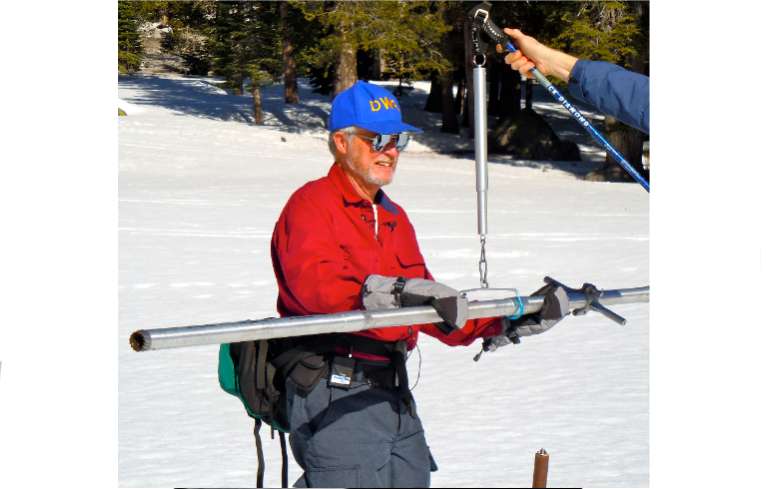
Like a pitcher taking the mound on opening day, Frank Gehrke gets the spotlight in California every early April. That’s when the otherwise obscure state water official trudges into the Sierra Nevada mountains, media in tow, and plunges aluminum tubes into the snow.

With those snow samples — and historical data and mathematical formulas — Gehrke and his colleagues can tell anxious farmers and hydroelectric power generators how much water they can expect for the coming summer.

Even with about 150 people taking samples across the state and the help of satellites and sensors buried in the ground, it’s a highly uncertain way to gauge much of the water supply for a thirsty state, where every drop is precious and expensive to move. According to one study, the predictions are off by 18 percent at least half the time.

Manually checking the water content of the snowpack is a winter ritual in the Sierra. Photo/LTN file

Manually checking the water content of the snowpack is a winter ritual in the Sierra. Photo/LTN file

That could change dramatically if an experiment in snowpack measurement under way this month proves promising. For the past few weeks, researchers from NASA and the California Institute of Technology’s Jet Propulsion Laboratory have been flying over the Tuolumne River Valley, which runs through Yosemite National Park, with sophisticated instruments that measure the snow’s depth and area, as well as the amount of energy it absorbs from the sun.

That will allow them to more precisely predict the volume of water that will come from the Sierra snowpack for 2.6 million people in the San Francisco area, how fast it will melt, where it will flow and how soon, the researchers say.

And they can deliver that information within 24 hours — a potential godsend to the people who control the hundreds of reservoirs strung the length of the state. When water managers guess wrong about the supply headed from the mountains, the valuable liquid can spill over dams or run dangerously short. Those can be expensive mistakes for consumers, farmers and electric utilities.

“What [the new method] gives me that we have never had is an actual estimate of what the total volume of water is in the mountains,” said Bruce McGurk, a consultant to the Airborne Snow Observatory (ASO) project and former manager of the Hetch Hetchy reservoir, which serves the San Francisco area. “All we’ve ever had is the statistical relationship between snow measurement at a bunch of points” and the water flow, he said.

Gehrke’s calculations show that the state will deliver only 35 percent of its normal water supply to agencies across California, which must figure out how to make up some of the difference. Farmers already are preparing to see their allocations cut and consumers are being urged to conserve. Knowing more about when the water will come down from the mountains would help.

“The idea that you can determine the total snow water equivalent in the basin is the icing on the cake of snow science,” Gehrke said.

At 20,000 feet, a DeHavilland Twin Otter aircraft jammed with equipment can cover the entire Tuolumne River basin in about six hours, according to Thomas Painter, the lead scientist on the ASO project, which has been aloft weekly since the beginning of April. Light-detection and ranging lasers, more commonly known as lidar, measure the depth of the snow, while a spectrometer maps the area it covers.

Also critical is the snow’s “albedo,” or reflective quality, which dictates how much sunlight it absorbs and helps determine how quickly it will turn to water. Albedo varies considerably; freshly fallen snow reflects 90 percent of the sunlight that hits it, while older snow, which forms larger crystals, reflects only 60 percent. Dust and black carbon carried to the snowpack by winds also can change the percentage. The spectrometer measures that as well.

The information is fed into powerful computers and combined with historical measures and models of snow density, Painter said. The end product, the scientists hope, will be the best estimate of water volume and flow ever developed, a truly new generation of snow science and snowpack measurement.

Satellites can map the snow’s area, but they provide huge snapshots, compared with the aerial surveys, which can show a patch of snow a yard or two square, and a patch of bare ground next to it, Painter said. And the satellite images can take weeks to arrive.

A sparse network of underground sensors, known as “snow pillows,” provides some idea every few hours of the snow’s depth, but they weigh everything that lands on them, including tree branches and the occasional bear, Painter said. They are small and there are far too few of them, none in the higher elevations of a mountain range that reaches more than 13,000 feet. There is no method to calculate snow albedo.

“We are massively undersampling the snowpack,” Painter said.

Climate change has begun to make the historic data that snow scientists use less reliable, McGurk said. “Our predictive tools get noisy,” he said. “What that means is you have to hedge more.”

Attempts at aerial snow measurement have been made for the past five or 10 years, said Ethan Gutmann, associate scientist at the National Center for Atmospheric Research, who has mounted a single, fixed laser in the Rocky Mountains near Boulder, Colo., to measure the snowpack there.

The aerial survey can cover a huge area once a week, while Gutmann’s laser provides continuous, precise information but for a much smaller swath. It is much less expensive than the $1 million aerial project and not subject to days when planes can’t fly, he said.

But the ASO, he said, is “the future of snow science and resource management for mountainous areas” and probably beyond.

Hetch Hetchy is a small reservoir by California standards; it holds just 360,000 acre-feet of water. (An acre-foot is the volume of water that would cover an acre at a depth of one foot, or about 326,000 gallons.). When water is plentiful, the challenge is to channel it to hydroelectric generators without allowing it to collect too quickly in the reservoir and spill over the dam.

The water needed to generate electricity at the Kirkwood Powerhouse 11 miles away is worth $66,000 per day, McGurk said. Any mistake that results in the use of gas or coal to generate power is therefore quite expensive and releases greenhouse gases into the atmosphere. Heavy spills also can affect downstream ecosystems, he said.

In times of scarcity, like the approaching summer, the trick is to keep the reservoirs as full as possible, while supplying consumers and farmers with the water they need. Moving water is an extremely expensive proposition in California. About 15 percent of the power used in the state goes to pumping water through its vast network of reservoirs and pipelines, McGurk said.

“There are very large dollar figures attached to this water and knowing how much is there and when it’s going to come out,” Gutmann said.

In droughts, water managers may have to shortchange power generators to ensure that reservoirs are full when the snowmelt stops flowing in the spring. “There is a great penalty, both political and personal,” for missing that goal, McGurk said.

“We’ve had reasonably good tools, and we were doing OK,” he said. “And what we’re trying to do is get to the next level.”


Bill would limit school police in discipline matters

By Susan Ferriss and Ben Wieder, Center for Public Integrity

As the national debate grows louder over deploying police in schools, the largest state in the union ­– California – is considering a bill that would require schools to set “clear guidelines” defining the role of school police and limit their involvement in disciplinary matters.

The Golden State joins Texas and Connecticut ­­­– home of the December Newtown school shootings – in considering legislation that would set limits on how schools involve police officers in discipline. Colorado adopted limits last year.

The proposals come amid burgeoning concern nationally over harsh school punishment policies, and police involvement in seemingly routine discipline. Police presence on campuses nationwide has grown steadily since two teens went on a killing spree at Columbine High School outside Denver in 1999. But a growing group of juvenile-justice researchers and judges argue that putting students into conflict with officers over minor infractions – and needlessly placing kids in the justice system – increases risks students will drop out and get into more serious trouble.

Since last December, lawmakers in various states and school administrators have rushed to fortify security in reaction to a young adult’s shooting rampage, which killed 20 first-graders and six educators in Newtown, Conn. President Obama and California Democratic Sen. Barbara Boxer, have urged appropriating money to schools that want to increase security.

California State Assemblyman Reginald Jones-Sawyer, a Democrat from Los Angeles, introduced the state school police bill, AB 549, to “get out in front,” he said, of the drive to put more security personnel in schools. A first hearing on the bill is set for Wednesday before the Assembly Education Committee.

California lawmakers are considering restricting other discipline practices critics say have become counterproductive, including suspensions that remove pupils from school for days at a time, often causing them to fall behind in classwork and leaving them unsupervised at home. The Assembly education panel recently approved a bill April 17 that would restrict out-of-school student suspensions and expulsions for “willful defiance,” the basis of almost half of all suspensions in 2011-2012, new state data shows.

The Jones-Sawyer bill faces opposition from the Association of California School Administrators. Laura Preston, the group’s legislative advocate, told the Center that the proposal takes too much control away from local districts and schools because it limits what they can do with school safety dollars.

In an April 29 letter, the group argued that the bill’s requirements to put police guidelines in school safety plans added up to an imposition “without regard” for “the additional time needed to do this work.” Preston suggested “a conversation” about improving school police training could be an alternative to Jones-Sawyer’s bill.

Jones-Sawyer’s bill does have support from the California Federation of Teachers, the union representing many Los Angeles teachers. That support helps it over one major political hurdle. The California Teachers Association, an even larger union, has no position yet.

“This is not anti-police. I do believe there is a role for public safety on campuses,” Jones-Sawyer said of his bill. “But before we get the guns and guards out, let’s get some mental health (care) in there for students.”

“There should be guidelines for when you don’t need police involved in discipline,” he said.

Last year, the Center for Public Integrity documented the ticketing of about 10,000 mostly black and Latino students a year, including middle-school-age children, in lower-income neighborhoods in the Los Angeles Unified School District. L.A. Unified is the nation’s second-biggest school district, and with more than 300 officers and additional security guards, it has the country’s largest district-controlled school police agency. At one point, school police were issuing about 1,000 tickets, or court citations, a month in 2011.

New York City police in schools, by comparison, issued 1,666 tickets to students during the entire 2011-12 school year, according to records obtained by the American Civil Liberties Union. The ACLU is suing New York City police for alleged abusive treatment of students, which the department denies.

Arguing that citations had spiraled out of control, community activists and juvenile-court judges have in recent months pressured L.A. Unified and police to seek other ways of handling some seemingly minor allegations – allegations like vandalism or possession of a marker to commit vandalism, trespassing, marijuana and tobacco possession, daytime-curfew violations and many charges of disturbing the peace or public fighting.

Fresh data obtained by the Center shows that L.A. Unified’s tickets have fallen sharply, driven mostly by a drop in daytime-curfew and tardiness violations. Between January and March, about 60 students were ticketed for minor cases of tardiness, or skipping school. The truant or tardy students were referred directly to counseling under a new agreement.

For other alleged legal violations, L.A school police issued 316 tickets this past January, 454 in February and 282 in March.

In January of last year, by comparison, officers issued more than 650 tickets.

Despite the decline, the new data also shows that certain L.A. Unified middle schools in lower-income areas continue to remain hot spots for ticketing pupils who are almost all black or Latino. The most frequent allegation for younger students is disturbing the peace – a charge that often stems from student fights, shouting matches or allegations of threats to fight.

Out of 1,590 tickets issued from last November through March, half went to children 14 and younger.

In fact, if ages are considered separately, fewer 16- and 17-year-olds were cited than students who were 13, 14 or 15 years old. Black students represent 10 percent of the district’s enrollment, but were more than 37 percent of those ticketed for disturbing the peace. And 56 percent of black students cited for this infraction were between 11 and 14 years old.

L.A. Unified officials did not respond to a request for comment on the Center’s new findings or Jones-Sawyer’s proposal. Last December, the district said it was continuing “to work with our internal and external stakeholders to identify and evaluate non-penal alternatives to various minor violations.

Jones-Sawyer, 56, attended L.A. Unified schools and remembers kids who scuffled being taken into the office of a vice principal, who put an arm around their shoulders and talked through problems. “We have to find out why kids are angry,” the assemblyman said. Reprimands were not in the form of police citations back then, he said.

He acknowledged educators’ complaints that California’s school counselor ranks have been decimated by budget cuts, leaving schools less able to deal with kids’ conflicts. Compared with a national average of 457 students for every counselor, California’s ratio of 814 students for every counselor in 2008-2009 was rock bottom among the states, according to data gathered by the American School Counselor Association.

Nonetheless, critics of involving officers in discipline matters say peer counseling, intermediate steps prior to police involvement and other cost-effective alternatives exist and are practiced in other states, and in schools in Oakland and San Francisco now as well.

Jones-Sawyer’s bill says schools “shall consider existing strategies and model approaches to minimize the involvement of law enforcement in pupil conduct and minor offenses that do not rise to the level of a serious and immediate threat to physical safety.”

In addition to requiring that schools’ mandatory safety plans define police roles, the bill would also require schools to “prioritize” federal and state public-safety funding on mental-health aid and other supportive behavioral-intervention programs – not just police. Schools would also have to publicly develop “memorandum of understanding” about officers’ duties.

“I think this bill is a huge shift in how we are talking about school safety,” said Zoe Rawson, a lawyer with the Labor/Community Strategy Center, a community group listed as a nonlegislative “sponsor” of Jones-Sawyer’s bill. The Strategy Center has represented students who received tickets and is negotiating with L.A. Unified and school police on standards that limit police involvement on district campuses.

The legislation gives “leverage” to local communities to set standards, Rawson said. “Right now, there is nothing required around police having frequent contact with young people.”

Any district in California with a school police force, or school resource officers, would be affected by Jones-Sawyer’s bill. Oakland’s district has its own school police, as does the Central Valley’s Kern Union High School District, which has more than two dozen high school campuses in Kern County.

After the Newtown massacre, the Obama administration proposed allocating $150 million in federal funds for schools to hire police or counselors or install bullet-proof glass or other security technology. The recommendations are in the 2014 Obama budget proposal now winding its way through the budget process.

Boxer, a California Democrat, introduced a bill to bring back federal funding cut in recent years for school police and offer grants to schools in need from a pool of at least $40 million a year. The measure was folded into the gun bill that stalled in the Senate on April 17, but Boxer is expected to revive it.

Various states are also considering how to fund more school police through property taxes or by tapping other state coffers.

Los Angeles County Presiding Juvenile Court Judge Michael Nash is so concerned about the rush to put police in schools that he wrote – as president of a national judges’ group – to Vice President Joe Biden, who was chairing a post-Newton gun-violence task force.

Penned by Nash as president of the National Council of Juvenile and Family Court Judges, the January letter warns that “the influx of police in schools” in recent years is already “one of the main contributors” to minors sent unnecessarily into the criminal justice system.

Nash told the Center he supports Jones-Sawyer’s bill.

“I like this bill,” he said. “I have been asserting that, in considering school safety and enlisting personnel to maintain safety, we have to be clear in differentiating between security and discipline.”

Colorado – the state that was shaken by the 1999 Columbine High School massacre – enacted reforms last year that require police to “de-escalate” student fights and for schools to ease up on referrals of students to law enforcement due to “zero tolerance” policies. Denver public school discipline data shows a 71 percent increase in referrals of students to police between 2000 and 2004, with 7 percent of referrals for serious offenses like carrying a weapon, according to analysis by the nonprofit Advancement Project.

Texas legislators are considering a bill that requires schools with police to adopt “graduated sanctions” and other means rather than having officers send children to court for disruption and disorderly conduct. The bill, which has bipartisan support, also requires school staff to submit sworn statements and prove steps were taken to counsel students before police referral to court. The state Senate has already approved the bill, which is now before its House of Representatives.

In Connecticut, where legislators are trying to balance new calls for security with concerns about over-policing, the legislature’s joint Committee of the Judiciary on April 19 voted overwhelmingly, 40-4, to approve a proposal requiring school boards to draft memorandum of understanding with police to limit their use in disciplinary responses. The proposal says agreements should spell out the need for “a graduated response model” to discipline problems. The bill is now before the state’s House of Representatives and, if approved, will go to the state Senate.

A Senate bill in Florida that would have required that schools refrain from referring students to law enforcement for “petty acts of misconduct” or misdemeanors – without written explanations – died when it failed to get out of legislative committees this spring.

In March, the U.S. Justice Department’s civil rights office reached a court-sanctioned agreement stemming from a federal investigation into alleged excessive involvement of police in discipline meted out in Meridian, Miss.

The agreement with the district of 6,100 students in Meridian essentially regulates school police on the district’s campuses. The district is required to train school police officers in “bias-free” policing and stop involving police in minor behavioral disputes in the majority-black district. Civil rights investigators said police in Meridian told them they were ferrying students to jail on allegations of defiance and disrespect at schools.

L.A. Unified, last summer, started referring most tickets not to court but directly to the Los Angeles County Probation Department. Because of a budget crisis, the county had to close its lower-level juvenile courts, where parents and students were usually summoned to answer to citations school police issued that carried hundreds of dollars in fines.

Judges and civil rights advocates saw the closure as an opportunity to keep most students out of court, and instead first divert students, through probation officers, to community-based counseling or other family treatment.

Between November and March, the big three infractions students were cited for were allegations of possessing or using less than an ounce of marijuana – 514 tickets – and disturbing the peace, for which 496 students were cited. Tobacco or smoking “paraphernalia” was next with 252 tickets.

Rawson, with the Labor/Community Strategy Center, said it is a positive step that most ticketed students at L.A. Unified are no longer sent directly into court.

But as a lawyer who has represented students, she’s concerned that black and Latino students in lower-income neighborhood schools are “over-policed” compared to students in more affluent areas. L.A. Unified’s school police chief, Steven Zipperman, told the Center last year that officers are generally evenly distributed to schools – mostly high schools – but that schools of all grade levels can request that officers be dispatched to intervene in a problem.

Conflict with police officers, Rawson said, can leave students with a sense that their citation is a first step toward future clashes with law enforcement. The youngest student cited between March and December was a 9-year-old accused of vandalism.


Vineyard of the year hails from Amador County

A scientist responsible for discovering the family ties of several varieties of wine grapes and a vineyard responsible for the rediscovery of the Sierra foothills as prime viticulture territory are receiving the California State Fair’s top wine and viticulture honors.

Carole Meredith, professor emerita of the Department of Viticulture and Enology at UC Davis, is receiving the State Fair’s Wine Lifetime Achievement Award. She was among early researchers to develop DNA markers for grapes, then used them to identify the genetic and geographic origins of numerous varieties.

A native of Wales who spent her formative years in Canada and California, Meredith joined UC Davis as an assistant professor in 1980 where she oversaw research in grapevine genetics, including the creation of a genome map now used internationally to identify genes that control disease resistance and fruit quality in wine grapes. Her use of DNA profiling has been instrumental in solving several longstanding vineyard mysteries, such as tracing the origin of the Zinfandel grape to Croatia.

The State Fair’s 2013 Vineyard of the Year is being awarded to the Deaver Vineyard. The 300 acres of rolling hills is located in Amador County’s Shenandoah Valley outside Plymouth.

Fifty years ago this coming harvest a Sacramento home winemaker bought some of the vineyard’s Zinfandel and made a wine that caught the attention of key players on California’s wine scene, setting in motion a revival of the region’s wine trade, largely dormant since the end of the Gold Rush about a century earlier.

The first vines on the Deaver Vineyard site are believed to have been planted in the 1860s by John James Davis, a cooper whose son Joseph Davis married the widowed school teacher Amy Elizabeth Deaver in 1927 and continued to farm the spread. Her son Kenneth Deaver gradually took over the Davis farm, now tended by his son, Ken Deaver.

In 1963, Sacramento home winemaker Charles Myers visited the Deaver Vineyard in search of mission grapes, spotted an old stand of Zinfandel on the property, and began to make wine with its fruit. In 1968, one of his early wines caught the attention of Bob Trinchero of Sutter Home Winery in Napa Valley. Trinchero liked the wine so much he bought 20 tons of Deaver Zinfandel that fall.

The critical and popular success of Sutter Home’s 1968 Deaver Zinfandel touched off a new rush to the foothills by aspiring growers and established vintners alike. Trinchero ended up buying one of the early modern wineries in the valley, Montevina, now known as Terra d’Oro, which continues to buy much of the fruit from Deaver Vineyard. Ken Deaver also uses grapes from the vineyard for his own eponymous brand.


STHS student honored for artwork

Five high school students garnered top awards in the Congressional Art Competition sponsored by members of Congress.

The five winners for the Fourth Congressional District competition will be recognized by Rep. Tom McClintock, R-Granite Bay, at a reception on May 1 at 5pm at BI Design Studio in El Dorado Hills.

Their art will be on display at the reception.

The competition was open to all high school students within California’s Fourth Congressional District, and more than 40 pieces of art were submitted for judging.

The winners are:

1st Place – “Future Farmers of America”

Artist: Ashlyn Woods, Del Oro High School

2nd Place – “Freedom”

Artist: Julia Schmidseder, South Tahoe High School

3rd Place – “He Said”

Artist: Brandon Borjon, Granite Bay High School

Honorable Mention – “The Aviator”

Artist: Teri Nittler, Granite Bay High School

Honorable Mention – “Voyage”

Artist: Daisy Allison, Minarets High School

The winning entry from each Congressional district across the United States will be displayed for one year in the Cannon Tunnel of the U.S. Capitol.


Kings Beach to celebrate Independence Day early

On July 3 (always the day before Independence Day) the Kings Beach skies will shine with a fireworks display and a beach party in honor of the birthday of the United States of America and the adoption of the Declaration of Independence.

New for 2013, a fun Beach Party starting at 2pm on the North Tahoe Event Center deck includes a DJ, live music, dunk tank, food, beer garden, vendors, watermelon eating, sand castle building and patriotic costume contests and more. Beach party proceeds are a fundraiser for the fireworks.

At approximately 9:30pm the skies light up with a dazzling fireworks display, free to the public. Bring a beach chair or blanket to view the fireworks.

Attendees are encouraged to walk, bike or take public transportation to the event.

For public transportation options, go online.

The beach is at 8318 North Lake Blvd., Kings Beach.

For more information, call (530) 546.9000.


Atmospheric CO2 levels to hit milestone

By James Gerken, Huffington Post

Scientists monitoring global atmospheric carbon dioxide concentrations report that, for the first time in human history, CO2 levels could soon rise above 400 parts per million for a sustained period of time in much of the Northern Hemisphere.

Hourly readings have surpassed 400 ppm in the past week, but daily averages remain just below 400, reported The Guardian. Daily readings are expected to surpass 400 ppm in early May. They will reach their annual peak by mid-month.

The measurements come from the NOAA-operated Mauna Loa Observatory in Hawaii, which has maintained a continuous record of atmospheric CO2 concentrations since 1958. Records of earlier levels come from air bubbles inside Antarctic ice core samples.

“I wish it weren’t true, but it looks like the world is going to blow through the 400-ppm level without losing a beat,” said Scripps Institution geochemist Ralph Keeling in a press statement. Keeling’s late father began taking the measurements which have come to form the “Keeling Curve.”

“At this pace we’ll hit 450 ppm within a few decades,” he added.

The symbolic CO2 milestone comes amid an apparent slowdown from Obama on the climate and energy front, despite bold words at the outset of the president’s second term.

Yet the Senate Finance Committee may soon take up discussion of a carbon tax, while Obama’s former climate czar, Carol Browner, has suggested the White House will act on power plant emissions.

“I think what you’ll see this term is more greenhouse gas requirements, particularly on new and existing coal-fired power plants,” she recently told The Chicago Maroon. Coal currently accounts for 80 percent of U.S. CO2 emissions from electricity generation.

Last summer, CO2 concentrations surpassed 400 ppm in the Arctic, but that concentration has not been recorded for prolonged periods across the globe.

Emissions from industrialized nations have dipped recently, but increasing atmospheric greenhouse gas concentrations — due to human activities like the burning of fossil fuels — mean continued planetary warming and more record years for temperature and extreme weather.

Environmental organization 350.org’s name was inspired by the growing threat of climate change from rising CO2 levels. Scientists have argued that atmospheric CO2 levels must be reduced to 350 ppm to prevent disruptive climate change.

Increasing concentrations of long-lived greenhouse gases like carbon dioxide mean “largely irreversible” climate change for 1,000 years after emissions are curtailed, research has shown.

Scripps recently launched a Keeling Curve Twitter account to provide daily updates on CO2 measurements from Mauna Loa.


Snippets about Lake Tahoe

ltusd• Lake Tahoe Unified School District’s elementary spring concert is May 22 from 6-6:45pm, with the middle concert that night from 7:30-8:30. The free event is at South Tahoe Middle School. South Tahoe High School’s Choral Pops Concert is June 5 at 7pm. The free event is at the high School. South Tahoe High School Instrumental Pops Concert is June 3 at 7pm at the high school.

• Douglas County Sheriff’s Office in Stateline (175 Highway 50) is having an open house May 8 from 5-7pm.

• Here is the El Dorado-Tahoe roadwork scheduled for Caltrans.

• UNR senior Ethan Leaverton, supported by his acting partner Cameron Miller-DeSart, earned top honors at the nation’s most prestigious collegiate acting competition on April 20 during the 45th Kennedy Center American College Theatre Festival, held at the Kennedy Center for the Performing Arts in Washington, D.C.


South Shore electeds united in legislative, recreation endeavors

By Joann Eisenbrandt

What bothered everyone present was the substantial loss of local representation and control, and the negative impacts on future funding for transportation and other projects that dissolution of the Tahoe Regional Planning Agency Compact would create.

This was one of many topics at the April 29 joint meeting of the Douglas County Commission and South Lake Tahoe City Council at Lake Tahoe Resort Hotel (formerly Embassy Suites).

The final topic was the potential impacts of California and Nevada Senate bills on the future configuration of TRPA. Controversy over the role and effectiveness of the bi-state agency has been the background noise of Tahoe economic and environmental discussions since its inception. Everyone’s ears perked up with the passage of Nevada Senate Bill 271 in March 2011, providing for the withdrawal of Nevada from the Tahoe Regional Planning Compact by 2015 unless the 1987 Regional Plan was updated. In that case, the Nevada Tahoe Regional Planning Agency would assume TRPA’s duties for the Nevada side of the Lake Tahoe Basin.

Recreation on the South Shore is now the economic focus. Photo/LTN file

Recreation on the South Shore is now the economic focus. Photo/LTN file

South Lake Tahoe Mayor Tom Davis said, “(I) never thought I’d be supporting TRPA, but SB271 got us to where we wanted to be with the Regional Plan. Now to see the California reaction. It will put the Tahoe economy back to the dark ages. This is how wars get started.”

The Regional Plan update was finalized and adopted in December 2012, but SB271 has not been repealed. That is the intention of Nevada Senate Bill 229, introduced in March. It was approved by the Senate on April 22 and now goes to the Assembly. Nevada Gov. Brian Sandoval has said he will veto the bill pending further information on the status of the Sierra Club’s lawsuit against the TRPA Regional Plan update.

Uncomfortable with the uncertainty, California decided to cover its own Tahoe backside, with the introduction of Senate Bill 630, authored by Sens. Fran Pavley, D-Agoura Hills and Senate President Pro Tem Darrel Steinberg, D-Sacramento. Should Nevada withdraw from TRPA, or fail to repeal SB271 in its 2013 legislative session, the California Tahoe Regional Planning Agency (CTRPA), a precursor to TRPA that was dissolved when the bi-state compact was enacted, would be reconstituted and put in charge of the California side of the lake on Jan. 1, 2014.

TRPA’s current 14-member board would be replaced with a nine-member governing body, appointed by California’s governor with the approval of the Senate, with one member coming from South Lake Tahoe and one from either El Dorado or Placer counties.

City Councilwoman JoAnn Conner expressed her indignation over the idea that those outside the basin have the right to control what happens here. “It’s a governance issue. Who has the right to govern this city . . . those senators from Southern California who condone the taking of our rights? Leave us alone. We’re the stewards of the lake, not Santa Barbara or Los Angeles.”

Douglas County Commissioner Nancy McDermid felt that all the work of SB271 has not yet been done. The Regional Plan was updated, but issues remain regarding the voting structure and who should bear the burden of proof in lawsuits against the agency. Currently the burden is on TRPA to prove it has lived up to its mandates, rather than on those suing to prove it hasn’t. “[SB] 229 is premature. It’s not like it’s now or never. We have time to work on the other parts of [SB] 271.” (McDermid is on the TRPA Governing Board.)

Commissioner Lee Bonner put into words the general sentiment in the room, “Our hearts are together on this issue …. Nobody wants the Compact to go away. No matter what, those of us at this table will work together.”

City Councilwoman Angela Swanson asked that sentiment be put into concrete action, requesting that a joint letter from the city, Douglas County, Placer County and El Dorado County to the California and Nevada legislatures be drafted, outlining just what’s at stake for the lake, and urging them to honor the commitments they made at the last environmental summit. City Manager Nancy Kerry and Douglas County Manager Steve Mokrohisky were tasked with drafting the letter as quickly as possible. The next joint City Council/Douglas County Commissioners meeting was tentatively set for immediately before or during the environmental summit in August.

Recreation, like most everything else at Lake Tahoe, is much more than child’s play. Whether it’s adults playing slot machines, or children thundering across a soccer field, it’s a high stakes game because it’s all tied to the basin’s economic survival.

At Monday’s meeting, the elected officials discussed the joint South Lake Tahoe-El Dorado County Parks, Trails and Recreation Master Plan, and the opportunity for Douglas County to partner with this effort.

Cindy Mendoza of MIG, the master plan consultant, spoke on the plan’s components, goals and timeline. The plan focuses on a change from a mainly gaming-based economy to a recreation-based one. The cost to the city and county for the master plan is $132,000. MIG was chosen, according to City Manager Nancy Kerry, “because they got the idea we needed guidelines on how to implement the plan, not just a document with pretty pictures.” The projected completion date is May 2014.

Along the same joint planning theme, Nevada and California Tahoe-based area plans were discussed. Brandy McMahon, senior planner for Douglas County, gave a presentation on the county’s South Shore Area Plan and John Hitchcock, planning manager for South Lake Tahoe gave a presentations on the city’s Tourist Core Area Plan. While these are separate area plans, being developed under the recently-approved TRPA Regional Plan update, they have compatible design guidelines and standards and both focus on a long term vision to make Tahoe a more viable resort destination.

Mark Rayback, project engineer with Wood Rogers, gave a presentation on Tahoe Transportation District’s loop road project. This project envisions the reconfiguration of Highway 50 from Pioneer Trail to about Edgewood Tahoe Golf Course, with the goal of creating a community “Main Street.”