By Richard Perez-Pena, New York Times
ANAHEIM — As the Supreme Court weighs a case that could decide the future of affirmative action in college admissions, California offers one glimpse of a future without it.
California was one of the first states to abolish affirmative action, after voters approved Proposition 209 in 1996. Across the University of California system, Latinos fell to 12 percent of newly enrolled state residents in the mid-1990s from more than 15 percent, and blacks declined to 3 percent from 4 percent. At the most competitive campuses, at Berkeley and Los Angeles, the decline was much steeper.
Eventually, the numbers rebounded. Until last fall, 25 percent of new students were Latino, reflecting the booming Hispanic population, and 4 percent were black. A similar pattern of decline and recovery followed at other state universities that eliminated race as a factor in admissions.
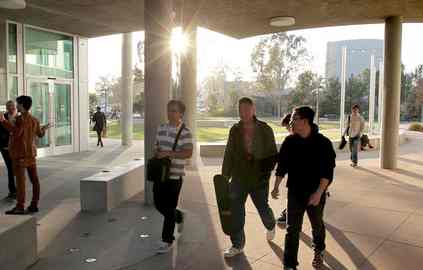
UC Irvine spends $7 million a year on preparing poor and minority high school students for college. Photo/David McNew/New York Times
If the Supreme Court justices, who are expected to rule in the coming weeks on a case involving the University of Texas at Austin, decide to curtail or abolish the use of race and ethnicity in college admissions nationwide, then the experience here and in other states that have outlawed affirmative action in college admissions decisions — including Florida, Michigan and Washington — could point to new ways for public universities to try to compose a racially and economically diverse student body.
Those states have tried a series of new approaches to choosing students, giving applicants a leg up for overcoming disadvantages like poverty, language barriers, low-performing schools and troubled neighborhoods. That process has drawn heavy scrutiny, but in California, it is only half of a two-pronged approach. Disadvantaged students in poor neighborhoods, like Erick Ramirez, a senior at Anaheim High School, are benefiting from the state university systems’ growing efforts to cultivate applicants starting in middle school.
“We’ve worked very hard to widen the pipeline, and there is still an enormous need to do more,” said Mark G. Yudof, president of the University of California system.
The results of California’s efforts offer some measure of satisfaction to supporters and critics alike. Both sides hail the UC system’s strides toward economic — and not just racial — diversity; opponents of affirmative action claim that as vindication of their argument that it primarily benefits middle-class minority members. Supporters of race-conscious admissions acknowledge that the system has reversed the initial decline in black and Hispanic enrollment, though they say that is not enough. Whatever the merits of race-blind admissions, gifted poor and minority students are less likely than others to take the right classes to be eligible for college admission, to take the SAT or ACT, to get academic help when they need it, to fill out complex forms properly or to apply to competitive colleges.
So California’s public universities, and some of their counterparts around the country, have embedded themselves deeply in disadvantaged communities, working with schools, students and parents to identify promising teenagers and get more of them into college.
It is not enough, university administrators say, to change the way they select students; they must also change the students themselves, and begin to do so long before the time arrives to fill out applications.
Erick Ramirez lives in a neighborhood here where most parents have low incomes and speak Spanish at home, and many have not finished high school. At his school, Anaheim High, only about one student in four has passed enough high-level courses to qualify for any of California’s public universities. But Erick, the Mexican-born son of a construction worker and a school aide, received acceptance letters from several selective colleges and chose San Francisco State.
It is impossible to say whether Erick, 18, with good grades and above-average test scores, would have been accepted at the same colleges without his disadvantaged background. What is certain is that he had considerable help from an unexpected source. For three years, people who work for the nearby UC Irvine, have met regularly with him — on Saturdays, after school and over the summers — to help him choose courses, complete classwork, prepare for the SAT, visit college campuses, fill out applications and apply for scholarships.
“I think I would have ended up in college anyway, but it would have been a lot more difficult,” Erick said. “I wouldn’t have done as well, and I wouldn’t know about a lot of the possibilities.”
The need for such intervention unites people like Yudof, who believes that race should be a factor in admissions, and Richard D. Kahlenberg, a senior fellow at the Century Foundation, a liberal-leaning research group, who is a prominent critic of race-based affirmative action.
“If you’re serious about doing admissions based on disadvantage, it requires a lot of outreach,” Kahlenberg said. “It’s the right thing to do, but it isn’t easy, and it isn’t cheap.”
UC Irvine alone spends more than $7 million a year on that outreach, with a few hundred people working on it — mostly part time, and not always for pay — and reaching into dozens of poor neighborhoods in its region, said Stephanie Reyes-Tuccio, director of the university’s Center for Educational Partnerships.
Many of the programs predate Proposition 209, but in the years after the ban took effect the University of California system’s spending on them jumped to $85 million from $18 million, before shrinking again in the last decade.
Campuses like Irvine have made up for some of that decline with federal and private grants, their own budgets and even donated services from test-preparation companies. A few years ago, Irvine began using its own undergraduates to work part time in low-performing schools.
At their height five years ago, Reyes-Tuccio said, Irvine’s programs reached about 24,000 students, but budget retrenchment has cut that to about 10,000.
Each of the nine undergraduate campuses in the UC system makes similar efforts, in addition to programs run by the system’s headquarters at Berkeley, and the larger, less selective California State University System.
The universities have programs that advise parents, programs to steer successful community college students into the state’s senior colleges, and programs for elementary and secondary school teachers, to improve their teaching and subject mastery. But the largest part of the outreach is aimed directly at students in low-performing middle and high schools — targeting gifted students like Erick Ramirez, as well as broader efforts for all those who might go to college.
On a recent afternoon at Anaheim High School, 25 laughing, texting seniors crowded into a computer lab to fill out the federal government’s online financial aid form. These are students who guide their parents through the English-language bureaucracy, not the other way around, so they expect little help from home. None can go to college unless they complete this form, and not one was able to do it alone.
Most were tripped up by unfamiliar terms like “emancipated minor” and “legal guardianship.” Many others stumbled on the tangled instructions to follow if their parents were not citizens or had not filed tax returns.
“You don’t have a Social Security number?” one girl said to her father in Spanish on her cellphone. The girl, an American-born citizen, was stunned to learn that he was in the country illegally.
Of the seven adults in the room, just one is an employee of the high school; three work for University of California, Irvine, and three work for CSU Fullerton.
The universities are doing work that in more affluent communities is handled by parents and guidance counselors. But after years of budget cuts, the average counselor in a California public school sees 1,000 students, the highest figure in the country and double the national average. In a few hundred schools around the state, the UC system even helps pay the salaries of counselors and other support staff who would otherwise be eliminated. It taps into computers at the state’s lowest-performing high schools, where it can evaluate each transcript and alert school staff members and university outreach workers about students who are falling behind.
To qualify for the state universities, California students must earn at least Cs in higher-level courses — and many of those students are still rejected. Over the last three years, 59 percent of Asians who graduated from California high schools met the university requirements, 44 percent of whites, 28 percent of blacks and 27 percent of Latinos.
“The schools have a serious lack of resources, and the counselors can be swamped with disciplinary problems and just getting kids to graduation,” said Reginald Hillmon, who manages the transcript evaluation system. Many students are unaware, he said, of “that gap between what it takes to graduate and what it takes to get into a university.”
It is a barrier that Cristina Flores, an employee at the Irvine campus, meets regularly at Century High School in Santa Ana, where nearly half the students are not proficient in English and 80 percent are poor enough to qualify for free meals at school.
Asking a group of juniors recently about meeting the university standards, Flores got mostly blank stares. “You guys know this, right? Please? Hopefully?”
She meets some students with unrealistically high expectations of getting into a college, but far more often, she says, the problem is students’ setting their sights too low. Studies show that high-achieving, low-income students are far less likely to apply to selective colleges than their better-off counterparts, because they do not know their options, or wrongly believe that better schools are beyond their reach.
“My high school counselor never said I should go to a four-year college,” Flores, 24, said. “When I expressed interest, they were surprised, and it was already too late because I didn’t have the right classes, so I started at community college. That’s what we want to avoid with these kids.”
Spending three days a week at Century, Flores, an Irvine graduate, helps students fill out applications, reminds them of deadlines, shows them how to get fees waived, points to Web sites listing scholarships and steers them around potential pitfalls.
“Do you have to baby-sit your brothers and sisters all the time, or cook for them, or go work with your parents?” Flores asked a group of students, about half of whom raised their hands. “My mom used to make me go with her to clean houses on the weekends. I hated it. That’s why I went to college.
“But that’s what you put on the part of the application that asks for activities and volunteering,” she said. “Because if you don’t tell them, they’ll think you didn’t do anything.”
Jasmin Rodriguez, 17, a senior at Century, met with Flores and her colleagues dozens of times over the last few years. She has good academic credentials and boundless energy — she created a club to help abandoned animals and revived a flagging hula dancing club.
University officials admit that it is hard to know how much difference these programs make. Most of the students they reach go on to some level of college, but those tend to be among the better students in their schools. In examining changes in UC enrollment, there is no way to tease out the effects of new admissions standards versus outreach to low-income students.
But to students like Jasmin, there is no doubt about the programs’ value.
“Without their guidance, I would have been so lost,” she said. “There’s so many little things you don’t know unless someone tells you.”
Jasmin will enroll at UCLA in the fall.