Besides having to deal with stolen traps, crayfish operations on Lake Tahoe are also limited to where they can work.
But that may change.
A bill sponsored by Assemblywoman Beth Gaines, R-Rocklin, to allow commercial fishing of crayfish in California’s waters of Lake Tahoe passed the Assembly on Wednesday.
Assembly Bill 165, which allows for commercial fishing of crayfish, is a response to worsening clarity of Lake Tahoe, the assemblywoman says.
Tahoe Lobster Co. crawfish were used at a food and wine fest. Photo/LTN file
The crustaceans are not native to Tahoe. Fishing them as close to extinction is a goal. Having them out of the lake, according to scientists, would help improve lake clarity. In the interim, it gives restaurants a uniquely local item to sell.
It is estimated that there are 240 million crawfish in Lake Tahoe. Without a native predator this number is expected grow at a faster rate.
“AB165 will now move to the Senate Natural Resource Committee. The bill has not received a single no vote in the Assembly, so the outlook is very positive,” Daniel Outlaw with the Gaines’ office told Lake Tahoe News.
Nevada changed its law in August to allow for commercial fishing for crayfish.
— Lake Tahoe News staff report
Letter: CalFire warning about scam
To the community,
It has come to our attention that residents in the Lake Tahoe Basin area may be receiving phone calls from a caller claiming to be with CalFifre who is soliciting funds.
CalFire has not, and will never, call residents asking them to donate money to support the department due to State budget cuts.
Amador-El Dorado-Sacramento Unit Chief Kelly Keenan states, “This is clearly a scam and we want to caution anyone who has received or may receive a phone call asking them to donate money to CalFire to hang up their phone. The state of California would never solicit funds in this manner.”
Teri Mizuhara, CalFire
Red Hawk revenues up, but still in financial trouble
By Dale Kasler, Sacramento Bee
The company that manages Red Hawk Casino reported higher revenue today because of improved results at the troubled Shingle Springs facility.
Lakes Entertainment Inc. of Minneapolis said it lost $300,000 during the first quarter compared to a profit of $1.8 million a year earlier. But revenue grew to $3.3 million from $2 million, and the primary reason was an $800,000 improvement in management fees from Red Hawk.
“Management fees from the Red Hawk Casino were up again this quarter … due to continued improvements in results at this property,” said President and Chief Financial Officer Tim Cope in a press release.
Despite the improvement, the casino remains in deep financial trouble.
Red Hawk, owned by the Shingle Springs Band of Miwok Indians, has struggled from the day it opened in late 2008. Gov. Jerry Brown has renegotiated the tribe’s gaming compact after concluding the tribe wouldn’t be able to pay all its bills.
The new gaming compact would significantly reduce the tribe’s annual payments to the state, but wouldn’t take effect until the tribe restructures $500 million in private debts, including a $66 million loan by Lakes Entertainment. The tribe stopped making principal payments on the Lakes loan two years ago.
Film captures the short life of Shane McConkey
By Mina Hochberg, Outside
When freeskier Shane McConkey of Squaw Valley passed away at age 39 during a ski-BASE accident in 2009, he left behind an inspiring legacy that’s deftly captured in the documentary “McConkey”.
The film leads you through the many phases of McConkey’s career: After an unsuccessful attempt to join the U.S. ski racing team, he forged his own path as a freeskier, then a BASE jumper, then a ski-BASE jumper—all the while documenting his exploits on camera, becoming an adventure film star. Directed by a team of his friends, “McConkey” is as heartfelt as it is gripping. We spoke with two of the directors, Rob Bruce and David Zieff, about the film.
When did the documentary first start coming together?
Bruce: Pretty much the moment he passed away it seemed like a logical thing to do. It seemed like it would be a wonderful living tribute to him, his family—and a great thing for his daughter [Ayla] to have. The fact that Ayla has a film about her father that she can refer to throughout her life is fantastic.
David, what did you know of Shane before doing the film?
Zieff: I didn’t know him and I really didn’t know of him, frankly, beforehand. Little did I realize that I’d come to love him indirectly through the footage and all the stories that everybody told about him.
The cliché, and it’s not such a cliché in his case, is living life to the fullest. He truly did that, but what was almost more attractive to me was the fact that he knew how to laugh with himself. He was self-deprecating and humble and he knew how to enjoy life and not take it too seriously.
It’s been a motivator in my own life, taking each day as a challenge to do more and enjoying myself and living life to the fullest and not taking things so seriously. That, in addition to learning how to ski better by way of footage through a point-of-view camera.
Rob, how far back did you and Shane go?
Bruce: Shane and I knew each other ski racing [as teenagers]. We both quit ski racing at the same time and we both pursued figuring out a way to be professional freeskiers at the same time — him as a skier, me as a cameraman.
More importantly, every day that I was with Shane, regardless of whether we were shooting, or hanging out, or in an airport, was always a great day. And that’s what he really gave all of us. When we were around Shane, everybody was elevated. It was impossible to be having a bad time because nothing got Shane down. If you started whinging, or complaining about having to climb something, or the snow wasn’t good, or that we’ve been in Alaska waiting for shoot day for three weeks, Shane would just laugh at you. He’s like, “Look guys, we’re living our dream, this is part of it.” He was able to overcome fear to have fun no matter what was going on.
Seeing the 80s ski rockumentary “Blizzard of Aahhhs” seemed like a real pivotal moment for Shane. What changed him?
Bruce: Our last ski race was at U.S. Nationals. We were in the lift line and he looks at me and he’s like, “Have you seen that movie “The Blizzard of Aahhhs”? And I looked at him and I was like yeah. He’s like, “Can you f—— believe that? Those guys are doing that? They’re getting paid to do that? We do that when we’re not training. That’s what we do on a powder day when they’re setting the course.”
We were probably supposed to train that afternoon but we went out with his mom and practiced skiing like those guys. So for me and a lot of other people, seeing that film was an example of an alternative way to keep playing in the mountains and possibly getting paid to do it. We were all really good skiers and we felt we could ski like that. We just had to figure out how we could make our own films and find a sponsor and figure out the business of it.
There are so many milestones in his career. How did you decide which ones to highlight?
Bruce: I sort of took the responsibility of tracking things in his life that would be relatable to audiences, so that became a matter of finding the events in his life where he overcame something. Because he was sort of Superman. The sports he was doing and inventing and his interests are not of the mainstream, so that’s not very relatable to a lot of people. What is relatable is having a difficult childhood. What is relatable is having a goal and failing — but then overcoming. That’s ultimately the message of the film.
How many hours of footage did you have altogether? Shane shot a lot of video throughout his life.
Zieff: I estimated it’s probably a thousand hours of footage. So there was a fair amount of work just in labeling and getting through it all.
When people talk about who directed this film, Shane directed it. It started 20 years ago when he was 18 years old with a yellow handycam camera capturing everything.
I wanted to ask about the footage of his fatal accident in the Dolomites. Did you know from the start that you didn’t want to show any of it? Can you talk about editing that?
Zieff: I think all of us knew that was something we would be very respectful about. The footage has been destroyed of the actual accident. I don’t think anybody would want to see that. In fact, I never did. I was given censored footage myself.
I think this is a film about his life, and that’s what matters. Obviously there’s a logistical issue that we’d have to deal with — people need to know something. So we only show the lead-up to it and not the actual moment, out of respect for the family and obviously for Shane’s wife, Sherry, and daughter. That’s not something they need to see. No one really does.
Rob, as someone who knew Shane for so long, was it difficult editing that whole sequence in the Dolomites?
Bruce: Yes, it’s hard. It’s hard for all of us, and it’s hard for audiences that are watching that portion of the film. It’s incredibly sad. So it was a hard film to make in that regards. Every time I see the film I come out a little bit rattled.
Do you guys have any favorite shots from the film?
Bruce: The college sequence I found hugely important because that’s a common time in a lot of people’s lives where people are trying to find themselves. And if you think about making the U.S. Ski Team and getting dropped early, that’s like having a mid-life crisis when you’re 18, 19 years old, right? It’s like, oh, now I have reinvent myself, and I’m in this academic environment and I haven’t really gone to school. There’s not a lot of footage from that period, and I was just so pleased with how it worked out because it shows him overcoming a tough spot.
Did his mother, Glenn, ever express regret that she hadn’t tried to restrain him from becoming a daredevil?
Bruce: She is obviously incredibly sad that her son is gone, but she never held him back. It’s so clear that the mountains and skiing — and eventually skydiving — were the things that he loved so much, and you just can’t ask people to stop doing what they love.
He only lived 40 years, but the way he lived them is so incredible. That’s much better than spending 70 years unhappy and without passion. I’d take the 40 years in a heartbeat.
Time to clean Tahoe’s bike trails
The 2nd annual Tahoe Bike Path Clean Up Day is May 30 from 3-6pm.
Bring water. There will be free waste facility passes for participants, and snacks will be provided at the end of the event. Gloves, trash bags, and brooms will also be provided.
Locations:
South Lake Tahoe — Meet at Sierra Nevada Alliance, 2311 Lake Tahoe Blvd. Clean up sites are behind Red Hut and Meeks Lumber, Motel 6 and Push Fitness.
To register, contact Taylor Fargo at (530) 542.4546 or taylor@sierranevadaalliance.org.
North Lake Tahoe — Meet at UC Davis Field Station (Historic Fish Hatchery), 2400 Lake Forest Road, Tahoe City. Site to be clean is the bike path between the Field Station and Commons Beach.
To register, contact Kelsey Poole at (775) 881.7560 or klpoole@ucdavis.edu.
This is community collaboration among the Sierra Nevada Alliance, Tahoe Regional Planning Agency, UC Davis Tahoe Environmental Research Center, AmeriCorps, Incline Village Waste Not, and Lake Tahoe Bicycle Coalition.
Snippets about Lake Tahoe
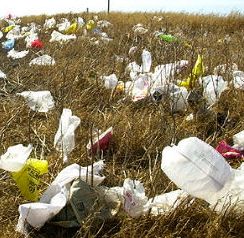
• A campaign is under way to have the South Lake Tahoe City Council ban plastic bags, even though the group already voted once not to do so. More info is online.
• The Lake Tahoe Aquatic Invasive Species Coordination Committee will spend a night talking about the past, present and future of aquatic invasive species in the Lake Tahoe Basin. This will be May 23, 5:30-7:30pm at Inn by the Lake in South Lake Tahoe.
• Truckee is having a workshop on the 2013-14 budget on May 15 from 2-8pm at council chambers.
• Vail Resorts Inc. added Arlberg, Austria, to the list of places where the Epic Pass may be used.
• The State Water Resources Control Board on May 7 approved certification of a water quality management plan for Lake Tahoe which also certifies the Tahoe Regional Planning Agency’s Clean Water Act Section 208.
El Dorado County winery reuses bottles
By Mike Dunne, Sacramento Bee
Don’t know what to do with those empty wine bottles other than toss them into the recycling bin? For ideas, go to the website Pinterest.
Judging by the photos posted there, old wine bottles can continue to provide happy service as hummingbird feeders, chandeliers, tiki torches, wind chimes and that all-time favorite, candleholders.
Brian Bumgarner advocates another alternative: Don’t recycle the bottles at all. Instead, reuse them. That’s what he’s been doing with a line of wines since he and his wife, Jennifer, founded Bumgarner Winery on El Dorado County’s Apple Hill in 2005.
Their “Silver Fork” wines – the name was inspired in part by the nearby Silver Fork of the American River – come in bottles with a swing-top clip closure rather than a cork or screw cap. When the bottle is empty, the buyer can return to the tasting room and exchange it for a new bottle of the same wine at $5 off the listed price. An empty bottle of the bright, rich, barrel- fermented 2010 Silver Fork chardonnay, for example, purchased for $24, can be swapped for a new bottle of the same wine for $19.
Bumgarner then washes and sterilizes the old bottle and adds it to his bottling line for the next go-around.
His interest in reusing rather than recycling bottles – indeed, his entire interest in the wine trade – began 20 years ago as he toured Europe. He was struck by the number of consumers who visited wineries, markets and the like to have their old bottles refilled with a favorite wine.
“They’d even come in with old Evian bottles to fill them up at grocery stores,” recalls Bumgarner.
He was far from establishing his own winery, but that vision stuck with him, and today it fits right in with his philosophy to own and operate a business that is sustainable and locally oriented. The couple use the bottle exchange more for wines meant to be consumed in their youth rather than laid down for indefinite aging.
The return rate for the reusable bottles is running around 50 percent, Bumgarner said. The rest just may not have been exchanged yet … or they’re doing duty as hummingbird feeder, tiki torch or something else.
Bumgarner wines in more traditional bottles are marketed as “Five Fingers” releases and include an earthy and oaky 2008 Tempranillo, a floral and fruity 2008 Petite Sirah, and an herbal 2008 Cabernet Sauvignon (recently sold out). The name “Five Fingers” and the handprint on the bottle are intended to convey the message that his wines are “personal” and “handcrafted,” Bumgarner said.
The newest and most impressive wine in that section of the couple’s portfolio is the Bumgarner Winery 2010 El Dorado Five Fingers Touriga, tantalizingly suggestive of musk in aroma, lush with red fruits in flavor, and pleasantly enduring in the finish.
It’s a husky wine, with sweetness from both fruit and oak, and firmness to its spine. Tannins aren’t so pronounced that they will interfere with the fruit when the wine is paired with a dish with appropriate mass, such as a rib-eye steak or a robust chili.
“Touriga” is the broad name for a family of black Portuguese wine grapes that include touriga nacional, touriga franca and touriga macho. In Portugal, they are used mostly for port, though some of the harvest also ends up as dry table wines. Wine-label regulations in the United States recognize only “touriga,” with no differentiation for the various strains.
Bumgarner came by the grapes that produced the touriga as he searched for fruit with which to make a dessert wine styled on port. That quest took him to Andrew and Elizabeth Standeven’s Shaker Ridge Vineyard at Shingle Springs. There, he got the Portuguese varieties he wanted, and also picked up a couple of extra tons of touriga nacional with which to make the dry table wine.
The grapes were harvested at a relatively low sugar level by Sierra foothill standards, but Bumgarner was convinced that they were ripe enough to yield the lively table wine he envisioned. He was so pleased with the result that he sees touriga playing a bigger role for his brand, and toward that end bought even more of the grapes from the 2012 harvest.
(Because 2011 was an even more challenging growing year than 2010, he didn’t get any touriga nacional.)
Bumgarner makes his wines at Fenton Herriott Vineyards in Placerville, but the couple pour the wine in a small converted horse barn just off Highway 50 at Camino in the heart of the Apple Hill district.
An adobe pizza oven built by Placerville earthworks craftsman Brian Evan Baker is just outside, while inside Nicole Berry oversees tastings with a knowledge of the wines and with a poetic interpretation of their impact refreshing for the trade.
Bumgarner also was a craftsman before getting into the wine business. He was studying music and building guitars in Sacramento before the commute from El Dorado County got to him and he began to look for work closer to home.
Thus in 1993 he began an 11-year stint with Boeger Winery in Apple Hill, where he worked the tasting room, the bottling line, the lab and just about every other corner of the business, learning the trade and eventually moving on to Primus Winery, also on Apple Hill, as winemaker.
In 2005, he launched his own eponymous brand by buying and processing 3 tons of Cabernet sauvignon, the variety that most intrigues him, despite its uneven history in the Gold Country. While at Boeger, he’d tasted some of the winery’s Cabernet Sauvignons from the 1980s, found them “amazing,” and remains enthusiastic about the varietal’s potential in El Dorado County, though he’s expanded his portfolio to include several other local varieties including touriga.
Bumgarner, incidentally, isn’t knowingly related to San Francisco Giants pitcher Madison Bumgarner, though he speculates they may be distant cousins. Many of Madison Bumgarner’s fans about the country have found Bumgarner Winery, however, as they do online searches about the pitcher. The Giants’ Bumgarner hasn’t yet visited the winery. Brian Bumgarner hopes he does someday, and brings along an autographed jersey.
The winemaking Bumgarner will be waiting for him, with a Silver Fork wine in a reusable bottle in hand, ensuring his return.
Nevada trading beach time for trash pick up
Want free beach time at Sand Harbor?
Then on Friday and Monday mornings in June, July and August, volunteer to pick up trash on the beach.
Nevada State Parks is providing free admission for the day people volunteer a couple hours for trash duty.
For more info, call (775) 831.0494.
Gardening in Lake Tahoe — it’s possible
By Kathryn Reed
While it can be dicey in the Lake Tahoe Basin to put plants in the ground before Memorial Day weekend, it doesn’t mean there isn’t gardening to be done now.
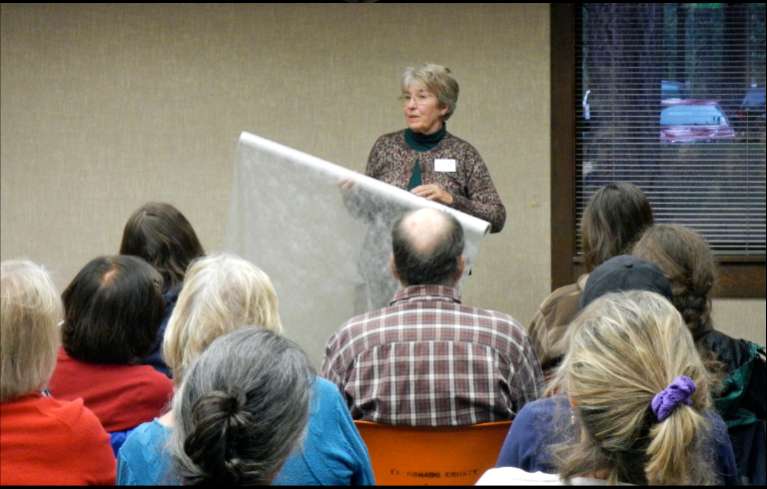
Carolyn Meiers drove that point home Tuesday night during a talk at the South Lake Tahoe library that was sponsored by Friends of the Library. Meiers, who is a master gardener, knows the soils of Tahoe well from living here for decades and being part of various garden clubs.
“Just because they sell it in Lake Tahoe, don’t assume it will be OK. There are a lot of things you should not be buying,” Meiers said May 7.
She suggests people go to reputable garden centers to talk to experts about plants.
Master gardener Carolyn Meiers says frost cloth will protect plants from freezing. Photo/Kathryn Reed
Reading the information on the tags that come with plants is also critical because they talk about sun and shade, growing season and how tall the plant will become.
While there are rules to follow, Meiers also advocates for just trying something to see how well it does in your yard.
Sun, shade, wind, water, soil – they all play a role in the success of a plant’s life.
“You don’t want to put a $5 plant in a 50-cent hole” is a phrase Meiers said she has borrowed from a fellow gardener. This means making sure the soil is nutrient rich.
“You need to modify the soil. There are all kinds of mulches you can buy,” she said.
Ideally, much of the work on the soil is done in the fall so when spring rolls around it’s perfect for planting.
Now is the time when everything should be raked, weeds dug out and anything that has blown into beds plucked out. Meiers even said people should be picking their daffodils. Some of the nearly 50 in the audience laughed, saying theirs were barely out of the ground and blooms have yet to be seen.
“Be careful how you fertilize. It’s either going in the air or water or on your own body,” Meiers said. “Use the least toxic pest control method. We do have a beautiful lake that we need to protect.”
Critters are something every gardener has to contend with. Rabbits have been growing in numbers on the South Shore in recent years. Meiers talks fondly of climbing roses she once had. Then a beaver “decimated” them. She is left with photographs of them.
A member of the audience suggested using sonar devices that are stuck into the ground to rid a yard of voles. Steer manure compost was another suggestion.
Putting tulip bulbs in nylon stockings stops the squirrels from uprooting them.
There are always daffodils. Squirrels don’t go after them.
A trend in gardening is to have edible plants as landscaping, and not just be part of a vegetable garden.
Even after Memorial Day the basin is susceptible to freezing nights. Meiers recommends using a frost cloth to put over plants on those occasions. She said lots of things could be used – just use something that is not too heavy.
For those who are going to start with seeds, time is ticking because they usually take four to six weeks before needing to be transplanted.
Meiers suggests everyone in the basin have a copy of “Home Landscaping Guide for Lake Tahoe and Vicinity” to use as a resource for gardening.
—-
Note: University of Nevada Cooperative Extension will host its annual Master Gardener Plant Faire and Sale from 7am-2pm May 18 at the Master Gardener Greenhouse, No. 13, 920 Valley Road in Reno. Thousands of certified organically grown plants will be available for sale.
Gangs take their toll on society
By Ted Long
I think it is safe to say this week’s session, session seven of the citizens’ academy, on gangs made the whole program worthwhile. This session was led by Deputy Carol Edwards.
She has been doing the job for over 20 years. Not only did she bring a professional touch to the issues, but a personal one. She definitely knows the problems and the people.
We saw, through a video presentation, gangs that are present in El Dorado County. And there are a lot. Everything from the Hells Angels to the Bloods.
Ted Long
Graffiti was also explained and for the first time I understood what I thought was meaningless waste of paint. While it is a waste for society, graffiti has great meaning and usefulness to the gangs. At one time, here at the lake I strongly supported program to give graffiti artists a place to paint other then our public and private building. While a great idea, it in no way will really affect gang graffiti, which is used to communicate, to mark territory and to honor their falling comrades.
Edwards is of the opinion that we will not stop the growth of gang activity and expressed our only hope in terms of the very young, to some how let them know what it really means to be in a gang. Most of the reasoning for the success of the gangs is placed on with the lack of discipline or the profit motive. There was little discussion of society’s role. For example our continued reliance on what our founding fathers gave us in 1776, the Constitution.
While I would be the first to argue, and have on many occasions, for the basic rights granted, such as free speech, religion and the right to bear arms I doubt that out founding fathers could or did foresee the world as we live in it today. Perhaps, it’s time to relook at all these rights with modern times and consequences in mind.
Laws are passed for what appears to be a “good reason” – a teacher abuses a student, a parent goes too far in disciplining a child, so we pass a law. The problem is that now no teacher dare discipline and no parent dare raise his hand or he they may end in jail, in other words we have “throw the baby out with the bath water.”
A parallel example that most people are familiar with is the laws to support the handicapped. Well indented and important, yet with them came a flood of attorneys that know sue people and create a mess.
Most of us who are over 50 remember walking through our neighborhoods actually talking to people. Today many neighbors don’t know who lives next door. The recent Cleveland discovery of three women held for 10 years makes my point.
The rise of gangs in my view is very much related to the break down of the family and the neighbor concepts in our society. We have literally made it a crime to be interested in someone else. Combing this with modern communication, travel and the need for two family income and you have a problem. Ask yourself, “If we could start over fresh, what would we do?” In there lays the answer.
Whatever we do or don’t do, the fact is gangs are a serious issue for us and the country. If you belong to a club or group, I strongly suggest you call Carol Edwards at (530) 621.6041 to schedule a presentation. This is information you need to know.
Ted Long is a South Lake Tahoe resident participating in the El Dorado County Sheriff’s Citizens Academy.