Then and now: Businesses change, structure doesn’t

oldnew


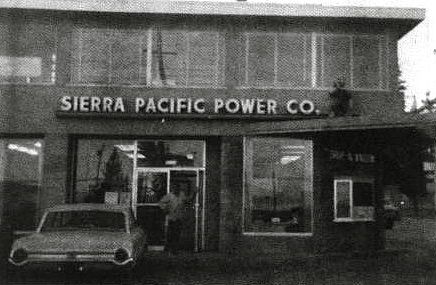
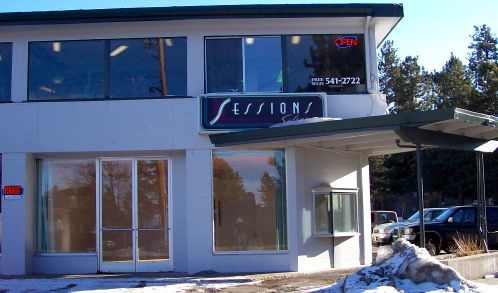
The corner drive-up payment window has survived since the 1960s on Fremont Avenue at Sandy Way in the Bijou area of South Lake Tahoe.

The 1970 photo was furnished by Bob Rockwell and the 2013 photo I took.

— Bill Kingman


Author shares reality of citizens being imprisoned without a trial during WWII

By Kathryn Reed

“Crimes of the government can become sins against the innocent, especially in the mind of a child.”

“In 1942, all three branches of the government violated the Constitution.”

“Immigrants are often scapegoats.”

Those are some of the thoughts Jeanne Watatsuki Houston shared with nearly 200 people who listened to her speak this month in South Lake Tahoe. She, with husband James Houston, wrote “Farewell to Manzanar” – a story about her three-year internment at the Eastern Sierra “prison” during World War II.

She was a 7-year-old living in Southern California in 1942 when the government started posting posters on telephone poles telling those who were of Japanese heritage to turn up at bus depots and train stations on a certain day. It didn’t matter if they were U.S. citizens.

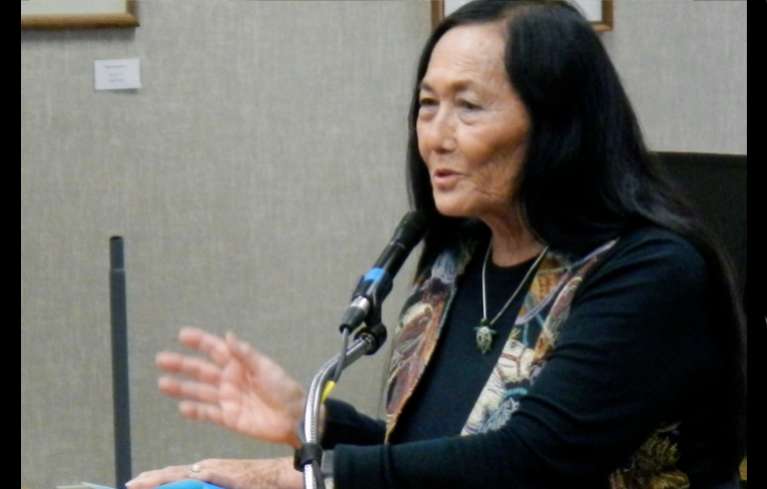
Jeanne Houston tells her story about being forced to live in an internment camp during World War II. Photo/Kathryn Reed

Jeanne Houston tells her story about being forced to live in an internment camp during World War II. Photo/Kathryn Reed

“We looked like the enemy,” Houston said.

Soldiers with guns herded them onto their transport. While not confrontational, at least for Houston’s family, it was still a military act.

Her father had already been whisked away. He was arrested the first day after Pearl Harbor because he was not a citizen. He had come to the United States with his parents in 1904 when he was 17.

“He was considered a dangerous person,” Houston said. He was a fisherman by trade. Her dad was sent to a federal prison in Bismarck, N.D.

The laws didn’t allow him to become a citizen until 1952.

“There had already been 100 years of anti-Asian laws,” the author said.

And while the United States was at war with other countries at this time, it was only Japanese who were rousted from their homes. Those other countries were in Europe where the people looked more like those in Washington, D.C., who were making the decisions.

It has been 40 years since Houston published the book. It took her more than two decades after being released from what was essentially a prison – not a camp in any sense of the word – to begin writing her story. It was a story that her husband did not know before they married.

“I don’t want others to feel guilty, it is understanding we want,” Houston said.

She realizes this segment of U.S. history is still unknown to many. People don’t realize the government rounded up 120,000 people – 70 percent of who were born in the United States – and sent them to one of 10 internment camps. That is why she continues to tell her story. (The May 14 talk was sponsored by the South Lake Tahoe Friends of the Library.)

“I don’t think it will happen again, but I think it could,” Houston said.

Today, Manzanar is a National Historic Site. It’s a bit like a ghost town. While Manzanar means apple orchard in Spanish, the dusty outpost in the Owens Valley with decaying remnants of the past and a visitors center with stories of the country’s racist act, sits in the middle of nowhere as a reminder of what the government can do to its own people.


Day of fun launches Wildfire Awareness Week

Lake Tahoe fire protection agencies all agree defensible space isn’t a bunch of hot air. To back up the importance of defensible space, they’re organizing a free Wildfire Awareness Week kick-off event that includes free tethered Smokey Bear hot air balloon rides (weather permitting), firefighter photo opportunities, a pancake breakfast and more on May 25 from 8am–noon outside MontBleu in Stateline.

Galvanizing around raising awareness of reducing fuels to reduce the risk of wildfire, local fire protection agencies including the U.S. Forest Service, regional fire districts, Tahoe Regional Planning Agency and Nevada Division of Forestry are hosting the free kick-off event to mark the start of Lake Tahoe’s 2013 Wildfire Awareness Week, May 26–June 2.

“Fire Chiefs around Lake Tahoe are concerned about an extraordinarily dry summer and the high risk of wildfire this year,” says Eric Guevin, fire marshal of the Tahoe Douglas Fire Protection District, said in a press release. “There are easy steps homeowners can take to reduce the fuels and reduce the risk of wildfire invading their property while increasing the safety of their family, and we have an exciting event planned to help them learn how.”

The kick-off event will feature free family activities including tethered hot air balloon rides (weather permitting), photos with Smokey Bear, a pancake breakfast, information booths and defensible space demonstrations geared to provide Lake Tahoe homeowners with tips and money saving tricks to create defensible space around their property.

For more information, call (530) 542.2571.


‘Farewell to Manzanar’ author

“Farewell to Manzanar” author Jeanne Houston talks May 14 in South Lake Tahoe about her experience in the internment camp during World War II.


Lake Tahoe Collaborative looking for input

Lake Tahoe Collaborative is a community strengthening group that collaborates with families and service providers about the services available in South Lake Tahoe.

The annual June 10 retreat is open to the public to join the dialogue to help set goals and intentions for this year.

Lunch will be provided.

The retreat is from noon-1:45pm at Lake Tahoe Community College’s board room.


Tahoe National Forest ready for holiday weekend

Most campgrounds and recreation sites within the Tahoe National Forest will be open for Memorial Day.

Most trails are open with only patches of snow on north facing slopes. Hikers will still find some snow patches in the high country, especially on north facing slopes or in shaded areas, however much of the forest is snow free.

Campfire permits are required outside of developed campgrounds and are free at all Forest Service, BLM, and CalFire offices.

For more information, call (530) 265.4531.


Democrats find more glory in Sac than D.C.

By Mark Z. Barabak and Richard Simon, Los Angeles Times

WASHINGTON — Early this year, Leticia Perez and her husband flew here for a whirlwind 48 hours. The couple dined at the Italian Embassy, visited the Lincoln Memorial and joined the crowd on the National Mall watching as President Obama was inaugurated for a second term.

Their host was the Democratic Congressional Campaign Committee, which hoped to persuade Perez, a Kern County supervisor, to run for a Central Valley congressional seat.

But a few weeks later, Perez ignored the entreaties from Washington when a spot in the state Senate unexpectedly opened up. The trip from the state capital to the Senate district, a 2 1/2-hour drive, was far more enticing than the cross-country flight between California and Capitol Hill, especially with a 2-year-old at home.

Perez was also convinced she could accomplish more in Sacramento — where Democrats hold the governorship and a two-thirds legislative majority — than in Washington, where she would be a member of the House minority. “I feel at this time and place, the state is where I can be most effective,” said Perez, one of five candidates in the May 21 special election.

After years of budget misery, public opprobrium and term-limit-induced turnover, Sacramento is starting to look a lot more attractive to Democratic lawmakers and candidates, who once might have viewed a seat in Congress as the higher, more desirable rung on the political ladder. (A voter-passed change in term limits, allowing legislators to serve 12 years in a single chamber, is another reason staying put has grown more appealing.)

“If you want to be on MSNBC … or quoted in Roll Call” — the Capitol Hill newspaper — then Congress is “a good place to be,” said state Sen. Kevin de Leon, a Democrat from Los Angeles who is favored to become the Senate’s next leader. The Legislature is far better, he said, “if you want to get real, tangible things done.”

He cites legislation creating the first state-run individual retirement program, which has brought De Leon national attention. Over the years, many other laws passed in Sacramento — on issues including family leave, clean air and consumer protection — have served as a model for Washington.

No congressional seat sits empty in California for want of interested candidates, Democrat or Republican. But with recruiting for the midterm elections underway and those races slowly taking shape, there has been no rush for the exits among Sacramento Democrats, even as more competitive primaries and a redrawing of political boundaries have loosened the hammerlock incumbents once held over their congressional seats.

“For all the criticism, much of it legitimate, over the last number of years when we were in the throes of the terrible deficit, look where we stand now,” said state Sen. President Darrell Steinberg, a Democrat from Sacramento who spoke with Perez as she weighed her choices. “We’re not perfect, but we’ve got a balanced budget, we’ve made deep cuts, we’ve passed a tax increase. We’re on the verge of turning it around, and so that’s a selling point.”

(For Republicans, the political dynamic is precisely the opposite. Democratic domination in Sacramento threatens to marginalize any Republican elected to the Senate or Assembly, while the GOP majority in the House of Representatives is an attraction. “You go to Congress and you’re part of a majority that’s likely to exist through the decade,” said Rob Stutzman, a veteran GOP strategist, who lamented the difficulty of attracting top-flight legislative candidates.)

Congress used to be the place where many of Sacramento’s most gifted and ambitious Democratic lawmakers — Philip Burton, Howard Berman and Henry Waxman among them — went to make their mark. The chance to serve in the congressional majority and build clout — the party controlled the House for 40 years, ending in 1995 — helped ease some of the hardship of living and working 3,000 miles from home.

Vic Fazio spent 20 years on Capitol Hill representing the Sacramento area after starting his political career in the California Assembly. The Democrat recalls without fondness the countless hours flying back and forth and having to choose on weekends between “going to your daughter’s soccer game or going off to the county fair, or whatever event your political life required.”

“It’s a very tiring kind of existence,” said Fazio, now a Washington lobbyist.

The sacrifice is far less attractive when the reward is serving in the minority, especially for lawmakers who, after about a year or so in Sacramento, have catapulted into leadership positions. California’s 38-member Democratic House delegation includes a former Assembly speaker, an ex-Senate majority leader and a number of former committee chiefs.

“That is a little bit of a culture shock,” said Democrat Julia Brownley of Oak Park, who spent six years in the Assembly and headed the Education Committee before winning a Ventura County congressional seat in November.

Rep. Jackie Speier, a Hillsborough Democrat who had hundreds of bills signed into law during 18 years in Sacramento — many by Republican governors — said pursuing policy goals in Congress “can be quite disheartening.”

“It doesn’t matter how talented you are,” she said. “It doesn’t matter if you have a good idea for a bill…. You can get, as I did the last session, 131 co-sponsors on a piece of legislation and I couldn’t get a hearing.”

Some have adapted better than others. “A lot of it is just finding the way to accomplish legislative ends and help your constituents in an environment where you’re not only in the minority, but it’s a very polarized, dysfunctional place,” said Rep. Adam B. Schiff, a seven-term Democrat from Burbank, who chaired the Senate Judiciary Committee during his years in Sacramento.

Liz Figueroa thinks she has a better idea.

The former Democratic state lawmaker from Fremont teaches part-time in the government program at UC Berkeley. When students and aspiring officeholders ask about a career in politics, she steers them away from Washington and toward Sacramento, where, she says, they can have a much greater impact.

“It’s the size of our state and the largeness of our economy that makes others pay attention,” she said via email. “Better to be the large fish in the small pond.”

Spoiled food being converted into power

By Tiffany Hsu, Los Angeles Times

What happens to the 40 percent of food produced but never eaten in the U.S. each year, the mounds of perfect fruit passed over by grocery store shoppers, the tons of meat and milk left to expire?

At Ralphs, one of the oldest and largest supermarket chains on the West Coast, it helps keep the power on.

In a sprawling Compton distribution center that the company shares with its fellow Kroger Co. subsidiary Food 4 Less, organic matter otherwise destined for a landfill is rerouted instead into the facility’s energy grid. Though many grocery stores have tried to cut down on food waste and experiment with alternative energy, Kroger says it’s the first supermarket company in the country to do both simultaneously.

The technology that helps transform moldy chicken and stale bread into clean electricity is known as an anaerobic digester system. At the 59-acre Compton site, which serves 359 Southern California stores, more than 100 onlookers gathered Wednesday to watch the system go to work.

Several chest-high trash bins containing a feast of limp waffles, wilting flowers, bruised mangoes and plastic-wrapped steak sat in an airy space laced with piping. Stores send food unable to be donated or sold to the facility, where it is dumped into a massive grinder — cardboard and plastic packaging included.

After being pulverized, the mass is sent to a pulping machine, which filters out inorganic materials such as glass and metal and mixes in hot wastewater from a nearby dairy creamery to create a sludgy substance.

Mike Vriens, Ralphs vice president of industrial engineering, describes the goop as a “juicy milkshake” of trash.

From there, the mulch is piped into a 250,000-gallon staging tank before being steadily fed into a 2-million-gallon silo. The contraption essentially functions as a multi-story stomach.

Inside, devoid of oxygen, bacteria munch away on the liquid refuse, naturally converting it into methane gas. The gas, which floats to the top of the tank, is siphoned out to power three on-site turbine engines.

The 13 million kilowatt-hours of electricity they produce per year could power more than 2,000 California homes over the period, according to Kroger.

Excess water from the digester is pumped out, purified and sent into the industrial sewer. Leftover sludge becomes nutrient-rich organic fertilizer, enough to nourish 8,000 acres of soil.

The so-called closed-loop system was developed by Boston start-up Feed Resource Recovery and offsets more than 20 percent of the distribution center’s energy demands — all without producing any pungent odors.

The program helps Kroger reduce its waste by 150 tons a day. The trash otherwise would have been sent to Bakersfield to be composted, hauled away six times a day by diesel trucks traveling 500,000 miles a year.

Kroger won’t say exactly how much it spent on the anaerobic digester but estimates that it will offer an 18.5 percent return on the company’s investment. The project, over its lifetime, could help the grocer save $110 million. The supermarket giant is considering similar technologies for its La Habra and Riverside facilities and other Kroger locations nationwide.

The grocery chain’s move, some four years in the making, comes amid heated debate over the nation’s food and energy supply.

In August, the Natural Resources Defense Council reported that 40 percent of food in the U.S. goes uneaten — the equivalent of 20 pounds of food per person per month. The waste is shuttled to landfills, where it contributes to 25 percent of the country’s methane emissions.

Some grocers have tried to cut back on garbage by putting less food out on display and even composting leftover products. Northern California chain Andronico’s Community Market sells aesthetically marred but still edible produce at a discount. The Austin, Texas, store In.gredients says it sends less than a pound of waste to landfills each month by offering reusable and compostable containers in-house.

Other chains try to reduce their environmental footprint through clean-electricity projects. Whole Foods Market said solar energy helps power stores in Berkeley, Brentwood and elsewhere. Wal-Mart is testing wind turbines, installing solar panels and fuel cells and says three-quarters of its California facilities use some form of green energy.

But in recent years, amid high waste disposal costs and uncertain energy prices, anaerobic digesters have gained favor. The technology has been proposed as a fuel source for data centers, farms, government buildings and other sites.

Nick Whitman, president of Feed Resource Recovery, said Kroger’s new anaerobic digester in Compton may help encourage future installations in more urban areas.

“We’ve had to solve some really critical problems — sanitation, efficiency and reliability issues — that have plagued anaerobic digestion and prevented its wider adoption in the U.S.,” he said Wednesday.

“We’ve been able to bring digestion out of the farms and off the composters and into cities and industrial centers.”


Homewood wins environmental award

Homewood Mountain Resort earned the National Ski Areas Association’s Golden Eagle Award for environmental stewardship.

The West Shore ski resort was competing in the Small Ski Area category, which consists of resorts with less than 200,000 annual skier visits .

This is association’s highest environmental honor. The award comes at the same time the resort is being sued by environmental groups wanting to stop proposed development.


LTCC literary publication needs writers

The “Kokanee” literary journal is accepting submissions of poetry and prose for its 2014 edition.

Lake Tahoe Community College students, former students, faculty, and staff are encouraged to submit up to five poems and/or 10 pages of prose (fiction or literary nonfiction/memoir) for consideration.

Include a 50-word bio written in the third person.

Submit as an attachment (Word or rtf) to kokanee@ltcc.edu by June 21. Write “Kokanee Submission” in the subject box.

A monetary prize will be awarded to the best student piece.