Limited forest access in parts of South Shore

Thinning of trees for fuels reduction and forest health begins this week on National Forest lands between Montgomery Estates and Sierra Tract in South Lake Tahoe.

The contractor has begun mobilizing equipment and will begin cutting trees within the next few days.

The Forest Service has closed the area from 7am-6pm daily through July 26 for public safety due to heavy equipment operations and falling trees.

Hazards may be present even when operations have ceased for the day and the closure is not in effect.

Individuals disregarding the closure order may be cited, with subsequent fines or jail time.

The forest thinning is part of the South Shore Fuel Reduction and Healthy Forest Restoration Project, which will treat approximately 10,000 acres between Cascade Lake and Stateline.


Win tickets to the El Dorado County Fair

2013 edc fair logoLake Tahoe News has teamed up with the El Dorado County Fair to send eight people to the annual shindig in Placerville. We will be giving away four pairs of tickets.

The fair is June 13-16 and the tickets will be good any one of those days.

To win the first set of tickets, be the first person to correctly write as a comment what year fair officials have on record as being the first El Dorado County Fair.

The winner must agree to have their full name published. Winners must be part of LTN‘s NEWS Team or a paid subscriber. Here is a paid subscriber form for those who need one.


Tree vandals strike West Slope

By Cathy Locke, Sacramento Bee

El Dorado County residents and sheriff’s investigators are trying to track down vandals who have laid waste to thousands of dollars’ worth of trees on private property.

Detective John Robertson said he has five active cases, all involving cedars that have been felled in recent months.

Three of the incidents occurred on the same property along Lotus Road.

“We’re looking at it as vandalism,” Robertson said. “I’ve never seen anything like it.”

The incidents have occurred in the Lotus, Coloma and Shingle Springs areas, north and west of Placerville. Robertson estimated that the financial losses to property owners are in the thousands of dollars.

Wendy Deitz, whose property has been hit three times, said the first incident occurred just before Christmas. Her husband, Robert, had hung holiday lights on the cedars planted as a buffer between their house and Lotus Road.

In the early morning hours, someone removed the lights and chopped down 20 trees in varying sizes.

The Deitzes initially thought someone had cut them down and stolen them for Christmas trees, but then they discovered that the trees had been dumped in their pond.

They planted more cedars, including some donated by El Dorado Nursery, but someone came along and pulled them up, Wendy Deitz said. The couple replanted once again, and this time her husband installed game cameras.

When their trees were targeted a third time, the cameras captured the image of a man cutting a tree with a hand saw. Although he is seen from the back, “he is obviously left-handed,” Wendy Deitz said.

She and her husband also found a soda can that they turned over to the Sheriff’s Office for possible fingerprint or DNA analysis.

Wendy Deitz said they had heard from three other residents on Lotus Road that trees on their property had been cut down as well.

“I guess it’s just someone who doesn’t like cedars,” she said, adding that the trees are cut so low they won’t grow back.

Brendan Wilce, a nurseryman at El Dorado Nursery in Shingle Springs, said the trees targeted have been incense cedars, which are native to El Dorado County.

“They grow naturally in this area,” he said. “They’re the trees on the (Highway) 50 corridor that you see as you go up here.”

Wilce said he couldn’t think of any practical reason someone would want to destroy them.

“They’re not an invasive plant,” he said, “They’re a great local native tree.”

Although they produce pollen this time of year, he said, they tend to be less of a problem for allergy sufferers than oaks.

Wilce said it was difficult to estimate the value of the mature cedars that have been felled.

He said the replacement trees the nursery has supplied to some of the victimized property owners are 24-inch box trees, which retail for $250 each.

Detective Robertson said most of the targeted trees have been fairly close to roadways. He urged people who see any suspicious activity to call him at (530) 642.4722.


Torn ACL not the end of activity for athletes

By Robert Rupp

An anterior cruciate ligament (ACL) tear is a common injury. The ACL is one of the major stabilizing ligaments of the knee, and it controls movement of the shinbone and thighbone.

Many activities, such as skiing, soccer, and volleyball, require the ACL to stabilize the knee for safe playing. An unstable knee that “gives out” or “shifts” can cause damage to the other knee structures, including cartilage.

A cartilage injury can be painful, and sometimes lead to arthritis. A knee injury that causes swelling and the sensation of a “pop” could indicate an ACL tear.

An ACL injury will not heal once it tears, so orthopedic surgeons highly recommend the ACL be replaced to avoid instability and cartilage injury. If you’re concerned about how ACL surgery might affect your athletic performance, rest assured that many active people with a new ACL may safely return to the activities they once enjoyed, including mountain biking or skiing.

ACL surgery has typically involved replacing or reconstructing the torn ligament with a new bundle of tissue, which then heals as a new ligament. The tissue may come from a different part of the knee, such as the kneecap, or donor tissue.

The ACL is composed of two distinct tissue bundles and, until recently, surgeons only recognized and reconstructed one of the bundles. Today, a double-bundle reconstruction is used to fully restore the function of the ACL. A single-bundle reconstruction increases knee stability, but does not fully restore the rotational stability of the ACL like that of a double bundle reconstruction.

Plus, studies show that the double-bundle reconstruction is a more natural fit for the knee.

The double-bundle approach is a more complex procedure and should be performed only by experienced orthopedic surgeons. The procedure should be considered by those trying to regain a strong and completely structural ACL with stable knee function.

Robert Rupp is a physician with Tahoe Orthopedics and Sports Medicine.


Ski resorts slow to deal with climate change

By Greg Hanscom, Pique

When a report warning of global warming’s disastrous impacts on skiing garnered national headlines in December, activists hoped the news would encourage a serious response both at home and in Washington, D.C. But the ski industry itself, where bad press means all the difference between a banner year and a bust, greeted the headlines with all the enthusiasm of a rainstorm on the slopes.

Industry leaders quickly jumped in to do damage control. Vail Resorts ran an ad in the New York Times under the banner, “The Climate HAS CHANGED,” with photos of skiers and snowboarders wallowing in fresh powder at the company’s playgrounds, which include Vail, Beaver Creek, Keystone and Breckenridge in Colorado, as well as three resorts around Lake Tahoe.

The company’s CEO, Rob Katz, wrote a letter to the editor of the Denver Post berating those who “alarm people with images of melting snow.” “Count me in the category of someone who is very worried about climate change,” Katz wrote, and then added, “You can count me out of the group that says we need to address climate change to save skiing.”
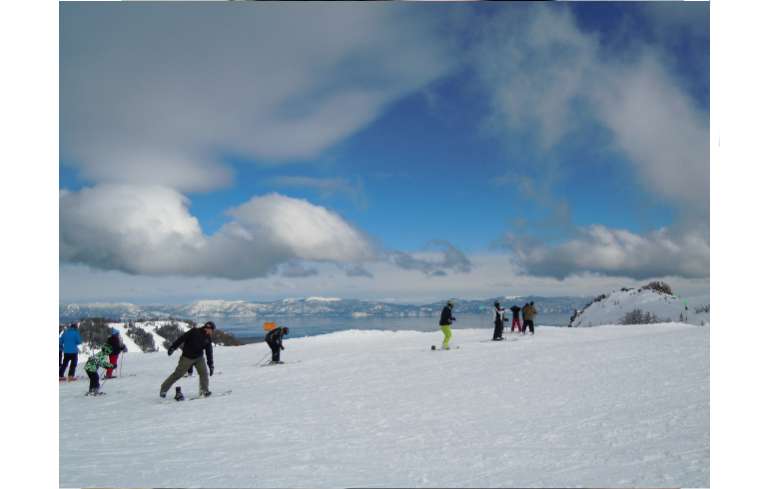
Ski resorts don't like using the C words -- climate change. Photo/LTN file

Ski resorts don’t like using the C words — climate change. Photo/LTN file

Save wildlife habitat and prevent natural disasters, sure, Katz intoned, but let’s keep skiing out of this.

The reaction revealed an industry deeply torn between protecting its long-term survival and ensuring its short-term profitability. “Ski area owners and operators are aware of the scientific studies and projections regarding the long-term potential impacts of climate change,” the National Ski Areas Association said in a position statement, “but we remain optimistic as an industry.”

The forecast does not inspire confidence, however. The report that made headlines in December, Climate Impacts on the Winter Tourism Economy in the United States, provided a long list of alarming reminders: By the end of the century, winter temperatures are projected to warm an additional four to 10 degrees Fahrenheit in North America. In high-emissions scenarios, the winter snowpack in the Cascades and the Sierra is projected to decrease between 40 and 70 per cent by 2050. If we continue to pollute the way we do now, skiing will be confined to the top quarter of Aspen Mountain in average years by the end of the century. Utah’s Park City Mountain Resort will have no snowpack whatsoever.

The report then attempted to put a price tag on all this, calculating that, over the course of the last decade, ski areas lost more than $1 billion in potential revenue to bad snow years. Failure to respond quickly to climate change, the authors wrote, “spells economic devastation for a winter sports industry deeply dependent upon predictable, heavy snowfall.”

Commissioned by the nonprofit Protect Our Winters (POW for short) and the Natural Resources Defense Council, the report was part of a broader effort to highlight the economic significance of outdoor recreation, and to use that as a lever to promote conservation. But the ski industry has been reluctant to talk about this looming catastrophe, even for the sake of prolonging its own life.

“It’s a tough reality to swallow,” says Elizabeth Burakowski, a Ph.D. candidate in snow science at the University of New Hampshire and one of the report’s co-authors. “It’s bad for business.”

The National Ski Areas Association does have a program called the Climate Challenge that encourages resorts to reduce greenhouse gas emissions — though it says nothing about all the emissions spewed when skiers travel to the resorts — and it has advocated for clean energy programs on the national level. And many individual resorts, including Vail, have cleaned up their operations by shifting to renewables like wind power. But when it comes to the larger fight against climate change, most industry leaders say they have enough to worry about already.

Nationally, the number of visits to ski resorts has remained essentially flat since the industry started keeping track in 1979. Analysts blame younger people, who aren’t replacing aging Baby Boomers, the ski industry’s main market. And now comes the news that snowboarding, a sport largely credited for saving the industry in the 1990s, is on a steep downhill slide. A report released this winter by RRC Associates, a company that tracks winter recreation, found that the percentage of snowboarding visits to ski areas has declined over the past two years, while the number of days boarders head to the mountain has dropped sharply in the past decade.

At Mammoth Mountain, environmental affairs director Ron Cohen says he’s got his hands full just keeping up with Forest Service and state regulations. The ski area, he says, simply lacks the resources to be more active on climate change. “Everybody knows — people who work here and think about strategy — we’re not ignorant of the issue,” Cohen says. “We know that there are these discussions, these issues, scientific theories, facts — all of the above — but we’re focused on business strategy a lot more than we are on something we have a lot less control over.”


Virginia City to put on parade, wine walk

The second annual Virginia City Wine Walk is May 25 beginning at 10am.

It will be followed by the Celebration of Heroes Parade down C Street, the historic town’s main drive, honoring U.S. heroes. The parade begins at noon in front of Fourth Ward School.

Glasses for the wine walk are sold in Delta Saloon parking lot until 3:30pm. The walk lasts until 5pm, with 21 participating locations. Early bird tickets may be purchased online for $15 until May 23. Regular price is $20.

For more information, call(775) 847.7500.


Golf, luau benefit Barton Foundation

Barton Foundation is bringing Hawaii to Lake Tahoe on June 20 for Barton Foundation’s Community Health Endowment. The endowment supports the future health of the Lake Tahoe region and beyond through equipment purchases, renovations and expansions for Barton Health.

Grab your favorite Hawaiian shirt and join the foundation for a day on the green followed by a pig roast at Lake Tahoe Golf Course beginning at noon. Partake in a scramble shot-gun start, on-hole libations, entertaining challenges and compete in the most magnificent Hawaiian shirt and ambitiously decorated cart contests.

There will be a Hawaiian luau and pig roast beginning at 6pm with no-host cocktails and auction.

Golf and luau is $150 person; luau only is 460.

To reserve your spot for the Tiki Tee Off or to buy luau tickets or donate to the auction, call (530) 543.5614 by June 7.


Blood drive in South Lake Tahoe

BloodSource will have a South Lake Tahoe blood drive June 10 from noon-6pm to meet the community need for blood and blood products.

Walk-ins are welcome.

Blood drive participants will receive a parking validation for the Lake Tahoe Resort Hotel (formerly Embassy Suites) parking lot at the blood drive check in. Participates will receive a coupon for one personal size pizza from Round Table Pizza at the Y and earn MyBloodSource rewards.

The blood drive is sponsored by the Barton Memorial Hospital Auxiliary.

Donors must weigh at least 110 pounds, be at least 17 years old (16 with a signed BloodSource Parental consent form) and be generally healthy. There is no upper age limit for blood donations. Donors must bring a photo ID and should drink plenty of fluids before donating.

For more information, call Dan Kerr at (775) 781.5343.


Snippets about Lake Tahoe

hike-1Here are two possibilities for hikes on June 1 – National Trails Day.

• South Lake Tahoe’s Planning Commission on May 23 at 3pm will discuss the Chateau project. Here is the agenda.

• Sugar Bowl plans to build the Crow’s Peak chairlift at the western end of the resort this summer.

• El Dorado County Board of Supervisors honored Mark Divittorio for helping to rescue a family last month when their car plunged into the South Fork of the American River.

• Lake Tahoe Basin Fire Academy’s graduation is June 29 at noon at Lake Tahoe Community College.


Fighting Chance helps keep kids safe

By Kathryn Reed

Krystal Steadman never learned the lessons taught in Fighting Chance. Her fourth-grade class at Meyers Elementary School was on the calendar that spring of 2000 a week after the 9-year-old was abducted.

It would be pure speculation that the then fourth-grader would be alive today had she been taught what to do if bad guys come after you.

Her capture occurred nine years after Jaycee Lee Dugard, then a fifth-grader at the same South Shore school, was abducted.

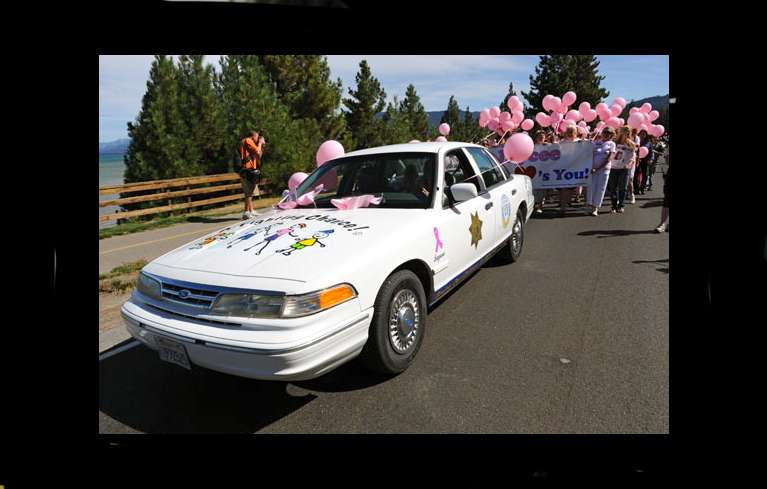
The Fighting Chance vehicle leads the 2009 parade celebrating Jaycee Lee Dugard's freedom. Photo/Lisa J. Tolda

The Fighting Chance vehicle leads the 2009 parade celebrating Jaycee Lee Dugard’s freedom. Photo/Lisa J. Tolda

Fighting Chance in large part came about as a reaction to Dugard’s abduction from a bus stop. Terry Probyn, Jaycee’s mom, is on the video that is used in the classrooms. This was taped on the 10-year anniversary of the abduction. (Jaycee was found alive in 2009.)

This week members of Soroptimist International South Lake Tahoe are in the classrooms throughout Lake Tahoe Unified teaching the Fighting Chance curriculum.

Brooke Laine, when she was president of the club, came up with the program in the mid-1990s. It has continued on every year since then. It started in the fifth grade, but now includes grade 3, 4 and 6, too. Laine said fifth grade was not chosen because that was Jaycee’s grade, but instead it had more to do with the age group molesters target.

“Pre-puberty, that is the age the child molesters want,” Laine told Lake Tahoe News. “They plan their attack. You have to be prepared to plan your escape. I don’t even want to tell them how many sexual predators are in town. I have a binder of them. I know where they live.”

Laine’s children were about 4 and 5 when the program started. She would read books about abductions, molestation – all to gain knowledge in her quest to put Fighting Chance together.

Laine said Probyn told her one of the biggest regrets she had was not teaching Jaycee what to do if someone grabbed her.

Soroptimist International Tahoe Sierra teaches the third-graders by using a board game that in large part looks like the South Shore. It’s about figuring out routes to get to home and school safely. Different “what if” scenarios are played out so kids will start thinking about what to do if some stranger approaches or grabs them.

Fourth-graders learn via the video. But the DVD is turned on and off, with discussion in between to engage them, let them ask questions and allow time for the material to sink in.

In fifth grade they are taught what to do. Laine said she is not aware in all these years of a single parent not turning in the permission slip. She said because the material can be “shocking”, parents must say it’s OK for their child to learn the message of Fighting Chance.

In sixth grade youths are taught that if the suspect gets out of the vehicle, but they’re locked in, to take a button off a shirt and put it in the ignition. Kick out a taillight if stuffed in the trunk. Cops in Tahoe know to pull over a vehicle with a busted out taillight just for the reason someone could be in there.

The El Dorado County Sheriff’s Office has twice donated an old vehicle for the purpose of teaching kids. And it has twice been used in a parade in Jaycee’s honor – first to remember her, and then to celebrate her release from captivity.