S. Tahoe to have March Against Monsanto event

South Lake Tahoe will have a March Against Monsanto event on May 25 to coincide with the worldwide demonstration.

Mike Herron is organizing the protest.

It will start at 11am at the Raley’s near Stateline.

“It may not be huge like some events will be, but it will help to raise awareness to further progress our cause,” Herron told Lake Tahoe News. “Consumption of GMO foods, corn syrups, or any major food brands for that matter during the march will be highly frowned upon, so if you want to march, bring healthy snacks and water.”


Future of Chateau up to S. Tahoe City Council

By Kathryn Reed

While the South Lake Tahoe Planning Commission on Thursday spent hours listening to testimony about the parceled down Chateau project, it will ultimately be up to the City Council on June 11 to decide what happens.

Much of the dialogue had nothing to do with what the commissioners were asked to take action on. History of what was to be a $410 million two hotel-convention center-retail project was hashed out, along with talk about how many locals have lost millions of dollars because of their misplaced trust in believing original developer Randy Lane would complete the project and not leverage their property.

City Manager Nancy Kerry, at the end of the meeting, said, “A lot of mistakes were made. A lot of people’s lives were harmed. We can’t undo the mistakes of the past. We agree it was a process problem.”

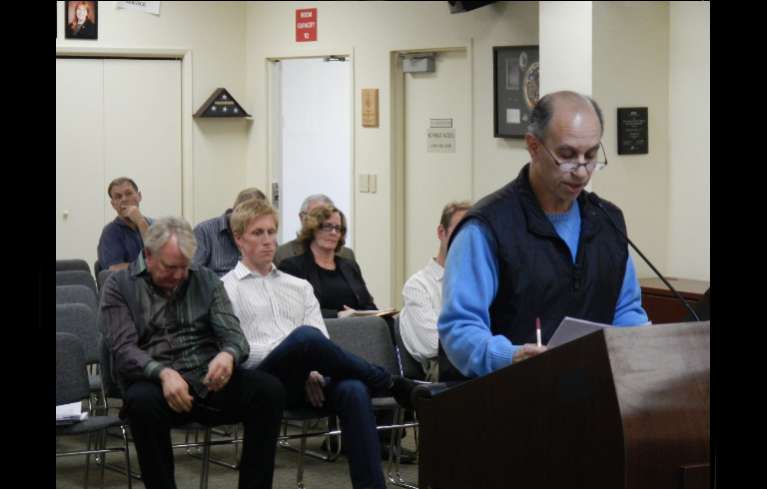
Harry Segal, an original property owner who is still in litigation, talks while current property Bill Owens (head down) listens. Photo/Kathryn Reed

Harry Segal, an original property owner who is still in litigation, talks while current property owner Bill Owens (head down) listens. Photo/Kathryn Reed

She said this time around staff is being more prudent and skeptical so those same mistakes are not repeated at the 11-plus acre site near Stateline.

This was evident when city engineer Sarah Hussong-Johnson and Deputy City Attorney Nira Feeley repeatedly said it is not up to the city to make a decision about the Caltrans right-of-way. An encroachment permit, per city regulations, is needed from Caltrans before the new building permit could be issued.

Lew Feldman, the attorney representing the developer, advocated the commission say that construction could begin without it. Staff said no way and that it is not up to the commission.

Kerry also said no authorization to go forward will be granted – assuming that is the course council takes – without proof the six parcels the applicant wants to build on this summer are consolidated into one map.

It was repeatedly brought up how the 29 parcels’ never becoming one led to many of the financial woes and problems that exist with property owners.

Rick Edwards, one of the original property owners, said, “Until we are made whole, this project should not go forward. I will do everything and anything to stop this project from going forward.”

He said a handful of locals are owed about $10 million.

Before the meeting he told Lake Tahoe News he felt bullied and threatened by Lane back when the developer was trying to shore up financing.

About 30 people attended the meeting, including all City Council members except JoAnn Connor. Seven people spoke, including a representative from City National Bank, which owns nine of the 29 parcels. The entrance off Cedar Avenue will affect a couple of those parcels. That person said so far they are not taking a position on the proposed project.

Three hours after all the talk the commission twice voted 3-1 to approve staff recommendations. Commissioner Tammy Wallace was the dissenter both times, but she didn’t explain her vote. Commissioner Jason Drew was absent.

The commissioners recommended to the council that:

• The original environmental documents be found valid;

• That 10,000 square feet of commercial floor area be designated to the project but that an additional 1,705 square feet of CFA that would come from a special projects pool be denied;

• The design review permit be granted;

• The special use permit for the increase in number of compact car parking spaces be granted.

The second vote involved abandonment of the right-of-way of a portion of Laurel Avenue and Poplar Street.

What is expected to be a two-year project is the building of retail along Highway 50 and a much larger McP’s restaurant at the corner of Stateline Avenue.


Open house planned at Tahoe City Field Station

UC Davis Tahoe Environmental Research Center’s open house at the Tahoe City Field Station (Historic Hatchery) is June 15 from 10am-2pm.

Visitors may tour the historic building, talk to TERC scientists about their work, and learn something about Lake Tahoe. Local garden clubs will be on hand to give plant selection and gardening advice, and Red Truck of Truckee will sell food and beverages.

The UC Davis Tahoe City Field Station has evolved from its origins as a state fish hatchery to its current function as a field station for UC Davis researchers at Lake Tahoe. The Field Station houses the Eriksson Education Center, native plant demonstration garden, a small laboratory facility, and the equipment necessary for researchers to boat on, dive in, and scientifically examine Lake Tahoe.

Between Memorial Day and Labor Day, the Eriksson Education Center offers visitors an opportunity to explore the facility at their pace with self-guided tours between 8am and 6pm daily. Volunteer docents are available on Saturdays from 10am-2pm for guided tours and hands-on science activities.

Eriksson Education Center also hosts the Green Thumb Gardening Series, a series of weekly lectures on sustainable gardening in the Lake Tahoe Basin. This year’s topics include edible gardens, pest management, composting and efficient irrigation. Green Thumb lectures are every Tuesday at 5:30pm beginning June 25.

For more information about the Open House, Green Thumb Gardening Series or volunteer opportunities, contact Kelsey Poole at (775) 881.7560, ext. 7402 or klpoole@ucdavis.edu.

The facility is at 2400 Lake Forest Road, Tahoe City.


Lahontan cutthroat trout spawn at Fallen Leaf Lake

Efforts to re-establish Lahontan cutthroat trout in Fallen Leaf Lake have resulted in a native, lacustrine strain of LCT to spawn in the Lake Tahoe Basin for the first time since their extirpation in the 1930.

The U.S. Fish and Wildlife Service with partners began stocking Fallen Leaf in 2002 with Pilot Peak Lahontan cutthroat trout. This effort was undertaken in order to reintroduce a lake form of this subspecies within the Tahoe basin. The Pilot Peak LCT strain is native to the basin.

This lake strain is thought to live 15 to 20 years.

The largest LCT captured prior to the 1930s from Fallen Leaf Lake was 29 pounds. The California state record for this subspecies is from Lake Tahoe in 1911 and weighed more than 31 pounds.

Fallen Leaf Lake is historic LCT habitat connected to Lake Tahoe by Taylor Creek.

To manage Lahontan spawning and prevent hybridization with rainbow trout, two weirs have been installed in Glen Alpine Creek, one at the interface of the lake and creek and the other approximately 230 meters upstream. Both weirs have been in place since mid-March to control access to spawning areas from Fallen Leaf Lake and act as a barricade to downstream movement of rainbow trout in the upper watershed. Although the weirs block access for mature trout to Glen Alpine Creek, other native species found in the watershed, Lahontan redside shiners, Paiute sculpin, and speckled dace are able to move through the half inch spacing of the bars at either weir.

Upon completion of the spawning season, both weirs will be outfitted with a fry box to capture fry produced within and above the spawning areas to ensure that hybridization is not occurring and to measure LCT reproductive success. Once fry are checked genetically, LCT will be released into Fallen Leaf Lake.


Waterfall season in Tahoe

Late spring is a great time of year to check out the waterfalls around Lake Tahoe.

Showcased here are: Eagle Falls, Cascade Falls, Horsetail Falls, Hawley Grade and Van Sickle State Park.

The video is produced by FirstTracks Productions in South Lake Tahoe.


Waterfall Season in Tahoe South from First Tracks Productions on Vimeo.


Study: Equity gaps widens in higher education

By Paul Fain, Inside Higher Education

Economic and racial stratification is increasing in American higher education, with growing concentrations of needy students at community colleges. Meanwhile, government funding skews toward universities with more advantaged students, due in part to research support and tax breaks.

Those are the findings of a new report from a panel convened by the Century Foundation. The paper, dubbed “Bridging the Higher Education Divide,” includes policy recommendations to address growing inequity in the academy.

“Two-year colleges are asked to educate those students with the greatest needs, using the least funds, and in increasingly separate and unequal institutions,” the report said. “Our higher education system, like the larger society, is growing more and more unequal.”

The report’s authors said community colleges’ relative lack of resources has contributed to the sector’s lackluster graduation rates.

Fewer than 12 percent of community college students earn a bachelor’s degree within six years of enrolling, the report said, while 81 percent of incoming students said they wanted to transfer and eventually earn at least a bachelor’s degree.

The federal government has long sought to level the economic playing field in K-12 schools, according to the report. That has not happened in higher education.

“We propose greater funding in higher education for institutions serving those students with the greatest needs, tied to accountability for outcomes,” wrote the panel, which was led by Anthony Marx, the former president of Amherst College and current president of the New York Public Library, and Eduardo Padrón, president of Miami Dade College.

Government support for colleges should incorporate the K-12 concept of “adequacy” funding, the report said, which require extra funding for schools with relatively large numbers of impoverished students.

The U.S. Department of Education should study the issue, according to the report. And state and federal lawmakers should develop funding formulas that take into account where disadvantaged students go to college.

If those strategies don’t work, the report points to the remaining branch of government – the courts – as an option.

“We encourage equity advocates to begin exploring the possibility of filing lawsuits in those states that have a constitutional guarantee that may extend to higher education,” said the report. “Litigation requiring adequate funding at the K–12 level has been successful in a number of states.”

Community colleges have far less money to spend on students than do four-year institutions, which have broader missions and access to more funding streams.

While four-year colleges have many costs — such as paying for faculty members to do research or running large residential facilities — that community colleges do not, they also spend more on student instruction. The two-year sector’s instruction costs were about $5,000 on per student in 2009, according to research cited in the report, compared with $10,000 at public research universities and $20,000 at private research universities.

Public funding contributes to this disparity, albeit somewhat indirectly. Community colleges received $8,594 per student in 2009 from federal, state and local government sources, the report said. Public research institutions received $16,966 while public master’s institutions got $8,384.

Private colleges also benefit from a range of tax breaks, said the report, including exemptions on private donations and endowment income.

The money gap is growing in higher education. In the decade before 2009, total operating expenditures at private research universities grew by an average of $14,000 per student while those of community colleges grew by only $1.

The policy paper is backed by three new studies. That research addresses the financing of community colleges, the racial and socioeconomic composition of students at two-year institutions, and the role of those factors in student success.

The growing divide in higher education has been driven in part by the increasing percentage of Americans who attend college – which has quadrupled since the 1950s. Inequality has gotten worse as more people go to college, the report notes.

At the most competitive colleges, wealthier students outnumbered those on the low end of the socioeconomic spectrum 14 to 1 in 2006. Yet the ratio of needy to wealthy students at community colleges was nearly 2 to 1. And that socioeconomic stratification has grown in recent decades.

Racial and ethnic divides are also increasing. White students’ share of overall community college enrollment dipped to 58 percent from 73 percent in the 12 years before 2006. That shift, which is due in part to the nation’s changing demographics, was only three percent at more selective four-year colleges.

The report proposes several fixes, aimed at both policy makers and colleges. They include:

  • Adopt state and federal adequacy-based funding akin to that used in K-12 education, combined with a consideration of outcomes.
  • Establish greater transparency regarding public financial subsidies to higher education.
  • Encourage the growth of redesigned institutions that improve the connection between community colleges and four-year institutions.
  • Take steps to help students transfer from community colleges to four-year institutions.
  • Encourage innovation in racially and economically inclusive community college honors programs.
  • Encourage innovation in early college programs that enhance community college diversity.
  • Prioritize funding of new programs for economically and racially isolated community colleges.
  • Provide incentives for four-year institutions to engage in affirmative action for low-income students of all races.


Barton working with cancer center in Truckee

Barton Health has partnered with the Gene Upshaw Memorial Tahoe Forest Cancer Center, a service of Tahoe Forest Health System in Truckee and an affiliate of the UC Davis Comprehensive Cancer Center, to expand its oncology services for cancer patients who reside in the South Lake Tahoe area.

Using advanced technology through Barton’s Telehealth for Tahoe Program, cancer patients undergoing treatment at Gene Upshaw Memorial Tahoe Forest Cancer Center can meet with their physicians via “real-time” videoconferencing.

For cancer patients who are in-between chemo doses the program can help minimizes stress and travel expenses.

For more information about the Gene Upshaw Tahoe Forest Cancer Center, call (530) 582.6450.


Study: Recreational pot not as safe as presumed

By Roxanne Khamsi, Scientific American

Marijuana is more popular and accessible in the U.S. than any other street drug. In national surveys, 48 percent of Americans say they have tried it, and 6.5 percent of high school seniors admit to daily use.

So it was not too surprising when two states, Washington and Colorado, became the first to legalize recreational marijuana in the November 2012 general election, albeit in limited quantity, for anyone over the age of 21.

Activists expect that similar measures will soon win approval in other parts of the country.

Some success with medical marijuana helped to pave the road to wider legalization of pot. Eighteen states and the District of Columbia permit possession and consumption of the drug for medical purposes.

Doctors in those jurisdictions may prescribe cannabis to treat or manage ailments ranging from glaucoma—an eye disease in which the optic nerve is damaged—to menstrual cramps. Cancer patients sometimes smoke pot to relieve the pain and nausea brought on by chemotherapy, and some people with the inflammatory disease multiple sclerosis rely on marijuana to ease muscle stiffness.

Although many physicians agree that marijuana is safe enough to temporarily alleviate the symptoms of certain medical conditions, the safety of recreational use is poorly understood. Researchers worry that short- and long-term use of the drug may harm the body and mind.

Marijuana’s continued popularity among teenagers raises particular concern because the drug might hinder the ongoing maturation of the adolescent brain.

Making matters worse, new growing techniques for the cannabis sativa plant — from which marijuana is prepared — have dramatically increased the drug’s potency. Some experts suggest that such high-octane weed is fueling a rise in cannabis addiction.

Finally, although investigators still debate how the legalization of recreational marijuana will change road safety overall, studies indicate that the drug slows reaction time and impairs distance perception behind the wheel. Despite such evidence, most new marijuana regulations, for medical or recreational use, fail to account for these potential risks.

Whether rolled into a joint or mixed into brownie batter, marijuana profoundly changes behavior and awareness. The primary psychoactive compound in marijuana, tetrahydrocannabinol (THC), mimics the structure of molecules called endocannabinoids that the human body produces naturally. Endocannabinoids act on a group of cell-surface molecules called cannabinoid receptors that help to regulate appetite, mood and memory. Because of its shape, THC fits into these receptors, too.

After all, jokes neuroscientist Giovanni Marsicano of the University of Bordeaux in France, “We don’t have a receptor in the body just to smoke marijuana.”

When THC strikes specific cannabinoid receptors, it triggers domino chains of interacting molecules in neurons that culminate in both unusually elevated and abnormally low levels of various neurotransmitters (the molecules that brain cells use to communicate with one another). The result is the well-known “high” of marijuana. Suddenly, the mundane seems hilarious, and ordinary foods taste delicious. People generally feel merry, relaxed and introspective, although undesirable effects—such as paranoia and irritability—are common as well.

Marijuana also temporarily impairs an array of mental abilities, especially memory and attention. Dozens of studies have shown, for example, that people under the influence of marijuana perform worse on tests of working memory, which is the ability to temporarily hold and manipulate information in one’s mind. Participants in these studies have greater difficulty remembering and reciting short lists of numerals and random words.

Research has further revealed that cannabis blunts concentration, weakens motor coordination and interferes with the ability to quickly scan one’s surroundings for obstacles.

Such mild cognitive deficits may not endanger anyone if a marijuana user lazes on the couch, but it is a different story when someone takes that high on the road. In driving-simulation and closed-course studies, people on marijuana are slower to hit the brakes and worse at safely changing lanes. Investigators still debate, however, at what point these impairments translate to more traffic accidents. A 2009 study found an increased risk of accidents for levels of THC higher than 5 nanograms per milliliter of blood, which some evidence inndicates is as impairing as a blood alcohol concentration around the legal limit of 0.08 percent. Typically one would have to take several puffs of a joint to reach such a concentration.

Consequently, voters in Washington State have adopted 5 ng/mL as the upper threshold for drivers.

Enforcing that limit presents a technical challenge, however. Unlike alcohol, marijuana cannot be detected with a relatively unobtrusive breathalyzer test. Police officers would have to look for it in blood—something that often requires a warrant.

“There is currently no practical method for law-enforcement officers at the scene to collect blood samples from suspected DUI cannabis drivers in a timely manner,” says Paul Armentano, deputy director of the Washington, D.C.–based National Organization for the Reform of Marijuana Laws, which advocates the legalization of marijuana.

Instead of using a blood test, Armentano says that police should look for poor maneuvering and the smell of pot wafting from the vehicle.

Although marijuana’s immediate effects are relatively easy to monitor in the lab, the drug’s long-term effects on body and mind are harder to determine. So far the results — which admittedly are subject to multiple interpretations — indicate the need for caution. In one recent study, clinical psychologist Madeline Meier of Duke University and her colleagues examined data from 1,037 New Zealanders. They found that people who began using pot earlier in life and used it most frequently over the years experienced an average decline of eight IQ points by the time they turned 38. By comparison, those who never smoked pot had an average increase of one IQ point by the same age.

A reanalysis of the New Zealand data by Ole Røgeberg of the Ragnar Frisch Center for Economic Research in Oslo, however, suggested that the IQ difference could be explained by socioeconomic factors. People who start smoking marijuana at an earlier age are often less intelligent to begin with. Even if this is true, Meier says, her study shows that the IQ drop is greatest for those who started smoking pot as teenagers rather than in adulthood, indicating a worrisome cumulative effect regardless of intelligence. This finding, she thinks, makes it all the more important to discourage the early use of marijuana among teens.

Increasingly potent marijuana of recent years may be driving a sharp rise in cannabis addiction among adolescents, according to a report released last year by the American Society of Addiction Medicine. Between 1993 and 2008, the average concentration of THC in confiscated marijuana jumped from 3.4 to 8.8 percent. Meanwhile hospital and rehabilitation center admission rates for minors abusing marijuana soared by 188 percent between 1992 and 2006. In contrast, admissions for alcohol abuse for the same group over the same period declined by 64 percent.

In addition to tracking levels of THC itself, some researchers have focused on the dangers of lingering contaminants in marijuana sold on the street. Dealers typically sell cannabis by weight, so some use sand or glass beads to make their products heavier. Breathing in these particles over the years may inflame and eventually scar the lungs.

An analysis published last year of data on more than 5,000 Americans did not find a decline in lung function among individuals who smoked joints two or three times a month over two decades. The authors emphasize, however, that they did not assess the effect of daily use on lung health.

“Somebody should do that study if marijuana is going to become legalized and prescribed” more widely, says Mark Pletcher, an epidemiologist at UC San Francisco, who co-wrote the paper.

Some opponents of legalization worry that lax regulation of medical marijuana foretells even looser laws concerning recreational marijuana. In states that have legalized medical pot, current laws do not guarantee the safety or quality of cannabis products or standardize levels of THC.

In Oakland, people can fill a marijuana prescription at Harborside Health Center, a massive dispensary with a strict quality-control system. Elsewhere in the state, however, people get their medical marijuana at mom-and-pop outfits or on the street.

The next big round of ballot initiatives to legalize cannabis in states other than Washington and Colorado could happen as soon as three years from now, in the 2016 presidential election. Until then, researchers have plenty of marijuana health risks to weed through.


Truckee man accused of stealing from family

A Truckee resident was arrested May 22 on multiple counts of check fraud, forgery, theft, burglary and financial related elder abuse.

Richard Copeland, 48, had allegedly been stealing money and other items from his family members for several months.

Once discovered by other family members, they reported their suspicions to law enforcement.

Copeland’s bail was set at $25,000.

 — Lake Tahoe News staff report


Red poppies — a symbol of patriotism

By Mike Crowley

Have you ever asked yourself while passing by some stores in May, why are these men and women in military dress handing out red poppies made of paper? Yes, it’s to commemorate and remember the loss of men and women who died in wartime for our freedom. But why a red poppy?

On May 3, 1915, during World War I, a young Canadian physician and lieutenant colonel named John McCrae was presiding over the funeral of a fellow soldier, killed in the western part of Belgium in a region known as Flanders Fields. McCrae composed a poem for the service titled, “In Flanders Fields.” He did not think it was a very good poem. He wrote it in 20 minutes, just before the service.

However, his fellow soldiers thought he had written an all-inspiring poem perfect for the battlefields in times of war. Over the next few months the poem became very popular throughout the free nations at war. On Dec. 8, 1915, the poem was first published by the British magazine Punch. It was so popular during World War I, it became the most quoted poem of its time. Here it is in full, from a 1919 published collection of McCrae’s works:

 “In Flanders Fields,” by John McCrae

 In Flanders fields the poppies blow

Between the crosses, row on row,

That mark our place; and in the sky

The larks, still bravely singing, fly

Scarce heard amid the guns below.


We are the Dead. Short days ago

We lived, felt dawn, saw sunset glow,

Loved and were loved, and now we lie

In Flanders fields.


Take up our quarrel with the foe:

To you from failing hands we throw

The torch; be yours to hold it high.

If ye break faith with us who die

We shall not sleep, though poppies grow

In Flanders fields.

According to writers, the reference to poppies is the red poppies that sprung up quickly from the ground around the graves of buried soldiers. These red poppies have been associated with battle since the Napoleonic Wars. A writer of the time noted that poppies grew in abundance over the graves of soldiers lost in battle. Research indicates that bombings of the landscape at Flanders fields increased the deposit of lime into the soil, which greatly increased the growth of poppies. After World War I ended in 1918, wearing a red poppy symbolized the remembrance of those who had died in war.

Wearing a Red Poppy today is the continuance of a great American tradition – remembering those who made the ultimate sacrifice so we could live in freedom. So now you know, why a red poppy.

Sources used: Article: In Flanders Fields, Wikipedia, the free encyclopedia; American Legion, Legion Auxiliary, and War Veterans.

Mike Crowley is a resident of South Lake Tahoe.