Tahoe bill passes Nevada Legislature

By Andrew Doughman and Conor Shine, Las Vegas Sun

Legislators slogged through dozens of bills Friday, turning the Senate and Assembly chambers into arenas for legislative triumph and death.

Following a lengthy day of voting, bills you might find good, bad or just plain weird are headed to Republican Gov. Brian Sandoval, meaning they now need nothing more than a signature from Sandoval to become law.

But just as many bills died because they didn’t pass by a legislative deadline that ended midnight Friday, perhaps none as spectacularly as a sex education bill from Assemblyman David Bobzien, D-Reno.

“You only have 120 days to do business with deadlines,” Bobzien said. “Bills die. That’s the way it is.”

Senate Democrats declined to consider the bill that Assembly Democrats had passed on a party-line vote, highlighting the inter-party fighting that can happen when senators need the Assembly to pass its bills and Assembly members need the Senate to pass its bills.

To achieve their goals, legislators swapped and traded in a this-for-that spate of paper-making frenzy resulting in dozens of last-minute amendments.

“We’ve done more alterations here than Joan Rivers’ plastic surgeon,” said Assemblyman William Horne, D-Las Vegas, in a tweet.

Legislators have for the past few months nurtured their bills through the legislative process, fending off opponents, compromising with interested parties, and gathering the legislative voting blocs necessary to pass their bills. In short, they get personally invested in the legislative process.

And while legislators can rise to the occasion to debate important state social and fiscal policy, they also can spend evenings in closed meetings debating the merits and demerits of a bill about raw milk.

“It’s surreal, but I think particularly for those of us who have been here a couple of sessions, you get used to it,” Bobzien said.

While past sessions’ deadline votes have run out the clock in lengthy and contentious arguments among legislators, the 2013 Legislature ended the day at 10pm with laughter in the Senate and congenial well wishes for a senator’s birthday.

Friday’s deadline is somewhat meaningless; big pieces of legislation including a major energy overhaul, a gun background check bill, a bill allowing for medical marijuana dispensaries, a gas tax, a Southern Nevada stadium study bill, and other bills are exempt from the deadline.

But that doesn’t mean major bills didn’t pass Friday either.

Here’s a look at some of the big bills the Legislature approved or killed Friday:

A bill to permit an increase in the sales tax to allow Las Vegas Metro Police to retain 300 officers has passed the Senate, 18-3. Assembly Bill 496 would increase the sales tax in Clark County by 0.15 percent if it is approved by a two-thirds vote of the Clark County Commission.

A controversial bill that would have updated and standardized sex education curriculum across the state won’t advance any further after it died in the Senate Friday.

Supporters framed the bill as a common sense update to the state’s sex education policy, but it became mired in heated rhetoric about what exactly would be changed.

Critics had earlier warned that the bill would serve to push the agenda of Planned Parenthood, especially in regards to abortion, and would disconnect sex education from morality and community concerns.

Legislators paved the way for a renewed agreement with California to protect the environment around Lake Tahoe.

Senate Bill 229 passed in the Assembly on a 40-1 vote and now heads to the governor’s desk.

Earlier this month, Sandoval and California Gov. Jerry Brown announced they’d reached a deal to keep the two states in a decades-old compact to protect the environment around Lake Tahoe, agreeing to ease some barriers for development and mollifying the concerns of some environmentalists.

The agreement comes two years after the Nevada Legislature passed a law requiring the Silver State to break the compact if substantial changes weren’t made by both the compact and the regional plan governing how the sensitive environment is developed. Environmentalists launched an effort this year to repeal the 2011 law, succeeding in convincing the Nevada Senate to pass Senate Bill 229 to keep Nevada in the compact.

Assemblyman Jason Frierson, D-Las Vegas, brokered a compromise to a major homeowners’ association bill that passed Friday out of the Assembly.

The omnibus HOA bill, Senate Bill 280, passed in a 35-6 vote.


Insects can be a good thing for gardens

By Melody Hefner

Of the more than 1 million types of insects in the world, less than 5 percent are harmful. Insects are an important part of the food web, providing a meal for other insects, birds and small mammals present in our yards. Many insects are pollinators. Without them, we would have no apples, cherries, melons or squash in our gardens.

Some insects can be nuisances but don’t cause plant damage.

Beneficial insects can be considered the “good guys” of the insects present in our landscapes. They are important tools for managing insect pests in your yard. Almost every insect pest has one or more insect natural enemies.

These beneficial predator insects kill or reduce the numbers of pest insects in your yard.

Just as many insect pests are most damaging at the larval stage, so are many beneficial insects the most predacious during their larval stage. Many people will recognize a lady bird beetle or “ladybug” but are unfamiliar with its dragon-like larvae. The larvae of lady bird beetles, green lacewings, syrphid flies and snakeflies are voracious pest predators, targeting aphids and other pests present in our landscapes.

Like all animals, beneficial insects need water, food and shelter to survive. Pest insects are food for beneficial insect larvae, and sometimes for the beneficial adults. Many adult beneficial insects sip flower nectar, so providing flowering plants will attract them to your yard.

The flowers also provide shelter for many beneficial insects. Insects require water, so providing a shallow dish or birdbath of water can also aid the good guys present in your yard. They will hang around if you treat them well.

Hopefully, the adults will lay eggs and perpetuate the beneficial insect cycle.

The balance between good and bad insects is critical to a healthy landscape. Most people are unaware of the relationship between good and bad insects in their yard until the relationship is disrupted, and insect pests begin eating their plants.

A change in weather patterns, use of a pesticide or even removal of a shrub that provides cover can disrupt the balance between good and bad insects. You can minimize this imbalance by keeping your plants vigorous and healthy throughout the year.

Melody Hefner is with the University of Nevada Cooperative Extension.


Outdoor conditions resemble summer, not spring

By Matt Weiser, Sacramento Bee

It may feel like spring in California, but this Memorial Day weekend, many rivers and creeks look like they’re already trickling through summer.

Rafters and kayakers headed outdoors this weekend will find no room to float their boats on some waterways. Snowmelt runoff peaked a month early in some watersheds, leaving some of their streams too low for holiday water play.

The north fork of the American River near Auburn, for instance, is normally used for rafting and kayaking into early June. But by the end of April, its flows were already too low for boating.

“It is unusual for it to go so low this early,” said Bill Center, a longtime California rafting guide and owner of the Camp Lotus rafting center on the south fork of the American River.

In the southern Sierra Nevada, the Kaweah River south of Fresno and the Kern River near Bakersfield are among other waterways flowing too low for boating, Center said.

Alan Haynes, a hydrologist at the California-Nevada River Forecast Center, a unit of the National Weather Service, said many streams are running at only about 10 percent of normal for this time of year.

“Because of the relatively light snowpack we had, and early melt-off, we’re already looking at flows that are more typical of midsummer,” Haynes said.

Tame rivers may not matter to a lot of people enjoying the outdoors this weekend. Forecasters predict unseasonably cool weather, and even rain, conditions unlikely to make people want to jump into the nearest stream.

The National Weather Service says high temperatures will reach only the 50s and 60s this weekend in the mountains and foothills, and the 70s in the Sacramento Valley.

Partly cloudy conditions are likely throughout the region Saturday and Sunday, with overcast skies and a chance of rain Monday.

The high in Sacramento on Monday is predicted to reach 71 degrees. The average for that date, in records reaching back to 1971, is 84 degrees.

For those who do go near creeks and rivers, experts advise caution, even with the lower-than-average flows. After all, the waterways are being fed with very cold snowmelt, which can immobilize a swimmer faster than many expect.

“Wear a life jacket, and be aware that it’s going to be a little chilly this Memorial Day,” Center said. “The key thing is to be careful.”

He said tubing has been growing in popularity in portions of the American River’s south fork, a waterway long popular for rafting and kayaking. Floating on an inner tube means being partially immersed in water at all times – not necessarily a good idea with cold May water temperatures.

“That’s more of a July-August thing,” Center said.

Many portions of the south fork are also too rough for tubing, Center said, especially for people with limited experience on the river.

Some rivers will still offer plenty of whitewater action this weekend and in the weeks ahead, including the south fork of the American River. That’s because the recent federal relicensing of upstream dams operated by the Sacramento Municipal Utility District requires certain minimum flows to accommodate rafting and kayaking.

“The south fork is in great shape,” Center said. “In fact, we’re seeing this as being one of our better years, in part because of the predictable flows but also because it’s been such an incredibly gorgeous spring.”

The same goes for the Truckee River, a popular rafting, fishing and wading destination in the Lake Tahoe and Reno areas. Low snowmelt has left the river with below-average flows, but there’s still enough for rafting.

Water releases from a small dam at Lake Tahoe regularly replenish the Truckee. Federal officials are required to maintain minimum flows, as long as the lake has water to release, to protect endangered fish species. Rafters and kayakers all the way to Reno and beyond get to enjoy that flow as a side benefit.

“We should do OK through the summer because of Lake Tahoe storage carryover from 2011,” the last wet winter, said Chad Blanchard, watermaster for the federal office in Reno that oversees Tahoe water releases. “We didn’t get a big peak that the kayak festival people (in Reno) would like to see. But because of storage, it hasn’t looked that bad.”

He said that snowmelt peaked in the Truckee River watershed on April 30, nearly a full month earlier than average. The river had its lowest peak natural flow – runoff not aided by reservoir storage – since 1988. Only one year since 1970 was worse, and that was 1977, a historically bad drought year.

The looming concern for Tahoe and other lakes throughout California is what happens in late summer and fall, when winter’s meager snowmelt runoff is long gone.

By then, Blanchard said, Tahoe “is going to approach the rim,” which means water releases into the Truckee River will no longer be possible.

Other reservoirs are likely to resemble puddles, relatively speaking, with vast exposed banks and restricted boating areas.

“Toward the end of the year, in the fall, we may start having trouble,” Blanchard said. “But through the summer, we should be fine.”


Seminars in Tahoe focus on health care changes

Barton Health and Lake Tahoe South Shore Chamber of Commerce are putting on seminars to educate people about healthcare reform, also known as the Affordable Care Act or Obamacare.

California and Nevada insurance exchanges for 2014 coverage enrollment open Oct. 1.

The workshops will be led by qualified industry specialists.

If you are an employer and have questions like:

How do I calculate my part-time and full-time employees to get my total full time equivalents?

I have seasonal employees, do I have to offer coverage to them?

What does “Pay or Play” mean? Do I qualify for tax credits and subsidies?

I have less than 25 employees, what does this mean for me?

If you live in the South Lake Tahoe region and have questions like:

Obamacare … Reform … Affordable Care Act, what does it mean for me?

I already get health coverage through my employer – will anything change?

Do I qualify for tax credits if I pay for coverage?

I don’t have a job; do I still have to get health coverage?

I didn’t qualify for Medi-Cal before, will I now?

The employer seminar is June 18; 3 to 4:30pm at LTCC, 1 College Drive, South Lake Tahoe in the board room.

Guest speakers are John Carlson, executive vice president of Benefit Intelligence, a leader in delivering the highest quality health and welfare benefits, insurance and human resources consulting solutions; and Gene Furr, from Menath Insurance an independent insurance agent located in the Lake Tahoe area and serving most Western states.

For community members the meeting is June 18 from 5:30 to 7pm at the same location.

Guest speakers are Carmella Gutierrez, president of Californians for Patient Care, a nonprofit dedicated to ensuring all California consumers have fair and equitable access to high-quality health care; and Debbie Stack from El Dorado County Health and Human Services.

Space is limited and pre-registration is strongly encouraged. For more information about these upcoming forums, contact Leanne Wagoner at Barton, (530) 543.5537 or Emily Abernathy at the chamber, (775) 588.1728, ext. 303.


Federal fine ends Ensign’s exit from politics

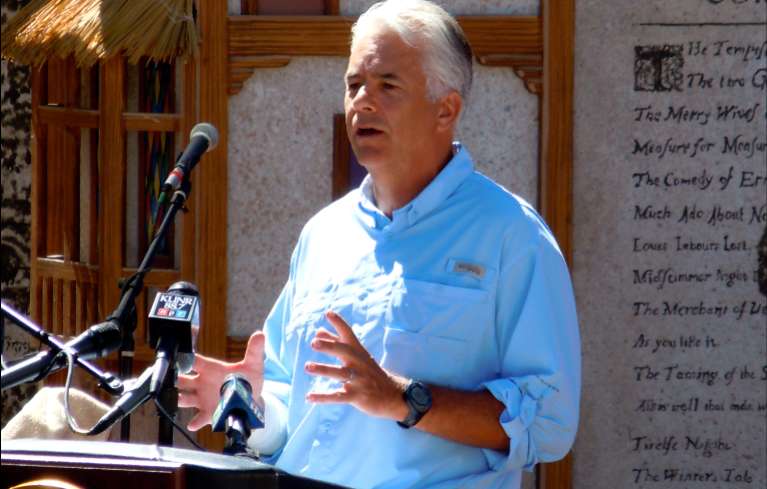
John Ensign, while a strong supporter of Lake Tahoe, left politics in disgrace. Photo/LTN file

John Ensign, while a strong supporter of Lake Tahoe, left politics in disgrace. Photo/LTN file

By Karoun Demirjian, Las Vegas Sun

Two years ago, the Federal Election Commission deciding to fine former Sen. John Ensign $32,000 for breaking campaign finance laws would have been big news.

But in a week filled with scandals, the first punishment levied on the erstwhile senator failed to stir anyone.

“It’s old news, and the political world has moved on,” said Eric Herzik, a political science professor at UNR. “It’s just a sad end to a sad story.”

The contorted tale of Ensign’s ethically shady steps to extricate himself from a long-term affair with his campaign treasurer — who also happened to be the wife of his chief of staff — gripped Nevada and the nation from when it was first made public, in June 2009, until well after Ensign stepped down in May 2011.

The Senate Ethics Committee excoriated him in a report detailing how Ensign had enlisted his staffers, family and even his Senate colleagues to help get Cynthia and Douglas Hampton to leave his employ quickly — and flagrantly ran afoul of campaign finance laws and congressional lobbying restrictions in the process.

In comparison to that 68-page tome, the FEC’s 10-page report offers few fresh details, save for a more exact itemization of Cynthia Hampton’s salary and health insurance cost, and the revelation that Ensign’s campaign and political action committee treasurer, Lisa Lisker (who replaced Hampton), was also complicit in failing to report the $96,000 Ensign’s parents gave to Hampton as off-the-books “severance.”

The FEC had dropped its case against Ensign in 2010, citing Ensign’s parents’ claim that they believed the $96,000 they gave the Hamptons was a “gift.”

Soon after, the Department of Justice dropped its investigation of Ensign.

The FEC only reopened its inquiry into the Ensign case after the Senate Ethics Committee released its report two years ago. The Justice Department, however, has not pursued charges against Ensign — and few think the FEC decision will change their minds.

“There’s nothing in there that DOJ didn’t already know,” said Melanie Sloan, executive director of watchdog group Citizens for Responsibility and Ethics in Washington, which has publicly criticized the Justice Department for failing to prosecute Ensign and filed a lawsuit seeking the Justice Department’s files on the case. “(The FEC decision) doesn’t even hold anybody culpable; nobody admits any wrongdoing. There’s not anything giving Justice grounds.”

The FEC rules by conciliation agreement — a handshake, effectively, between the FEC and the accused individuals — that the charges are fair and final. But there is a clause in the Ensigns’ agreement to ensure that the facts of the case, as laid out by the FEC, can’t be considered an admission of guilt.

Prior to the FEC’s fine, Douglas Hampton was the only person involved in the Ensign saga to have been sanctioned for his participation in illegal activity.

Hampton, who had been charged with seven felonies, was found guilty of breaking the law that requires former congressional staffers to wait at least one year before lobbying and was sentenced to a year’s probation.

Ensign, who was forced to abandon his political career, had otherwise gotten off scot-free.

Few in the political world think Ensign — who resumed his veterinary practice and has otherwise been keeping a low profile since he left Congress — will have to face a further reckoning.

“I would be amazed if there’s any more to this story. Ensign has moved on. The political world’s moved on. If anybody wants to go after John Ensign, I think it would be viewed as kind of piling on,” Herzik said. “You look back at it with a couple of years’ perspective, and there was no scandal here except the personal stupidity of John Ensign.”

“I think it’s just water under the bridge. If he were still in office, that’s a different ball game,” said David Damore, political science professor at UNLV. “But out of sight, out of mind. There’s been like 15 scandals since then.”


College student transforms planters into artwork

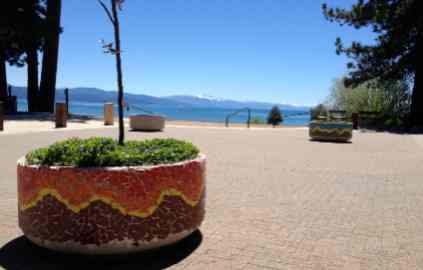
The facelift of Kings Beach begins later this year, but Jamie Himes, an interdisciplinary studies student at Sierra Nevada College in Incline Village, already got the beautification started.

As part of a project for her Service Learning class she came up with the Coloring Kings Beach idea. Himes’ project won the college’s award for Inspiring Community Impact.

Arty planters in Kings Beach. Photo/Provided

Artsy planters in Kings Beach. Photo/Provided

Himes was inspired by the mosaic fish created by Peter Hazel that stands guard over the driveway at Lanza’s restaurant in Tahoe Vista. She also wanted to involve the Boys and Girls Club of North Lake Tahoe in a project that would help to bring more public art into the community.

Himes saw the perfect canvas for her project in the flower pots that sit outside the entrance to the North Tahoe Event Center.

During three weekends this month, the mosaics on the pots took shape.

However, there is still work to do. Himes is soliciting donations to purchase an additional 50 pounds of clay to complete the work and will need help cutting more tiles, glazing them and then applying and grouting them. If you would like to donate money, materials or time, call (530) 412.2701.


9-day outdoor fest coming to North Shore

Alpenglow Sports is putting on its inaugural nine-day Mountain Festival June 22-30.

All events are free and focus on non-competitive recreation opportunities in nature designed to inspire participants as they enjoy and explore the North Lake Tahoe playground and community.

There will be nature hikes, trail runs, lakefront yoga sessions, athlete presentations, cutting-edge product demos, and giveaways. World-class athletes, local heroes, community businesses and nonprofits, and quality brands are partners in sharing this series of outdoor activities and lifestyle events.

Festival highlights include:

• Ultra Trail du Mont Blanc winner and Western States 100 competitor Krissy Moehl leading a women’s only fun run and presenting “An Ultra Runner’s Life: Adventures, Stories and Life Lessons”. (Presentation open to all genders.)

• Ellie Greenwood, Western States 100 women’s record holder and Montrail athlete, signing posters and guiding a fun run through scenic Paige Meadows.

• Running shoe demos and athlete-led runs from industry leaders Salomon, Montrail, Hoka One One, and Salewa.

• Evening presentations by local sports nutritionists and trainers focusing on hydration, training best practices, and general health and nutrition information.

• Long-time North Lake Tahoe resident, hiker, biker, and Tahoe Rim Trail guidebook author Tim Hauserman leading a group fun hike.

• Tahoe Rim Trail full moon hike led by the Tahoe Rim Trail Association.

• Alpenglow team-led fun runs and community hikes.

• Yoga on the lake with local instructors.

• Wildflower and birding hikes with the Tahoe Institute for Natural Science.

• Guided Emerald Bay historical hike with Tahoe Trips and Trails.

• Two-day Lake Tahoe climbing demo event at the Old County Boulders and Donner Summit, with free equipment demos and beginner climbing instruction.

• Rock climbing presentation by local hero and Alpenglow Ambassador Dave Nettle on his adventures in the High Sierra.

The complete events schedule and map of locations can be downloaded. While all events are free, space is limited and participants are encouraged to register online today to assure spots.


Barton throwing itself 50th birthday bash

Alva Barton and Fay Ledbetter brought the South Lake Tahoe community together to build a hospital. Barton Memorial is named after their parents, Bill and Ouida Barton. Photo/Provided

Alva Barton and Fay Ledbetter brought the South Lake Tahoe community together to build a hospital. Barton Memorial is named after their parents, Bill and Ouida Barton. Photo/Provided

Barton Memorial Hospital will celebrate 50 years of being in South Lake Tahoe on June 29 from 11am-3pm.

The party is open to the public. It is free and will be in the back corridor of the hospital grounds at 2170 South Ave.

History of the medical facility will be highlighted. Guest may take part in tours led by Borges Family Carriage Rides. Music from the ’60s will set the mood. There will be a vintage car show, free face painting and children’s activities, barbecue, and 50-cent drinks.

This Lake Tahoe News story has more about Barton’s history.


Holocaust survivor, author to give talk

The Friends of the Library are hosting Leon Malmed, South Lake Tahoe resident and the author of  “We Survived … At Last I Speak”, on June 25.

This is Malmed’s true story of his and his sister, Rachel’s, escape from the Holocaust in Occupied France with the help of their French neighbors who volunteered to watch the children until their parents returned from the roundups.

bookMalmed bares his soul in this narrative of love and courage, set against a backdrop of tragedy, fear, injustice and prejudice. It is a story of goodness triumphing, once more, over evil.

In addition to sharing this story, Malmed will be showing the documentary, “17 rue St Fiacre” realized by Daniel Meyers, a Steve Spielberg collaborator.

Books will be available for purchase and signing. Malmed will donate $5 from every book sold that night to the Library.

The free event starts at 6pm at the South Lake Tahoe Library, 1000 Rufus Allen Blvd.

For questions e-mail Tahoe.Programs@gmail.com or call (530) 573.3185.


Heavenly evolving into year-round playground

By Kathryn Reed

A playground of a different kind is mapped out for the area surrounding Tamarack Lodge at Heavenly Mountain Resort.

Of the $25 million Vail Resorts will be spending in the coming months on summer recreation plans at its California and Colorado resorts, it is not being revealed how much is going into Heavenly.

Construction on two rope courses, a canopy tour and zipline center is slated to begin in mid-June. It’s likely some of this will be open in August. All should be ready for the ski season. And if the weather cooperates, most of these amenities will be accessible year-round.

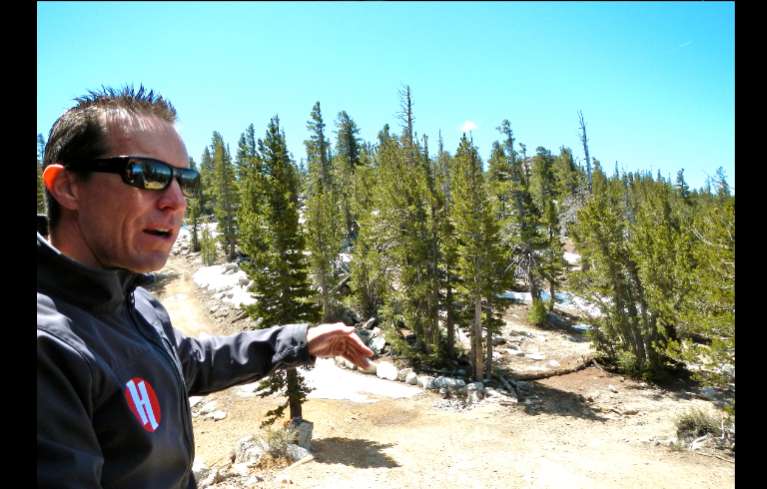
Pete Sonntag, Heavenly's general manager, points to where the amphitheater for weddings will go off the mid-station gondola deck. Photos/Kathryn Reed

Pete Sonntag, Heavenly’s general manager, points to where the amphitheater for weddings will go off the mid-station gondola deck. Photos/Kathryn Reed

Stakes are in the ground at the various locations outlining the various courses. Even though measurable snow is on the ground at the top of the gondola, Heavenly General Manager Pete Sonntag doesn’t anticipate this being a hindrance to starting work.

On a tour of the project site Thursday, Sonntag stopped at the mid-station of the gondola to point out where an amphitheater for weddings and other special events will be constructed on the southeast side of the walkway in the woods.

“It will be all natural stone with terraces built in. It will be rustic,” Sonntag said.

It’s possible interpretive talks will take place there, with a hike to follow from the top of the gondola.

Wedding guests and others will have a view of Lake Tahoe. After the ceremony, everyone would get back on gondola for the reception at Tamarack Lodge.

The lodge will be expanded in the back this summer to allow for more storage. Sonntag said with the dining facility exceeding expectations and now being the No. 4 producing restaurant of the entire company, storage has been an issue. (It opened in December 2010.)

As for the gondola, the resort is in the middle of a four-year project to replace the windows of each car.

Ed Cook, who owns a tree service by the same name, was riding the gondola May 23 to look for hazardous trees. The goal is to take ones out before they could take out the gondola line.

New amenities

A four-line zipline called the Zip Flyer will be accessed from the Easy Rider lift. The mini-climbing wall that had been nearby will go where the umbrella bar used to reside.

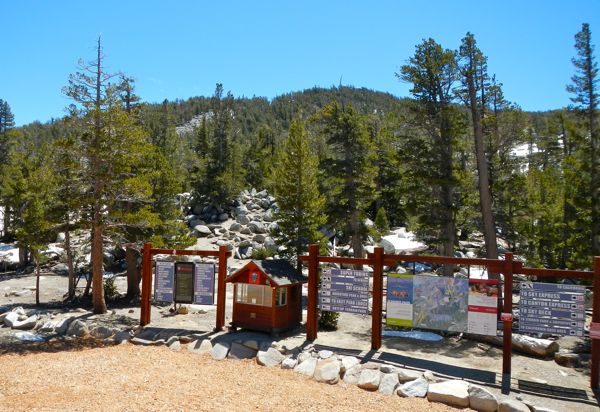
A rope course will be built in the boulders.

A rope course will be built in the boulders behind the signs.

The zipline will be about 1,000-feet-long – nearly one-third the length of the Heavenly Flyer that was taken out after someone riding the Tamarack Chairlift died after being struck by a zipliner. That 2009 incident is still not completely resolved.

One day the resort would like to have a longer zipline.

(At 3,100 feet, the old zipline when built in 2008 was the longest in the lower 48 states; it took 60 seconds to ride.)

The one that will be built this summer is considered more of an introductory zipline. The landing platform is near the north side of Tamarack Lodge.

The Discovery Forest Canopy Tour is slated to be fun and educational, as well as kid-friendly. It will be in front of the lodge between the kids’ ski school building and the Tamarack Chairlift.

The Black Bear Challenge will be just above that in the area now used in the winter for children’s ski school through Black Bear Hollow. Winter use of the challenge course is still being discussed.

It will be more of a straight line and rectangular.

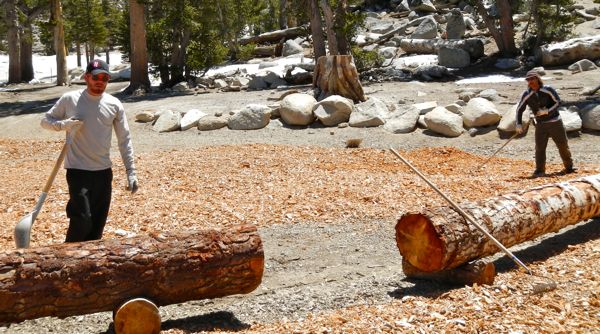
Crews are getting the Adventure Peak area ready for the summer season.

Crews are getting the Adventure Peak area ready for the summer season.

One of the rope courses will be 15 feet off the ground, the other 30. People are harnessed on each one. They will be designed in a manner that the course can be as challenging as the participant wants it to be. Various ages from varying physical abilities will be able to access the apparatuses.

The other rope course is Boulder Cove Challenge. This area is behind the sign at the base of the gondola stairs where the boulder field is. This will be a self-guided challenge course with vertical wood columns, ropes, bridges and platforms.

Pricing for everything remains an unknown. Package deals are likely.

Down the road

Vail Resorts has said it wants to spend $100 million in the next few years developing summer recreation at what were originally just ski resorts. Vail and Breckenridge are also getting upgrades this summer, as is Northstar.

With the U.S. Forest Service owning most of the land Heavenly sits on, it must sign off on new uses and infrastructure, and even tree felling. Tahoe Regional Planning Agency has a say in most things, too. But a portion of Heavenly is outside the Lake Tahoe Basin. That area is where mountain biking might one day be allowed. But to get there it would require going up the gondola.

For now, mountain biking at Heavenly is something that is just being talked about.

A plot of land to the left of the gondola stairs (when descending) is where a climbing wall five times the size of the current one is slated to go. Preliminary designs include 18 routes, with the base to mimic Sierra granite. It would be a permanent structure. That, too, requires USFS approval.

Expanded hiking is in the works – just not this year. One day a single-track trail to the top of East Peak is likely.

To date, the Forest Service has signed off on specific items that are in the Ski Area Recreational Opportunity Enhancement Act of 2011 and nothing more.

This summer

The gondola is running this long weekend for scenic excursions. It will operate seven days a week beginning June 14 from 10am-4pm, with seasonal closure in October.

The climbing wall, tubing hill and hiking will be open this summer as they have been in past years. And the Tamarack Lodge will be open with food service.

Heavenly bans all types of burning during the summer. This includes cigarette smoking and barbecuing.