California budget surplus not all good news

By Adam Nagourney, New York Times

LOS ANGELES — After years of grueling battles over state budget deficits and spending cuts, California has a new challenge on its hands: too much money. An unexpected surplus is fueling an argument over how the state should respond to its turn of good fortune.

The amount is a matter of debate, but by any measure significant: between $1.2 billion, projected by Gov. Jerry Brown, and $4.4 billion, the estimate of the Legislature’s independent financial analyst. The surplus comes barely three years after the state was facing a deficit of close to $60 billion.

At first glance, the situation should be welcome news in a state overwhelmingly controlled by Democrats, who have spent much of their time slashing programs they support. After last November’s elections, the party has two-thirds majorities in the Assembly and the Senate, relegating Republicans almost completely to the sidelines.

Instead, the surplus has set off a debate about the durability of new revenues, and whether the money should be used to reverse some of the spending cuts or set aside to guard against the inevitable next economic downturn.

At least seven other states — among them Connecticut, Utah and Wisconsin — have reported budget surpluses in recent weeks, setting the stage for legislative battles that, if not as wrenching as the ones over cuts, promise to be no less pitched. Lawmakers are debating whether the new money should be used to restore programs cut during the recession, finance tax cuts or put into a rainy-day fund for future needs.

The debate reflects uncertainty about whether the revenue is a one-time event, a result of state taxes on wealthy residents selling off investments at the end of last year to avoid increased costs as the Bush-era federal tax cuts expired. But it also illustrates philosophical differences about the role of government, about spending versus taxes and about the need, as Mr. Brown argued, to learn lessons from a decade in which many states saw the bottom fall out from their revenue collections.

“We’re seeing a change in conversation in state legislatures this year,” said Todd Haggerty, a policy analyst with the National Conference of State Legislatures. “They’re not talking about how to close a budget gap anymore, which is a welcome relief after years of that during and after the Great Recession. Rather, states are having conversations about how to allocate increased revenues.”

Nowhere does that battle promise to play out with more force and intricacy than in California, the state that underwent perhaps the most severe retrenchments in the country.

Brown, a Democrat who has always had a fiscally conservative streak, is leading the don’t-pop-any-Champagne-corks brigade, saying that he would oppose significant increases in new spending and that the money should go into a rainy-day fund. His administration put out the lower $1.2 billion estimate.

“A good deal of the surge of revenues that we have seen since the beginning of the year is the result of higher-income individuals being able to realize some of their gains at the end of 2012,” said H.D. Palmer, the director of external affairs for the California Department of Finance. “We don’t believe it is prudent to budget on the capital gains. It wasn’t that long ago when we had the same experience during the dot-com boom. We don’t want to see that movie again.”

In one particularly revealing moment, the office of the independent legislative analyst — which has a history of scolding governors for unrealistically optimistic budget projections — dismissed Brown’s figure as pessimistic, saying extra revenue was closer to $4.4 billion. The report undercut Brown just as he and lawmakers moved into the final stages of budget negotiations, and it empowered Democrats and social service advocates eager to reverse budget cuts.

“I support the governor’s call to pay down more debt aggressively, I support the notion of a rainy-day fund,” said Darrell Steinberg, the president pro tem of the Senate. “But I also believe that we have an obligation to make some limited but important investments in restoring some of what has been lost over the last four or five years.”

Vanessa Aramayo, the director of California Partnership, a group of organizations pushing for social service spending, said Mr. Brown was deliberately understating the state’s financial health.

“The governor is attempting to leave a legacy of solving our state budget crisis,” she said. “But he’s doing so on the backs of poor people in the state.”

Other Democrats said the Legislature should proceed with caution, given the history of financial gyrations in California and, no less important, concern that any perception that Democrats were on a spending spree could prove politically damaging to the party.

John A. Pérez, the speaker of the Assembly, said that he supported putting revenues into a contingency fund, but that some of the money should go to increase spending on programs like college scholarships for middle-class students.

“It is still uncertain how much of this is one-time money and how much is ongoing money,” he said. “Anything that is clearly one-time money we should treat as one-time money. What we’re mindful of is that historically in California, we have a greater degree of volatility than in other states.”

A capital-gains tax windfall from investors aside, the state has erased its deficit as a result of improving housing and stock markets, a temporary sales and income tax increase approved by California voters and the cuts in spending.

The debate over what to do next is not exclusive to California.

In Connecticut, local government officials want the Legislature to use $150 million in new revenue to reverse a $93 million cut in aid to local governments. It has not been an easy argument.

“We’re competing with hospitals and some social service programs for those surplus funds — along with the governor’s desire to put the money back into a rainy-day fund,” said James J. Finley Jr., the executive director of the Connecticut Conference of Municipalities.

In Indiana, Gov. Mike Pence called for using any surplus to finance a 10 percent cut in income taxes. But fellow Republicans who control the Legislature, after initially supporting that notion, reduced the tax cut by half, reserving the money for other programs.

“Coming off of a five-year recession, there were so many things that had been forgone during that period of time, like funding education and road infrastructure,” said State Senator Luke Kenley, the chairman of the Appropriations Committee. “The public and the leaders felt there were important things we needed to take care of first.”

And in Wisconsin, Democrats have pushed the Republican-led Legislature to use as much as $2.1 billion in new revenue to undo cuts.

“Last budget we had a deficit of $3.6 billion, and the talk was about shared sacrifice and targeting our public employees,” said State Senator Jennifer Shilling, a Democrat who is on the Budget Committee. “We need to invest any additional revenue back into our middle class.”

The disagreement in California is between members of the same party. Assemblyman Bob Blumenfield, the chairman of the Budget Committee, disputed Brown’s projection of the extra revenue.

“The only way the governor can possibly come up with his numbers is if you assume the worst on every single variable,” he said. “That’s just not going to happen.”

“We’ve made some brutal cuts,” Blumenfield said. “There’s a lot of pain that’s been spread across California, and we can’t ignore that. But we have to be smart. We have finally clawed our way to stability, and we’re not going to squander it.”


Placer County attracting slew of film crews

Placer County isn’t just a place to visit, it’s an area film crews like to shoot.

In the last 15 years, millions of dollars have been generated from film companies.

The vistas, abundant recreational activities and diverse terrain have been used in feature films, television commercials and photography for national companies.

Beverly Lewis, director of the Placer-Lake Tahoe Film Office, recently hosted a Tahoe Film Conference for government officials who may be involved in some aspect of a production company’s work in the county. The conference highlighted the needs of production companies and the local economic benefit that is derived from this work.

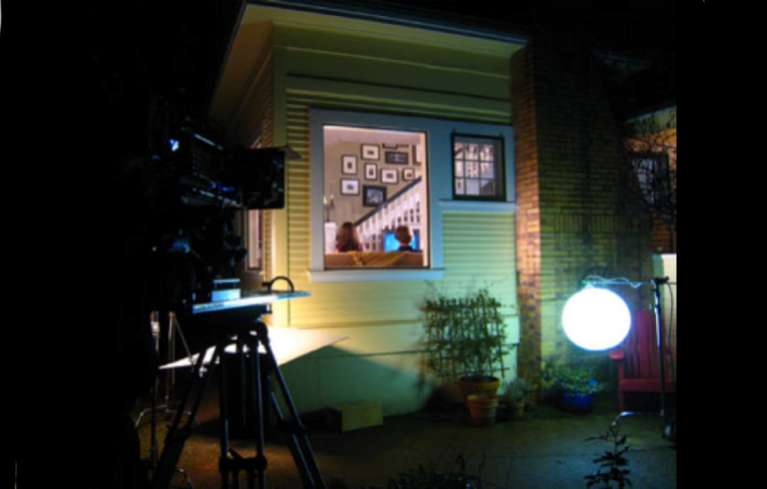
Cinema Verite was a critically acclaimed HBO TV movie that aired in 2012. Scenes were shot in a wide variety of homes in Auburn in four days and used for a montage of homes all over America. Photo/Provided

“Cinema Verite” scenes were shot in a variety of homes in Placer County.  Photo/Provided

Placer County said of the film industry, “It brings Placer County to the world.”

The Placer-Lake Tahoe Film Office publicizes the many available locations and assists production companies in finding the right “look” for what they’re trying to achieve. The film office also expedites the permitting process and ensures all the needs of the production companies are met, from lodging and meals to materials used to construct sets.

Keynote presenter Amy Lemisch, executive director of the California Film Commission, pointed out the huge economic effect the film industry has on the state.

“The film industry brings millions of tourists to California,” she said. “People do want to visit the places they see on TV and in the movies.”

Although Placer County is distant from most Southern California-based studios, the close proximity of varied terrain within the county makes it a popular place to shoot. While there have been numerous feature films shot in whole or in part in locations throughout Placer County, production work primarily comes from commercials and photography shoots.

Commercial film director Tim Damon has produced 14 commercials in the county in the last 10 years. This year also marks the ninth time in five years that the Orvis Company chose Placer County to shoot still photography for its seasonal catalogs.

California, which at one time was the state where almost all movies and commercials were shot, is now facing competition from other states that offer financial incentives to production companies. To sweeten the pot for filming in California, the state Legislature recently enacted a film tax incentive, giving production companies tax breaks for production shoots in the state.

Placer County has already played host to four such productions including The Muppets, an HBO movie and an upcoming Spike Jonz film starring Joaquin Phoenix. The California Film Commission estimates that, depending on the complexity of the shoot; a production company will spend between $100,000 and $250,000 a day.

— Lake Tahoe News staff report


N. California quake shakes up seismic scientists

By Rosanna Xia, Los Angeles Times

A magnitude 5.7 temblor Thursday night was the largest earthquake to shake California since 2008 and has generated curiosity from seismologists.

The temblor occurred in a rugged section of Northern California that has not been studied as thoroughly as Southern California and the Bay Area and has less monitoring equipment. Experts said they were surprised the quake was felt over such a large area, and they plan to go to the region to investigate.

The magnitude 5.7 quake struck about 8:47pm, about 150 miles northeast of Sacramento; its epicenter was about 27 miles southwest of the town of Susanville.

The last quake of similar magnitude, recorded at 5.5, struck Chino Hills in San Bernardino County in July 2008, said David Schwartz, an earthquake geologist for the Northern California U.S. Geological Survey division in Menlo Park. It caused little damage, but it was the most sizable quake to hit a metropolitan part of California since the much larger and destructive 1994 Northridge quake.

Thursday’s quake did occur in a zone with known active faults, said David Schwartz, an earthquake geologist for the Northern California USGS division, including a series of faults that extend through the northern end of Lake Tahoe all the way to Oregon. But 5.7 is the strongest magnitude recorded in the area. This mountainous eastern Sierra Nevada region, known for its lakes, rivers and national forests, has had about seven magnitude 4 earthquakes since the 1930s, Schwartz said.

Scientists are still studying the intensity of Thursday’s shaking and have moved seismographs there from more populated areas to monitor aftershocks.

Within minutes of the first quake, more than 7,000 people reported feeling it, from across state borders into Oregon and Nevada and as far south as the San Francisco area, according to the USGS website. Officials in Susanville and Sacramento said the quake set off a number of home and car alarms and rattled windows. A Chico resident told The Times he felt a slow roll that lasted about 30 seconds.

The quake itself was not a huge surprise for Schwartz’s USGS division, but “what was interesting was it was felt along an unusual distance,” he said. “Earthquakes in different parts of the state are felt over different distances. We just haven’t had that many examples of earthquakes in this part of the state, really, for comparison.”

“There are more interesting questions now than we have answers for, at present,” he said.

More than four dozen aftershocks, ranging up to a magnitude 4.9 in an area of about 20 square miles, have been recorded since the first quake, according to the USGS.

Schwartz said these aftershocks look to be “fairly standard.” Within the next week, there is a 20 percent chance that an earthquake larger than magnitude 5 will strike the area and a 5 percent to 10 percent chance a quake of a magnitude greater than 5.7, according to a USGS probability report released Friday morning.

There have been no reports of injuries in the areas closest to the epicenter, Plumas County Sheriff’s officials said. About 600 residents lost power for a brief period, and a water tank was ruptured due to the earthquake, affecting up to 1,500 customers.

At least three homes in the area had moderate damage – collapsed chimneys and plaster cracking, authorities said. No structural damage has been reported.

“A 5.7 is still a moderate-size earthquake, and earthquakes of that magnitude can occur really anywhere throughout the state,” Schwartz said. “But it’s large enough to generate interest and provide us some real info on how things work. We plan to keep looking at the sequence.”


Wagon train to roll through South Shore

The wagon train will make its annual trek along Highway 50 in June.

The Highway 50 Association is a nonprofit organization dedicated to horse and wagon enthusiasts, and the historical re-enactment of the Great Western Migration captures the spirit of the old West.

Rendezvous at Zephyr Cove for an evening of cowboy poetry, Western music and New York steak barbecue, hosted by Wagon Train for $25 on June 1.

The wagons depart on June 2, travel west on Highway 50, with overnight stops along the way, arriving in Placerville at High Hill Ranch on June 7.

On June 8, the wagons pull into Placerville for an all-day celebration at High Hill Ranch.

For information about times and tickets, call (530) 644.3761.


Tahoe man receives statewide award

Scott Gabler was awarded the California Volunteer of the Year award by the governor.

Gabler is the South Lake Tahoe search and rescue program volunteer manager for the El Dorado County Sheriff’s Office.

In 2012 the local SAR team responded to 94 incidents. Out of those calls, Gabler responded to 86, making his deployment participation level at 91 percent.

This award recognized the excellence in the field of service and volunteering.


Then and now: Bijou area evolves

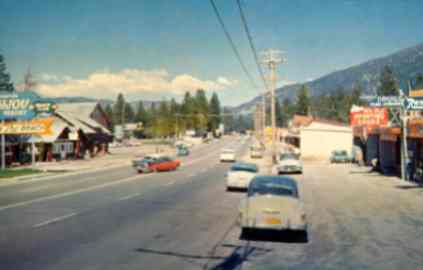
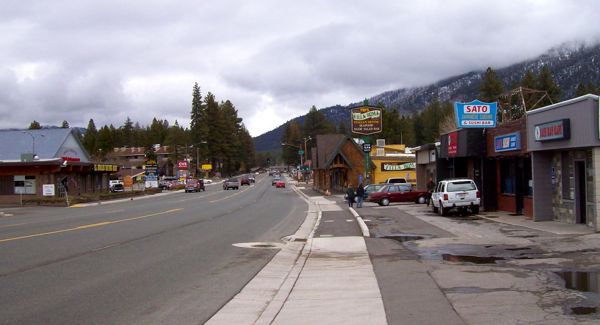
oldThe early photo is from Dave Borges, while the current photo is from me.

Here is Bijou, on Highway 50 as it appeared circa 1956 (parked blue car at far right appears to be a 1955 Dodge Coronet; the oncoming blue Ford = 1956?).

Bijou is French meaning “jewel” which described its deep white beach before the Tahoe City dam of 1913 raised the lake level, narrowing the beach. The California post office addresses of Bijou, Stateline, Al Tahoe, and Tahoe Valley all became incorporated into the city of South Lake Tahoe in November 1965.bijou new

The profile at left of Nay’s Bijou Center 1956 and the CVS of 2013 seems unchanged. Also, the 1956 strip building at right which included Shelley’s Rexall Drugs and Mile High Sporting Goods remains today, now housing Jazz Kat Cafe, Sato’s, Auntie Q’s, and Salon. Just beyond them in 1956 was a parking lot and Nel’s Tahoe Supply, the building now housing Tep’s Villa Roma and Lou Pierini’s Pawn & Gold.

Notice the 1956 overhead power lines, no center lane, no traffic lights, and there was parallel parking on Highway 50.

— Bill Kingman


SnowGlobe’s return to S. Tahoe not definite

By Kathryn Reed

Between the producer of SnowGlobe wanting to be paid and the use of the field being a question mark, the New Year’s Eve music festival may not come back to South Lake Tahoe for a third year.

“The taxpayers voted to provide funds to construct a community play field and therefore the first concern is to ensure the taxpayers receive what they paid for. If the field can be protected in such a way as to ensure its playability and also be utilized for this and other events, that could be a win-win,” City Manger Nancy Kerry told Lake Tahoe News. “City staff has been exploring options to achieve both goals and believe the best solution would be to cover the field with rubber field mats, but the costs are significant.”

That is an expense the producer does not want to incur.

While the city could purchase the mats – they cost six figures, the installation and tear down would be passed on to whatever entities were to use them.

The music fest SnowGlobe starts its three-day run Dec. 29 in South Lake Tahoe. Photos/Kathryn Reed

SnowGlobe music fest may not threepeat in South Tahoe. Photo/LTN file

Chad Donnelly, producer of the three-day event, did not return phone calls.

Talks are still ongoing, but not as optimistically as they were earlier this year, sources have told Lake Tahoe News.

The event is said to be an economic boon for the region. It brings in people who would not otherwise have been in town and is an older crowd than those milling about Stateline on New Year’s Eve.

The city is also talking with Lake Tahoe Visitors Authority and the business community to see if they have the money Donnelly desires and if another location could be secured.

There was talk Donnelly was being wooed by North Shore entities. Andy Chapman with North Lake Tahoe Resort Association did not return a phone call.

As for LTVA, Executive Director Carol Chaplin said, “We’re not trying to keep it, we are trying to understand what the issues on all sides are, the challenges and the opportunities to make sure that if and when it happens, or not, that all of our constituents understand why and agree that it has been thoroughly vetted.”

LTCC’s board has already committed to being a partner with SnowGlobe if it were to return to the ball fields adjacent to the college.

“The college stands ready to support the local community. If SnowGlobe is an event our community finds as viable and a desired event, the college will be a partner in providing a safe and responsible event that benefits the businesses and community of South Tahoe,” LTCC President Kindred Murillo told Lake Tahoe News.


Exercise during pregnancy good for mom, fetus

By Kenneth Spielvogel

A vital component to a healthy pregnancy is some element of exercise. Beyond the potential physical benefits for both mother and fetus, improvement in one’s emotional and overall mental well-being can be achieved through even the simplest of exercise plans.

It is important to establish clear guidelines with your health care provider regarding what is safe for you and your baby during pregnancy. Certain medical conditions — such as high blood pressure, a history of preterm labor (or short cervix), and other high-risk conditions — require more specialized plans. But even the most restrictive exercise plan may still allow a woman to reap the exercise benefits of a sound mind and body.

Focus on your goals

Exercise during pregnancy is important. Photo/Women's Health Care

Exercise during pregnancy is important. Photo/Women’s Health Care

A workout plan during pregnancy should be separate from discussions of weight gain. A recent patient of mine was told by her previous provider that she was, “gaining too much weight and should drink only water and exercise more.”

Few providers take the time or have the experience to give specific guidelines about when to exercise and when to slow down. For those who have never been formally told how to exercise, this type of advice often falls on deaf ears. With each passing visit, the number on the scale becomes the focus.

With little guidance, patients’ self-esteem decreases, stress levels increase, and the chances for a healthy and happy pregnancy are reduced even further.

Let us not focus on a number, but rather our goals. Weeks of pregnancy challenge one’s strength, posture, and balance. Expectant mothers grow more fatigued as their sleep is disturbed by both physical and hormonal changes. We work to ensure the safety of both mother and fetus in our plan.

I target a goal for beginners of approximately 30 minutes of activity, five days a week. If time restrictions make this difficult, they can break it into two, 15-minute sessions, or even three, 10-minute sessions.

Start with easy walking

Assuming you have no dangerous health conditions, I recommend beginning by walking. Mix in a hill or two, pump the arms, and maybe even add some tiny hand weights if you’re not pushing a stroller. If you can hold a conversation, but are also huffing and puffing, you’re exercising at the right pace.

With regular exercise, you can improve your strength, balance, and cardiovascular conditioning. And exposure to sunlight raises vitamin D levels, decreasing your risk for gestational diabetes, in addition to other potential benefits for your baby — but don’t forget that sunscreen. Bring along some friends and combine your walk into a pregnancy support group.

Each individual has different guidelines. Even exercise enthusiasts need support regarding limitations, positional considerations, and which activities to avoid during pregnancy. Work with your provider to develop a plan that is both safe and effective in accomplishing the simple goals of sound mind and body for a healthy mom and baby.

Kenneth Spielvogel is a doctor with Barton Women’s Health.


Letter: Patience needed regarding Chateau project

Publisher’s note: This letter was submitted to the city in regards to the Chateau project. It is reprinted with permission.

Members of the city of South Lake Tahoe Planning Commission:

As a former member of the Planning Commission for approximately 13 years, I am well aware of the difficult task that you have before you in recommending action to the City Council regarding the stalled Convention Center and Retail project. I served on the Planning Commission in the early stages of the project and saw it as an engine for driving the economy of the city as well as a good land use for the properties involved.

The commission at that time saw the project in its entirety and supported it as a complete project, not one to be completed in stages. As time has passed, that vision has seemed to become difficult to complete as originally planned. I urge you to look to our actions involving the then Embassy Vacation Resort as a successful guide as to how to proceed involving such a complex project to be completed in stages. Our actions consolidated all the parcels, abandoned all the streets and assured that the project would be built in four stages.

I strongly urge you to recommend to the City Council that the project be approved under the following conditions:

1. That all the parcels of the project, not just the six being considered, be consolidated at this time. This will work to insure that the complete project be completed.

2. That all the streets in the complete project area be abandoned, not just the one you are considering. This will show developers that the city is looking ahead and continues to support the project as initially envisioned.

3. That no action be taken until all the original property owners in project area be financially be made “whole”.

We are on the verge of finally seeing this long stalled project come to completion. I urge you to not be rushed into a hasty decision. Look to the past for successful actions on how to proceed in order for us all to prosper.

Thank you,

Patrick J. Frega, South Lake Tahoe


Public asked to help locate AIS plants in Tahoe

In June, several Lake Tahoe agencies are kicking off a volunteer effort called “Eyes on the Lake” in which water recreationists of all types will be identifying and reporting on the locations of aquatic invasive plant species that threaten Lake Tahoe.

This effort will be led by the League to Save Lake Tahoe, in partnership with the Tahoe Resource Conservation District and the Tahoe Regional Planning Agency, as well as other organizations that make up the Lake Tahoe Aquatic Invasive Species Program.

Eyes on the Lake’s two main targets will be Eurasian watermilfoil and curlyleaf pondweed, which are already established in several locations throughout the lake, and are difficult and expensive to control.

The Lake Tahoe AIS Program occasionally contracts with aquatic ecologists to conduct surveys in areas around Lake Tahoe that support suitable habitat for aquatic plants. Volunteer reporting will help enhance information about these infestations as well as potential new ones that may not be currently identified.

Eyes on the Lake will offer formal instruction in both classroom and field sessions scheduled for mid to late June to educate water recreationists on how to identify these aquatic invasive plants. When dates have been finalized, they will be posted at www.keeptahoeblue.org. Identification training materials will also be available online but formal trainings are highly recommended to provide the most accurate and useful data.

For more information about joining Eyes on the Lake, contact the League at protect@keeptahoeblue.org.