Opinion: Tahoe City residents being ignored in planning

This is one vision for a section of Tahoe City. Rendering/Design Workshop

This is one vision for a section of Tahoe City. Rendering/Design Workshop

By Melody Monk

As a long time Tahoe City resident, arriving in 1972, I am concerned the Tahoe City Community Plan decision making process has been seized by special interests: Tahoe City Public Utility District, Chamber of Commerce, and the Resort Association.

I attended a Tahoe City “visioning” meeting May 8, 2013, at the Gatekeepers Museum and found that the committee members, sadly, had no patience for any public comment, and second homeowners and locals appear to be left out of the conversation. We live here, what do we all really want?

The committee members are hell bent on maximizing development, scale and height. I guess this is only natural for the Chamber of Commerce, Tahoe City business owners, the Resort Association, and now the TCPUD as owners of the golf course. Although the Tahoe City Golf Course was purchased with supposedly no intent to develop it, now there is talk of a huge hotel right on that golf course, which was purchased with our public money.

Most of us moved up here, being willing to live a harder lifestyle in the mountains, to be among nature and our beautiful and very rare clear lake, and to take care of that gift. No one at the meeting was speaking about what we leave future generations, the vastly growing algae in Lake Tahoe, the animals or the forest or the detrimental effects of large resort development. It brought tears to my eyes, literally.

TRPA designated “Town Centers” as areas targeted for redevelopment. Tahoe City is a designated town center that would shockingly allow up to 56 feet in height and 40 units/acre density compared to the present allowable 34 feet in height and 15 units/acre density. That’s a huge difference. The Tahoe City team is even going for the maximum height allowed of 56 feet. To give you a comparison, the new unsightly Domas building in Kings Beach is 48 feet. Interestingly, the Kings Beach Plan team doesn’t want heights greater than 48 feet and those only on the mountain side of the highway. Smartly, they want to keep the low scale beach feel. I’d like to see the same in Tahoe City. Why visit Lake Tahoe when you can’t even see the lake?

In the last few minutes of the meeting, the team all agreed to incorporate more parcels into the Tahoe City Town Center: the Golf Course (owned by the TCPUD using our money), “64 Acres” where the empty and little used Transit Station is located, and the lakefront parcel located between Tahoe Tavern and Tavern Shores. These three large parcels will be zoned “mixed use recreation”, which with these changes certainly doesn’t mean open space. Recreational use businesses can, and probably will, fill the area because they can.

This is all justified by “trying to save a dying Tahoe City”. I wonder about the wisdom of embracing large resort development like Northstar and Squaw’s new condo proposal and water park (we need this by Lake Tahoe?) as the solution to the economic woes of the recession. It seems to me low scale development on the order of Truckee, Calistoga, Santa Cruz, Carmel, Yountville, and Healdsburg … authentic mountain charm, is the real solution. These are the places people really want to go.

How can Tahoe City compete with Northstar’s horseback riding, golf, tennis, pool, bike trails, skiing, and skating rink, and why would we? Don’t get me started on the proposed Northstar roller coaster. What? Tahoe City has Lake Tahoe and bike trails, but it needs its open space and opportunities for recreation. Let’s have more to do, more quality low scale lodging, and the right amount of commercial given the limitations of our infrastructure and small population. Please!

We’re already at maximum capacity for the summer and New Year’s holidays. And that’s the stated opinion of the Chamber of Commerce. We don’t want to look like South Lake Tahoe. Let’s keep our quaint charm. Who wants to leave the city to visit just another overdeveloped city?

Please, people, get involved and find out what is in store for you if no one becomes aware of what is being planned or takes any action. Gentrification is not good. Read “Down Hill Slide” by Hal Clifford to see what happened with the rape of Vail. Don’t be fooled by the “green wash” postcards being mailed. Please check it out yourself. I’m honestly scared for our beautiful jewel, Lake Tahoe.

Melody Monk is a resident of Tahoe City.



Suspect arrested in bike theft

Brandon Lee Rose, 41, was arrested this week on charges of second degree burglary and possession of stolen property in connection with a high-end bike that was stolen from an El Dorado Hills shop.

Brandon Lee Rose

Brandon Lee Rose

Rose allegedly broke into the store May 20 and left with $7,000 worth of cycling equipment.

El Dorado County sheriff’s Detective Troy Morton was able to identify the suspect and obtain a search warrant for a locations in Sacramento and West Sacramento.

While serving the search warrant, Morton said he recovered the bicycle and other stolen property from a crime committed in another jurisdiction.

The suspect was subsequently arrested.

 — Lake Tahoe News staff report


USFS has free firewood near Luther Pass

The U.S. Forest Service Lake Tahoe Basin Management Unit has free firewood permits for the Luther Pass Overflow Campground on Highway 89 for collection through June 30.

Permits are available at the forest supervisor’s office in South Lake Tahoe.

The free-use permit has specific conditions and complete information with map is provided when the permit is issued. The permit is for collection of “down-dead” wood or firewood that is piled in slash piles from previous forest thinning. “Down-dead” means the tree is down on the ground and dead, rather than dead and standing. Cutting any standing tree, whether dead or green, is not allowed.

No off-road travel is allowed and permit holders must comply with all permit conditions.

Campers are advised that firewood gathering activities, including chain saw use and trucks hauling firewood, will occur in and around the campground area through the end of the month.

For more information, call (530) 543.2694.


Scientists zapping Lake Tahoe aquatic life

By Kevin Oliver, KCRA-TV

It’s shocking research on invasive species, literally.

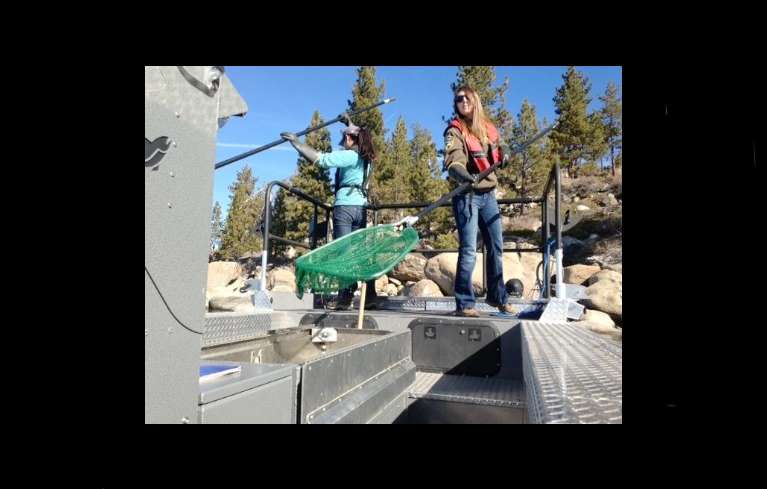
Researchers and scientists spent this past week on Lake Tahoe zapping fish with electricity as they try to survey the number of non-native fish and stop their spread.

The researchers used modified vessels called E-boats, equipped with electrified probes that stun anything that swims within 10 feet of them.

Researchers then scoop up the stunned fish as they float to the surface.

 6 of 12 Kevin Oliver/KCRA Researchers from the University of Nevada, Reno, UC Davis, and California State Fish and Game regularly survey fish using a specialized boat with electrical probes extending from it which stun temporarily stun nearby fish. Read more: http://www.kcra.com/news/-/11797728/18991232/-/u25jv2/-/index.html#ixzz2VaCCkR11

Researchers regularly survey fish using a specialized boat with electrical probes extending from it. Photo/Kevin Oliver/KCRZ

Invasive fish are pulled from the water, put into storage tanks and hauled off to be examined and disposed of.

Researchers used five boats simultaneously to conduct what they called a “blitz” in order to get as accurate a count as possible of how many invasive fish are in various areas of the Tahoe Keys in a three-day period.

Biologists use the figures to compare data in an attempt to see what kind of an effect invasive species are having on the lake.

Part of the study will look at whether they can break the spawning cycle and reduce the number of non-native fish by pulling them from the water before they fertilize their eggs.

The same researchers found large goldfish during past expeditions. Three more goldfish were found earlier in the week.


Job market improving for new graduates

By Marilyn Geewax and Andrew Schneider, NPR

For the last five years, graduation day has been as much a time for apprehension as for celebration.

Even now, with the Great Recession over, many recent graduates are still struggling to turn their high school and college diplomas into tickets for a better life. The unemployment rate for Americans under age 25 remains more than double the overall rate of 7.5 percent.

But experts are predicting this year’s graduates — whether from high school, community college or a four-year college — should have better career launches than at any time since 2008. Companies expect to hire about 2.1 percent more college graduates from the Class of 2013, and will offer a higher overall starting salary of $44,928 — up 5.3 percent over last year, according to the spring survey by the National Association of Colleges and Universities.

Many college officials are cheering as the job offers come in for their graduates. “At both the graduate and the undergraduate level, we’re seeing higher salaries, we’re seeing earlier offers, and we’re seeing better acceptance rates than we’ve seen in quite some time,” said Jamie Belinne, assistant dean for career services at the University of Houston’s Bauer College of Business.

On Friday, the U.S. Department of Labor will release data about May hiring. The new numbers likely will confirm a trend that already is well entrenched: Job growth is improving in general, but the higher your skill level, the better your chances of landing one of those jobs.

In April, the unemployment rate for people with at least a college bachelor’s degree was 3.9 percent. For those with less than a high school diploma, the rate was 11.6 percent. Not only do college graduates have more job offers, they also command salaries that average nearly twice as much as high school graduates.

But even for the roughly 1.7 million Americans who will earn college degrees this year, the job market will remain very uneven, with hot spots and cold. NACE, the nonprofit organization that assesses graduates’ employment prospects, says the biggest pay gains this year are going to people entering health-sciences careers. They are being offered 9.4 percent more than last year’s recruits.

But graduates in the humanities and social sciences are still facing tough times. Their job offers pay just 1.9 percent more than last year, the survey showed.

For people who have high school diplomas or two-year-degrees, the prospects are improving too, but mostly for those in growing economic sectors, such as health care and energy.

“It helps to have a hard skill that is immediately useful for a company,” said John Challenger, who heads the global outplacement firm Challenger, Gray & Christmas.

That’s exactly what Adan Alanis discovered when he decided to go into automotive repair work. He graduated from high school three years ago when the job market was far weaker. Still, he managed to land a good job at a Ford dealership in Pasadena, Texas, because he was at the top of his class.

“The manager here and a few other managers from different dealerships came by and they interviewed all of us, and they only hired me and one other guy because we were always on top of our studies, and we always had the highest grades in class,” Alanis said.

But he could see the repair tasks were getting more complicated all the time as automakers continued increasing the technological sophistication of their vehicles. “Everything’s getting more electronic, and I’ve been into electronics, too,” he said. So he went back to school and has just earned his associate’s degree from nearby San Jacinto College.

The Bureau of Labor Statistics’ shows the best opportunities are turning up for people like Alanis — those willing to keep layering on skills involving electronics, software and computer systems.

And in health care, jobs abound for high-skilled professionals such as physical and occupational therapists, optometrists, dental hygienists and audiologists, the handbook says.

But not all skilled workers are flourishing. Many people who have challenging jobs — such as flight attendants, mail carriers and newspaper reporters — are in industries that need to reduce employee ranks.

J.C. Gage, an Iraq War veteran and new graduate of the University of Houston, is learning how tough the job market remains for those with degrees outside of technology or a hard science. With his degree in public relations, he has started an internship with a public-relations firm. He also is working for the Houston Chronicle’s sports section while continuing his search for a full-time job.

“I’m working 9 to 4, Monday through Thursday [at the PR firm], and then I’m working four nights a week at the Chronicle, from 6 to midnight,” he said. “It is exhausting.”


TOCCATA sets summer music fest dates

TOCCATA — Tahoe Symphony Orchestra and Chorus — is celebrating its eighth anniversary with the summer music festival July 7-14.

It includes the Mozart Coronation Mass, Saint Saen’s 2nd Piano Concerto, and Beethoven’s 8th Symphony. Guest artists Michael Angelucci, piano; Josue Casillas, flute; and Joy Strotz, soprano will be featured.

Performances are:

July 7 at 5pm at St Patrick’s Episcopal Church in Incline Village (341 Village Blvd.)

July 9 at 7pm at Trinity Episcopal Church in Reno (200 Island Ave.)

July 11 at 7pm at St. Theresa Catholic Church in South Lake Tahoe (1041 Lyons Ave.)

July 14 at 7pm at the Resort at Squaw Creek in Olympic Valley.

Tickets are available at the door or online. General admission is $25 adults, $20 seniors, and $5 students aged 19 to 23. Preferred seating is $35 and $15 for youth/students. Youth under 19 are admitted free in non reserved seating.

For more information, email ToccataTahoe@gmail.com or call (775) 313.9697.


Learn how to be safe playing outdoors

Prepare for Outdoor Emergencies/Wilderness Safety is the top of Tamara Burns’ lecture on June 12.

The Barton Health registered nurse will talk from 6-7pm at Kahle Community Center in Stateline.

Attendees will learn about the 10 essentials for outdoor adventure. This is designed for those who hike, bike, backpack and climb.

For more info, call (530) 543.5537.


No surprise to find rogue genetically altered crop

By Michael Wines, New York Times

One week after the revelation that an Oregon farmer had found genetically engineered wheat growing in his fields, scientists remain mystified over how the strain — apparently the remains of a test crop shut down a dozen years ago — got there.

The boom in so-called transgenic crops should prompt even more careful evaluation of future varieties.

But few are surprised. Even with extensive precautions, gene-altered plants turn up in unwanted places regularly enough that farmers have come to consider a few of them weeds, and even a threat to their livelihood.

And while none of them yet poses any known public health hazard, experts say the boom in so-called transgenic crops should prompt even more careful evaluation of future varieties with an eye to the prospect that they, too, could eventually appear elsewhere.

In the case of the wheat found in Oregon, most experts say, all those prospects are remote. The experimental wheat was created and tested by the Monsanto Company to be resistant to its best-selling Roundup herbicide, and similarly Roundup-resistant varieties of corn, soybeans and other crops are widely grown with no known health effects.

In a telephone news briefing on Wednesday, Monsanto officials called the appearance of the altered wheat “a random isolated occurrence” and said there was no evidence that the wheat had moved beyond the single farm or that its seeds were in the seed stocks that the farmer used to plant his fields.

Nor is the Monsanto wheat likely to spread elsewhere, most experts say. The plants found in Oregon, which the company said covered less than 1 percent of the farmer’s 125 acres, are the only ones found anywhere since Monsanto abandoned plans to sell modified seeds in 2004.

As with most transgenic plants, the wheat could have transferred its engineered trait to ordinary wheat via its pollen, which contains the single gene for herbicide resistance. That gene is dominant, meaning plants fertilized by the Monsanto wheat’s pollen would likely pass the Roundup-tolerant trait to future generations.

But while plants like corn fertilize each other, spreading their pollen far and wide by winds, butterflies or bees, wheat plants generally fertilize only themselves. Moreover, wheat pollen rapidly loses its potency once it leaves the plant.

“A transgene that comes up in corn could be a much different situation,” Kendall Lamkey, the chairman of Iowa State University’s agronomy department, said in an interview. “Corn pollen can travel, under the right conditions, a great distance,” he said. But with wheat, he said, “The gene’s unlikely to be moving to other varieties in any significant way.”

When a gene does move to other varieties, however, the potential for mischief can be considerable.

Consider the benchmark example: in 1998, Aventis Agroscience Inc., a Swiss company now known as Syngenta, won federal approval to sell a strain of corn called StarLink altered to produce a pesticide that kills insect larvae. After scientists found a moderate possibility that the strain could trigger allergic reactions in some people, the government registered the corn for use only in animal feed and biofuels, and imposed safeguards to keep it out of the food processing chain.

At its peak, StarLink corn was grown on less than half of a percent of all the corn acreage in the United States. Yet by September 2000, it was discovered in corn taco shells, triggering a huge recall, tests on more than four billion bushels of corn and the cancellation of StarLink’s federal registration.

Such dire consequences are rare, but not unheard of. A group representing more than a thousand organic farmers in Saskatchewan complained in 2002 that gene transfers from canola that had been genetically engineered to tolerate herbicides had contaminated their fields. That made it impossible to certify their canola as wholly natural, costing the farmers $10 million, the group stated.

Nature is hardly the only culprit in genetic transfers. Farmers can accidentally mix bags of natural and modified seed. Combines that harvest a gene-altered crop can pick up its seeds, then drop them while harvesting a field of natural plants.

Both farmers and manufacturers alike employ measures like putting buffer zones around fields, to limit the risk that genetic material will cross from altered crops to natural ones. But many experts say that the myriad ways that seed and genes can be spread make that possibility substantial.

The real question, they say, is how much that matters.

Absent any proven health threat, the most common fear is economic — that organic farmers will lose crops, or that food exports to countries that ban imports of gene-altered products will suffer. The Oregon incident instantly raised fears that the United States’ $8 billion annual wheat trade would be hard hit, although the strain of winter wheat at issue makes up only a fraction of those exports.

But a 2010 report on genetically engineered crops by the National Research Council noted that genes can pass not only from an altered plant to its natural brother, but to less close relatives in the wild. “Such hybridization is common in plants generally and is a key process for the evolution of new plant species,” the report stated.

Concerns about transfers to the wild already had stalled approvals of genetically altered crops like sunflowers and rice. During tests in Oregon of a pesticide-tolerant bentgrass in 2003, “introgression of the transgene into weedy populations was detected at a considerable distance from the test sites,” the report stated.

That is also a potential problem with genetically modified wheat, said the chairman of the group that prepared the report, David E. Ervin, an environmental management professor at Portland State University in Oregon.

“There has always been a worry with wheat, being in the grass family,” he said. He added that if there were a transfer of the gene into grasses, “There’s going to be difficulty in controlling those grasses, and you might have to resort to stronger herbicide treatments, some of which have more environmental consequences.”

That underscores the need for caution in approving new varieties of altered plants, he said, adding: “All bets are off when you start introducing new kinds of crops. That we haven’t had any serious events to this point doesn’t mean we won’t have significant risk of them occurring in the future.”


STHS student earns prestigious scholarship

Brenda Yan, a senior at South Tahoe High School, is one of a few students to receive the Horatio Alger California Scholarship.

These scholarships are made possible with generous support from the Carlyse and Arthur Ciocca Charitable Foundation in Northern California. Horatio Alger scholarship recipients have been chosen based on their demonstrated commitment to education, dedication to community service, and strength of character in overcoming personal obstacles to achieve academic excellence.

Each scholar will receive $5,000 that will go toward their college tuition, fees, books and on-campus room and board.

In addition to the scholarship, the students have access to the following opportunities:

· Financial aid and scholarship counseling

· College readiness tools and assessments

· 24/7 support and referral services including crisis response and counseling resources

· Free housing opportunities provided by Campus Crest at 44 campuses across the nation

· Graduate school funding

· Access to a network of their peers and alumni through the Horatio Alger Association of Distinguished Americans website, Facebook and LinkedIn.


Mountaintop dinners planned at Homewood

Homewood Mountain Resort has planned two mountaintop farm-to-table summer dinners.

Guest chefs Breana Greene and Kellan Hori will create locally-sourced meals served atop Homewood’s slopes overlooking Lake Tahoe.

The five-course dinners will be July 6 and Aug. 31.

Each dinner is $150 per person, with a limited number of reservations available. Advance reservations are required at least two weeks prior to each event.

Guests will meet at Homewood’s South Lodge (105 Tahoe Ski Bowl Way) and will begin the chairlift ascent up the mountain between 4-4:30pm. Dinner service will begin promptly at 5pm and conclude by 9pm. Vegetarian options are available upon request.

For reservations, call (530) 584.6849.