Study: Vegetarians live longer than meat eaters

By Avery Johnson, Wall Street Journal

Vegetarians live longer than meat-eaters, according to a study published this week in JAMA Internal Medicine, a Journal of the American Medical Association.

The authors tracked 73,308 members of the Seventh-day Adventist Church for almost six years. The church is known for promoting a vegetarian diet, though not all of its followers adhere to that teaching. Researchers found out what type of diet participants ate, then followed up to find out how many of those participants had died and how.

Vegetarians in the study experienced 12 percent fewer deaths over the period. Dietary choices appeared to play a big role in protecting the participants from heart disease, from which vegetarians were 19 percent less likely to die than meat-eaters.

There also appeared to be fewer deaths in the vegetarian group from diabetes and kidney failure.

Caloric intake didn’t seem to matter. The different participant groups generally ate around the same amount of calories daily. Researchers found that the beneficial associations weren’t related to energy intake.

The advantage appeared stronger in men than women, whose diet didn’t seem to make as much of a difference. Eating plant foods didn’t seem to protect participants against cancer, which struck both the vegetarians and non-vegetarians in roughly equal measure.

The paper, written by researchers at Loma Linda University in Loma Linda, California, is larger and includes a more diverse population than previous research, says lead author Michael Orlich, director of the preventive medicine residency program there. “People are confronted with all sorts of nutritional information, but the bottom line is, ‘How will your diet pattern affect your risk of dying?'” he says.

Researchers don’t know why a plant-based diet seems to have a protective effect, but one likely reason is the nutrient profile of vegetarian diets, which tend to be higher in fiber and lower in saturated fat. Vegetarians tend to be thinner, another factor known to have an effect on health outcomes, Dr. Orlich says. He adds that the study benefited from examining a group whose rates of alcohol and tobacco use are low.

Of course, just eliminating meat from the plate doesn’t always equal a healthy meal. Vegetarian dishes—for example, a vegetable spring roll—still can be high in fats and calories. And certain meats are healthy.

Loma Linda University is a Seventh-day Adventist institution specializing in health care. The church recommends a diet with “generous use of whole-grain breads, cereals and pastas, a liberal use of fresh vegetables and fruits, a moderate use of legumes, nuts and seeds,” according to a statement on its website. The study published Monday was funded by the National Institutes of Health.

When adopting a vegetarian lifestyle, nutritionists recommend watching closely to make sure the intake of key nutrients is sufficient. These include iron and zinc, frequently found in meat, and calcium and vitamin B12. Roughly 5 percent of Americans consider themselves to be vegetarians, according to a survey published last year by Gallup.

The Loma Linda researchers used a questionnaire to categorize participants into groups based on their diets.

The categories include nonvegetarians and people considered semi-vegetarians, who eat meat more than once a month but less than once a week. In addition to meat, vegans eliminate dairy and eggs from their diets.

Others eat fish, in addition to the cohort that eats no meat but consumes dairy and eggs. For many of the analyses, the researchers lumped all of these subsets of people together as simply “vegetarians.”

Seniors group has money to give out

There has been a core group of individuals working together for several years, raising awareness and funds to support “wellness, dignity and independence of El Dorado County seniors and their caregivers”. They call themselves the Friends of El Dorado County Seniors.

Through their newly created Friends of El Dorado Seniors Fund at the El Dorado Community Foundation they are ready for their first granting cycle and offering $3,000 in grants to local not for profit organizations serving seniors in El Dorado County.

A grant application form is available to qualifying organizations at the El Dorado Community Foundation Office, 312 Main St., Suite 201, Placerville, or call (530) 626.5621 and request a Friends of El Dorado Seniors grant application form.

Applications are due by 5pm June 30.


Placer County approves tentative 2013-14 budget

The Placer County Board of Supervisors approved tentative 2013-14 $690.5 million budget is 5.4 percent less than the current year’s budget.

The reduction is largely a result in how the county is budgeting multi-year infrastructure projects.

The proposed operating budget is up $10 million, or 1.9 percent, because of projected increases of $7.9 million, or 2.2 percent, in the general fund and $3.6 million, or 2.6 percent, in the public safety fund.

More budget workshops are planned for August before the board is expected to adopt the final budget in September.

“I do think it’s important that any of the budget adjustments we make throughout the year are reflected in documents we provide to the public,” Vice Chairman Jack Duran said at this week’s meeting. He suggested the county provide quarterly updates to allow the public to track mid-year changes.

The county budget team and board members pointed to several encouraging signs, including a $60 million reduction over the last two years in the county’s unfunded liability for post-retirement benefits other than pensions. Collectively, they are known as other post-retirement benefits and include medical, dental and vision benefits.

A new actuarial report places the unfunded liability at about $136 million, down from approximately $196 million two years ago.

“Hopefully, the economy will continue to improve,” Supervisor Jennifer Montgomery said, “and, years into the future, we will be able to build back some of our services and build back some of our staffing to really provide that top-notch level of service that we provide now, but we could provide even better with more dollars and more staff.”

In a report to the board, the county budget team pointed to several accomplishments over the past year, including:

• A stronger focus on communicating with the public and employees about the county’s priorities and plans for achieving them. A cornerstone of that effort is a transition over the next several years to priority-based budgeting, an approach that seeks to improve transparency in the budget process while helping ensure county resources are allocated based on priorities and results to county residents.

• An approved plan for a phased opening of the county’s new jail in Roseville early in 2014.

• Board adoption of a multi-year budget strategy focused on balancing county priorities with available resources and making sure the costs of county programs can be sustained in future years.

• A comprehensive approach to infrastructure planning that seeks to identify and fund high-priority projects.

• Using one-time revenue for one-time costs.

• Budgeting conservatively so the county has flexibility to handle revenue and cost fluctuations.

• Maintaining healthy budget reserves.

• Focusing on innovative, cost-effective approaches for providing public services.

• Relying on a pay-as-you-go approach whenever feasible so the county maintains a relatively light debt load.

— Lake Tahoe News staff report


Meeting all about Bijou erosion control project

South Lake Tahoe is having a meeting June 24 about the Bijou erosion control project.

Construction is scheduled to commence in late June. The 5:30pm gathering is at the South Lake Tahoe Senior Center at 3050 Lake Tahoe Blvd.. The construction contractor for the project will be available to answer questions. Plans will be available to view.

The project is located in the Bijou Commercial Core (Fairway, Highway 50 and Bal Bijou Road), Bijou Meadow, Glenwood Way and Woodland Road, and on U.S. Forest Service parcels adjacent to Woodland and Walkup roads. The project includes various water quality improvements.

For more info, call Chris Stetler at (775) 588.2505, ext. 27.


Summer camp designed to embrace Tahoe’s outdoors

By Lauren Thomaselli

Summer is fast approaching and the school bell has only a few more rings before school is out for summer. If you are local or a visiting family with children between the ages of 5 and 16, the city of South Lake Tahoe Recreation Programs offer a unique and memorable experience.

Authentic Tahoe adventure is the theme of STAR Camp — South Tahoe Adventure Recreation. The newly designed STAR Camp programs provide an active, healthy, and safe environment for youth to learn and play at an affordable price.

The unique Tahoe adventure recreation concept represents why most residents live here and why most visitors vacation here. The recreation department has embraced this concept through STAR Camp. For 10 weeks from June 12-Aug. 23, STAR Camp will be guiding kids on new adventures daily. The camp motto is “no child left inside.”

Every week the youth program aligns with an adventure theme such as “Wild West,” “Outdoor Fun/Survival” and “Junior Olympics.” STAR Teen Camp is reserved for a higher level of adventure that satisfies the teen-age appetite for excitement. Teen themes encourage learning, adventure, and nature through activities such as orienteering, hiking, parasailing, and standup paddling.

STAR Camp is made possible through recreation partnerships with local businesses and nonprofit organizations to jointly plan, finance, and coordinate shared services to provide a quality experience at an affordable price. STAR Camp is a drop-in program for K-8 priced at $25 per day or $100 per week. STAR Teen Camp is a multiday program scheduled Monday through Wednesday and prices vary from $125 to $225 for all three days depending on the activity planned.

Safety and quality of camper experience is ensured through maintaining a ratio of one leader for every 10 campers. Additionally, STAR Camp leaders are experienced in outdoor education and leadership. Learn more about STAR staff by viewing a short bio and photo online. Reservations are recommended by calling (530) 542.6056.

STAR Camp aligns with our commitment to the California Parks and Recreation Society pledge “Parks Make Life Better.” The pledge is a promise to offer recreation programs that provide access to the serenity and inspiration of nature, spaces and places for play and exercise, opportunities for directed and organized recreation, positive alternatives for youth and activities that support social connections, and human development.

Stop by the Recreation and Swim Complex at 1180 Rufus Allen Blvd., to meet our staff and learn more about how STAR Camp can enrich your child’s life this summer.

Lauren Thomaselli is the South Lake Tahoe recreation manager.


Study: Sunscreen may help slow signs of aging

By Mary MacVean, Los Angeles Times

As if reducing the threat of skin cancer was not enough, scientists report that they have shown using sunscreen daily can slow the signs of aging skin — even into middle age.

Skin ages as people age, obviously. The sun is a major culprit in the skin’s deterioration. Signs include wrinkles, of course, but also deterioration in texture and an increase in visible blood vessels.

Scientists from Queensland Institute of Medical Research and other institutions divided 903 Australians 55 years old and younger into groups who used sunscreen with an SPF of at least 15 daily — on face, neck, arms and hands — and those who did so at their own discretion. The first group applied sunscreen each morning, after swimming or sweating heavily and after a few hours in the sun.

After 4 1/2 years, members of the first group were 24 percent less likely to show signs of increased aging, the scientists wrote.

Their work was published Monday in the Annals of Internal Medicine, and the researchers said this was the first time sunscreen was shown to be effective against aging in humans.

To assess the state of the skin over time, experts looked at the back of the left hand. The daily sunscreen users also were evaluated every three months to ensure they were sticking to the program.

In 1992, at the start of the experiment, almost 60 percent of the participants had moderate skin aging, but the effect of daily sunscreen use did not depend on how much aging had already occurred, the researchers said. What did appear to matter was use of a liberal dose of sunscreen.

The scientists noted that people spend billions of dollars a year on treatments to retard wrinkles — many of them unproved.

The scientists also randomly assigned study participants to take B-carotene pills or a placebo. They found no evidence to indicate that B-carotene affects skin aging but said the study was too small to reach a conclusion.


Settlement reached in EDSO discrimination suit

By Bill Lindelof, Sacramento Bee

The lawsuit brought by three community service officers against El Dorado County has been resolved.

The suits were filed by the three community service officers with the sheriff’s office – Nicole Sahaj-Myers, Stacie Walls and Jona Scher – in June 2010.

The women complained that other members of the department had harassed and discriminated against them.

County officials denied that there was a violation of the law. The parties were scheduled to begin trial Monday in federal court on the claims of gender discrimination and harassment.

A joint statement released Friday said that rather than go through the expense and uncertainty of a jury trial, the parties agreed to settle the case for $95,000.

The sheriff’s office and the three plaintiffs thought they had good cases. However, the county sought to avoid plaintiffs’ attorney’s fees that would be rewarded if the jury awarded even $1 to any of the women. And the plaintiffs agreed to settle to resolve the issue and avoid the risk of having to pay county costs if the women lost at trial.


Snippets about Lake Tahoe

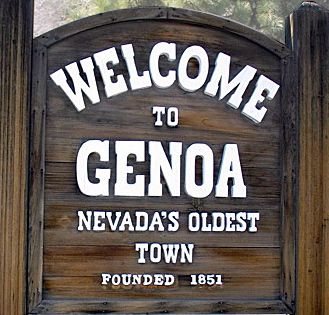
genoa• Genoa is featured in the May-June issue of Via magazine.

• The science wizard is coming to the South Lake Tahoe library on July 19 at 2pm. The library is at 1000 Rufus Allen Blvd.

• Douglas County has been selected to receive a special achievement award in Geographic Information Systems from Environmental Systems Research Institute.

• Truckee’s Tahoe Adventure Company has grown from a handful of kayaks to an entire fleet of equipment geared toward adventure, from snowshoes to mountain bikes to corporate team-building tools in the 10 years it has been in business.

• The Washoe County Sheriff’s Office now has an app for iPhone and iPad.


Inspection leads to better defensible space

By Kathryn Reed

“My goal here is when I leave your house it has a chance.”

A chance to survive a fire that is.

Tyler Jack is a South Lake Tahoe Fire Department captain who does defensible space inspections.

He likes the composite roof. But there are pine needles that need to come down.

The rounds of wood near the house are not so good.

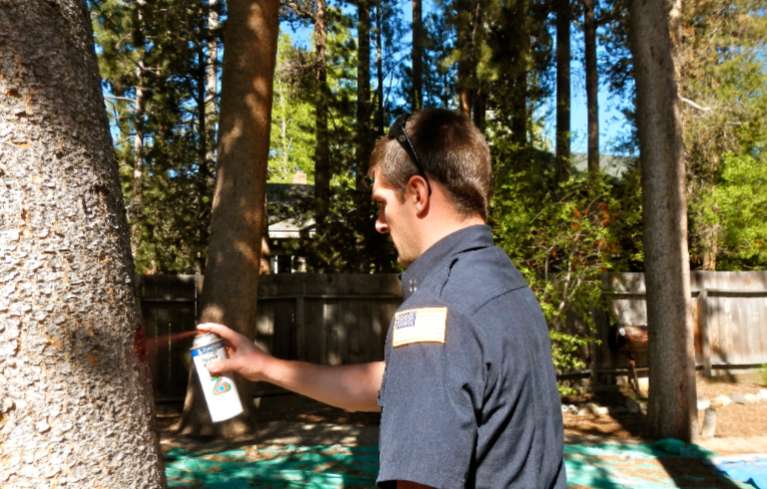
South Lake Tahoe fire Capt. Tyler Jack marks a tree that needs to come down. Photo/Kathryn Reed

South Lake Tahoe fire Capt. Tyler Jack marks a tree that needs to come down. Photo/Kathryn Reed

The prickly plant life on the other side of the fence that I considered California Tahoe Conservancy’s issue really isn’t. I suddenly realize a bunch of it is on our property line even though it’s on the other side of the fence. That’s going to have to go away.

At first I tried to cheat on my inspection. The day before Jack came over I moved stacked wood off the fence line and into the shed. But I came clean when he arrived. Something about lying to a firefighter seemed really wrong. And lying about the wood, well, he was going to figure it out.

The distances between our house, the fence and then the neighbor’s are ridiculously close. That’s the fence where the wood that doesn’t fit in the shed goes. It’s there for much of the fall, with most getting used up during the winter. There is no way to create the buffer like the defensible space guidelines suggest.

“We like gaps because it breaks up the fire spread,” Jack said. “We recommend mosaic landscaping.”

Next winter’s wood will be stacked in a longer row and not directly against the fence. Then it will be covered with fire-retardant tarps. Until the inspection I had no idea such tarps existed.

The wood against the old cinder fireplace wall is fine. That is not flammable.

Having some of our Tahoe Regional Planning Agency-mandated erosion control measures in place gives us that mosaic look Jack talked about. We have some rock by the house for the drip line before fire would get to the wood siding.

Our layer of wood chips is much thinner than what TRPA first had us lay down. Now it’s scattered – more to the liking of fire officials, and finally accepted by TRPA.

“Basically, we want a moat around your house,” Jack says as we look at where the chips and pine needles are. Some raking is needed.

He looks at the wood deck. Fortunately, nothing is stored under it. Some pine needles are in the gaps — those can be swept out.

One of the trees out back now has a red spot on it. It will be coming down. At least we didn’t have to pay for that tree felling permit. It’s over 14 inches, so a permit is required.

No violations are found, so Jack won’t have to come back.

These inspections are free and are done by local firefighters. It just takes a phone call to set things up. The purpose is to ensure your house is protected as well as it can be in the event of a fire; whether it’s a wildland fire or your neighbor’s place goes up and threatens yours. This article tells more from the firefighter’s point-of-view.


Defensible space can be the difference between a home still standing and one reduced to ash

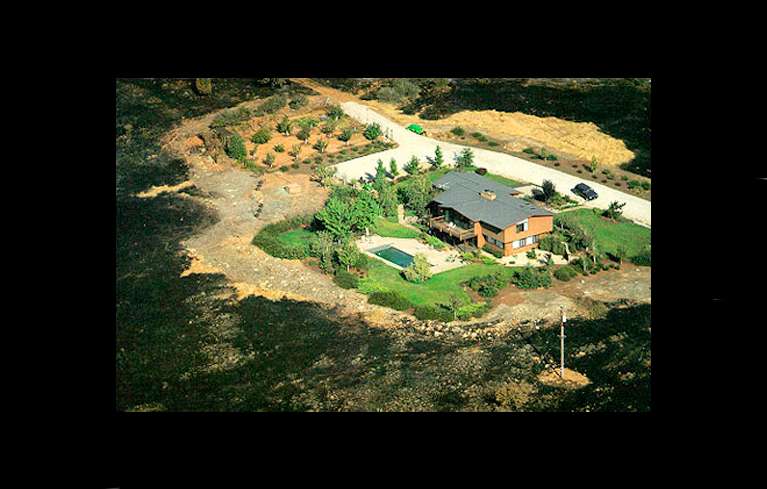
Defensible space can help save a house from fire.

Defensible space can help save a house from fire.

By Kathryn Reed

What would happen if an ember the size of a softball were to land on your property? On your roof? Is there anything that would catch fire?

That is the visual Leona Allen with Lake Valley Fire Protection District likes people to think about.

If that burning ball can ignite a larger fire, then better defensible space is needed.

“Our fire season is predicted to be heavy to extreme. That is something we want people to be prepared for. We want people to do defensible space,” Eric Guevin, Tahoe Douglas Fire Protection District fire marshal, told Lake Tahoe News.

While defensible space has become a common phrase in the last handful of years, laws about defensible space have been on the books for decades.

But it really came into play after the 2003 Southern California fires. After they were extinguished, a Blue Ribbon Commission was convened. Out of that came recommendations for suppression, response, building standards and defensible space.

“With expanding communities, we now have structures embedded in natural fuels. People who live there see it as nature, not fuels. Fire sees a structure as something to burn,” South Lake Tahoe Fire Chief Bruce Martin told Lake Tahoe News.

Many people moved to Tahoe to be in the mountains, which means being around trees. But too many trees too close together, with canopies not adequately spaced can be a bad thing.

Years of suppressing fire also means some forests are now more combustible. That is a reason thinning or fuels reduction projects are so common.

But individuals have a responsibility to be fire aware, too. From zero to 5 feet is supposed to be a noncombustible area around a structure. This means rock or succulent plants that hold lots of moisture. The 5- to 30-foot area is supposed to be lean, clean and green. Trees should be 10 feet apart; same with crowns. From 30 feet to 100 feet or the property line is where vegetation can start transitioning back to the wild.

A rake, loppers and gloves can improve the defensible space area of many houses, Guevin said. He added that juniper is “like a gas can” and it’s best to remove it.

“They say your defensible space is as good as your neighbors’, so you have to look at it from a community aspect,” Guevin said. “The way codes are written now there is more ability to enforce people to take action. They can be liable for fires that start on their property and spread to another. It’s called fire trespass.”

Adequate water supply, ease of access to and from a house, proper signs on streets, addresses clearly marked are all part of being fire ready. So is having an evacuation plan.

Gareth Harris, fire chief at Lake Valley, said, “Every home in the Angora area had been contacted three times. Of the homes that did defensible space, 75 percent survived the Angora Fire. Statistically, that is saying a lot considering the devastation of homes lost there.”

Six years ago this month, 254 houses on the South Shore – in Harris’ jurisdiction – were swallowed by fire. This, after someone who has never been caught left an illegal campfire without its being fully extinguished.

Fuel, weather and topography are the key factors in how a wildland fire will spread.

“Because a fire is a force of nature we can’t stop it. We can try to protect homes in front of it and work the edges. We have to wait for the weather to moderate to put (the fire) out,” Martin said.

He believes if a couple million dollars had been put into fuel breaks or treatments that the $150 million in property loss from Angora would not have been so high.

In 2007 the Tahoe Regional Planning Agency was promoting wood chips and pine needles as tools to cut down on erosion. Property owners could only cut down trees with a diameter of 6 inches or less. Policies have changed and TRPA even has a forester on staff now. Now trees 14 inches or less in diameter may be taken down without a permit; and firefighters can mark trees for defensible space reasons.

“Reducing the threat of catastrophic wildfire is a top priority for TRPA and we encourage defensible space and fire resistant landscaping practices. Our stance on pine needles is clear: on areas of bare soil, rake them in the spring and let them fall in the fall. Keep pine needles and flammable vegetation away from structures and follow fire guidelines to clear your roof of pine needles regularly,” Jeff Cowen with TRPA told Lake Tahoe News.

—-

Note:

• Living with Fire is a website that has more information about defensible space.

• This article is about an individual defensible space inspection.