Tahoe casinos fare well, statewide numbers drop in April

Lake Tahoe and Reno gaming revenue was up significantly in April compared to 2012, but overall Nevada’s numbers dropped slightly.

The Gaming Control Board released the figures today.

The Stateline casinos’ revenue increased 14.48 percent, while Washoe County’s were up 10 percent. Just in Reno the percentage increase was better at 15.36 percent. The state was down 0.16 percent.

Statewide, the gaming revenue was $854.3 million compared to 2012 when $855.7 million was collected.

— Lake Tahoe News staff report


K’s Kitchen: Begging for a recipe

By Kathryn Reed

One of the fun things about going to dinner where everyone is asked to bring something is that there will be a variety of food.

k's kitchenSuch was the case last week. Everyone was asked to bring an appetizer. Unfortunately I didn’t have much time to come up with something original. But others did. And that was a yummy treat.

Renee’s beet dish was incredible. I asked her if I could have the recipe. She said she doesn’t have one. Just throw X, Y and Z together. I wasn’t letting her get away with that.

I begged a bit and that worked because she sent me directions. While I  haven’t made them yet, I can tell you they are super tasty. Below is what Renee emailed.

Roasted Golden Beets

Roast golden beets in oven. (I started with some water; halfway through added olive oil.) About an hour, 400 degrees.

Cool and cut up beets.

Add diced red onion, tomato and fresh basil.

Add salt, pepper, garlic, olive oil, toss.

Taste and adjust spices.

Add fresh lemon juice.

Toss.

Chill some.


Ex-S. Tahoe resident vying for Nev. business award

Marie Gibson, who founded Sierra Tahoe Fabrics and lived in South Lake Tahoe from 1998 to 2003, is a finalist in Nevada’s entrepreneur business competition for $100,000.

Gibson is now a Reno-based business consultant, college instructor and author. “The Caregiver’s Journal” focuses on helping families successfully manage the hospitalization of a loved one. It recently won the National Caregiver Friendly Award.

Voting for the $100,000 award takes place online through June 21. For more information about “The Journal”, go online.


Scientist details human impact on Lake Tahoe

By Jessie Marchesseau

INCLINE VILLAGE – Lake Tahoe is not the same as it used to be. Most of us are already aware of this, but none as much as Charles Goldman.

In 1959, Goldman, a limnologist and UC Davis professor, formed the Tahoe Reasearch Group and began regular and extensive testing of Lake Tahoe.

On Friday evening, Goldman gave a presentation at the UC Davis Tahoe Environmental Research Center in Incline Village entitled “The impact of climactic change and global warming on inland waters of the world.” The lecture was part of the annual UC Davis volunteer docent training session.

In his introduction on June 7, Geoff Schladow, director of TERC, credited Goldman with providing “unassailable evidence that Lake Tahoe has changed. Without that,” he said, “we would all be here arguing about whether or not it’s changed.”

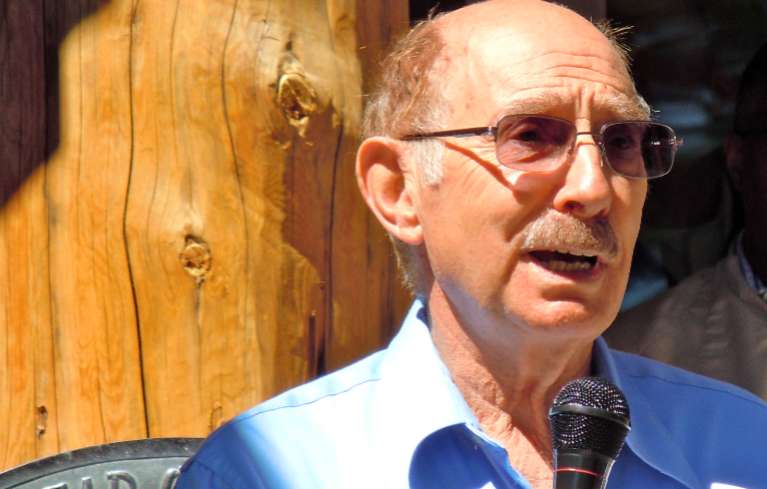
Charles Goldman has been studying Lake Tahoe for decades. Photo/LTN file

Charles Goldman has been studying Lake Tahoe for decades. Photo/LTN file

Event organizers continued to bring in more and more chairs as 135 people crowded into the tight room to hear Goldman speak. The docent training sessions are generally for trainees only, but this year, organizers decided to open Goldman’s presentation to the public.

“He has all of the historic knowledge that really grounds the science in a historical context,” Heather Segale, UC Davis education and outreach director, said. “We can tell our docents about the latest and greatest, but giving them history gives them the long view of science at the lake.”

Goldman started with the long view of climate change in general by putting up a graph showing carbon dioxide levels going up faster and higher then they have in 800,000 years.

“There’s probably no problem that’s faced humanity the way this has since the ice age,” he said.

He acknowledged the climate change skeptics and compared their argument to that of tobacco companies arguing that cigarettes are good for you.

His slide show was filled with charts, graphs and photographs depicting everything from Arctic ice melt to changes in atmospheric makeup to the fault lines under Lake Tahoe. Pictures of lakes in Asia showed one so green with algae it practically glowed and another so polluted people can hardly breathe when attempting to cross it by boat.

Stopping and preventing pollution in Lake Tahoe has been one of Goldman’s main goals. In fact, he calls convincing authorities to stop putting sewage, treated or otherwise, into Lake Tahoe in the late 1960s his “single greatest contribution” and the most significant thing that could have been done for the lake.

He also remembered a time when the clean Tahoe air resembled the smog of a big city. The air quality outside the casinos, he said, was worse than inside, and virtually all the pollution was being created inside the basin. Again, he spoke up. People were defensive at first, but eventually changes were made.

Over the years, Goldman has seen a lot of changes in Lake Tahoe. He talked about watching the Tahoe Keys be built and how it is the main culprit of the Eurasian milfoil invasion in Lake Tahoe. It is also the site of the addition of non-native species such as goldfish.

Over the course of 30 years, Goldman has also seen the overall temperature of Lake Tahoe increase by about 1 degree. His graphs showed that while the maximum and minimum temperatures of Lake Tahoe fluctuate constantly, the average maximum temperature has remained virtually the same; it is the average minimum temperature that appears to be rising at a relatively steady rate. This means the lake is not cooling off at night like it used to, the result of increased CO2 in the atmosphere.

The long-term data collected by Goldman and his team over more than 40 years has resulted in building restrictions, erosion control, protection of wetlands and the establishment of water quality thresholds, all put in place to protect the delicate environment of Lake Tahoe.

Now retired, Goldman’s legacy in Lake Tahoe continues with the Tahoe Research Group and the Tahoe Environmental Research Group.

Goldman left the audience with this: “Keep in mind that the younger generation is going to inherit a badly damaged planet. It’s really up to us to inspire them with a lot of enthusiasm.”


Tahoe Tails — Adoptable Pets in South Lake Tahoe

Toby

Toby

Toby is a great all-around dog, and we have no idea why he hasn’t found his new home after being at the shelter for three months.

He is most likely a Harrier, which is a relative of the foxhound and beagle.

Toby is a cheerful and sweet-tempered boy, about 6 years old and 60 pounds, and he is quite easy-going and likes children. He likes to play with female dogs and be with people. As a hound, he likes to go exploring, sniffing, and trailing, so he should be kept on a leash or in a safe enclosed area.

Toby’s owner died and he had nowhere else to go.

Toby is neutered, microchipped, and vaccinated. He is at the El Dorado County Animal Services shelter in Meyers, along with many other dogs and cats who are waiting for their new homes.

Go online to see photos and description of all pets at the shelter.

Call (530) 573.7925 for directions, hours, and other information on adopting a pet.

For spay-neuter assistance for South Tahoe residents, go online.

— Karen Kuentz


Editorial: State should not risk county public health

Publisher’s note: This editorial is from the June 5, 2013, Sacramento Bee.

Protecting public health is a basic government function. County health officers track illnesses and deaths from West Nile virus to hospital infections to food-borne contamination. They conduct vaccination campaigns and restaurant inspections. They respond to outbreaks and disasters.

Unfortunately, this essential public health function is being lost in the budget battle between Gov. Jerry Brown and the counties in the jostling over preparing for the federal Affordable Care Act. The governor wants the state to take back the bulk of a $1.5 billion block grant (so-called “county health realignment funds”) that goes to counties for the medically indigent and for public health.

Counties, justifiably, are up in arms. Yet legislative leaders have sent no clear signal where they stand. As the June 15 budget deadline approaches, that should change. Senate President Pro Tem Darrell Steinberg, D-Sacramento, and Assembly Speaker John A. Pérez, D-Los Angeles, need to step up.

Brown is right that under federal health care reform, many of the uninsured who now fall back on county care will be covered after Jan. 1 either under an expanded Medi-Cal paid for by federal dollars or in the exchange of private insurers with federal subsidies. Counties won’t need as much money to cover the medically indigent.

The best estimates so far are that of 6 million uninsured Californians, 2 million to 3 million of them will get insurance coverage under the Affordable Care Act. Some 3 million to 4 million, however, will remain uninsured.

The governor is justified in wanting to reduce the amount that goes to counties for covering the medically indigent – so counties have an incentive to get people enrolled in Medi-Cal and the exchange. At the same time, counties are justified in wanting to ensure they can care for the remaining uninsured and continue basic public health functions.

In 2013-14, Brown would take $900 million of the $1.5 billion block grant. After that, he would take $1.3 billion. That’s too much.

Counties historically have spent more than half of the grant on public health, according to the California State Association of Counties – though there is variation among them. If Brown sweeps the bulk of the funds, counties will have to choose between covering the remaining uninsured or continuing basic public health functions, when they should be doing both.

The governor wants to allocate the block grant based on actual county costs for the remaining uninsured, which is fine for the part dealing with indigent care. But what about public health?

In a compromise, the counties have proposed a formula that would reserve 30 percent of the block grant for public health. The rest would be divided between the counties, for caring for the remaining uninsured, and the state – with a true-up at the end of each year to make sure that counties get money only for actual services to uninsured individuals. This would take effect in 2015-16 – providing a transition.

The Legislature, a co-equal branch of government, needs to jump into the fray, sending the message that public health is important.


1 person dies, 4 injured in Zephyr Cove collision

Updated: 9:10pm June 9.

One person died in a two-vehicle accident in Zephyr Cove on Sunday afternoon near the fire station at Highway 50 and Warrior Way.

Four other people were transported to Renown Medical Center in Reno; three by ground and one by air.

Nevada Highway Patrol Trooper Barb Stapleton said told Lake Tahoe News a Toyota Camry was headed west on Highway 50 when the vehicle slid on the slick roadway. It went into oncoming traffic, where the passenger side was struck by a Hyundai Elantra.

Rain and hail been coming down at a rapid rate just before the accident.

No names or hometowns of any of the five have been released. The driver of the Camry was a male and it was his female passenger who died. The Hyundai had three occupants.

In other news, smoke was seen about 3pm on the ridge above Zephyr Cove in the Genoa Peak area. Tahoe Douglas firefighters did not locate a fire.

— Lake Tahoe News staff report


Financial know-how of Americans in short suppy

By Brenda Cronin, Wall Street Journal

Some household balance sheets have mended during the recovery but that may be thanks less to fiscal stewardship than the improving economy.

In fact, Americans’ grasp of concepts such as investment risk and inflation has weakened since the recovery began in mid-2009. Research released last week shows that on a five-question test (Take the test here), respondents did worse in 2012 than in 2009. The average number of correct answers fell to 2.9 in 2012 from 3.0 on the test in 2009.

The test, along with a wide-ranging survey of financial capability of more than 25,000 American adults, was conducted during the fall and funded by the Financial Industry Regulatory Authority Investor Education Foundation.

“People are finding it a little easier to make ends meet,” Finra Chief Executive Richard Ketchum said in presenting the 2012 National Financial Capability Study results last week in Washington. “More respondents have rainy-day funds, which puts them in a better position to deal with life’s unexpected events…But there are still very significant concerns,” he said, adding that debt continues to be a serious problem.

Patterns of spending and saving changed little between the two studies: 41 percent of respondents still say they spend less than their income, 19 percent spend more than it and 36 percent spend roughly what they earn.

In the most recent study, 40 percent of respondents said they had no trouble covering their monthly expenses, a slight improvement from 36 percent in 2009.

Although many respondents were short on financial education, they didn’t lack confidence about managing their books. Researchers said they found “a disconnect between self-perceptions and actions in day-to-day financial matters.” Many people who gave themselves high marks for managing their finances also were using non-bank borrowing methods, such as payday loans, or had overdrawn their checking accounts.

The survey focused on four areas of financial capability: making ends meet, planning ahead, managing financial products and financial knowledge and decision-making. (The five-question test was part of the fourth area, financial knowledge.) Researchers sliced the data by age, gender, ethnicity and education as well as census division and state.

It isn’t surprising that the worst downturn in the U.S. since the Great Depression hasn’t produced better personal financial habits, said Annamaria Lusardi, who was part of the team that designed the questions for the Finra test and survey.

Although the tattered economy often was front-page news throughout the recession, she said, simply reading about markets and the economy is no substitute for financial-literacy education at school or work.

“It’s not that people learn because we’re in a financial crisis,” said Ms. Lusardi, a professor at George Washington University and director of the school’s Global Center for Financial Literacy. “We can’t expect people to learn about inflation by osmosis.”

She emphasized that young people in particular need education not only on asset and wealth-building, but on managing debt. The study found that debt remains an acute problem for those with lower incomes and less education — as well as the young.

Among young people ages 18 to 34 years old, 43% have used often high-cost methods of borrowing, such as pawn shops or rent-to-own establishments, Lusardi said, compared with about 30% of the entire population.

“That means… young people are basically becoming accustomed to financial transactions that require non-bank institutions and that are also high-cost,” Ms. Lusardi said.

Young people also are likely to have precarious finances and scant savings socked away for emergencies. When asked if they would be able, in one month, to come up with $2,000 for an unexpected expense such as car repairs, 49 percent of 18-34-year-old respondents said probably not. That contrasts with 27 percent of respondents age 55 or older who said they couldn’t, and 42 percent of those between ages 35 and 54.

Planning for further down the road also got short shrift: 40% of respondents said they had set aside a rainy-day fund that they could live on for three months; 56 percent said they hadn’t.

Survey questions on housing yielded good and bad news. While the number of 0% down payments on homes fell by 5 percent from 2009 to 2012, foreclosures inched up, with 3.7 percent of respondents in 2012 involved in one, compared with 3 percent in 2009.

“Financial literacy is this new skill and we need to live in this new world of individual responsibility,” Lusardi said. “Very few countries have taken the initiative to improve financial literacy and capability… If you don’t do that, this is not something that grows with you or that people acquire by their daily lives.”


Nevada gaming firm, Calif. lawmakers at odds over tribal casino

By Anthony York, Los Angeles Times

SACRAMENTO — When California voters approved Las Vegas-style gambling in 1998, proponents said it would be limited to places already recognized as American Indian lands.

But a rare ruling from the Obama administration and a deal approved by Democratic Gov. Jerry Brown would allow one tribe to build a casino on a 300-acre property owned by Station Casinos in the Central Valley town of Madera. The prospect has divided Indian tribes and touched off an intense fight in the Capitol.

Members of the tribe, the North Fork Rancheria of Mono Indians, have not lived on the Madera land for generations. But if the group is successful, it could help reshape the future of tribal gaming in California, opening the way for new casinos up and down the state — and closer to urban centers — according to critics of the gaming industry and other opponents of the deal.

Backers of the tribe’s plan say it is an exception. They point to strong support for the casino from Madera city and county officials as well as the tribe’s historic ties to the area, documented in an intricate seven-year appeal process and approved by the U.S. Department of the Interior.

Tribes that own some of California’s largest gambling halls say North Fork leaders and their Nevada-based financial backers are “reservation shopping” to put a casino in a prime location. Approval of the deal, they say, would break a promise made to voters 15 years ago that gaming would be restricted to remote locations.

State law limits casinos to land where the federal government recognizes a tribe’s historic tie. Once that determination is made, the tribe must negotiate a casino deal with the governor and have it ratified by the Legislature.

North Fork made its claim to the land, which was once slated to be a NASCAR racetrack, in question in 2004, a year after it was purchased by Nevada-based Station Casinos. Tribal leaders say the band spent summers in the Sierra Nevada foothills near Yosemite National Park to escape the Central Valley heat and moved to the lowlands that include present-day Madera to flee the snows of winter.

In the 1980s, the federal government set aside 80 acres for North Fork about 50 miles away, but the group’s leaders say that land is held privately by tribal members and does not belong to the tribe. Moreover, the land, on a steep slope on a remote hillside near Yosemite National Park, is environmentally sensitive and could not sustain a casino development, they say.

North Fork officials say the root of opposition to their plan lies in wealthy tribes trying to keep other Indian nations from sharing in the prosperity of the gaming business.

Other tribes also are uncomfortable, the North Fork leaders say, with the cut of gaming revenue the group is willing to share with state and local governments — potentially millions more than tribes typically have agreed to contribute in exchange for approval to operate casinos.

The tribe and Station Casinos have been trying for more than 10 years to build a hotel and casino with 2,000 slot machines on the Madera land. Along the way, they have enlisted the support of local leaders, labor unions and environmental groups.

The Department of the Interior accepted the tribe’s land claim in 2011. It was just the seventh time the federal government had granted such a request on land acquired after 1988, when Washington created rules to allow tribal casinos. Last year, Brown signed the gaming deal with North Fork.

The governor has downplayed concerns about casinos creeping toward California’s major cities, where they can add to traffic congestion, strain city resources and upset residents. He has said he expects the kind of deal he struck with North Fork to be rare.

The nearly 2,000 members of the tribe, the fifth-largest in California, “are mired in the type of poverty tribal gaming was designed to ameliorate,” said Jacob Appelsmith, a senior adviser to Brown who negotiated the casino deal.

Last month, the state Assembly ratified the plan. It has stalled in the Senate despite an intense lobbying effort for it by organized labor, which has been promised that the project would create thousands of union jobs.

The Picayune Rancheria of the Chukchansi Indians have a casino about 30 miles off the highway from the proposed North Fork site. Its leaders say the proposed new casino, with its more convenient location, could put them out of business and leave them saddled with debt after an investment of nearly $300 million to expand their operations.

Wealthier gambling tribes such as the Riverside-based Pechanga Band of Luiseno Indians and the United Auburn Indian Community, which operates the Thunder Valley Casino Resort between Sacramento and Lake Tahoe, are worried about other pending casino deals that could gain momentum if the North Fork accord is approved.

Brown also has authorized a casino with 2,000 slot machines for the Enterprise Rancheria of the Estom Yumeka Maidu tribe on newly acquired land the federal government ruled eligible in Yuba County. Enterprise is planning a 170-room hotel, as well. Its plan is not yet before the Legislature. Its business would compete with Thunder Valley, which has 3,000 slots and a 300-room hotel.

In addition, the federal government is considering a land request from a tribe in Barstow that could lead to a casino along Interstate 15 between Los Angeles and Las Vegas. That business could be a threat to some of the large tribal casinos in the area.

“Developer-driven gaming proposals like Stations-North Fork have infected Indian gaming for over a decade now,” Pechanga’s chairman, Mark Macarro, told senators at a recent hearing. “Tribes used to respect the boundaries of each other. But casino developers don’t care one way or the other.”

North Fork’s chairwoman, Elaine Bethel-Fink, said wealthy tribes oppose her group’s deal because their own will be up for renegotiation in a few years, and they don’t want pressure to match North Fork’s revenue-sharing plan.

“The concern,” Bethel-Fink said, “is that we’re being too generous.”



Important to be smart while playing on Lake Tahoe

If you’re a first-time visitor to the cold waters of Lake Tahoe, be aware that the possibility of becoming hypothermic while involved in water activities is greater here than in warmer climates.

The combination of high altitude and cold alpine water may quickly fatigue a swimmer or water sporter.

Also remember, anyone under 12 years of age is required to wear a Coast Guard approved life jacket while boating on the lake. You must also carry enough life preservers on board for everyone.

— Sallie Ross-Filgo, South Lake Tahoe Fire Department