Tahoe Tails — Adoptable Pets in South Lake Tahoe

Kitties at the Meyers shelter.

Kitties at the Meyers shelter.

It’s kitten time at Tahoe. The shelter is overflowing with about 25 crazy, rambunctious, energetic kittens that were transferred to the Meyers shelter from other shelters in the Central Valley.

Every possible color, males and females, long and short hair are ready for adoption. Several have been adopted already, so come out to the shelter soon to pick your favorite. (And if you’d prefer an adult cat, we have several nice adults, too!)

All of the kittens are spayed or neutered, microchipped, and vaccinated. They are at the El Dorado County Animal Services shelter in Meyers, along with many other dogs and cats who are waiting for their new homes.

Go online to see photos and descriptions of all pets at the shelter.

Call (530) 573.7925 for directions, hours, and other information on adopting a pet.

For spay-neuter assistance for South Tahoe residents, go online.

— Karen Kuentz


4-wheelers have more places to play in Eldorado

Eldorado National Forest is opening 24 popular high-country off-highway-vehicle routes for public motorized vehicle use and another 18 that will be designated after repairs have been made.

The routes were closed in 2012 by court order until their impacts on water flow in meadows were analyzed.

A supplemental environmental impact statement and a record of decision were released last week. Both documents are available on the Eldorado National Forest website.

“The decision I made … affects two very important resources – healthy meadows and high country recreational opportunities,” Supervisor Kathy Hardy said in a statement. “We need both.”

The changes will be implemented once any administrative appeals to the decision are resolved and the designated routes are printed on the Eldorado National Forest Motor Vehicle Use Map.

Eldorado has already begun applying for grants from the California Department of Parks and Recreations OHV Division to help get some of the repairs started as soon as possible.

Many of the routes will need simple fixes and simple environmental documentation and some will be more complex requiring engineering designs and more detailed environmental analyses.


Storytime at weekly Ski Run farmers markets

In keeping with the South Lake Tahoe library’s Summer Reading Club theme “Reading is So Delicious”, there will be a series of special storytimes at the farmers’ market on Ski Run Boulevard in South Lake Tahoe.

The program is free, and features stories and activities appropriate for young children.

This will be on Fridays from June 21-July 26 at 5pm.


A scenic paddle between Tahoe eateries

By Kathryn Reed

While everyone touts there only being one island in Lake Tahoe, four of us say not so fast.

What about that sandbar of sorts between Trout Creek and the mouth of the Upper Truckee River that is home to a flock of geese?

“It’s a natural part of Lake Tahoe’s sedimentation and fluvial geomorphology. Unless the area was part of a planned river restoration, islands like that might remain unaltered for many years before natural hydrologic action takes them out or moves them entirely,” Jeff Cowen with the Tahoe Regional Planning Agency told Lake Tahoe News.

Geese Island

Geese Island

Lauri Kemper with Lahontan Regional Water Quality Control Board had this to say, “The ‘island’ is formed from the flows and sand/sediment coming out of the Upper Truckee River and Trout creek and is dynamic. [It] changes based on lake elevations and river flows and timing of snow melt, etc. It is not likely to ever become ‘permanent’, but if it persists, it may provide an environment for willows and other plants to begin growing there.”

While Kemper said I could name it Reed Island, she said to not start doing anything to the island.

“You can name temporal objects,” she explained.

The four of us out on a recent paddle opted to call it Geese Island based on the inhabitants.

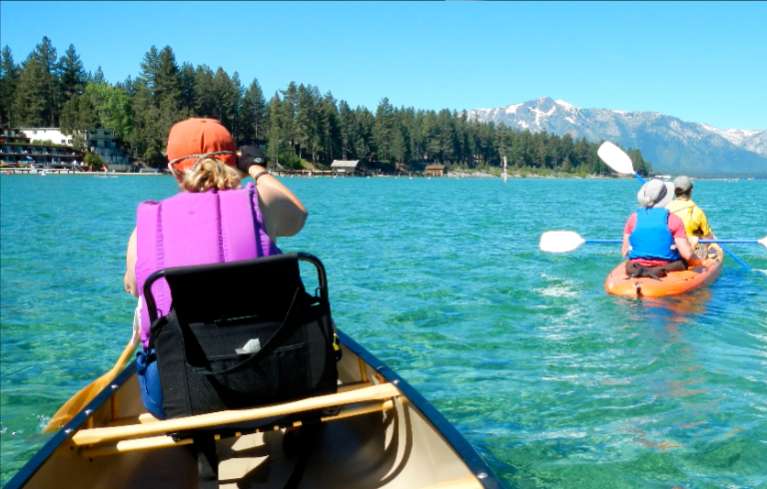
We started the morning at Lakeland Village, where our friends had access to a kayak. Sue and I launched our canoe from there.

In addition to the island’s being new since we were last on this stretch of water along the edge of the South Shore, the entrance to Trout Creek is covered with sand. A year ago it was spectacular to paddle in there among all the blooming lilies. While we could have portaged our vessels, we opted to keep heading toward the Tahoe Keys.

Standup paddleboarders outnumbered other human powered craft – at least on our way out. By the time we headed to our home port there were whitecaps on the lake.

Sue steers clear of Brenda and Roni in the kayak. Photos/Kathryn Reed

Sue steers clear of Brenda and Roni in the kayak. Photos/Kathryn Reed

Headed south we had Mount Tallac as our beacon. The water is so clear – even more than 100 yards from shore. And some places it’s shallow enough for people to be standing next to us.

Lakeview Commons really is something to see from the water. Regan Beach is as unimpressive from the water as it is on land.

It becomes a bit of an architectural tour going along Lakeview Avenue and into the Keys.

“I loved being on the lake and seeing things from a whole new perspective,” Roni said.

We didn’t know what to expect coming into the Tahoe Keys Marina in terms of whether we could tie up the kayak and canoe. No problem. We could have stayed for two hours.

As we leave the Fresh Ketch, a marina worker warns us the winds are supposed to be picking up soon and to be cautious. We thank him and heed his warning as we paddle a bit closer to shore on our way back.

It’s getting rough, but plenty of people are still playing on the water.

We get to Timber Cove pier and have the only unpleasant experience of the day. I shout “hey” to a Zodiac with “Camp Richardson” on the side to get the guys’ attention. They are headed to shore and we are headed to go under the pier.

Lakeview Commons

Lakeview Commons

They nastily shout back, “It’s a boat channel.”

Perhaps if they would have been looking in front of them and paying attention to those on the water instead of the skimpily clad woman on the pier they were keeping pace with, they wouldn’t have been annoyed by being shouted to by two middle-aged women in a canoe with unattractive life jackets on. I can only imagine if we were tourists, what kind of impression the exchange would have left.

We paddle on.

Now it’s time for a stop at Riva Grill. No problem getting beyond the boat channel and putting our toys alongside those that are available for rent.

One short push and we make it back to Lakeland – ready for another day on the lake.


Letter: Harrah’s-Harveys employees give back to community

To the community,

Harrah’s-Harveys casinos generously sponsored a Bread & Broth Adopt-A-Day of Nourishment on June 3 at St. Theresa Church Grace Hall.

B&B is very thankful for their support in helping to feed the needy of our community. Their donation of $250 provided the evening’s guests with a delicious dinner consisting of baked ham accompanied by scalloped potatoes, green salad and fruit salad prepared by B&B’s first-week volunteer cooks’ team.

In addition to funding the dinner, Harrah’s-Harveys HEROs were on hand to assist the B&B volunteers with the dinner. HEROs is a volunteer group of Harrah’s-Harveys employees whose goal is to give back to the community throughout the year by fund raising and supporting causes which benefit the community. For this B&B Adopt-A-Day event, Sara Anderson, Pat Frega, Debbie Neall, Randy Sumner and Darlene Winkelman represented the HEROs employees. They were a “wonderful, experienced crew of volunteers” according to Nora Jones, the B&B volunteer coordinator for the evening.

As a community service organization, Bread & Broth is very grateful to have sponsors like Harrah’s-Harveys- casinos and their community minded HEROs employee organization hosting an Adopt-A-Day. Their involvement helps B&B feed the working poor, families in need, elderly on fixed incomes as well as those living outdoors in our community.

If you would like to support Bread & Broth, please contact me at (530) 542.2876 or carolsgerard@aol.com.

Carol Gerard, Bread & Broth


Truckee embracing train heritage

Truckee is celebrating its railroad history and the town’s 150th and 20th anniversary’s on June 20 from 5-9pm.

Throughout 2013, Truckee is celebrating 150 years since establishment and 20 years since incorporation.

As workers built the Central Pacific Railroad from Sacramento to Reno, Truckee became a thriving boomtown. Today, the railroad remains a central part of Truckee’s economic and cultural heritage.

Union Pacific Railroad will be designating Truckee as a Train Town as part of its Train Town USA project at 5pm on the stage in front of the Train Depot in Downtown Truckee.


Reid says no one in D.C. willing to compromise

By Karoun Demirjian, Las Vegas Sun

Legislation, as Sen. Harry Reid often says, is the art of compromise. But lately, Reid has not been in a compromising mood.

“Who would I negotiate with?” Reid said last week when asked about his recently expressed reticence to parley with Republicans over how to keep student loan rates from rising on July 1, an issue on which Republicans and Reid’s Democrats differ. “I don’t know of anyone. I’m serious about that. I don’t know of anyone.”

In light of Republicans and Democrats trying their best to work with fresh bipartisan vigor on divisive issues from immigration reform to the federal budget, Reid’s observation might sound like defeatism.

But the conclusion he has been building toward for years also is the foundation of a strategy Reid regularly deploys to achieve his aims.

Sen. Harry Reid says compromise is elusive in Washington. Photo/LTN file

Sen. Harry Reid says compromise is elusive in Washington. Photo/LTN file

Ask Democrats why Reid is sticking so fiercely to his proposal to extend student loan rates instead of linking them to interest rates, as Republicans would prefer, and they will recall December 2011, when Reid and Republicans couldn’t agree on how to offset the cost of a payroll-tax-cut extension.

Reid didn’t like the Republican proposal to pay for it with a salary freeze for federal employees. He dug in his heels, insisting he would go no further than a temporary extension. After a punishing few weeks as the target of campaign-style advocacy, Republicans acquiesced — 36 hours before Christmas.

Since then, the experience of the debt ceiling, budget, sequestration and “fiscal cliff” suggest that as the hourglass runs low, the House can be driven to follow, albeit often at the last minute, the Senate’s lead.

“The play right now is to put (House Speaker John) Boehner in a box … to make it so uncomfortable for Boehner that this is his only course of action,” said David Damore, a professor of political science at UNLV. “He either has to let popular legislation die going into 2014 or, essentially, allow Democrats to be part of the winning coalition. Or does he want to run in the midterm with his party killing immigration and killing student loans?”

Congress will contend this summer with issues that are both pressing and practically designed to play on the campaign trail. The first half of the summer promises to be dominated by immigration and student loan rates, and the second half by immigration and the budget.

On immigration reform and student loans, Democrats have the more naturally crafted sales pitch.

“On immigration and student loans, Reid is in a position of strength, on the substance, on the politics and on his team sticking together,” said Eric Herzik, a political science professor at UNR.

“Republicans have to figure out a way to keep their most conservative Tea Party base happy while at the same time at least start to talk to immigrants, especially Latinos. … And on student loans, Republicans can’t make up a good story line. It’s not only a lot of young people trying to pay their student loans, it’s their parents, too.”

Republicans, however, are in no mood to roll over. Boehner’s House passed a student loans bill last week despite the threat of veto by President Obama, and the speaker has been adamant that while he supports the idea of comprehensive immigration reform, he has no intention of having the House rubber-stamp the Senate’s proposal.

But if Reid is listening to Boehner’s words, he’s filtering them liberally.

“He’s already said a lot of things,” Reid said, calmly dismissing the force of Boehner’s stated plans for immigration and saying with steely confidence: “I would prefer them to pass our bill.”

Reid, for months, has been maintaining a nearly split stance when it comes to his estimation of Republicans in the House and Senate.

On the one hand, he oversees a Senate in which he routinely expounds on the merits of bipartisan cooperation, as he has lately with his hands-off approach to the Senate’s immigration bill, designed by a bipartisan group of eight lawmakers and vetted through the regular order in the Senate Judiciary Committee.

On the other hand, he is still Democrats’ No. 1 attack dog, charged with pillorying his Republican counterparts.

Lately, Reid has abandoned the 2012 election description of Republicans as “extreme” in favor of calling them “anarchists.”

“You have to understand, we’re in a period where the anarchists have taken over the House of Representatives,” he said in a recent interview, supporting his claim with: “I studied the anarchists, before World War I, after World War I. … Some say they’re the ones who started World War I. Now the new anarchists aren’t violent. But they still have the same basic beliefs that the anarchists had — no government.”

Reid’s firebrand tactics are normally part of a larger, coordinated strategy to advance the Democratic position.

“If Reid pushes too hard and becomes the bad cop, he’s usually able to find a good cop to carry his message for him,” Herzik said.

Usually, the good-cop role is played by the White House, whether it’s Obama intervening on grand bargain talks with Boehner or Vice President Joe Biden spending New Year’s Eve at the Capitol to hash out the final details of a fiscal cliff deal with Senate Republican Leader Mitch McConnell.

But with the White House largely distracted by scandals at the IRS and National Security Agency, Reid has lately been on his own, and as such may be seeing other incentives to make an uncompromising push for the Democratic platform.

“You look at 2014 and those Senate seats, and it’s going to be hard for Reid to hold the Senate,” Damore said. “So he’s got to do all this now; otherwise, he’s just going to be the minority leader.”

Even Reid has obliquely referred to the potential of losing the Senate in reference to his agenda, telling an audience at a ceremony on Capitol Hill last week to honor the victims of last December’s school shooting in Newtown, Conn., that a Republican-controlled Senate is a sure sign that “we’ll never, ever get anything done” on gun control.

As long as he has a Democratic majority, Reid can put relative faith in the reliability of his caucus. In every major deal of the past two years, Senate Democrats have stuck together more than any other quadrant of Congress.

“This divisiveness within the Republican caucus is new. Traditionally Democrats are the more divided caucus, so they were the ones that could be split,” Damore said. “But now, there’s hay to be made for that. … The issues line up well for him, so why not take the opportunity?”

In lieu of a negotiating partner, Reid is publicly relying on the strength of the Senate Democrats, and the substance of his position, to try to knock out the top items on his agenda.

“I feel confident we’ll get something done, in spite of the Tea Party (on immigration) … because it’s an issue that 80 percent of the American people support,” Reid said. “Now maybe (Republicans) will do the same thing with this that they did with guns — 90 percent of the American people supported gun legislation. But I think that they’d better be very careful.”

In a divided Congress, to truly operate without a negotiating partner is a tall task. But, experts remind, even in an adverse environment, Reid is still a dealmaker. So broadcasting that he can’t make a deal may be just what lets Reid get a deal done.

“At the point Reid is finally just saying, ‘I’ve got no one to work with, so I don’t even have to concern myself with them, I’m just going to pummel whomever’s on the other side’ … then you’re really not attempting to negotiate. But I don’t think that’s happening,” Herzik said.

“What Harry Reid says at the start of an issue and where he ends up on the issue can be very different. Because he’s ultimately about guiding an issue to conclusion.”




Future of Incline Lake up for discussion

The U.S. Forest Service’s Lake Tahoe Basin Management Unit is taking comments until July 19 regarding the possibility of removing the Incline Lake dam in Incline Village.

An open house is set for July 8 from 5-7pm at the Incline Village General Improvement District’s board room, 893 Southwood Blvd.

The Forest Service purchased the 777-acre parcel off the Mount Rose Highway in 2008 for its recreational, scenic and natural-resource values. It wasn’t until after it was bought that officials learned the dam wasn’t up to code. Because of that, the lake was drained.

Comments may be mailed to Matt Dickinson, Incline Lake Dam Project, Lake Tahoe Basin Management Unit, 35 College Drive, South Lake Tahoe, CA 96150.


States influence direction of gay marriage

By Alan Greenblatt, NPR

The Supreme Court may rule on gay marriage this week. Advocates both for and against are glad the issue didn’t reach the court any sooner.

They didn’t want a repeat of the abortion issue. With its landmark decision in Roe v. Wade, the high court stepped in and guaranteed a right to abortion but also triggered a backlash that has lasted for 40 years.

With same-sex marriage, by contrast, legislators and voters in nearly every state had the chance to make their feelings known before the Supreme Court weighs in.

“People forget that durable rights don’t come from courts, they come from consensus and strong support from society,” says Jonathan Rauch, author of Denial, a recent memoir about growing up gay. “We are winning the right to marriage in a bigger, deeper way by winning it in the court of public opinion.”

After losing political battles in a majority of states, gay marriage supporters have won a number of legislative victories and ballot measures in recent years. Sensing momentum is in their favor, it may not be surprising that they’re glad they’ve had time to make their case to the public.

A Pew Research Center this month found that 72 percent of Americans believe universal gay marriage rights are “inevitable,” including 59 percent of those opposed to the idea.

But supporters of traditional marriage definitions also say that they’re pleased the court has waited to rule on this issue. The number of states blocking gay marriage still outnumber those allowing same-sex marriage by 3 to 1.

“If states originate marriage laws, then state legislatures should legislate them,” says Sam Schulman, a journalist who has written a number of articles critical of gay marriage. “To let the courts decide feels just as wrong as letting opinion polls decide.”

In 2004, Rauch, a guest scholar at the Brookings Institution, wrote a book advocating gay marriage. That same year, Massachusetts saw its first legal same-sex marriages following the state Supreme Court’s in Goodridge v. Dept. of Public Health.

The issue became central to the presidential campaign that year. On Election Day in 2004, voters in 11 states approved measures defining marriage as the union of one man and one woman.

If it had been the U.S. Supreme Court that issued a ruling back then, Rauch says, resistance would have been even more fierce.

States where opposition to gay marriage was strongest would have been angry not only about having had this issued decided for them in a way they didn’t approve, but about federal intrusion as well.

“Gay marriage would be a legal reality, but it would have been in the crosshairs of massive resistance for two generations,” Rauch says.

Thanks to federalism, each state has been able to decide for itself. Last month, Minnesota granted gay couples marriage rights, joining 11 other states and the District of Columbia.

allow civil unions. All the rest block gay marriage, although there’s still some about the law in New Mexico.

“If Goodridge had gone to the U.S. Supreme Court, we would not have been ready,” says Fred Sainz, vice president for communication and marketing for the gay rights group Human Rights Campaign, referring to the Massachusetts case.

But opponents of gay marriage are also glad this issue has played out in states.

“Who has the constitutional authority in our regime to make marriage policy?” asks Ryan T. Anderson, a fellow at the Heritage Foundation who has written extensively in favor of traditional marriage. “It’s not the unelected officials who sit on the federal bench.”

Having this issue continue to play out politically gives opponents a fighting chance, he says.

“Obviously, it’s very important that the majority of Americans do still support the description of marriage as between a man and a woman,” says Caitlin Seery, director of programs at the Love and Fidelity Network, referring not to poll numbers, but to the laws enacted in most states.

Sainz is hoping the Supreme Court will find that there’s a constitutional right to same-sex marriage. “There is absolutely no doubt that the best possible outcome is a finding by the court that there is a fundamental right to marry nationwide,” he says.

Most observers don’t expect that outcome. More likely, they say, justices will offer a split decision, striking down the Defense of Marriage Act, which blocks federal recognition of same-sex marriages, but not creating a universal right to such marriages.

Rauch says that may be for the best. He argues it would still be better to let states continue to handle the issue.

He can understand the impatience of those who want marriage rights to be sanctified nationwide. He works in a jurisdiction in which his own marriage is legal — Washington, D.C. — but lives in Virginia, where it is not.

Rauch says Loving v. Virginia, not Roe v. Wade, may be the more apt comparison.

In its 1967 ruling in Loving, the Supreme Court struck down bans on interracial marriage. But that decision came 19 years after a similar ruling by the California Supreme Court, during which time a number of states had decided to remove such bans themselves.

“There may well come a time, maybe not all that long from now, when the Supreme Court will be recognizing rather than imposing socially recognized marriage equality,” Rauch says. “It’s a much bigger deal doing that at the front end, before there’s a national consensus, and at the back end when you’re basically cleaning up.”


Study: Reading novels makes people better thinkers

By Tom Jacobs, Salon

Are you uncomfortable with ambiguity? It’s a common condition, but a highly problematic one. The compulsion to quell that unease can inspire snap judgments, rigid thinking, and bad decision-making.

Fortunately, new research suggests a simple anecdote for this affliction: Read more literary fiction.

A trio of University of Toronto scholars, led by psychologist Maja Djikic, report that people who have just read a short story have less need for what psychologists call “cognitive closure.” Compared with peers who have just read an essay, they expressed more comfort with disorder and uncertainty—attitudes that allow for both sophisticated thinking and greater creativity.

“Exposure to literature,” the researchers write in the Creativity Research Journal, “may offer a (way for people) to become more likely to open their minds.”

Djikic and her colleagues describe an experiment featuring 100 University of Toronto students. After arriving at the lab and providing some personal information, the students read either one of eight short stories or one of eight essays. The fictional stories were by authors including Wallace Stegner, Jean Stafford, and Paul Bowles; the non-fiction essays were by equally illustrious writers such as George Bernard Shaw and Stephen Jay Gould.

Afterward, each participant filled out a survey measuring their emotional need for certainty and stability. They expressed their agreement or disagreement with such statements as “I don’t like situations that are uncertain” and “I dislike questions that can be answered in many different ways.”

Those who read a short story had significantly lower scores on that test than those who read an essay. Specifically, they expressed less need for order and more comfort with ambiguity. This effect was particularly pronounced among those who reported being frequent readers of either fiction or non-fiction.

So how does literature induce this ease with the unknown? Djikic and her colleagues, Keith Oatley and Mihnea Moldoveanu, have some ideas.

“The thinking a person engages in while reading fiction does not necessarily lead him or her to a decision,” they note. This, they observe, decreases the reader’s need to come to a definitive conclusion.

“Furthermore,” they add, “while reading, the reader can stimulate the thinking styles even of people he or she might personally dislike. One can think along and even feel along with Humbert Humbert in Lolita, no matter how offensive one finds this character. This double release—of thinking through events without concerns for urgency and permanence, and thinking in ways that are different than one’s own—may produce effects of opening the mind.”

The researchers have no idea how long this effect might last. But their discovery that it is stronger in frequent readers suggests such people may gradually become programmed to respond in this way. “It is likely that only when experiences of this kind accumulate to reach some critical mass would they lead to long-term changes of meta-cognitive habits,” they write.

Their results should give people “pause to think about the effect of current cutbacks of education in the arts and humanities,” Djikic and her colleagues add. After all, they note, while success in most fields demands the sort of knowledge gained by reading non-fiction, it also “requires people to become insightful about others and their perspectives.”

If their conclusions are correct, that all-important knowledge can be gained by immersing yourself in a work of literature. There’s no antidote to black-or-white thinking like reading “It was the best of times, it was the worst of times.”