Motorcycle raffle benefits Empowerment Center

A 2003 Screaming Eagle Anniversary Edition CVO Harley Davidson Road King is being raffled off.

There will be 200 $100 tickets sold.

The money is being raised for the Empowerment Center, a Reno nonprofit whose mission is “To provide safe and sober housing to recovering addicts and alcoholics, with services, support, and commitment to our client’s long term success using a 12 step recovery process.”

The motorcycle has less than 2,000 miles on it.

The winning ticket will be drawn at the annual Texas Hold ’em Charity Poker Tournament at the Atlantis Casino on Aug. 16.

For more information, call (775) 853. 5441 or email HD@EmpowermentCenterNV.com.


K’s Kitchen: A salsa without tomatoes

By Kathryn Reed

When the family gathered last weekend we were all asked to bring an appetizer to share. My sister, Jann, made the recipe below.

I would not have thought of turning cherries into a salsa. It was so yummy I tried to keep the bowl in front of me.

k's kitchenCherries are one of those fruits I didn’t like much growing up. I barely could just eat a plain cherry, and I would always turn away ones that were cooked. It amazes me how our taste buds change – evolve? – through the years. That’s why I always like to try foods again that in the past I knew I didn’t like.

And cherries are still at the Tahoe farmers’ markets. The Ski Run market in South Lake Tahoe opens this Friday. It runs from about 3pm to 8pm.

While I have not made this recipe, I can recommend it. It comes from Kathy Morrison at the Sacramento Bee who created it by adapting several others.

Jann served it with pita chips.


Cherry Salsa

2 C sweet cherries, stemmed, pitted and chopped

¼ C red onion, finely chopped

½ C chopped fresh cilantro leaves

Zest from 1 lime

Juice from 1 lime

1 jalapeño pepper, seeds removed, minced

1 clove garlic, minced

Salt and pepper to taste

Mix all ingredients in a medium bowl until well combined.

For best flavor, chill for an hour. Stir again before serving.


Study: Red meat linked to diabetes

By Allison Aubrey, NPR

You’ve likely heard about the link between sugar consumption and Type 2 diabetes. But fresh research ties another dietary pattern to increased risk of the disease, too: eating too much red meat.

It’s not that we are trying to pick on meat (I’m a meat-eater, in moderation), but the recent studies linking carnivorous habits to health problems seem to be piling up. We’ve had Salami Suicide and Death by Bacon. Now, there’s a new study that links red meat consumption to an increased risk of Type 2 diabetes.

The researchers tracked what happens after people changed their meat-eating habits, using data from the Health Professionals Follow-up Study and the Nurses’ Health Study, which include about 100,000 people. Diet was assessed by food frequency questionnaires.

“Some people [in the study] increased their red meat consumption and other people decreased their consumption,” says Dr. Frank Hu of the Harvard School of Public Health, one of the co-authors of the paper, which appears in JAMA Internal Medicine.

The study found that among those who started eating more red meat, about 3.5 servings more per week, the risk of developing Type 2 diabetes during four years of follow-up increased by almost 50 percent, which Hu describes as “a really large increase.”

As with previous studies linking red meat to health concerns, the researchers found that processed red meats such as hot dogs and bacon were more strongly associated with the risk of diabetes.

Among those who starting eating less red meat, the risk of developing diabetes dropped by about 14 percent during a 10-year follow-up period.

Now, to put this study in context, it’s important to point out that the most significant driver of Type 2 diabetes is body weight. People who are overweight and obese are much more likely to develop the condition.

Since red meat is typically high in calories and fat, some experts say that it’s likely these factors that create the link between heavy red meat consumption and and increased risk of diabetes.

But in this study, the link held up even after the researchers controlled for the role of weight gain. And this suggests that there’s an independent effect of red meat consumption increasing the risk of diabetes.

It’s not clear what’s happening in the body, but there are a few theories. It’s possible that heavy red meat consumption can lead to iron overload, which sets the stage for insulin resistance.

It’s also possible that compounds called nitrosamines play a role.

“Our understanding is that, especially [when they occur in] processed meats, these nitrosamines can cause inflammation,” explains Dr. David Nathan, who directs the diabetes center at Massachusetts General Hospital.

And there’s also some evidence that nitrosamines can damage the cells in the pancreas that make insulin. But experts say more research is needed to understand these connections.

In the meantime, Nathan says his advice is to pay attention to the big picture. If you like the occasional hot dog, that’s OK. It’s the overall pattern of eating and maintaining a healthy weight that’s most important.

“Red meat should be considered in the setting of a balanced diet,” says Nathan.


40% of food in U.S. ends up as garbage

By Quentin Fottrell, Wall Street Journal

New York Mayor Michael Bloomberg’s plan to require residents to compost their food waste may cause headaches for some families, but experts say it could also help cut their rising grocery bills.

Under the proposal, by 2016 the city will require residents to separate their food waste for collection. Organic waste in New York City — which could otherwise be recycled for fertilizer or natural gas — currently accounts for 1.2 million tons or 35 percent of landfills, and a pilot program on Staten Island achieved a participation rate of 43 percent, according to the mayor’s office. Last year, Vermont introduced a bill to by 2020 require residents to recycle their food waste — and 33 percent of the organic waste in that state already gets composted.

Aside from the environmental advantages of composting, the effort may also be a boon for pocketbooks. Throwing out separate bags filled only with uneaten food could work as a big wake-up call for consumers, experts say. “We have a tendency to overbuy and overcook,” says Phil Lempert, CEO of grocery information site SupermarketGuru.com. “Awareness of how much food you’re wasting does help people buy properly. As prices go up, people also become more aware.”

And consumers today have every reason to be more judicious in the grocery store. The price of food purchased for consumption at home is expected to rise 2.5 percent to 3.5 percent in 2013, according to the U.S. Department of Agriculture.

As much as 40 percent of food goes uneaten in the U.S., according to estimates from the Department of Agriculture and the Environmental Protection Agency. Americans are, in other words, throwing out the equivalent of $165 billion in wasted food every year, according to a recent analysis by the Natural Resources Defense Council, a nonprofit environmental group. In fact, one study estimates, just 15 percent of wasted food would be enough to feed more than 25 million Americans every year. And one in six Americans currently lacks a secure supply of food, says Dana Gunders, an NRDC project scientist in San Francisco.

Grocery bills are the biggest household expense. The average American family of four spends between $632 and $1,252 per month on grocery bills, according to the Department of Agriculture’s April 2013 “Cost of Food” survey. Composting forces people to actually see how much food they’re throwing away and how much money they’re wasting, says Andrew Shakman, president of LeanPath, a Portland-based company that tracks food waste in industrial kitchens. LeanPath helped cut food waste at the UC Berkeley campus by 43 percent.

There are, of course, easier ways to cut one’s supermarket bill than composting. Consumers can waste less food by bringing a calculator to the store, making a note of when food goes bad, cooking only what they need and eating their leftovers, experts say. iPhone apps like Green Egg Shopper ($3.99) and Food Storage & Shelf Life ($1.99) can help keep track of perishables. One caveat to Bloomberg’s plan, however: “Recycling can also give less conscientious people a good excuse to waste,” Shakman says.


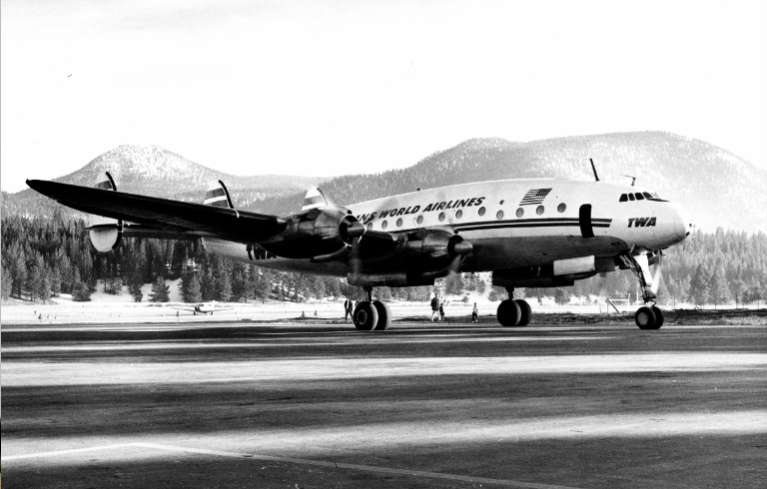
Plane travel has long history at Lake Tahoe

TWA was one of several airlines that used to fly into Lake Tahoe Airport. Photo/Del Laine

TWA was one of several airlines that flew into Lake Tahoe Airport in South Lake Tahoe. Photo/Del Laine

By Kathryn Reed

STATELINE – Aviation on the South Shore is nearly 100 years old, with the first recording of planes landing in the 1920s on the water. It was a bi-wing floatplane near Camp Richardson.

Swaths of land have served as air strips, plans were drawn up that never came to fruition, and some airfields are talked about but historians are not exactly sure where they located.

Local historian Dave Borges gave a brief history of Lake Tahoe aviation during the June 19 Soroptimist International South Lake Tahoe lunch at Harrah’s. He is a past history instructor at Lake Tahoe Community College and is on the board of the Lake Tahoe Historical Society.

It was the 1960 Squaw Valley Olympics that led the charge to develop what is now Lake Tahoe Airport. It was completed in 1959. The land was home to the Barton dairy before it was paved over for planes.

The runway was extended and the current terminal added as the years went by.

“It was paid for with a lot of casino money,” Borges said.

It was in 1983 that South Lake Tahoe bought it from El Dorado County for $1.

Several commercial airlines flew in and out of the airport. The highest passenger count was in 1978 at 294,188. The last commercial flight was in 2000.

Borges showed an ad for a flight from the Bay Area to South Lake Tahoe costing $11.95. A pamphlet claimed that a DC-3 could bring passengers from Oakland to Lake Tahoe Airport in 50 minutes.

The deadliest crash at the airport was on March 1, 1964, when 85 people died. The flight originated in Oakland, went to Salinas, and then San Jose before heading to Tahoe. While officials claim the weather was good when they took off, it was stormy in the Sierra, plus mechanical issues contributed to the crash.

Before Lake Tahoe Airport opened most of the planes flew in and out of Sky Harbor Airport in Stateline. This strip is essentially what the mobile home park on Kahle Drive now sits on. It operated from 1946-56.

“They would fly from the mountain side to the lake to alert the cattle. The planes made so much noise,” Borges said. Then they would go out to the lake and circle around to land. “From a pilot’s perspective it looked like they were going into the mountain because Kahle Drive goes uphill.”

A fence had to be erected so the cows would not eat the fabric on the wings.

In the area was also the Sky Harbor Casino.

Johnson Field existed in the 1930s and ’40s, but where exactly is not known because old maps don’t have it pinpointed. But the old drive-in is said to have moved to the Johnson Field. The Johnson family used to own much of the Bijou area.

The Dunlap Ranch-Tamarack Dairy near what is now the Tahoe Keys was going to be an airfield in the 1930s, but never came to fruition.

Borges showed plans from 1938 for the Meyers Lake Tahoe Airport.

“I’ve talked to a few people. A Meyers airport would be horrible,” Borges said, explaining that the current airport is already challenging for pilots.

In 1951 there was a proposal by the California Aeronautics Commission for a tarmac that could hold 400 aircraft near Pope Beach.

“It’s what the Tahoe Keys would have been if the Tahoe Keys didn’t happen,” Borges said.

—-

Note:

For more information about Lake Tahoe Airport, revisit the three-part series Lake Tahoe News published in July 2012:

Part 1

Part 2

Part 3.


Opinion: Making a case for secret marriages

By Joe Mathews, Valley Public Radio

Pssst. Wanna know a secret?

I’m going to let you in on confidential marriage, an only-in-California concoction that is little known but deeply relevant to today’s debates about marriage.

Confidential marriage is in most respects the same as any old legal marriage—solemnized and binding. But confidential marriage licenses, unlike the regular marriage licenses, are not part of the public record. And confidential marriage is limited to couples who are already living together (although no proof of cohabitation is required).

In this marrying month of June, with the U.S. Supreme Court about to rule on same-sex marriage in California, now is the right time to ask: How and why did Californians get this strange marriage option? And what does it mean for us today?

Confidential marriage got on the books in February 1878 as a way for churches and pastors to legitimize couples who were already living together out of wedlock. The state had lots of common-law marriages between people who—often because they lived in remote areas away from churches and courthouses—couldn’t sanctify their unions. Pastors, who got the exclusive right to solemnize confidential marriages, saw it as getting couples right with God. The state liked it because it clarified inheritance rights for children. Couples liked it because no one could find out they’d been living in sin.

“The confidential marriage statute is a bit of Victoriana, designed as were so many expressions of that era, to preserve the illusion if not the fact of respectability,” according to a 1984 state report on those early beginnings.

The institution remained unchanged—and little used—until the 1970s, when legislators made it easier to perform confidential marriages, expanding the type of people authorized to sanctify such unions beyond the clergy. Californians liked that confidential marriages didn’t require blood and rubella tests—or the resulting waits. Conservatives, appalled by the spread of cohabitation, thought confidential marriage might encourage couples to enter the holy institution secretly while keeping up appearances with marriage-skeptic friends.

All of this led to a surge in confidential marriages. In 1972, the first year of state recordkeeping, about 1,200 confidential marriages took place. In 1982, 58,000 couples entered into confidential marriages, approaching one-third of all marriages in California. Wedding chapels in Lake Tahoe and San Bernardino County took business from competitors in Reno and Las Vegas by touting the speed, privacy, and lack of blood tests. (“One Stop Instant Weddings,” was a common billboard ad.) When brides and grooms asked about the requirement that the couple were living together as husband and wife, clerks in El Dorado County would reply, “Honey, if you’ve ever been to bed together, you qualify.”

The growth of confidential marriage spurred reports of abuses. More than 100 bigamists in San Diego were said to have used confidential marriage licenses to avoid detection. Sailors on leave in Los Angeles, dead and under-age people in Orange County, and all sorts of other sketchy types were getting married confidentially—and often disappearing.

In 1984, a legislative effort to eliminate confidential marriage came up one vote short in a key Assembly committee. But subsequently, new laws got enacted to make confidential marriage more like regular marriage, apart from the fact that confidential marriage licenses can only be obtained with a court order or by one of the spouses. After the state stopped requiring blood and rubella tests for public licenses, the numbers of confidential marriages dropped.

Still, for some, such as paparazzi-evading celebrities, confidential marriages remain appealing. In recent years, about one out of five marriage licenses issued (41,816 out of 223,265 in fiscal year 2011-12) was confidential, according to California Department of Public Health estimates.

Confidential marriage could see another boost if the U.S. Supreme Court comes out for same-sex marriage. Wary of societal prejudice, some gay couples may prefer to marry without bigoted family members or bosses being able to find out.

But the real power of confidential marriage could come into play if the court leaves Prop 8 in place—or issues a ruling that leaves the question of same-sex marriage open in California. In that case, I would submit that—as a temporary measure until full marriage equality arrives— a fitting compromise would be for the state and its voters to grant same-sex couples a constitutional exemption to marry confidentially. That would give the title “marriage” to gay unions—but allow conservatives to say that it is not the same as traditional marriage. (Conservatives who resist this compromise as “redefinition” of marriage should be reminded that confidential marriage is itself a redefinition they have supported.)

Such a prospect may sound to some readers like a matrimonial “separate but equal.” But in many ways, such marriages are separate—but better. For those who want their marriage publicly known, nothing requires couples to keep a confidential marriage confidential; you can televise your ceremony if you want. Confidential marriage licenses are a few bucks cheaper ($85 in L.A. versus $90 for a public license). Cloaking a public record makes it a little bit harder for you to be targeted by marketers or, for that matter, identity thieves. And confidential marriage is kind of cool in that it connects today’s couples to a noble, historic institution that served people who wanted to define family on their own terms.

Indeed, California might be wise to sell confidential marriage around the country as a special benefit that you can’t get anywhere else (though, to be fair, Michigan has a less confidential form of secret marriage). Privacy-loving people might come here from out of state to marry and honeymoon, and our economy could use the boost. And if more couples settle here and start families, so much the better. California is getting older, and needs more children.

Heck, maybe we all should embrace confidential marriage. Yes, there’s something clean and handy about public records. But isn’t mystery what keeps marriage alive?

Joe Mathews wrote this Connecting California column for Zocalo Public Square.


Fire destroys Tahoe City house

This Tahoe City house was fully engulfed when firefighters arrived. Photos/North Lake Tahoe Fire

This Tahoe City house was fully engulfed when firefighters arrived. Photos/North Lake Tahoe Fire

Damage was severe, though no dollar amount has been placed on it.

Damage was severe, though no dollar amount has been placed on it.

An early morning fire Wednesday completely destroyed a house in Tahoe City.

The occupant and a dog got out without injury.

North Lake Tahoe Fire Protection District crews have not determined the cause of the fire in the 1800 block of Silver Tip Drive.

There was concern the fire would grow larger because flames shot into trees.

— Lake Tahoe News staff report


Snippets about Lake Tahoe

skier• The U.S. Ski and Snowboard Association has named Mammoth Mountain as an official training ground for U.S. Freeskiing and U.S. Snowboarding, including spring and fall camps for U.S. athletes through 2019 including Olympics in Sochi and PyeongChang.

• Indian Hills resident Shahla Fadaie recently purchased the Mr. Ice Cream truck and started a new business, Shahlala Healthy Ice Cream Rush. She is serving the same Douglas County route as the previous owner with a new ‘50s theme. Fadaie will introduce two of her custom ice cream flavors at the Casino Fandango Food Truck Festival on June 29 from noon-5pm.

• Dancing with Your Stars, a fundraiser for Tahoe Arts Project, is returning March 8 to MontBleu in Stateline.

• Domus Development earned a Gold Nugget Award for general excellence at the Pacific Coast Builder’s Conference for the Kings Beach Housing Now project.

Sample the Sierra is a farm to fork event in South Lake Tahoe on Sept. 1 from 1-5pm. The event is on Ski Run Boulevard. Tickets are $30.


K’s Kitchen: Serving up a winning appetizer

By Kathryn Reed

Sports psychologists have made a living trying to figure out why people win or lose and the speed and consistency at which they do so.

But I have never read about food being a motivator.

k's kitchenI think it must be for the Zephyr Cove 3.5 women’s team. They dominate at home, having won the last two matches 5-0. And it is the home team that provides the food and beverages after a match. (OK, there is a whole lot of talent on that team, too!)

I have played on USTA teams in Las Vegas and the Bay Area – the food is nothing like what these women serve. While I started the season on the Zephyr team known as Lake Aces, I am no longer a member because the USTA thinks I’m really a 4.0 – but that’s another story.

I am still an eating and drinking member of the team.

Below is a recipe for a dish that Suzy brought to one of the matches. Her teammates and the opposition devoured it. She originally got it from her friend Heather.

 Pesto Pistachio Cheese Torte

Pesto

2 cloves garlic

1 C fresh basil

1 C grated Parmesan

½ C olive oil

Blend pesto ingredients in food processor. (Can be made in advance and refrigerated.)

Garlic Cream

8 ounces cream cheese (softened)

2 T butter

1 clove garlic (minced)

2/3 cup shelled and roasted pistachios (chopped; reserve 2 T for sprinkling on top.)

Black pepper (pinch)

Blend garlic cream ingredients either by hand or in food processor.

Other

1 lb provolone (deli thin sliced)

¾ C sun dried tomatoes packed in oil (not drained/chopped)

Select two bowls or one loaf pan for the mold. (Ideally nothing with an inverted lip.) Generously grease inside with olive oil. (It’s nice to make two versus one … your choice!) Line the bowls/pan with half provolone. Leave about ½ inch excess to fold over sides. Press edges together to seal. Spread half pesto on provolone. Add a layer of provolone. Spread half of the tomatoes. Spread all of the garlic cream. Spread remaining tomatoes. Add another layer of provolone. Spread remaining pesto. Top with final layer of provolone. Fold excess provolone from sides over top and place in fridge to set for about an hour. (It can be kept in a cold part of fridge for up to a week.)

Serving suggestions:

Invert on to a plate or platter. Slice in half to reveal layers and wedge open. Sprinkle reserved pistachios over top and on platter for effect. Add pretty basil leaves for a nice presentation. Best served with crustini but may use crackers in a pinch.

Crustini:

1 sourdough loaf (good quality such as Truckee Sourdough or bakery fresh)

Spray can olive oil.

Slice thin slices on baking sheet, spray with olive oil. Broil until golden. Turnover and spray other side, broil until golden.


Calif. budget bill threatens access to public records

By Annalise Mantz and Jeffrey Dastin, Sacramento Bee

A budget bill awaiting Gov. Jerry Brown’s signature would make it optional for local governments to comply with several key provisions of the California Public Records Act.

The change is intended to save the state money because it typically reimburses local agencies for providing services it mandates.

Brown’s administration says it expects little effect on public access to records. Many local governments told the Bee they intend to comply anyway and pay the costs themselves.

Yet advocates of open government say the changes essentially would gut provisions that ensure the public and the media get responses to their records requests. They warn it would do the most damage in places where there is a need to protect the public’s interests – local governments that already seek to restrict access or have a history of corruption.

Peter Scheer, executive director of the First Amendment Coalition, said citizens and journalists who request public records would now have to trust local governments and agencies to skirt the “very big hole” the bill opens in the Public Records Act.

“I think the biggest cities will continue to comply, or they will say that they are adhering to the provisions, and in practice they may not really be adhering to them,” Scheer said. “Once they become optional as a matter of law, I’m not sure how enforceable they will be.”

The language of Assembly Bill 76, one of several bills in the budget package for the coming fiscal year, would make multiple provisions of the records act “optional best practices.” It adds a requirement that local governments who choose not to follow “best practices” publicly announce that they won’t comply with that portion of the act.

Local governments could choose whether to help members of the public craft their records requests to increase the chances they will obtain what they are seeking. The governments could opt to release records on paper rather than electronically.

The measure would eliminate a requirement that governments respond within 10 days with a determination about whether the records are wholly or partially disclosable. It also would eliminate a requirement that governments provide a legal justification for not releasing documents.

The Legislative Analyst’s Office has estimated that removing the mandates would save California tens of millions of dollars.

Terry Francke, general counsel at Californians Aware, said the way the measure is written conceals the effect of the changes.

“(It) allow(s) the governor and the Legislature to say, ‘The CPRA is still there, we didn’t repeal it,’ when the effect is really to gut the act of response to your request,” Francke said.

He said he has concerns about the minority of agencies that are already not fond of releasing information to the public.

“If you tell local agencies that are already rogues under the CPRA that any legal duty they have is no longer present, then it’s going to serve the interest of those who have something to hide most,” Francke said.

Brown’s administration maintains that the backbone of the Public Records Act would remain intact. Department of Finance spokesman H.D. Palmer said that making those provisions optional would cut the state’s costs without infringing on public right to access government records.

“Californians will continue to have a constitutional access to rights of information,” Palmer said. “The Legislature only chose to change a few provisions.”

Last year’s budget deal triggered a suspension of state mandates tied to the Brown Act, which regulates meetings of local agencies that must be open to the public. Palmer said that change was similarly minor and that the administration expects local governments are likely to remain responsive to public records requests.

Jean Hurst, a lobbyist with the California State Association of Counties, predicted that many counties would continue to follow the best-practices provisions in order to avoid backlash.

She said shortages of staff and funding make it unlikely that counties would gamble with the extra expense of a potential lawsuit.

“Why would we waste the time and money on litigation over a records request?” she said.

Hurst also said that responding to requests for records has become routine for most local agencies and that changing their policy would be more of a hassle than complying with the law.

Mike Applegarth, principal analyst in the El Dorado County Administrative Office, agreed with Hurst but noted that records requests can be a burden.

“I think open-government laws like the Brown Act and the Public Records Act are just part of the fabric of local government, and I can’t see El Dorado County deviating from that,” Applegarth said. “We would definitely have to take it on a case-by-case basis. We have in the past received very voluminous records requests, and it’s very challenging to respond.”

Both Placer and Yolo counties also said they would continue to comply with the act. Placer County Supervisor Jennifer Montgomery, who represents District 5, said potential costs would not deter the county from responding to public records requests. “We’re going to be sure that we remain committed to being responsive to the public – honest, fair and above board in our dealings,” Montgomery said. “If we have to cover those costs, then we will cover those costs.”

Several Sacramento area school officials and board members contacted by the Bee also said they didn’t have much of an appetite for changing the way their districts deal with records requests.

California is not the only state to roll out changes to its open records laws in recent years.

In 2011, Utah legislators passed House Bill 477, which modified the state’s Government Records Access and Management Act to prohibit elected officials’ text messages, voice mails and communications from being released. The widely unpopular bill also allowed the state to keep more records private and increase fees for viewing public records.

Utah Gov. Gary Herbert eventually asked legislators to repeal the bill, and they complied.

Mark Horvit, executive director of Investigative Reporters and Editors, said both Utah and California represent a nationwide trend toward more stringent records laws.

“In general, the state legislatures have been rolling out these suspensions to public records requests laws,” Horvit said. “Now, for some reason, lawmakers are finding a raft of excuses to prohibit the public from finding out what government is doing.”

Opponents of California’s changes also criticize the bill for being hastily written late in the budget process.

When the Pacific Media Workers Guild sent Brown a letter urging him to veto AB 76, the organization not only objected to the effect the bill would have on journalists making records requests but also to the principle of crafting the “trailer” bill at the last minute.

“Equally egregious is the surreptitious manner in which (the bill) and other trailer bills have been attached to the budget package,” the letter said. “The Guild strongly urges either that you remove the afore-cited sections from (the bill) before signing it into law or that you veto the entire bill.”

Without a full guarantee of legal coverage, open government advocates say citizens would have to take more responsibility for ensuring access to public documents.

Jim Ewert, legal counsel for the California Newspaper Publishers Association, guessed that in cities and counties with active citizens, agencies would feel obligated to continue responding to records requests within 10 days as an act of good faith. The problem, he said, would be in places like the city of Bell, which earlier this year saw the mayor and four City Council members convicted of corruption.

“To the extent that there is a vibrant presence, (the change to the law) may have little impact at all. The expectation won’t change among the constituents,” Ewert said. “In those areas such as the city of Bell where this may not be the case, this has to be very damaging.”