Douglas County approves South Shore Area Plan

By Kathryn Reed

STATELINE – The Tahoe Regional Planning Agency Governing Board next month will tackle the initial area plan under the 6-month-old Regional Plan.

In what some thought would be a big deal has been a rather easy process to date. On Thursday, the Douglas County commissioners approved all of the items associated with the South Shore Area Plan on 4-0 votes, with Lee Bonner absent.

While the League to Save Lake Tahoe submitted two letters and the Sierra Club one and reps from both groups spoke June 20, there was no other opposition.
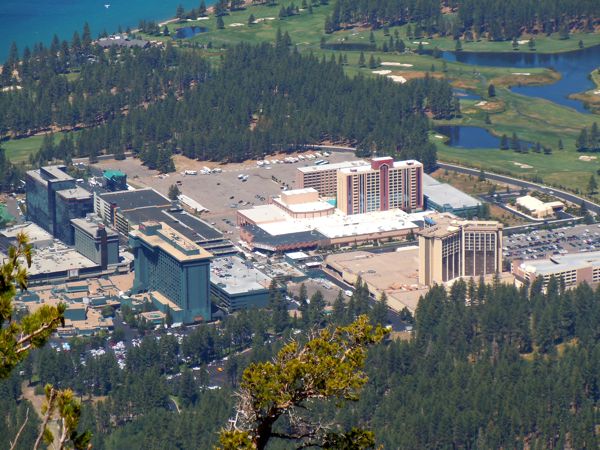
With Douglas County approving new design guidelines, it's possible the Stateline casino core could have more modern look one day. Photo/LTN file

With Douglas County approving new design guidelines, it’s possible the Stateline casino core could have a more modern, even alpine look one day. Photo/LTN file

They are likely to repeat what they said this week at the July 10 TRPA Advisory Planning Commission meeting and July 24 Governing Board meeting.

Douglas County opted to go with an environmental checklist for its review instead of a more stringent environmental process. Staff believes that by following what is in the Regional Plan, which had an environmental impact report and environmental impact statement, that duplicating those efforts was not needed.

Jennifer Quashnick with the Tahoe Area Sierra Club said there is a gap between the Regional Plan and checklist, adding that many of the changes have not been studied.

There is also a memorandum of understanding between the county and TRPA that the conservation groups have an issue with that is likely to be debated further at the TRPA level.

Richard Shaw, with Design Workshop in Aspen, developed the design standards and guidelines for the area plan. He is also the man behind the South Shore Vision Plan and Tahoe City’s Vision.

“It’s a visual guide that establishes the character for the area that is consistent with the mountain setting and environmental conditions,” Shaw said.

He told the commission he sees the document as a guide to what the area could become. He said with revitalization, the South Shore has the “capability to be a full resort community.”

This area plan affects the casino area of Stateline and Lower Kingsbury Grade.

This is a program document. Any projects must still be approved, and depending on what they are may require TRPA approval.

The county and South Lake Tahoe have been talking as each goes through the area plan process. The goal is that similar design guidelines will be adopted so it looks like one contiguous community.

This is more likely to happen if the casinos revamp their facades.

South Lake Tahoe’s plan on the other side of the state line will be the next one the TRPA will review. First, though, it has few local processes to go through. A special council meeting is set for July 2 at 9am at Lake Tahoe Airport, then the negative declaration will be released for a 30-day review. The Planning Commission will discuss the plan Aug. 8 and it will be on the council’s agenda Aug. 20. The APC and Governing Board will vote in September.

A difference with the city is that it must adhere to the California Environmental Quality Act, which can slow the process down.




Optimist putting on day of fun in Tahoe Paradise

Optimist Day in the Park is June 22 at Tahoe Paradise Park.

The Optimist club of South Lake Tahoe will be hosting its 10th annual duck race at Meyers Paradise Park, along with lots of other activities.

The day starts with the semiannual pancake breakfast at 8am. For three hours people can eat all the pancakes, scramble eggs, and sausage for $5.

posterThe duck race is from 10am-2pm. Duck costumes will be judged at 11am, with the first ducks to begin racing as soon as the judging is complete. Business ducks may be purchased in advance from any optimist member.

Baby duck racing will also begin at 11am. They can be purchased in advance or at the door for $5 each or a six quack for $20.

While the duck race is beginning, more than 40 classic cars will begin to fill the parking lot. Official judging will take place at 3pm.

There will an official rib cook-off. At the other end the park hamburgers and veggies burgers will be on the grill.

The beer garden opens at 2pm.

The band Deep Fried Mojo will be playing.


Opinion: CTC crosses the line with taking of property

Note: The following letter was read into the record at the June 20 California Tahoe Conservancy meeting by Lake Tahoe News Publisher Kathryn Reed.

Thank you for allowing me to speak today.

I am Kae Reed and I am a homeowner in South Lake Tahoe who lives next to a Conservancy lot.

Susan Wood and I have owned this house since April 2003. In that time the Conservancy has mostly been a good neighbor; removing trees as necessary. In turn, we pick up errant trash and dog poop left by others on the side of the property that might actually be in the city’s right-of-way.

I may not get through all of this in my allotted time, so I will leave a copy, or feel free to read it in full on Lake Tahoe News [today].

CTC has literally staked a claim to what homeowners thought was their property for the last 10 years. Photo/LTN

CTC has literally staked a claim to what homeowners thought was their property for the last 10 years. Photo/LTN

What brings me to the podium is an encounter I had with two of your staff members on Tuesday. One was Jeff Miller, associate environmental planner, and the other guy’s name I don’t remember; definitely a subordinate to Miller.

After my encounter with them, a headline for a column flitted through my head – it was “Conservancy in the business of taking private property.” It might still be something like that.

I went out front when I saw them standing around like most government workers, just staring and not doing anything. Reminded me of Caltrans. But I digress.

They said someone else at the Conservancy had been by and asked them to come by. They asked where I thought the property line was. I told them it was one of two markers in the front – that depending on who from the Conservancy came out I was told something different. They said I was all wrong and that in fact the property line was much closer to my house. They said they were going to revegetate the land that we had disturbed.

I said not so fast. Prove it. They came back with a measuring device and metal detector. As they were doing their thing, I was leaving messages for CTC Deputy Director Ray Lacey and the city’s board rep Tom Davis.

The worker bees had me come out and see the metal marker in the middle of the Conservancy lot and how 60 feet toward my property would be our shared property line.

They could not find the property marker dividing our lots. They said they did. But the metal detector did not ping while I was there. They said someone would be back to dig it out. They had already left a sizeable hole and literally put a stake in the ground to claim that as CTC property.

From the hole to the closest previous marker that CTC staff has said was the property line is 5 feet. Yes five. If you go back the 100-plus feet of how deep the parcel is, that would have the CTC taking more than 500-square-feet of land. Considering our house is only 1,150-square-feet, if this were a structure they were commandeering, it would be just less than half of our living quarters.

What made this experience even more unpleasant is that I was told I had until that afternoon of June 18 to move what was allegedly on CTC property. What is on there are rounds of wood and a wheelbarrow. Wood is our primary heat source and I split most of it by hand. The disturbed land is some wood shards and sawdust from when the chain saw comes out.

I was able to talk to Ray Lacey that day. He said he was going to have an independent assessor figure out where the lot lines are. While this is great, it does seem like an incredible waste of taxpayer money.

I wonder if I didn’t have Lacey’s number, know who he is or that if he didn’t call back, that I could call his boss, Patrick Wright, if the CTC would have just taken my property this week. People who have the “right” names and numbers should not get special treatment. And the government should not screw people who don’t have connections.

Tom Davis also swung by to see the situation. He seemed a bit surprised by the lot line assessment of the CTC, but I’ll let him speak for himself.

Even if the measurement comes back that the CTC dudes were correct, the lack of due process and the manner in which the CTC goes about taking private property is horrendous. Jeff Miller said he had been by before but no one was home. He never left a card, no letter was sent, no phone call made, no appointments made. It wasn’t like I was playing hard to reach.

At least the U.S. Forest Service when it has an encroachment issue with a neighbor sends letters before they drive a stake in the ground.

Miller could have made this a teachable moment. He could have said why cutting wood there was a bad thing.

Instead he said his colleagues would be out to plant more of the thorny wild roses that have overtaken most of that lot. When Davis saw the parcel he said he thought the lot needed cleaning up. I laughed and said staff thought more needed to be planted.

Two weeks ago we had a defensible space inspection. The South Lake Tahoe fire captain said those wild roses were way too close to our fence. Now I’m not sure if I should remove them or not – I don’t know who owns what and if I would be destroying government property.

I do know planting more vegetation closer to my house, as the CTC wants to do, would go against the definition of defensible space.

Assuming the property lines are redrawn to what the CTC guys said were true earlier this week, why the change now after we’ve been here 10 years?

I can’t wait to find out what happens to the shed that we use for wood storage. It was there when we moved in. A few inches of it may be creeping onto CTC territory.

All I was left with was a sour taste and having the same question I have of TRPA – why does either one of your agencies exist and what good do you really do? Shame on you CTC for allowing this to happen.

Maybe it’s time for South Lake Tahoe, El Dorado County and Placer County to manage the urban lots in their jurisdictions – and to even own them. Get the state out of back yards and side yards. Less government would be a welcome change in all our lives.

Thank you for your time.


California electeds to get bump in pay

California legislators can expect to earn about $5,000 more in 2014. The 5 percent pay increase takes affect for statewide elected officeholders starting in December.

The California Citizens Compensation Commission made the ruling June 19. While the group was appointed by the governor, it was the voters who created the entity.

Most lawmakers make about $95,291 a year.

Lawmakers have had their pay cut by about 23 percent since 2008. This is the first increase to bring them back to the level of five years ago.

— Lake Tahoe News staff report


Weekend rain to bring prescribed fires

U.S. Forest Service fuels management crews may resume prescribed fire operations on the South Shore June 23.

If forecasted rain moves into the basin, crews expect to burn approximately 10 acres near the Cold Creek area. Operations are scheduled to last through Tuesday, weather and conditions permitting.

Residents and visitors can expect to see smoke from this prescribed fire project area. The Forest Service strives to minimize the impacts of smoke on local communities. Smoke-sensitive residents should consider staying indoors and keeping doors, windows and outside vents closed.

To directly receive prescribed fire updates, send an email to pa_ltbmu@fs.fed.us.


Meeting all about faster access to Internet

There will be a meeting about broadband on June 24 from 6:30-7:30pm at the South Lake Tahoe Recreation Complex in the Aspen Room.

This meeting will focus on the broadband needs of businesses and residence in the South Lake Tahoe and Meyers area. Local Internet service providers will describe their services.

The meeting is being put on by the Gold Country Broadband Consortium, which is one of 14 regional consortia in the state funded by the California Advanced Services Fund Rural and Urban Regional Broadband Consortia grant program to leverage regional, state and national resources as an investment in improving and expanding broadband access.

The goal of the consortium is to provide choices for affordable Internet service. In order to do that, the GCBC is in the process of mapping out demand by rural homeowners, neighborhoods and business owners and conducting community meetings.

The GCBC needs the assistance of rural residents and businesses by taking a speed test and sending the results to russ@sedcorp.biz, with a physical street address, to be included in the mapping process.

To conduct the speed test, go online. This website is used to record the results of all speed tests and reported to the CPUC. The goal is to get service to those who don’t have it and to upgrade service that doesn’t meet the state standard of 6 mbps down and 1.5 mbps up.


Wildflower season beginning to blossom in Tahoe

A setting sun casts a spotlight on lupine. Photos/Kathryn Reed

A setting sun casts a spotlight on lupine among the aspens. Photos/Kathryn Reed

With a dry winter, wildflower season is bound to arrive early in the greater Lake Tahoe area.

Reports from the Carson Pass are that the flowers are not out yet.

However, at lake level, lupine, mules’ ear and Indian paintbrush are creating a purple-yellow-red mosaic on the landscape.

With summer now here, temps are supposed to be in the 70s starting Saturday. This should help the wildflowers blossom even more. There is a slight chance of showers on Sunday.

The Tahoe Rim Trail Association, Sorensen’s Resort and other entities organize wildflower hikes at various times for those who want to know where to look and what they are looking at.

— Lake Tahoe News staff report

ngg_shortcode_0_placeholder (Click on photos to enlarge.)


Tahoe Keepers looking for new members

Tahoe Keepers is having an appreciation event for registered Tahoe Keepers at the Live at Lakeview summer music series June 27 from 4:30-8:30pm.

The first 75 Tahoe Keepers to check in will receive a voucher to Lakeview Café.

Tahoe Keepers is a free self-inspection and decontamination training program that provides paddlers and hand launched watercraft users with the information they need to help stop the spread of aquatic invasive species. The program was launched in the summer 2011 and now there are more than 900 trained and registered Keepers.

At the June 27 event, the Tahoe Keepers booth will provide access to the video and quiz so unregistered paddlers can become Tahoe Keepers and participate in the appreciation event. Staff from the Tahoe Regional Planning Agency, the Tahoe Resource Conservation District, and the League to Save Lake Tahoe will be on hand to assist paddlers with the registration process.

For more information about becoming a Tahoe Keeper, go online.


Book launch, artist reception combo in Truckee

Truckee artist and designer Sara Zimmerman will be celebrating her newest artworks and book release with her “Tahoe Macro and Micro” exhibit on July 5 from 4-8pm at Riverside Studios in Truckee.

The works emphasize the idea of what energy looks like in Tahoe, showcasing how energy at all levels exhibits similar behaviors. Additionally, Zimmerman will be signing copies of her first comic book “Unearthed Comics: Un-earthing the Universe, One Comic at a Time” at the show.

For more information about Zimmerman, call (530) 587.7492 or email sara@sarazimmerman.net.


Obesity declared a disease by AMA

By Melissa Healy and Anna Gorman, Los Angeles Times

The American Medical Association voted Tuesday to declare obesity a disease, a move that effectively defines 78 million American adults and 12 million children as having a medical condition requiring treatment.

The nation’s leading physicians organization took the vote after debating whether the action would do more to help affected patients get useful treatment or would further stigmatize a condition with many causes and few easy fixes.

In the end, members of the AMA’s House of Delegates rejected cautionary advice from their own experts and extended the new status to a condition that affects more than one-third of adults and 17 percent of children in the United States.

“Recognizing obesity as a disease will help change the way the medical community tackles this complex issue that affects approximately 1 in 3 Americans,” said Dr. Patrice Harris, an AMA board member.

Tuesday’s vote is certain to step up pressure on health insurance companies to reimburse physicians for the time-consuming task of discussing obesity’s health risks with patients whose body mass index exceeds 30. It should also encourage doctors to direct these patients to weight-loss programs and to monitor their often-fitful progress.

The federally funded Medicare program, which insures an estimated 13 million obese Americans who are over 65 or disabled, already covers the costs of “intensive behavioral therapy” for obese patients, as well as bariatric surgery for those with additional health conditions. But coverage for such obesity treatments has been uneven among private insurers.

Insurers who are members of the California Association of Health Plans cover many services to treat medical conditions associated with obesity, including bariatric surgery and diabetes, said President and Chief Executive Patrick Johnston.

The AMA’s decision essentially makes diagnosis and treatment of obesity a physician’s professional obligation. As such, it should encourage primary care physicians to get over their discomfort about raising weight concerns with obese patients. Studies have found that more than half of obese patients have never been told by a medical professional they need to lose weight — a result not only of some doctors’ reluctance to offend but of their unwillingness to open a lengthy consultation for which they might not be reimbursed.

Past AMA documents have referred to obesity as an “urgent chronic condition,” a “major health concern” and a “complex disorder.” The vote now lifts obesity above the status of a health condition, disorder or marker for heightened risk of disease — as high cholesterol is for heart disease, for instance.

“As things stand now, primary care physicians tend to look at obesity as a behavior problem,” said Dr. Rexford Ahima of University of Pennsylvania’s Institute for Diabetes, Obesity and Metabolism. “This will force primary care physicians to address it, even if we don’t have a cure for it.”

The new designation follows a steep 30-year climb in Americans’ weight — and growing public concern over the resulting tidal wave of expensive health problems. Treatment of such obesity-related illnesses as cardiovascular disease, Type 2 diabetes and certain cancers drives up the nation’s medical bill by more than $150 billion a year, according to the Centers for Disease Control and Prevention.

Projected increases in the obesity rate could boost that figure by an additional $550 billion over the next 20 years, a recent Duke University study concluded.

In laying out the case for and against the redefinition of obesity, the AMA’s Council on Science and Public Health argued that more widespread recognition of obesity as a disease “could result in greater investments by government and the private sector to develop and reimburse obesity treatments.”

The Food and Drug Administration, which has approved just two new prescription weight-loss medications since 1999, would probably face increased pressure to approve new obesity drugs, spurring new drug development and more widespread prescribing by physicians, the council noted.

“The greater urgency a disease label confers” also might boost support for obesity-prevention programs such as physical education initiatives and reforms to school lunch, the council added. In addition, it speculated that “employers may be required to cover obesity treatments for their employees and may be less able to discriminate on the basis of body weight.”

But the council also said that making obesity a disease could deepen the stigma attached to being overweight and doom some patients to endless nagging — even if they were otherwise healthy or had lost enough weight to improve their health.

It might also shift the nation’s focus too much toward expensive drug and surgical treatments and away from measures to encourage healthy diets and regular exercise, the council wrote in a background memo for AMA members.

Dr. Daniel H. Bessesen, an endocrinologist and obesity expert at the University of Colorado Anschutz Medical Campus, called the AMA’s shift “a double-edged sword.” Though the semantic change may reflect “a growing awareness that obesity is not someone’s fault,” he worried that “the term disease is stigmatizing, and people who are obese don’t need more stigmatizing.”