Athletes rethinking what to eat

By Aaron Gulley, Outside

There’s a trend in some cycling circles away from drink mixes and back toward real, whole foods. Osmo Nutrition puts it succinctly with their catchy tag line, “Hydration in the bottle, food in the pocket.”

That might sound ridiculously basic, but it’s actually unorthodox thinking compared to the all-in-a-bottle strategies that many athletes have adopted.

bookIt’s also not as easy as it sounds. Finding foods that are nourishing, palatable while going hard, compact, and easy to carry and eat while riding can be surprisingly difficult. Sports physiologist Allen Lim, owner of Skratch Labs and a proponent of whole foods for athletes, recognizes this obstacle. His first book, “The Feed Zone Cookbook: Fast and Flavorful Food for Athletes”, co-authored with chef Biju Thomas, included 12 recipes for homemade energy bars. The book was chock full of things to eat before and after exercise, but Lim’s variations on the rice cake were the true sensations.

Now Lim is back with a second edition that’s devoted entirely to homemade foods for eating while exercising. Released in late May, “Feed Zone Portables: A Cookbook Of On The Go Food For Athletes” has 75 recipes, including lots of vegetarian gluten-free options.

In addition to a new set of rice cake variants, Lim fills out the table with nutritious recipes for baked cakes, two-bite pies, waffle sandwiches, baked eggs and soufflés, rice balls, and cookies.

The recipes are simple, with generally eight ingredients or fewer, and take little time to prepare. There’s great advice for wrapping and packing the little treats for easy consumption on the bike, and, having tried a number of the new portables, we can say that they are as delicious as the previous iterations.

Convenience is probably the No. 1 reason athletes choose pre-packaged bars, gels, and liquid fuel, and while Lim acknowledges that his recipes require more time and energy than just cracking a PowerBar, he puts forward a strong argument for making the effort.

Here are a couple of our favorite portable recipes from Lim’s new book. For a full menu of bars and cakes, purchase Feed Zone Portables here.


Snippets about Lake Tahoe

concert• Journey has been added to Harveys Outdoor Concert Series. The groups will play Sept. 14 at 7pm.

• Chase International real estate company had opened its first office in Minden.

• John Carlson, who was principal of McQueen High School in Reno, has been hired as principal of Tahoe Truckee High School.

• Lava Cap Winery in Placerville is having live music July 21 from 3-7pm. Call (530) 621.0175 for tickets. They are $5.

• Mark Kraniger, who owns 19 Domino’s Pizza stores in Northern California and Northern Nevada, earned the International Franchise Association Gold Franny Award for operational excellence.


Acceptance of gay marriage grows as court takes time to rule

By Jennifer Medina, New York Times

LOS ANGELES — Less than five years after California voters approved a constitutional amendment banning same-sex marriage, the fate of that referendum — and the ability of thousands of gay men and lesbians to marry — is expected to be decided by the United States Supreme Court this week.

But even as the decision is awaited, there is not much apprehension here, in the current epicenter of the fight over same-sex marriage.

Proponents now say they have little doubt that even with the worst outcome from the court — upholding the ban — California voters would legalize gay marriage if the measure made it on the ballot again. That level of confidence is evidence of how the cultural and political landscape has shifted here, but also of the lessons learned from the unexpected defeat of five years ago. Even opponents of same-sex marriage, looking at many of the same polls, say they would have a far more difficult battle if California voters were given another chance to vote on the issue.

In the four years since the legal challenge to the state’s constitutional amendment, Proposition 8, was first filed, gay marriage has become legal in eight more states. Last year, President Obama became the first sitting president to speak out in favor of same-sex marriage, and voters in Maine, Maryland and Washington approved same-sex marriage proposals.

Many prominent Republicans — most recently Senator Lisa Murkowski of Alaska — now say they favor same-sex marriage, a significant change from just several years ago.

A poll from the Pew Research Center last month showed that 51 percent of Americans supported same-sex marriage, up from less than 40 percent in 2009. Several polls show overwhelming support from young people; a recent Field Poll in California showed that 78 percent of voters under 39 favor making gay marriage legal.

“There’s no other social issue that you could compare that has had this pace of progress,” said Chad Griffin, the president of the Human Rights Campaign and founder of the American Foundation for Equal Rights, which filed the legal challenge against California’s constitutional amendment in 2009. “When we filed the case, there was far less national support for marriage, but now we’ve had the single greatest public awareness campaign we’ve ever had. It has woken up the world and infused some incredible fuel for the movement for equality.”

Couples all over the state, almost unconcerned with the law, say they are simply waiting for the time when they can have a state-recognized marriage, drawing up wedding plans that they hope to put into action soon.

“We’re going to live our lives the same way anyway — if they say no, we’re still going to be together and create a family,” said Katie Woodrick, a 33-year-old teacher. She proposed to her partner, Suzanne Murphy, 34, three years ago, though they have held off getting married until the case is decided. “But until it’s legal, I worry it will feel fake or pretend. We want the recognition that we’re not different from anyone else, that this is a normal thing to do and that we’re accepted.”

In many ways, the preparations for the decision are heading down two tracks: Countless same-sex couples are taking steps to plan weddings, while public officials are preparing for the possibility that they will have to return to the ballot as early as next year.

“There is no doubt that if we need to put this back on the ballot, we will and that would absolutely favor marriage equality,” said Gavin Newsom, the state’s lieutenant governor and former mayor of San Francisco, who was a prominent opponent of Proposition 8. “There is no real worse case here. If the court rules to uphold Prop. 8, there will be such a backlash that it would galvanize everyone in the state.”

Still, some advocates caution against too much optimism, pointing out that in 2008, polls initially showed that voters were against Proposition 8. But it passed with 52 percent of the vote.

“We were the underdog the last time around, too,” said Frank Schubert, a political strategist who spearheaded the fight against the gay marriage ban in California and several other states. While same-sex marriage proponents would most likely have a significant financial advantage, he said, a win would be far from inevitable. “If we win in the courts, then all of the sudden it’s a replay with the wind at our backs. People haven’t changed their beliefs; some of them have just been cowed into silence.”

Many advocates say the most important changes have come from one-on-one conversations — that having gay neighbors, co-workers or family members has changed the minds of many people once opposed to same-sex marriage.

“The level of visibility we have now is just tremendously different,” said Lorri L. Jean, the chief executive of the Los Angeles Gay and Lesbian Center. “But the last thing we should say is that this is a slam dunk. If the decision comes our way, it is going to be a death knell for the other side, but we are still going to have a lot of things left to fight for.”

Last summer, Jason Rodich, 31, a rabbinical student at Hebrew Union College in Los Angeles, married his longtime partner, Fran Benjamin, 26, in their hometown, Minneapolis. The Jewish ceremony had no legal standing, but the two wear rings and refer to each other as husband. Since the Minnesota State Legislature legalized same-sex marriage last month, the couple has considered returning home to get legal status. But with both of them in graduate school here, they are eagerly awaiting the Supreme Court’s decision on the state’s same-sex marriage ban. As they have begun to look for jobs, they are limiting their search to states with strong protections for gay parents.

“We never thought about waiting for a legal piece of paper, but right now there is a whole patchwork of laws we have to consider,” Rodich said. “Things have changed, yes, so I would like to think it is inevitable. Legal status would make it clear we are welcome. It is deeply important to our generation and everyone who comes after us.”


Tahoe Tails — Adoptable Pets in South Lake Tahoe

Violet

Violet

Violet has been in the shelter system for over 18 months. She was transferred to our Meyers shelter in January in the hopes of finding a home at Lake Tahoe.

And especially since the kittens have arrived, she is still being passed over. She is 5 years old and is very affectionate with people, but she’d rather be your only pet.

Violet has her own large covered litter box.

Violet is spayed, microchipped, and vaccinated. She is at the El Dorado County Animal Services shelter in Meyers, along with many other dogs and cats who are waiting for their new homes.

Go online to see photos and description of all pets at the shelter.

Call (530) 573.7925 for directions, hours, and other information on adopting a pet.

For spay-neuter assistance for South Tahoe residents, go online.

— Karen Kuentz


Firefighter making history in South Tahoe

By Kathryn Reed

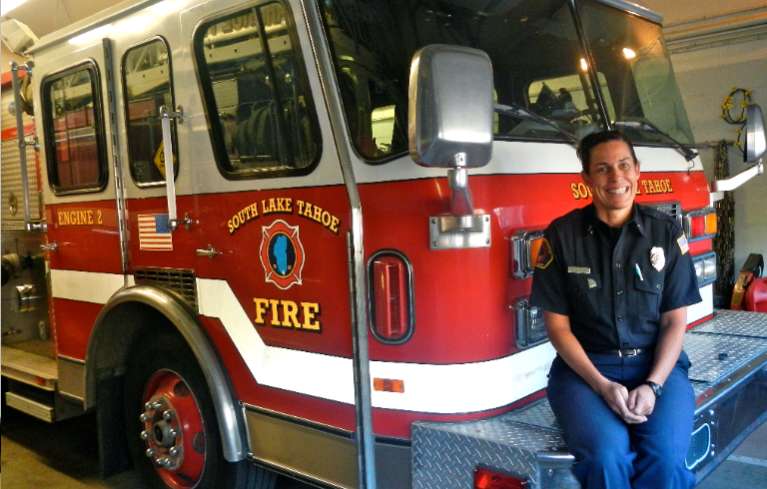
Leslie Asbury didn’t grow up dreaming of being a firefighter. But she became one. She didn’t set out to break ground in South Lake Tahoe, but she is. She isn’t saying she will be a fire chief one day, but she’s on that path.

The 38-year-old South Lake Tahoe firefighter is about to earn her captain’s pin. And in doing so she will be the first female captain in South Lake Tahoe Fire Department’s history.

“The thing I love about this job is you never know what you are going to get when come to work,” Asbury told Lake Tahoe News. “Unfortunately, you deal with lot of people’s really bad days. We try to make it better. It takes a lot of training and education.”

Leslie Asbury is South Lake Tahoe Fire Department's first woman captain. Photo/Kathryn Reed

Leslie Asbury is South Lake Tahoe Fire Department’s first woman captain. Photo/Kathryn Reed

Asbury went to college to become a magazine writer. As she was about to graduate she knew that was not the profession she wanted to pursue. She thought firefighting might interest her so she set up a meeting with a director of an academy in San Jose. That week there was a seminar about women in fire service.

“I fell in love with it,” Asbury said. “The biggest thing is helping people; trying to make a difference in their situation.”

She started with CalFire seasonally in 1998 in Santa Clara.

Asbury took a break to go to paramedic school. Then she went back to CalFire in the Indian Wells area.

She started with South Lake Tahoe in November 2002 as a firefighter-paramedic. A handful of years ago she was promoted to engineer. In May she found out she would be captain.

It’s not a matter of having a higher up promote an individual to captain. A written test, tactical simulation exercise, public presentation, an exercise involving managing a crew and writing a staff report for the chief were some of the criteria to be considered for the promotion to captain.

Plus, there were the prerequisites to apply – the necessary state fire training and education.

“The folks I have worked with, men and women, they want to be identified as firefighters first,” Fire Chief Bruce Martin told Lake Tahoe News. “Women in fire is something I have seen all my career.”

Martin started in business in 1978. Today, across the U.S. the fire service is still is male-dominated profession, with about 10 percent of the work force being women, Martin said.

He said about five years ago he was at a women’s firefighting conference where the group was celebrating the first retirees – showing that a generation of women firefighters have gone through the ranks.

“It brings a necessary diversity to our departments that help us relate better to our communities,” Martin said of having women on staff.

Asbury said being a woman has never been an issue for her at this department. And she doesn’t foresee her promotion changing that.

What she sees changing is having to do more paperwork.

One of the main responsibilities of a captain is being in charge at the scene of an emergency.

“(I will be) making decisions how to mitigate that emergency. Along with that comes the responsibility of making sure your crew is safe and goes home safely,” Asbury said

For Asbury, the hardest calls are the ones that involve children.

Being on the ground June 27, 2007, was hard too. She fought to save homes, but 254 were destroyed in the Angora Fire.

“It was hard to see friends’ houses burned down,” Asbury said.

One of the more memorable calls was when a guy died in front of the crew, but using a defibrillator the paramedics revived him. He was transported to the hospital and lived.

Running and cycling are ways for Asbury to clear her mind of the day’s events – especially the unpleasant ones. She also skis and does triathlons – the half Ironmans.

Note:

• Pinning ceremony is June 28, 4pm, Lake Tahoe Airport.

• Tyler Jack will also receive his captain’s pin.


Opinion: Be prepared to evacuate

By Teri Mizuhara

It’s your day off and you’re home relaxing when suddenly you hear sirens, a lot of them, off in the distance. So you wander outside to see what’s happening when you suddenly spot a large column of smoke from a wildfire on the horizon growing fast.

Your stomach knots up as you realize your worst nightmare is happening before your eyes and you have seconds to respond. What would you do.

Preplanning for an evacuation is in your best interest. When you walk through your home, room by room, and consider exactly what you would need to do when the real thing happens, you will be far better prepared to handle the stress of the situation.

Pre-evacuation preparation steps

When an evacuation is anticipated, follow these checklists (if time allows) to give your home the best chance of surviving a wildfire:

Inside the house

Shut all windows and doors, leaving them unlocked.

Remove flammable window shades and curtains and close metal shutters.

Remove lightweight curtains.

Move flammable furniture to the center of the room, away from windows and doors.

Shut off gas at the meter. Turn off pilot lights.

Leave your lights on so firefighters can see your house under smokey conditions.

Shut off the air conditioning.

Outside

Gather up flammable items from the exterior of the house and bring them inside (patio furniture, children’s toys, door mats, trash cans, etc.) or place them in your pool.

Turn off propane tanks.

Move propane BBQ appliances away from structures.

Connect garden hoses to outside water valves or spigots for use by firefighters. Fill water buckets and place them around the house.

Don’t leave sprinklers on or water running, they can affect critical water pressure.

Leave exterior lights on so your home is visible to firefighters in the smoke or darkness of night.

Put your emergency supply kit in your vehicle.

Back your car into the driveway with vehicle loaded and all doors and windows closed. Carry your car keys with you.

Have a ladder available and place it at the corner of the house for firefighters to quickly access your roof.

Seal attic and ground vents with pre-cut plywood or commercial seals.

Patrol your property and monitor the fire situation. Don’t wait for an evacuation order if you feel threatened.

Check on neighbors and make sure they are preparing to leave.

Animals

Locate your pets and keep them nearby.

Prepare farm animals for transport and think about moving them to a safe location early.

For more information, go online.

Teri Mizuhara is public information officer for the CalFire Amador-El Dorado-Sacramento Unit.


Letter: Is something better than nothing?

To the community,

On June 11, the City Council promised us tomorrow. That day the council approved the permit for part of the original plan for the Chateau project that was billed at $400 million. The plan present on the eleventh will cost under $20 million.

No one knows when what’s left of the Chateau project will be built. If ever. The process adopted on the eleventh, if continued, looks like a cut and paste piecemeal idea for a project.

Bill Crawford

Bill Crawford

Of course, the council did stipulate conditions that have to be met for the project to move forward. Such as bonds to protect the city’s interest. But the rub is, as of the eleventh, nothing was agreed to on paper. It remains to be seen what will be the result of negotiations. But if past performance by the city is a guide, things don’t’ look promising. The council is sitting on pins and needles to get something in the ground at the Chateau site. And that spells trouble.

The councilperson with the most at stake in the present deal is Hal Cole who was a heavy lifter for the Chateau in 2006, which became the embarrassing Hole in the Ground. Cole needs redemption for that mistake. There, it’s said, something is better than nothing. So let’s cut and paste tomorrow.

Bill Crawford, South Lake Tahoe


Colo. fires have officials thinking how to pay for future ones

By Jenny Deam, Los Angeles Times

JEFFERSON COUNTY, Colo. — As five major wildfires rage at the onset of a fire season far from over, many in this state are saying the time has come to consider toughening building regulations and shifting some fire protection costs to those who live in danger zones.

After the deadly 2012 Waldo Fire — at the time the most damaging in state history, with 346 homes lost and two deaths — Gov. John Hickenlooper convened a task force to begin to look at ways to restrict or at least rethink how to build on forestland.

Then the 2013 fire season arrived. The Black Forest Fire ignited on June 11, eclipsing the Waldo Fire in its devastation: 509 homes destroyed, 16,000 acres scorched, two dead — a new “worst in history” record.

“This has become the new normal for Colorado,” said a weary Skip Smith, head of the Department of Forest, Rangeland and Watershed Stewardship at Colorado State University, about the worsening toll of wildfires.

A renewed sense of urgency has enveloped the task force members, who are intent on presenting their final recommendations to Hickenlooper, a Democrat, by the end of the summer.

In nature-loving Colorado — where residents relish their mountain views and have built dream homes and moved to subdivisions deep in the woodlands — many worry that firefighters may not be able to protect forest communities in the new age of heat and drought.

Some recommendations under consideration are unprecedented in Colorado, including assessing additional fire protection fees on residents in high-risk areas, changing insurance rates and enacting brush and tree clearance regulations and stricter building codes that require more fire-resistant materials.

One measure calls for mandatory disclosure of wildfire risks to homeowners. Many people in suburban subdivisions have told authorities they had no idea they lived in danger areas.

“It is not a question of preventing wildfires. There will always be wildfires. But how do you mitigate the risk and reduce the danger?” asked Barbara Kelley, director of the Colorado Department of Regulatory Affairs, who heads the task force.

“We really need to get moving,” she said, “I don’t want to be having this same conversation next summer.”

The task force includes a broad representation of public and private interests — fire officials, home developers, the insurance industry and politicians. More than 1.1 million people in Colorado live in “red zones,” areas at high risk for fire, according to Census data analyzed by I-News Network, a public service journalism organization. That represents roughly 1 in 4 Colorado homes.

If development continues at the current pace, the number of acres of new residential land in forested areas is expected to more than double to 2.1 million by 2030, said Joe Duda, deputy state forester.

“Years ago there were fires, but there were less people in the fire area so it was less critical,” he said, “If we don’t get our arms around this now, it is going to get away from us.”

As he spoke with the Times on Thursday night, Duda was packing for mandatory evacuation from the town of South Fork as the massive West Fork Complex wildfire was bearing down. On Friday, the town’s entire population of about 600 was ordered out, and officials worried it might not be saved. By Saturday, however, the blaze had slowed its course, easing fears.

Kelly says people who live in fire areas do not typically cause fires or increase their severity, but the resources needed to protect them is extraordinarily high.

She sees the fire protection recommendation as a question of paying your fair share: With the scenery comes responsibility.

Under the current system, there is no disincentive for residents to live in a fire zone, Duda said.

City and county governments often welcome plans for new development and have generally not considered the cost of protecting those homes against fire, he said.

The insurance industry often does not assess higher premiums for homes in fire danger areas, so all homeowners are subsidizing those in high-risk areas, according to testimony at a recent task force meeting.

As development creeps into forested land, thinning of trees and controlled burns also become less palatable to residents. A 2008 assessment of Colorado forests showed millions of acres of trees that were considered unhealthy but allowed to stand.

There is little doubt wildfire protection is getting more expensive, said Ray Rasker, executive director of Headwaters Economics, a nonprofit research group based in Bozeman, Mont., that studies environmental issues in the West.

Nationally, $3 billion is allocated to federal agencies to fight wildfires — three times the amount a decade ago, Rasker said. Of that, at least a third is going to defend homes.

During the same decade, the number of acres burned across the country doubled, mostly in the West, Rasker said.

Supporters of tougher regulations predict homeowners and some elected officials will push back on the task force’s upcoming recommendations.

There is a long-standing tradition in Colorado and other Rocky Mountain states of local governments being reluctant to interfere with something as personal as where people should live. The joke is that “code” is a fighting word.

Rasker says one solution might be to shift some of the burden of protecting homes in forested lands — much of which now is borne by the federal government — to the local level. He said the staggering costs alone might be enough to put some teeth into building restrictions.

“Governments and people have to have the intestinal fortitude to do the right thing, and the right thing is not the easy thing,” Duda said. “We’re going to have to think differently.”


Nev. lawmakers bet on tax breaks to generate revenue

By Andrew Doughman, Las Vegas Sun

Actor Nicolas Cage told legislators that investors and movie producers could flock to Nevada.

But he would only get to produce his “four scripts that could easily be shot in Nevada” if the Legislature passed a $20 million tax credit for the film industry, Cage told lawmakers several months ago. Legislators passed the bill, but only time will tell whether the $20 million tax discounts will ultimately bring more jobs and investment to the state.

The gamble for the state is this: Pay for schools, public safety, roads and other services now, or give some money away in hopes that the businesses receiving tax breaks will bring even more money to the state in future years.

Legislators made this bet again and again and again during the legislative session that ended this month in what’s become a give-’em-a-break ritual.

“We always have bills that deal with abatements,” said Carole Vilardo, director of the Nevada Taxpayers Association.

Legislators authorized hundreds of millions of dollars in potential tax breaks, most of which will benefit large businesses and organizations. (That’s in addition to hundreds of millions of dollars in breaks for things like energy-efficient buildings and renewable energy development.)

Whether it’s movie tax credits, insurance tax breaks for companies or investors, property tax exemptions or energy bill discounts, here’s a look at whom the Legislature helped this year.

With a banner cry of “help us help Nic Cage,” legislators passed the film tax credit bill, which the bill’s sponsor said will help attract all sorts of new business to Nevada.

Senate Bill 165 also had the enthusiastic support of Mayor Carolyn Goodman, who told a legislative committee that “my wholehearted support for his bill is beyond wholehearted.”

Basically, the bill says people filming movies, TV shows and other programs spending 60 percent of their production costs in Nevada can then claim tax credits for 15 percent of the expenses.

Sen. Aaron Ford, D-Las Vegas, said the bill will help stimulate a small but growing film industry in Nevada.

Critics of the bill attacked it from both the political right and left.

Former state Sen. Sheila Leslie, D-Reno, said on Twitter that she’d rather see the state spend money on health and education programs than give tax breaks to film companies.

Conservative critics said the government shouldn’t pick which industries deserve a tax break.

“That’s money that’s not available for a tax cut for everyone,” said Victor Joecks of the Nevada Policy Research Institute, a think tank critical of the film tax bill. “That’s money that’s not available for a government program.”

Will the tax credit bring in more money for government programs? Nevadans should know in five years, once the program expires and reports show how much went out and how much came back in.

Arguably the best deal for businesses is a tax credit that allows investors to get a tax break that eventually equals 58 percent of their investment.

In Senate Bill 357, the Legislature authorized up to $200 million in statewide “new market tax credits” that are generally awarded when investors put money into businesses in poor neighborhoods with high unemployment rates.

After an initial two years during which no exemption is awarded, investors can deduct from the state insurance premium tax 12 percent for the next three years and 11 percent for the next two years.

Unlike the film tax credits, nobody can trade or sell these on the open market.

Still, it’s not just the financial firms that get a tax break for insurance premium taxes. Under the law, investment firms like the ones that lobbied the Nevada Legislature will get to transfer the tax credits to their partners, members or shareholders in Nevada.

If those members are large insurance companies in Nevada, they could be able to claim a significant deduction on the state’s insurance premium tax.

The law, sponsored by Sen. Michael Roberson, R-Henderson, is modeled on a similar federal program designed to provide investors with an incentive to enter low-income markets and allow businesses in low-income communities to access private capital.

The current recipients of the federal tax credit in Nevada are banks and other investors.

It’s unclear which groups will participate in the state-level program.

Out-of-state manufacturing companies would benefit from another state-sponsored abatement.

The Nevada Manufacturers Association has long lamented that Nevada has some of the highest energy rates in the Western United States. So commercial and industrial businesses that might otherwise find Nevada’s low-tax environment attractive don’t come here partially because of high energy costs.

Assembly Speaker Marilyn Kirkpatrick, D-Las Vegas, sponsored Assembly Bill 239 in hopes of changing that.

New companies coming into Nevada can get up to a 30 percent discount on their energy rates during the first year they’re in the state, up to a 20 percent discount during the second and third years, and up to a 10 percent discount during the fourth year.

But the rate reduction is limited. These new companies could get a discount for up to 50 megawatts of energy use.

A report to the Legislature in 2015 should show how many companies participated in the program and how much of a discount they got.

Businesses that want to give more than $500,000 to Nevada’s universities and colleges can also get property tax breaks under certain conditions.

A new law created by Assembly Bill 138 allows businesses to invest in support of college certification, research or training in exchange for a property tax break up to 50 percent of the value of the investment for five years.

So, if the business meets all the requirements and invests $1 million, it could deduct $500,000 or 50 percent of its property tax bill, whichever is less.

It’s not just donations that qualify businesses for the tax break.

Businesses can give universities money, personal property or other assets to get the tax break, too.

In addition to the benefit to the universities, the businesses have to employ students as well.

Although legislators wrote in Assembly Bill 138 that tax exemptions “will achieve a bona fide social or economic purpose and that the benefits of the exemption are expected to exceed any adverse effect of the exemption,” nobody really knows what will happen.

Critics of these incentives and tax breaks say the money could go to health care or schools, both top priorities for Democrats at the Legislature this year. Critics on the right say that eliminating these specific incentives could allow the state government to lower tax rates for everybody.

Are the discounts worth it?

“You can make the argument that we’d collect more if you hadn’t given it,” said Steve Hill, the director of the Governor’s Office of Economic Development, which oversees many incentive and tax break programs. “Then you can make the argument that they wouldn’t have come without the abatement.”

This year, the Legislature also passed some bills to look at whether these tax breaks are actually working and whether they need a fix.

“This ought to be a virtuous circle where the Legislature sets policy, we implement that, we measure the results,” Hill said.

Because of those bills, Nevadans may know whether these gambits pay off. The governor signed into law Assembly bills 333 and 466, both of which will measure the costs and benefits of tax breaks, deductions, credits, abatements and so on.

“You’ll know if you’re building a farm or if you’re giving away a farm,” Vilardo said.



Postcards’ importance fades with technology

By Monica Cure

In this age of Instagram and Twitter, it is easy to forget how recently postcards were a principal way of sending images and short messages. Nothing about postal communication seems appropriate for that today: Someone once confessed to me that he hand-delivers postcards after he returns from a trip because they arrive more quickly that way.

Yet when postcards were invented, they were revolutionary technology — and caused their own uproar.

It was 1865 when German postal official Heinrich von Stephan was the first to propose the adoption of what he described as an “open post-sheet” made of stiff paper. One side would be reserved for the recipient’s address, and the other side would have just enough space for a brief message. It would circulate at the cheapest rate possible.

Von Stephan’s proposal was rejected as too radical.

It seemed economically unworkable to the other delegates of the Austro-German Postal Conference. Who would forgo their privacy, even for the sake of convenience and frugality?

Four years later, when a similar proposal was accepted by the Austrian post office, the public answered that question. Three million postcards passed through the Austrian post within the first three months. Nations around the world quickly issued their own official postcards. Seventy-five million were sent in Britain in 1870, the year it adopted the new medium.

The postcard’s popularity baffled and even appalled the cultural elite. On one hand, it seemed ridiculous and highly inappropriate to write anything remotely personal on a postcard, where postal workers, neighbors or servants could read the message. On the other hand, if one lacked anything substantial to write, why write at all? The smaller format inhibited sustained thought. Some even blamed the postcard for a decline in literacy and argued that its shorter format led to poor grammar.

“I have no words in which to speak of this abomination,” complained one writer in Scribner’s Magazine in 1908. “It symbolizes the triumph of the commonplace, of the cheap-and-easy, the utter capitulation of individuality…. On their edges will be scrawled flying words, and some initials … to me who so dearly love a quiet letter from a friend, [even] written infrequently.”

Postcard enthusiasts became just as extreme in their pronouncements. They saw it as a symbol of democracy itself and a revolution in interpersonal communication. Affordable to all, the postcard was hailed as the most important postal advancement since the penny post. It created more points of contact between family members and friends, regardless of class. It was even credited with facilitating global understanding through the establishment of international postcard exchange clubs.

For true postcard aficionados, communicating via postcard was not just easier but also better. They waxed poetic about the sentimental merits of this new abbreviated medium. Less room to write meant instant synecdoche. “Wish you were here” on a hand-colored postcard of the “moonlit” Eiffel Tower — necessarily just a taste of what the sender was thinking as he put pen to card — could evoke a world of desire. The recipient would imagine the rest.

Yet, ultimately, this way of saying everything could also be interpreted as saying nothing. As telephone service spread exponentially in the early 1900s, it now seemed to exemplify all the benefits once attributed to sending a postcard. Placing a call was faster and eventually would become cheaper so that one could both “say” more and say it more easily.

The postcard’s history reminds us that there are always hopes and fears projected onto the latest communication technology. Ease and speed promise greater intimacy, but eventually the very attributes that attracted us to the new form seem to strip messages of their depth.

We’ve all experienced the thrill of reconnecting with elementary school friends on Facebook before slowly realizing we have nothing in common with them. Instagram continually reminds us that seeing what people ate for dinner feels like the furthest thing from actually having dinner with them.

Each new form gestures toward the fantasy of perfect communication. And each, in turn, becomes dispensable once it disappoints us.

A friend recently found out that her 25-year-old brother-in-law had never received a postcard in his life. She told me this with an air of such sadness and regret, as if that fact conveyed so much of what was wrong with the world. It seemed to imply that no one cared enough to take the trouble to buy a simple postcard and stamp, write a few lines and mail it to him. She decided to be the first.

Perhaps we have it backward. We seek communication that is easy and effortless, and think that will foster genuine connection. But what truly matters is the trouble we take.

Monica Cure is an assistant professor in the Torrey Honors Institute at Biola University. This article first appeared in the Los Angeles Times.