By Corey G. Johnson, Center for Investigative Reporting
Doctors under contract with the California Department of Corrections and Rehabilitation sterilized nearly 150 female inmates from 2006 to 2010 without required state approvals, the Center for Investigative Reporting has found.
The women received tubal ligations in violation of prison rules during those five years – and there are perhaps 100 more dating back to the late 1990s, according to state documents and interviews.
From 1997 to 2010, the state paid doctors $147,460 to perform the procedure, according to a database of contracted medical services for state prisoners.
The women were signed up for the surgery while they were pregnant and housed at the California Institution for Women in Corona or Valley State Prison for Women in Chowchilla, which is now a men’s prison.
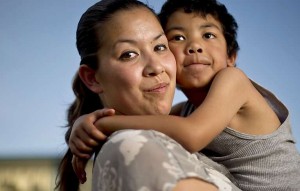
Crystal Nguyen, with son Neiko, 6, says Valley State Prison infirmary staff offered sterilizations. Photo/Noah Berger/CIR
Former inmates and prisoner advocates say that prison medical staff coerced the women, targeting those deemed likely to return to prison in the future.
Crystal Nguyen, a former Valley State Prison inmate who worked in the prison’s infirmary during 2007, said she often overheard medical staff asking inmates who had served multiple prison terms to agree to be sterilized.
“I was like, ‘Oh my God, that’s not right,'” Nguyen, 28, said. “Do they think they’re animals, and they don’t want them to breed anymore?”
One former Valley State inmate who gave birth to a son in October 2006 said the institution’s OB/GYN, Dr. James Heinrich, repeatedly pressured her to agree to a tubal ligation.
“As soon as he found out that I had five kids, he suggested that I look into getting it done. The closer I got to my due date, the more he talked about it,” said Christina Cordero, 34, who spent two years in prison for auto theft. “He made me feel like a bad mother if I didn’t do it.”
Cordero, who was released in 2008 and lives in Upland San Bernardino County, agreed. But she added: “Today, I wish I would have never had it done.”
The allegations echo those made nearly a half-century ago, when forced sterilizations of prisoners, the mentally ill and the poor were commonplace in California. State lawmakers officially banned such practices in 1979.
During an interview with CIR, Heinrich said he provided an important service to low-income women who faced health risks in future pregnancies because of past cesarean sections.
The 69-year-old Bay Area physician denied pressuring anyone. Referring to the $147,460 total, he said, “Over a 10-year period, that isn’t a huge amount of money, compared to what you save in welfare paying for these unwanted children.”
The top medical manager at Valley State Prison from 2005 to 2008 characterized the surgeries as providing inmates with the same options as women on the outside.
Daun Martin, a licensed psychologist, also contended that some pregnant women, particularly those who were on drugs or homeless, would commit crimes so they could return to prison for better health care.
The California Institution for Women in Corona was one of two state prisons where female inmates were sterilized without required state approvals. At least 148 women received tubal ligations in violation of prison rules from 2006 to 2010.
“Do I criticize those women for manipulating the system because they’re pregnant? Absolutely not,” Martin, 73, said. “But I don’t think it should happen. And I’d like to find ways to decrease that.”
Martin denied approving the surgeries, but at least 60 tubal ligations were done at Valley State while she was in charge, according to the state contracts database.
Federal and state laws ban inmate sterilizations if federal funds are used, reflecting concerns that prisoners might feel pressured to comply. California used state funds instead, but since 1994, the procedure has required approval from top medical officials in Sacramento on a case-by-case basis.
But no request for tubal ligations has come before the health care committee responsible for approving such restricted surgeries, said Dr. Ricki Barnett, who tracks medical services and costs for the California Prison Health Care Receivership Corp.
The receiver has overseen medical care in all 33 of the state’s prisons since 2006, when U.S. District Judge Thelton Henderson in San Francisco ruled that the system’s health care violated the constitutional ban on cruel and unusual punishment.
The receiver’s office was aware that sterilizations were happening, records show.
In September 2008, the prisoner rights group Justice Now received a written response to questions about the treatment of pregnant inmates from Tim Rougeux, then the receiver’s chief operating officer. The letter acknowledged that the two prisons offered sterilization surgery to women.
But nothing changed until 2010, after the Oakland organization filed a public records request and complained to the office of state Sen. Carol Liu, D-La Cañada Flintridge. Liu was the chairwoman of the Select Committee on Women and Children in the Criminal Justice System.
Prompted by a phone call from Liu’s staff, Barnett said the receiver’s top medical officer asked her to research the matter. After analyzing medical and cost records, Barnett met in 2010 with officials at both women’s prisons and contract health professionals affiliated with nearby hospitals.
The 16-year-old restriction on tubal ligations seemed to be news to them, Barnett recalled. And, she said, none of the doctors thought they needed permission to perform the surgery on inmates.
“Everybody was operating on the fact that this was a perfectly reasonable thing to do,” she said.
Martin, the Valley State Prison medical manager, said she and her staff had discovered the procedure was restricted five years earlier. Someone had complained about the sterilization of an inmate, Martin recalled. That prompted Martin to research the prison’s medical rules.
Martin said she and Heinrich began to look for ways around the restrictions. Both believed the rules were unfair to women, she said.
“I’m sure that on a couple of occasions, (Heinrich) brought an issue to me saying, ‘Mary Smith is having a medical emergency’ kind of thing, ‘and we ought to have a tubal ligation. She’s got six kids. Can we do it?’ ” Martin said. “And I said, ‘Well, if you document it as a medical emergency, perhaps.'”
Heinrich said he offered tubal ligations only to pregnant inmates with a history of at least three C-sections. Additional pregnancies would be dangerous for these women, Heinrich said, because scar tissue inside the uterus could tear.
Former inmates tell a different story.
Michelle Anderson, who gave birth in December 2006 while at Valley State, said she’d had one prior C-section. Anderson, 44, repeatedly was asked to agree to be sterilized, she said, and was not told what risk factors led to the requests. She refused.
Nikki Montano also had had one C-section before she landed at Valley State in 2008, pregnant and battling drug addiction.
Montano, 42, was serving time after pleading guilty to burglary, forgery and receiving stolen property. The mother of seven children, she said neither Heinrich nor the medical staff told her why she needed a tubal ligation.
“I figured that’s just what happens in prison – that that’s the best kind of doctor you’re going get,” Montano said. “He never told me nothing about nothing.”
But Montano eagerly agreed to the surgery and said she thinks it had a positive effect on her life.
Dr. Carolyn Sufrin, an OB/GYN at San Francisco General Hospital who teaches at UCSF, said it is not common practice to offer tubal ligations to women who’ve had one C-section. She confirmed that having multiple C-sections increases the risk of complications.
But even then, Sufrin said, it’s more appropriate to offer women reversible means of birth control.
Lawsuits, a U.S. Supreme Court ruling and public outrage over eugenics and similar sterilization abuses in Alabama and New York spawned new requirements in the 1970s for doctors to fully inform patients.
Since then, it’s been illegal to pressure anyone to be sterilized or ask for consent during labor or childbirth.
Still, Kimberly Jeffrey says she was pressured by a doctor while sedated and strapped to a surgical table for a C-section in 2010 during a stint at Valley State for a parole violation. Jeffrey, 43, was horrified, she said, and resisted.
“He said, ‘So we’re going to be doing this tubal ligation, right?'” Jeffrey said. “I’m like, ‘Tubal ligation? What are you talking about? I don’t want any procedure. I just want to have my baby.’ I went into a straight panic.”
Jeffrey provided copies of her official prison and hospital medical files to CIR. Those records show Jeffrey rejected a tubal ligation offer during a December 2009 prenatal checkup at Heinrich’s office. A medical report from Jeffrey’s C-section a month later noted that she again refused a tubal ligation request made after she arrived at Madera Community Hospital.
At no time did anyone explain to her any medical justifications for tubal ligation, Jeffrey said.
That experience still haunts Jeffrey, who lives in San Francisco with her 3-year-old son, Noel. She speaks to groups seeking to improve conditions for female prisoners and has lobbied legislators in Sacramento.
State prison officials “are the real repeat offenders,” Jeffrey added. “They repeatedly offended me by denying me my right to dignity and humanity.”
Corey G. Johnson is a reporter for the independent, nonprofit Center for Investigative Reporting, the nation’s largest investigative reporting team.