Bison Fire threatening structures in Lyon County

Updated 7:45pm:

The voluntary evacuation area for the Bison Fire has grown to parts of Lyon County.

Sheriff’s deputies were going door to door this evening asking residents to leave Pipeline Canyon.

The fire that is predominately in Douglas County has consumed 25,773 acres and is 25 percent contained. Full containment is still slated for July 14.

There are now 1,065 firefighters on the scene. On firefighter twisted a knee.

Several old mining structures have been destroyed.

Additional heavy helicopters are assisting in the aerial firefighting efforts, with winds on Tuesday posing less of a problem on certain areas of the fire than in past days.

The following road closures to non-residents are currently in place for:

Pine Nut Road at the intersection of Out-R-Way

East Valley Road at Grandview

Sunrise Pass Road at Coyote Rock

Brunswick Canyon Road

Mexican Dam Road

Sunrise Pass Road at Artesia Road.

—–

Crews were able to make significant progress on the Bison Fire early Tuesday morning after the winds died down about 3am.

It has, however, increased in size to 25,733 acres. It is 25 percent contained, with full containment expected July 14.

The fire in the Pine Mountains of Douglas County started July 4 from a lightning strike.

The fire ran through the Slater Mine area on Sunday burning several old structures, but no further structures have been reported destroyed.

Road closures in the area are still in place.

— Lake Tahoe News staff report


Younger readers prefer print over e-readers

By Aron Chilewich, New Republic

A study from the Pew Research Center on young Americans’ library habits defies the conventional narrative of today’s youth as a generation who has abandoned print. Despite being heavy Internet users, the press release states that “Americans under age 30 are strong supporters of traditional library services,” including in-person assistance and — yes — books.

Pew found that Americans between the ages of 16 and 29 were actually more likely to have read a book in print in the past year than their 30-and-up counterparts; the breakdown was 75 percent to 64 percent, respectively. (Americans in this younger age bracket were also more likely to have visited a library in the past year, about as likely to have received assistance from a librarian in the past year, more likely to utilize a library’s quiet space and more likely to be “strongly opposed” to the idea of automated check-out services than older Americans.)

And, despite growing popularity of e-books among all age ranges, Americans aged 30 to 49 are more likely than Americans aged 16 to 29 to own an e-reader or tablet computer.

So what’s going on here? In part, it’s that young people who are still in school tend to stick to pretty conventional research methods.

As Kathryn Zuckuhr, one of the authors of the study, told me in an email, “The need to do reading and research for school are definitely part of what’s keeping print the base of many younger Americans’ reading habits.” (The same team of researchers found in 2011 that between ages 16 and 29, 81 percent of readers gave school or work as their reason for reading, 76 percent said they read for pleasure, 73 percent to keep up with current events and 81 percent to research a topic of interest.)

Another possible reason is that schools have not switched over to e-readers and e-books. Cost is likely a major factor here — and also probably explains why adults are more likely to own e-readers. Young people who are reading e-books were “more likely to read their e-books on a computer (55 percent) or cell phone (41 percent),” Zuckuhr said.

Perhaps, then, the continued prevalence of print books has less to do with their popularity than with the ease with availability. Young people may be in the process of transitioning to e-books and e-readers, only at a slower pace due to their more limited resources. For now, at least, we have paper.


Mancuso focuses training on Sochi Olympics

By AP

Julia Mancuso is holding her breath for the Sochi Olympics. So far, she can stay under water for more than a minute.

The Squaw Valley skier incorporated freediving into her training program this summer in Maui, plunging under the ocean’s surface to collect shells and gaze at aquatic life.

Mancuso usually spends her offseason mountain biking and surfing the big waves around the island. Being an Olympic year, though, she’s decided to stay “a little less radical in my other sports I do.”

That’s why she picked up freediving, which is like snorkeling, except without, well, the snorkel.

Later this month, Mancuso will swap the sea for snow as she ventures to New Zealand for camp with the U.S. ski squad.

After all, Sochi is just seven months away.

“It’s approaching really fast,” said Mancuso, who splits her time between Hawaii and Squaw Valley. “Just have to keep getting strong and stay healthy.”

Mancuso is coming off a solid World Cup season, but one that was pretty much overshadowed by Tina Maze’s amazing run. The Slovenian compiled a record 2,414 points to take the overall crown away from Lindsey Vonn, who sustained a season-ending knee injury in a February crash.

The 29-year-old Mancuso finished on the podium four times, all in the super-G. She wound up second overall in that discipline, behind Maze.

Given Maze’s extraordinary season, though, along with Vonn’s expected return from a torn ACL and the rise of U.S. teenager Mikaela Shiffrin, Mancuso realizes that she probably won’t be among the favorites heading into Sochi.

That’s fine with her. She hardly ever is at the Olympics, even though she typically saves her best for the biggest of stages.

Mancuso captured gold in the giant slalom at the 2006 Turin Games. Four years later in Vancouver, she stole some of the spotlight from Vonn, taking silver in both the downhill and super-combined.

“I definitely perform well under pressure,” said Mancuso, who recently added ZICO Pure Premium Coconut Water as a sponsor. “I think it will be really exciting having a little more pressure going into Sochi.

“I’ve always thought of the Olympics like it’s another race and just try to shine.”

Rain or shine, she’s been enjoying her time in Maui, even if she’s curtailed some of her usual activities.

By this time of year, she’s normally visited most of her treasured spots to surf and stand-up paddle. And by this time of year, she’s also put plenty of daring miles on her mountain bike.

Not so much this offseason.

“I’ve been training really hard. But it’s just a little more focused, like instead of going on a crazy mountain bike ride, I might ride the stationary bike and watch a movie,” Mancuso explained. “Every summer I train hard, but it’s more important to stay injury free. In the past, I’d just be playing and maybe hurt myself. A sprained ankle or something, or just little tiny things that kind of put you back a week in training.”

And that’s why she picked up freediving to fill her time. In the process, she’s amassed quite a collection of sea shells.

“It’s a lot of fun,” said Mancuso, who’s planning a vacation to Fiji later this summer to freedive with friends. “We have these really cool fins, three-foot fins, and we stay in the water for a really long time, dive and just search for shells.”

These days, Mancuso is in a good place — more at peace and more relaxed. That has a lot to do with being healthy, which hasn’t always been the case. For years after winning gold in 2006, Mancuso dealt with nagging back problems that fragmented her training.

“It’s horrible trying to perform when something is hurting you. You couldn’t train that extra day because something was hurt, couldn’t push yourself as hard because you were holding back,” Mancuso said. “But I’ve learned to take care of my body. Dealing with injuries is a big part of being an athlete and being happy.”

There’s also this: Things are well with boyfriend and fellow skier Aksel Lund Svindal of Norway, even if they don’t see each other as much as they would like.

“We’re so busy that it’s fine. We’re both really driven,” Mancuso said. “That’s just part of the game, when you have a lot of personal goals, when you want to win, and you live on other side of the continent.

“But it’s cool to have a good friend on the World Cup circuit, a good friend who’s your boyfriend.”

Her new goal? Introduce Svindal to freediving.

“Maybe he will be into freediving. We’ll see,” Mancuso said. “This summer has been really good for me.”


Study: Exercise lowers anxiety

By CBS News

Exercise can lower anxiety, but how it does so remains a mystery. Now, a new study conducted at Princeton University, published in the Journal of Neuroscience, may offer clues as to what happens in the brain.

Conducted on mice, the study was done on two groups of the animals. The first group was was given a good amount of exercise and the other was more sedentary. Upon studying their brains, researchers found both groups had formed new brain cells called neurons, but the exercisers formed more neurons that release the neurotransmitter GABA, which has a calming effect on the brain.

Dr. Holly Phillips noted on “CBS This Morning,” that GABA is known to reduce anxiety. In fact, many prescription anxiety drugs cause the brain to release GABA. “These cells help to calm down the brain and hence fight anxiety,” she said.

It’s also likely, Phillips said, that the results will translate very well into humans. She said, “We’ve suspected for a very long time that GABA would, of course, be involved and now, there’s just extra (evidence) of that.”

Exercise actually changes the brain permanently, Phillips pointed out. It changes the types of cells that are there. Phillips added, “This is important because then it has lasting effects. Even 24 hours after exercise, you’re less prone to experience anxiety symptoms.”

Phillips says exercising 30 minutes four days a week can help, based on other studies on exercise.

She added, “For anxiety in particular, high-intensity exercise is really important and also we’re always looking for natural alternatives. Some of the anti-anxiety medications can be habit-forming and anytime we can do something where we don’t need to take a medication, of course, is a good thing.”


Snippets about Lake Tahoe

fallen leaf lake• Fallen Leaf Lake Fire Department’s annual wine tasting is July 27 at 5pm at Fire Station No. 9.

• Greensky Bluegrass will be playing the Phish after-party on July 30 at Blu Nightclub at MontBleu in Stateline.

• The Bicycle Advisory Committee of the South Lake Tahoe Recreation Facilities Joint Powers Authority will meet July 12 from 9–11am in the upstairs conference room at Lake Tahoe Airport.

• El Dorado County Office of Vital Statistics will expand its hours July 15 to Monday through Friday from 8am-5pm, with processing of documents ending at 4pm.

• The Ragnar Trail Relay Run is July 26-27 at Sierra-at-Tahoe.


Report: 2000-10 hottest decade on record

By K. Kaufmann, Desert Sun

It’s now official. The decade of 2001-2010 was the warmest on record, causing almost a 2,300 percent spike worldwide in heat-related deaths.

That shocking figure is one of many contained in the report, “The Global Climate 2001-2010, A Decade of Climate Extremes,” released last week in Geneva by the World Meteorological Organization. An agency of the United Nations, the WMO has members from 191 countries and territories worldwide and is dedicated to creating networks for collecting and sharing weather and climate data and expertise.

The report is 20 pages of meteorological figures and charts, some rather technical, but what it all boils down to, in the report’s opening sentence, is that:

“The first decade of the 21st century was the warmest decade recorded since modern measurements began around 1850. It saw above-average precipitation, including one year — 2010 — that broke all previous records.

“Many of these events and trends can be explained by the natural variability of the climate system. Rising atmospheric concentrations of greenhouse gases, however, are also affecting the climate. Detecting the respective roles being played by climate variability and human-induced climate change is one of the key challenges facing researchers today.”

What all this means, according to the WMO summary of the report:

“Every year of the decade except 2008 was among the 10 warmest years on record. … Results from WMO’s survey showed that nearly 94 percent of reporting countries had their warmest decade in 2001-2010 and no country reported a nationwide average decadal temperature anomaly cooler than the long-term average.”

The long-term analysis is important, the report notes, because distinguishing between individual extreme weather events and climate change requires long-term data, precisely because extreme weather events do not occur frequently. A decade is the minimum time frame for detecting temperature changes, the report says.


Rash of car thefts in South Lake Tahoe

Auto thieves in South Lake Tahoe are targeting vans.

In three days five vehicles have been stolen or thieves tried to steal them.

No arrests have been made.

Thefts include:

• July 4: 1992 Dodge van stolen from 2111 South Ave. This van was located and recovered locally.

• July 7: 1993 dark Green Ford Aerostar Van was stolen from 861 Emerald Bay Road. This van has not been located. It has “bondo” material on the left rear quarter panel and has separating paint. It has a California license plate No. 4BLP370.

• July 7: 2013 a black 2000 Ford E350 was broken into at 924 Emerald Bay Road. The ignition was damaged.

• July 9: 2006 Ford E350 1-ton diesel extended length van was stolen from 976 Emerald Bay Road. This vehicle has not been located. It is all white. It has a California license plate No. 8G35339 and displays the number16 in 4-inch block letters near both front doors and on rear of the van.

• July 9: An attempt was made to steal a 1989 Ford Bronco from 976 Emerald Bay Road. The ignition was damaged.

It another case, which may be related, the Placerville Police Department investigated the theft of a van from the Marshall Hospital parking lot in Placerville on July 8. This vehicle was recovered.

Officers suggest the following tips to protect you from having your vehicle stolen.

• Do not leave keys in vehicle. Thieves are very skilled at locating hidden keys.

• Lock your vehicle. No community is exempt from this type of crime, and this simple step will ward away the less determined criminal.

• Diminish attention. Don’t leave valuables or documents in plain view.

• Security devices. Remember to activate your alarm if equipped. Steering wheel inhibitors and other theft protection systems such as LoJack can help as well.

• Report suspicious activity. Watch out for your neighborhood and business parking areas.

— Lake Tahoe News staff report


TAMBA to work on Tahoe Rim Trail

In partnership with the Tahoe Rim Trail Association, TAMBA has adopted the segment of the TRT from Tahoe Meadows to Hobart Road.

This segment gets the highest bike use of any section of the Tahoe Rim Trail. Last week a group did a trail assessment to plan out what is needed to bring the trail back to the original design standards. Brushing the corridor is needed along much of the trail, there are braided go-arounds that are being created around some of the rocky sections as well as general wear and tear on the trail in many areas that need shoring up.

Work on the trail every Monday in July starting at 5:30pm.

July 15- Meet at 5:30pm at the west end of Tahoe Meadows. Hike in with tools about one mile to Chickadee Ridge.

July 22- Meet at 5:30pm at the west end of Tahoe Meadows.

July 29- Meet location TBD.


Camp-build-ride weekend for mountain bikers

TAMBA is putting on a camp-build-ride weekend July 19-21.

Camping provided Friday and Saturday at Campground by the Lake, TAMBA Trail Day on Saturday building the new Monument Pass connector, and rides of varying difficulty on Sunday.

Rebecca Rusch, who recently completed a world-record ride on the 142-mile Kokopelli Trail, will be giving a presentation July 19 at Sports Ltd. in South Lake Tahoe starting at 7:30pm. There will be social hour starting at 6pm. Cost is $15.

Go online for more info about the three days.


Incline Lake may forever be dry

By Kathryn Reed

INCLINE VILLAGE – Should a manmade lake at Lake Tahoe be restored? Or should the acreage be returned to what it was pre-1930s?

Those are some of the basic questions being asked by the Lake Tahoe Basin Management Unit. The answers aren’t as simple.

A handful of people showed up Monday night to give the U.S. Forest Service input into what was Incline Lake. The 777-acre parcel was acquired in 2008 from the Incline Lake Corp. The final price, though, of $43.5 million was not settled until 2011.

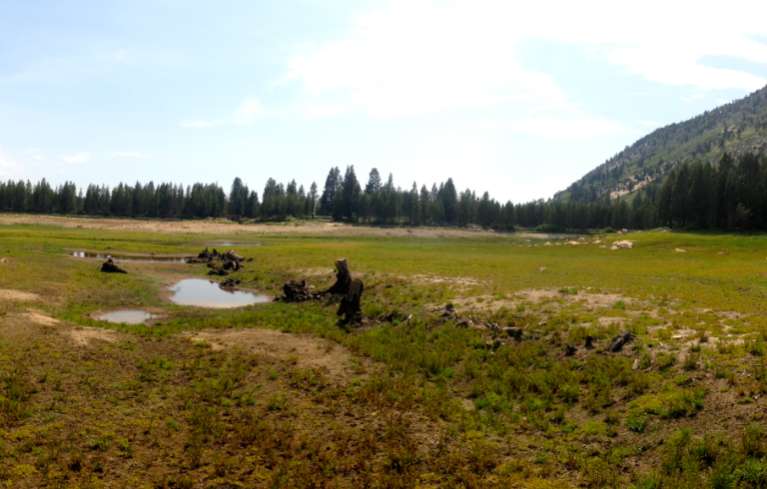
The private lake had existed since the 1930s. It was regularly stocked so fishermen would have something to catch. The lake covered 19 acres of the land that is situated along Mount Rose Highway. It is about a mile below Tahoe Meadows and to the left if driving toward Reno.

Two national forests and Incline Village General Improvement District own the land surrounding the parcel. That is in large part why the Forest Service wanted the land – to remove that private parcel from the middle of forest and make it contiguous public property for recreation use.

Ponds are naturally forming where Incline Lake used to be. Photo/Matt Dickinson

Ponds are naturally forming where Incline Lake used to be. Photo/Matt Dickinson

The lake was drained in 2009 because the dam was deemed seismically unfit. It was the previous owner that drained the lake and took down all structures on the property.

The entire area is open for public use. Hikers and bikers are welcome, but no motorized vehicles.

The Forest Service is taking comments on the scoping documents until July 19. Today the agency is looking at removing the dam and restoring the land to a marsh area. It could resemble what Grass Lake on Luther Pass is like. This would be 15 to 20 years out to allow Mother Nature to do her work.

“I’m leaning more toward rustic wetlands. I like their proposal,” Sue Hughes of Incline told Lake Tahoe News as she was leaving the July 8 open house at the IVGID offices.

Ponds are already starting to naturally form. John Gregory of Incline said water flows year-round at this location.

Leaving the dam and refilling the lake are not options because of the instability of the rock structure. This area is prone to earthquakes and downstream is where the bulk of Incline Village residents live. It is possible a smaller dam could be built, but that would also mean a smaller lake.

Dan Dominy of Incline is a fisherman who for years enjoyed casting a line there. He worries about what the impacts might be if more people use the area in the future, especially since there is a road on the land.

The Forest Service has $5 million set aside for improvements. Dam building and then the subsequent maintenance would require more money.

A network of trails and signage are possible. Informal trails exist today. One leads to the Mount Rose Wilderness, another goes along Third Creek to downtown Incline.

An environmental analysis will likely be released in January 2014. Work – whatever that looks like – could begin in 2015 building season.

Notes:

• The next meeting about the future of his property is July 10 from 5-7pm at Homewood Suites, 5450 Kietzke Lane, Reno.

• Comment deadline is July 19.

• More info is online.