Study: Wildfires have role in global warming

By Geoffrey Mohan, Los Angeles Times

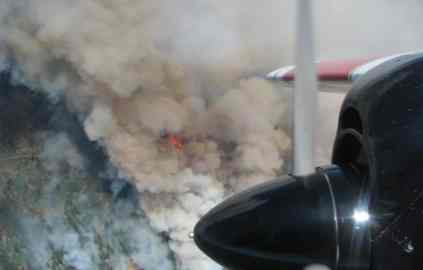
Wildfires such as the Yarnell Hill blaze in Arizona may be warming Earth’s atmosphere far more than previously thought, according to a study by Los Alamos National Laboratory.

Researchers at the Department of Energy facility normally chase fires throughout the western U.S., to measure their atmospheric effects. But in 2011, they took advantage of a conflagration that came to their doorstep – the Las Conchas fire that burned more than 150,000 acres and briefly caused the evacuation of the sprawling facility in the New Mexico desert.

“This was just an opportunity in our backyard,” said Manvendra Dubey, a senior atmospheric scientist at the laboratory. “It was a freebie for me, so I couldn’t miss that opportunity.”

After the brief evacuation ended, Dubey’s team set up monitoring devices while the fire continued to rage across the desert scrubland. Their analysis, which included painstaking counting and classification of thousands of particles, revealed components that had not been considered in climate models, most of which have suggested that cooling and warming effects of two kinds of aerosols tended to cancel each other out.

The Los Alamos team identified tar balls – spherical, carbon-based particles – that are 10 times more prevalent than soot particles, and can boost the heating effect of wildfire emissions, according to the study, published last week in the journal Nature Communications.

“We provided the data that shows that current estimates, which are close to zero or show a very slight warming, are incorrect and the warming will be higher,” Dubey said. “We are confident this will change the results and show that fire emissions will have a tendency to warm.”

Close examination of soot also showed these particles were sheathed by organic coatings that “act like a lens to focus sunlight and amplify the sunlight that soot absorbs,” Dubey said.

Wildfires have increased in number, intensity and acreage throughout the southwestern U.S. over the last three decades, driven by climate change and forest management decisions to suppress fires instead of letting them take their natural course. That burning biomass pumps tons of aerosols into the atmosphere, directly changing how sunlight is absorbed, and indirectly affecting the process by influencing cloud formation.

“For a given amount of water vapor in the atmosphere, you could be condensing the water in many, many more small particles. So clouds could become brighter,” Dubey said. “These tar balls can get embedded, and soot can get embedded in clouds, and the clouds can then absorb more sunlight and evaporate faster.”

Climate scientists generally focus on the effects of two aerosols: soot, or black carbon, and smoke, known as organic carbon. Smoke tends to scatter solar radiation, for a net cooling effect. But black carbon absorbs it. Research in the last decade has increasingly suggested that black carbon may be the second strongest contributor to atmospheric warming, behind carbon dioxide, the most well-known greenhouse gas.

The Los Alamos researchers also attempted to simplify the complex chemistry and physics of aerosols. Climate models, they said, should consider aerosols as a combination of tar balls, soot and “other” particles, including smoke and irregularly shaped specks of dust and salt. Soot, they said, can be further classified by its degree of coating, enabling climate modelers to capture the nuanced effects of these particles.

The study results could push the U.S. back into the spotlight cast on emitters of black carbon, said Dubey, who recently spent several months in India. U.S. policymakers have increasingly pointed to the Indian subcontinent and China as major sources of emissions from burning biomass, largely from wood and charcoal fires.

“All these things emit the same; if you burn wood in your open stove or you have a fire, you have some similar emissions,” Dubey said. “I think this gives us all a common language to develop solutions to it.”


Low water level impacts Lahontan Reservoir

Due to low water levels, both launch ramps at the Silver Springs and the Fallon sides are closed at Lahontan State Recreation Area.

Beach launching is available at boaters’ own risk. Decreasing water levels continually expose new rock and sand bar hazards; extreme caution is advised for boats pulling skiers or traveling at higher speeds.

The reservoir is open for camping, swimming, canoeing and fishing.

For more info, call (775) 577.2226.


More structures in path of Bison Fire

The Bison Fire is now the largest wildland fire on record in Northern Nevada – at 25,733 acres.

While the fire is 40 percent contained, it is threatening 98 structures in Douglas and Lyon counties. Lyon County Sheriff’s Department has implemented a voluntary evacuation for Smith Valley subdivision. This will be in place at least through Wednesday afternoon.

Full containment is still expected on July 14.

The cost, to date, to fight this fire is $4,814,994. Aircraft is the biggest expense.

The following road closures to non-residents are currently in place for:

* Pine Nut Road at the intersection of Out-R-Way

*East Valley Road at Grandview

*Sunrise Pass Road at Coyote Rock

*Brunswick Canyon Road

*Mexican Dam Road

*Sunrise Pass Road at Artesia Road.

Lightning started fire July 4. An old mining structure was lost and one firefighter twisted a knee.

— Lake Tahoe News staff report


Smoke from fires creating unhealthy conditions

The Kyburz Fire and other wildfires in the region are creating smoky conditions in some areas of El Dorado County, prompting the county Air Quality Management District and Health Services Department to issue an advisory.

Officials expect that El Dorado County may continue to be affected on an intermittent basis. Smoke conditions can vary a great deal in El Dorado County because of the terrain, wind direction and weather.

Fine particles in smoke can cause health issues, especially for children, older people or those with lung problems.

The following advise is applicable to people being affected by the Bison Fire in Douglas County, too.

Residents who see or smell smoke should consider taking precautions:

• Healthy people should delay strenuous exercise until the smoke has cleared.

• Children and older people should consider avoiding outdoor activity, especially prolonged outdoor exercise.

• People with health-related illnesses, particularly those with lung problems, should stay indoors.

• Windows and doors should stay closed as much as possible. Use the recycle or re-circulate mode on the air conditioner in your home and car.

• Avoid using non-HEPA paper face mask filters that do not filter extra fine particles.

• Keep airways moist by drinking lots of water.

Wildfire smoke can cause coughing, watery and itchy eyes, and difficulty breathing. People with questionable or severe symptoms should seek medical advice. When there is smoke in the air, the smoke visibility index can help people assess the air quality based on visibility in their area.

To assess visibility:

• Face away from the sun. Determine visibility range by looking for targets that are at known distances (miles).

• The visibility range is the distance at which high-contrast objects disappear.

• After determining visibility in miles, use the following Wildfire Smoke Visibility Index to assess air quality.

Visibility

Range (miles)

Health

Category

Precautions

10+

Good

None

5 – 10

Moderate

Unusually sensitive people should consider reducing prolonged or heavy exertion.

3 – 5

Unhealthy for Sensitive Groups

Sensitive people should reduce prolonged or heavy exertion.

1.5 – 3

Unhealthy

Sensitive people should avoid prolonged or heavy exertion. Everyone else should reduce prolonged or heavy exertion.

1 – 1.5

Very Unhealthy

Sensitive people should avoid all physical activity outdoors. Everyone else should avoid prolonged or heavy exertion.

< 1 miles

Hazardous

Sensitive people should remain indoors and keep activity levels low. Everyone else should avoid all physical activity outdoors.


Kyburz Fire at 80% containment

First day assault on Kyburz Fire. Photo/Eldorado National Forest

First day assault on Kyburz Fire. Photo/Eldorado National Forest

Firefighters made significant gains on the Kyburz Fire overnight. The 615-acre blaze is 80 percent contained.

The fire is burning on the north side of Highway 50 in the Eldorado National Forest.

While the highway is completely open, officials are urging motorists to drive slowly, and watch for fire personnel and debris on the road.

Crews will continue today to hold and improve line around the perimeter of the fire, and begin mop up operations. Steep terrain, multiple dead snags, and increasing winds are likely to present challenges to firefighters today.

The fire started early afternoon July 8 when a vehicle lost a tire and that sparked the fire.

— Lake Tahoe News staff report


Beer drinkers want some exercise while imbibing

By Brad Tuttle, Time

Beer tends to be paired with burgers, not bicycles. But around the country, a new recipe in tourism mixes craft-beer tastings with cycling, running and rafting. Think of it as a sweaty spin-off of the foodie craze.

While the clientele tends to be fit, the physical demands of these brew tours are not all that daunting. John Stevens launched Port City Running Tours in his hometown of Portland, Maine, in 2012 and now offers 3-mile jogs on Saturdays with samplings at three breweries.

OARS offers a variety of beer-rafting adventures. Photo/OARS

OARS offers a variety of beer-rafting adventures. Photo/OARS

“The longest stretch is just under a mile,” he says. “Anyone can run that, especially if there’s beer at the end.”

Last year alone, more than 400 new breweries opened in the U.S., as sales of craft beer increased by a whopping 17 percent. Not surprisingly, beerercise expeditions have been popping up in areas with high concentrations of craft breweries and active residents. There’s no national count of such tours, but Portland, home to no fewer than 35 breweries, has at least three beer-focused cycling tours — including the funky Brewcycle, a jointly pedal-powered contraption that fits 15 riders.

And in Fort Collins, Colo. — 145,000 residents, nine breweries. Bob Williams launched Beer and Bike Tours last year, offering scenic day tours and multiday rides in the Rockies with ample brewery breaks. This autumn, the company is peddling beer-bike-foliage tours in Vermont, which has the most craft breweries per capita of any state in the country.

Beer-themed rafting trips have become a big draw for the California outfitter OARS, where in addition to the usual adventure equipment — tents, life jackets and sleeping bags — beer tours require an extra raft just to carry 10 or 11 5-gallon kegs.

“We try to put the kegs down on the bottom of the raft, near the water, to keep them cool,” explains Scott Saulsbury, head brewer for Southern Oregon Brewing Co., who has accompanied OARS on multiday trips down Oregon’s Rogue River for the past two summers.

As for what kind of beer goes best with rafting and cycling, there’s no consensus.

“Some people like porters regardless of what they’re doing, or if it’s 110 degrees,” says Saulsbury. Doctors might suggest water as the best postaerobics beverage, but don’t tell that to craft-brew aficionados. “Beer is just a terrific reward,” says Evan Ross, founder of Oregon’s Cycle Portland Bike Tours. “After working hard, that great feeling you get from beer is your body’s way of saying thank you.”


Teens can experience 3 indoor paintball venues

Teens can spend three days in a paintball camp Aug. 12-14.

The camp is put on by the South Lake Tahoe Parks and Recreation Department.

Preregistration is required.

Bring long pants, long shirt, tennis shoes, baseball cap, swim clothing, extra clean clothing, sunscreen, lunch, a water bottle. Campers will go to the Reno Indoor Paintball facility, Squaw Valley paint ball, and Capital Edge Paintball in Sacramento.

Cost is $225.

For more info, email Jen Menzel at jmenzel@cityofslt.us.


Empty school costs DCSD thousands each month

By Kathryn Reed

ZEPHYR COVE – A prime piece of real estate on the South Shore sits idle, with no buyer in sight.

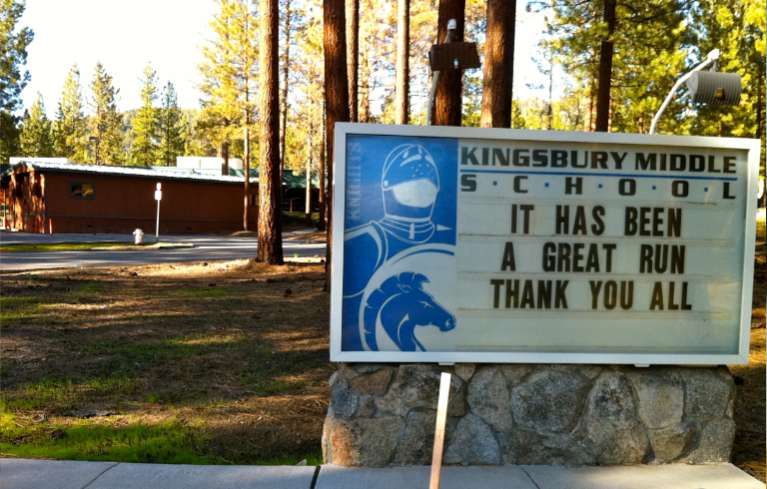
The empty 36,000-square-foot former Kingsbury Middle School in Stateline is costing the district between $10,000 and $15,000 a month to ensure the alarm is on, pipes don’t freeze and other basics are taken care of.

The Douglas County School District board first voted to put the 10-acre site on the market in January 2012.

Kingsbury Middle School sits empty. Photo/LTN file

Kingsbury Middle School sits empty. Photo/LTN file

Superintendent Lisa Noonan told the board July 9 that no buyer has come forward. The potential sale has been on the agenda each time the board meets in Tahoe – which is quarterly.

While groups have come forward expressing interest and people have looked at the property, no one has put in an offer. Noonan said all the lookers have said they need to raise the cash.

It’s possible the county’s area plan that is nearly through the Tahoe Regional Planning Agency approval process could ease some of the stipulations on what the land could be used for. There are also Nevada education rules that limit future uses.

The property is listed at $4 million based on an appraisal from close to two years ago. Per state law the district cannot sell for less than the asking price.

An attorney advising the district has said based on the length of time the property has been on the market that legally the price could be lowered.

But board members were not thrilled with that idea, even without offers, based on the real estate market improving at Lake Tahoe.

Board President Tom Moore told Noonan, “I think in October we’ll be looking for creative recommendations in how to go forward (if there is no buyer).”

In other action Tuesday:

• The board voted 4-1 (Neal Freitas abstained and Sharla Hales was absent) to turn Aspire into a stand-alone high school. It has been an alternative education program in the valley until now. The plan is to seek accreditation this coming school year.


Letter: Community gives to firefighters

To the community,

The Lake Valley Professional Firefighters Association would like to thank the community and Tahoe visitors for the tremendous support during the July 7 “Fill the Boot” drive in Meyers.

The entire $12,004.13 that was collected by firefighters from the agencies and organizations listed below will be given to the families of the Granite Mountain Hot Shots from Prescott Fire Department in Arizona. In addition, we wish to thank the businesses listed for their generous donations:

• Lake Valley Professional Firefighters Association

• Lake Valley Volunteer Firefighters Association

• Lake Valley Fire Protection District

• South Lake Tahoe Firemans Association

• South Lake Tahoe Fire Department

• Tahoe Douglas Fire Protection District

• Fallen Leaf Fire Department

• CalFire – Amador, El Dorado, Sacramento Unit

• Lake Tahoe Basin Fire Academy

• Steve’s Transmission

• Angie’s Signs

• South Tahoe CrossFit.

Individuals still wishing to donate to the 19 firefighters killed while battling the Yarnell Fire in Arizona can do so using the following organizations (both have been confirmed as valid donation sites):

United Phoenix Firefighter’s Association

Prescott Firefighters Charities (501(c)3 – Chase Bank), Account #987218757, 61 East Columbus Ave., Phoenix, AZ 85012 or National Fallen Firefighter’s Foundation, www.regonline.com/yarnellhill.

Leona Allen, Lake Valley Fire


634-acre Kyburz Fire at 40% containment

Updated 8:25pm:

No estimate is being given on when full containment of the Kyburz Fire might be achieved.

It has consumed 634 acres and is 40 percent contained.

Highway 50 between Tahoe and Placerville is open without controls.

A shed and outhouse have burned to the ground.

—-

Cool weather and no wind overnight allowed firefighters on the Kyburz Fire to contain 40 percent of the blaze.

The fire remains at 160 acres.

Two outbuildings have been destroyed. No other structures are threatened.

Officials are not estimating when full containment will be achieved.

The blaze started July 8 about 12:40pm when a vehicle lost a wheel which sparked the fire.

A music camp evacuated, but no one else has been displaced.

Highway 50 between Lake Tahoe and Placerville is open with escorts.

— Lake Tahoe News staff report