N. Nevada casinos do well in May

Northern Nevada’s May gaming win far outpaced the rest of the state, which helped bring in a positive number for the entire Silver State.

Stateline and Reno casinos each saw a 9.7 percent increase from May 2012 to 2013 with $13.3 million in revenue, the Gaming Control Board said in numbers it released July 11. Carson Valley was up 7.4 percent.

Statewide the revenues grew 1.37 percent, with revenues of $897.2 million in May.

— Lake Tahoe News staff report


Youth state baseball tourney in South Tahoe

South Lake Tahoe is hosting the Babe Ruth 13–15 All-Star State Tournament July 12-15.

The local 13- to 15-year-old All-Star team will be competing against teams from Fallon, Sparks, and North Valley.

The tournament will be at the Babe Ruth field on Rufus Allen Boulevard. Game times on Friday and Saturday are 10am, 1pm, 4pm and 7pm. South Lake Tahoe team plays at 1pm and 4pm Friday and Saturday at 1pm and either 4pm or 7pm. Championship game will start at noon on Sunday.

It costs $10 to watch. All of the money goes to support South Lake Tahoe Babe Ruth. Snack shack will be open serving breakfast burritos, pulled-pork sandwiches and more.


Kyburz Fire almost at full containment

The Kyburz Fire burning on Highway 50 between Tahoe and Placerville is 95 percent contained, with full containment expected Friday.

Motorists are advised to watch for debris on the roadway. Granite Springs Road and Webber Mill Road remain closed for public safety.

All campgrounds are open.

The fire, which is in the same location where the Fred’s and Cleveland fires burned, has consumed 615 acres.

Firefighters on July 10 continued securing line around the fire perimeter.

The blazed started July 8 when a vehicle tire blew and sparked the fire.

Two outbuildings were lost.

— Lake Tahoe News staff report


Swimmer relives historic crossing of Lake Tahoe

By Kathryn Reed

While Erline Christopherson doesn’t remember every stroke, she does remember much of the 13 hours, 37 minutes she spent in Lake Tahoe.

Fifty-one years ago this month the then-16-year-old made history by becoming the first female to swim the length of Lake Tahoe.

This week the Lake Tahoe Museum in South Lake Tahoe debuts an exhibit about Christopherson. She was in town briefly Monday to view it. The 67-year-old now lives in Florida.

“I wanted to do something no one else had done,” Christopherson told Lake Tahoe News. It took her three tries, but she did it. The first was at age 15 when she came 3 miles shy of shore, the second time she was 1 mile short. All three swims entailed dealing with afternoon storms. The second and third attempts were three weeks apart.

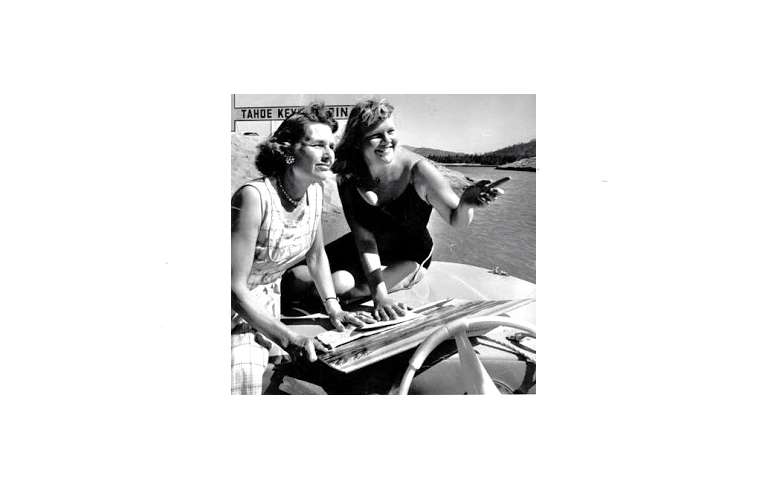
Erline Christopherson, right, with her mother, Elizabeth. Photo/Provided

Erline Christopherson, right, with her mother, Elizabeth. Photo/Provided

She swam from Cascade Properties to Dollar Point. It was so windy, the chaperone boat had to dock elsewhere.

Christopherson tried reading books about how best to prepare, but in 1962 that type of material didn’t exist. Her dad applied grease he used on the bailer to her body so it would not become water logged.

Her mom boiled beef and kept the water as protein water for her to consume during the swim. She also drank brown sugar water. Energy drinks as we know them today didn’t exist then.

Her sister sang to her to pass the hours.

Wes Stetson was in the air in his seaplane monitoring the progress. He landed and told Christopherson’s dad, who was in a boat, how to stay on course.

“All my dad had (as a point of reference) was a bald spot on the other side of the lake,” Christopherson said.
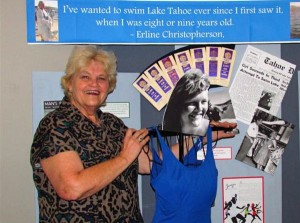
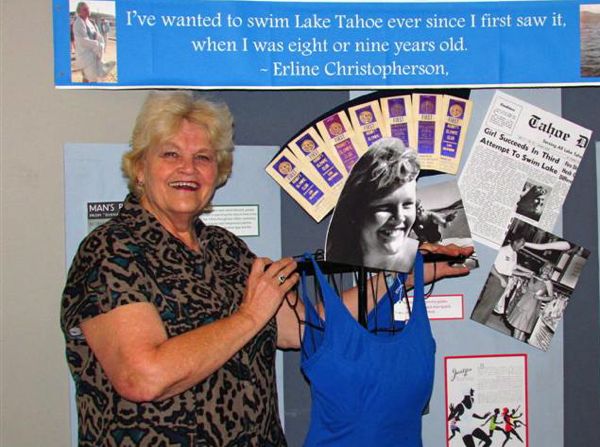
Erline Christopherson with the museum display. Photo/Denise Haerr

Erline Christopherson with the museum display, which includes the suit she wore. Photo/Denise Haerr

Christopherson was 7 or 8 when she first declared she was going to swim the 22 miles of Lake Tahoe.

“I did something that was my own. They can’t take that away from me,” Christopherson said.

She started swimming when she was 4, and was competing by age 10 in AAU meets. Her specialties were breaststroke and butterfly. At one point she was on the Junior Olympics.

Each attempt the family would come from their ranch in Lodi a few days early to acclimate to the Sierra. She swam the 15-mile width of the lake each of those three times as practice. Going from about Baldwin Beach to Emerald Bay, around Fannette Island and back were other training swims.

At home she would jump into the Mokelumne River and swim upstream against the current. Her swim coach allowed her train in one of the lanes.

She wore a blue one-piece swimsuit that is on display at the museum.

“A wetsuit gives you buoyancy. That is cheating,” Christopherson said.
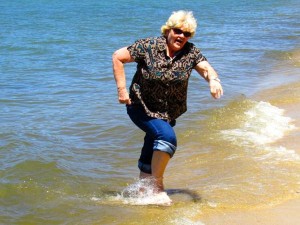
Remembering what it's like to be in Lake Tahoe -- Erline Christopherson. Photo/Denise Haerr

Remembering what it’s like to be in Lake Tahoe — Erline Christopherson. Photo/Denise Haerr

After she made history, the old Outdoorsman store allowed her to pick out any suit she wanted. What she wanted was not something she would compete in, but a bit more feminine. A poster of her was in the store as an advertising marquee.

Christopherson continues to swim. Four years ago, she won the series championship in an ocean race in Clearwater, Fla. – the only time she competed in it. She swims at least a mile when she gets in the pool; longer if she has the time.

“I love this lake. It’s the most beautiful lake in the world. I can’t come to California without coming up here,” Christopherson said. This time, though, there was no time for a swim.

—-

Notes: Museum volunteer Denise Haerr discovered a box full of memorabilia donated by Erline Christopherson. She started corresponding with the swimmer, which led to the visit on July 8. Haerr hopes Christopherson will give a talk about the July 25, 1962, feat and that a video would be created from old photographs and newspaper clippings.

The museum at 3058 Lake Tahoe Blvd., South Lake Tahoe is open Wednesday-Sunday from 11am-3pm. Donations are accepted.


Ex-EDSO sergeant arrested on kiddie porn charges

A former El Dorado County sheriff’s sergeant has been accused of possessing child pornography.

William Wilson, 51, turned himself in to the county jail in Placerville on July 9. He was booked and released.

William Wilson

William Wilson

The investigation started in January.

“During the course of the investigation the employee retired, but the investigation continued. Eventually information was developed indicating the employee had committed criminal acts,” a press release stated.

Wilson worked for the department for 25 years.

He is scheduled to be arraigned July 16.

— Lake Tahoe News staff report


Editorial: Time is now for responsible water bond

Publisher’s note: This editorial is from the July 7, 2013, Riverside Press-Enterprise.

Another two years of stalling will not ensure a reliable long-term supply of water for California. The state cannot afford to let ideological battles stifle progress once again on addressing the state’s water issues. Legislators should revamp a proposed water bond to pare the cost, scrape out the political pork and concentrate any new spending on the state’s most pressing water needs.

The Assembly Water, Parks and Wildlife Committee last week took up the water bond issues, discussing a set of principles for designing a realistic bond measure. Legislators realize that the $11.14 billion water bond proposal from 2009 has little chance of voter approval without significant changes that shrink the cost and excise the frivolous spending.

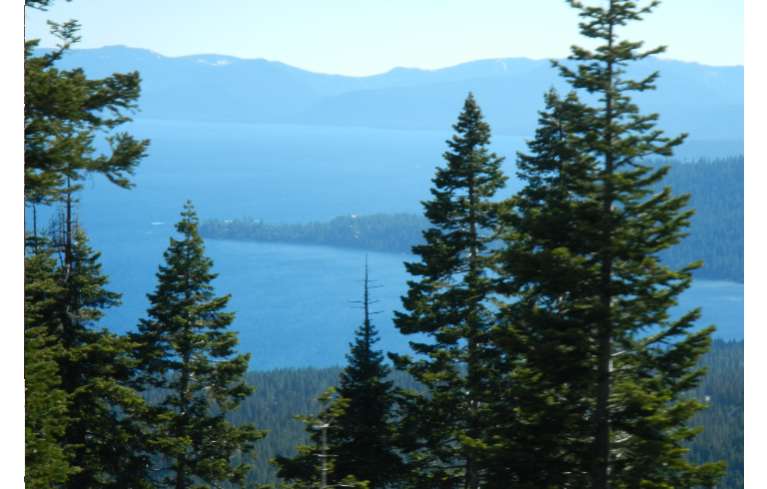
Lake Tahoe in past versions of the water bond would be a beneficiary. Photo/LTN

Lake Tahoe in past versions of the water bond would be a beneficiary. Photo/LTN

The measure is now slated for the 2014 ballot, but legislators have twice postponed putting the bond before voters, fearing that Californians would reject its hefty price tag. And the fact that legislators inflated the measure’s cost with a variety of pork projects only irritated voters. Taxpayers have little interest in footing the bill for self-serving political handouts that some legislators demanded in order to support the bond.

The state, however, has water needs that require prompt attention, and those should be the focus of a slimmer water bond. The Sacramento-San Joaquin Delta’s environmental and physical challenges, for example, threaten the state’s primary water system, which ships water from Northern California through the delta to the rest of the state. The state has periodically had to curtail water deliveries to protect endangered delta fish, and the delta depends on more than a thousand miles of aging levees in danger of collapse in an earthquake.

The delta’s ills put at risk the water exports that serve two-thirds of the state’s population and irrigate millions of acres of farmland. Gov. Jerry Brown supports a plan to channel the exports around the delta, thus separating the state’s water from the estuary’s environmental challenges. Water users would pay most of that cost, but the plan also requires money to restore delta habitat and address the ecological issues in return for more reliable water exports.

The state also needs additional capacity to catch and store water for later use, in reservoirs and groundwater basins. Long-term forecasts predict the state will see more winter rain and less snow, so the state will be less able to rely on mountain snowpacks to store water until the hot summer months.

Any feasible long-term approach also requires increased conservation and recycling, pollution cleanup and other steps — all of which cost money. But the Legislature could trim the size of a new water bond by redirecting some existing water bond funds. The legislative analyst reported in February that the state had more than $5 billion in unspent natural resources bond money, mostly from two previous water bonds. Legislators should put those funds toward the most urgent water priorities.

California needs to move past old political battles to ensure a healthy water supply for its future. Legislators will not serve that goal by failing to craft a feasible water bond once again.


Nevada taking orders for anniversary plates

Nevada Department of Motor Vehicles is taking orders for the special license plates commemorating the state’s 150th anniversary.

These are limited edition plates.

Distribution begins July 29.

Proceeds will fund the yearlong celebration that will conclude on Nevada Day in 2014.


Electric companies not thrilled with surge in solar

By Michael Grunwald, Time

America is having a solar revolution, and it’s a big deal. Solar installations increased more than 1,000 percent during President Obama’s first term and contributed nearly half the new power capacity added to the grid in the first quarter of this year.

We’ve always gotten energy from the sun—oil, gas and coal are essentially millions of years’ worth of photosynthesized sunlight—but now we’re getting it directly, without drilling or spilling or earth-broiling emissions. Solar prices have plunged 80% since 2009, a boon to installers like SolarCity, Sungevity and Sunrun, which have grown from a few hundred customers to more than 35,000 today.

It’s also good for consumers, who can get clean power that’s cheaper than coal in large swaths of the country.

Maybe you’re not interested in reducing our dependence on fossil fuels or promoting one of our fastest-growing domestic industries. Maybe you’ll never put solar panels on your roof. But you should still care about the solar revolution, because it’s on the verge of blowing up the electricity business. The shift from centralized plants to decentralized rooftops won’t be as widespread as the shift from landlines to cell phones, but it could be just as disruptive.

The power sector is dull and complex. But the key thing to know is that utilities make most of their money in two ways: selling electricity to their customers and building stuff that gets factored into regulators’ formulas on rates. So they want their customers to buy as much of their juice as possible, partly for the revenue, partly so they can justify building more power plants at a guaranteed profit.

That makes it awful for a utility when a customer goes solar. He won’t need as much power from the grid during peak daytime hours, and he can even sell power back to the grid, which means lower revenue for the utility and flimsier justifications for new plants. It’s like having a new mini-competitor.

Utilities are fighting back in states like California, pushing to roll back solar ratepayers’ right to sell power back to the grid. They justify their efforts by arguing that so-called net metering hurts nonsolar customers. A Californian’s electric bill is calculated by multiplying the amount of power he uses by a rate that’s supposed to cover all the utility’s costs plus some profit.

So it’s true that if he goes solar and needs less power from the grid, other ratepayers will have to pay a larger share of the cost of distribution lines, service calls, decommissioned nuclear plants and so forth. But studies suggest that even nonsolar ratepayers benefit from the solar stampede because their utilities don’t need to turn on expensive fossil-fueled “peaking plants” as often to meet high demand and won’t need to build as many new plants to meet future demand.

That raises a separate question: Why are utility bills calculated in ways that have so little to do with the services provided? For example, wholesale prices in electricity markets are usually very high during peak hours and very low overnight, but consumers generally pay the same retail price no matter when they consume. It’s like paying a set monthly rate for groceries on the basis of weight, regardless of whether you’re buying caviar or crackers.

Now imagine a system of dynamic pricing that reflected the real cost of power at the time of purchase and then empowered consumers to make choices accordingly. They’d have an incentive to run their dishwashers at off-peak hours, which would help utilities manage their loads. Solar would be even more cost-effective, especially when combined with fuel cells, batteries or other emerging technologies that could store power for when the sun stops shining. Electric vehicles could become roving utilities, charging at night when power is cheap and selling power back to the grid at peak hours.

Most of these changes would be devastating for utilities, which is why so many are lobbying to hold back the tide. But eventually, change will come. Utilities are going to have to find new ways to do business, or they will go where the landline is going—away.


Disagreement over how to manage wild horses

By John M. Glionna, Las Vegas Sun

ANTELOPE VALLEY — Just after dawn, a dozen mustangs stampede across the high desert, harassed by a white helicopter that dips and swoops like a relentless insect. Frightened stallions lead a tightknit family band, including two wild-eyed foals that struggle to keep up.

 Rick Loomis / Los Angeles Times A cowboy working for the BLM lassos a wild young Mustang horse during a round up held on BLM land, Nov. 4, 2012. Read more: http://www.lasvegassun.com/news/2013/jul/07/mustang-debate-wild-ride/#ixzz2YNCGcIF7

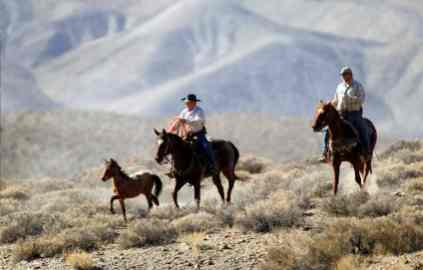
Wild mustangs in Nevada have long pitted animal groups against the government. Photo/Rick Loomis/Los Angeles Times 

Three animal activists watch through long-range camera lenses as wranglers hired by the federal Bureau of Land Management help drive the animals into a camouflaged corral. The private-contract pilot is paid $500 for each captured horse, dead or alive.

After a 10-mile run, one band of horses storms past the corral, prolonging the chase. While most of the horses enter the trap, a few break for open territory, the chopper in pursuit.

Few escape. The roundup corrals 180 mustangs, often employing a tactic that sets the species up to betray itself: A wrangler holds the reins of a tame horse at the mouth of the trap. As the mustangs draw close, the worker releases the animal — known as a Judas horse — which dashes into the corral, followed instinctively by the others.

Read the whole story


Nevada officials need help tracking invasive moth

The Nevada Division of Forestry wants help determining how widespread and severe the White Satin Moth, Leucoma salicis, infestation is in Northern Nevada.

mothThe non-native insect is capable of defoliating aspen, cottonwoods and willows.

The moth can be found flying in the upper canopy of any poplar species and laying eggs or mating on trunks, leaves or branches. Eggs laid in July and August will hatch in a few weeks, and larvae will skeletonize leaves on aspen, cottonwoods and willows before moving to bark fissures and spinning protective coverings to winter in.

White Satin Moths appear all white except for the body which looks like it has black bands and are about 1½-inches wide at full wing span. New larvae will be small, furry, brown and black caterpillars. Late stage caterpillars mature at about 1¾-inches long.

To report a sighting of the moth, email Gail Durham at the Nevada Division of Forestry at gdurham@forestry.nv.gov or call (775) 849.2500.