Opinion: Community colleges need to help themselves

By Neil Kreisel and Vanessa L. Patterson, Chronicle of Higher Education

The country’s community colleges are at great risk of becoming “separate but unequal institutions in the higher-education landscape,” according to a report issued recently by the Century Foundation. This is hardly news to those of us in the world of community colleges. And yet we — particularly those of us with fund-raising responsibilities — could be doing so much more than we are to help close the parity gap and help our own institutions thrive.

Nearly one-half of students in higher education attend community colleges, representing a diverse ensemble who will eventually be among the leaders in such critical fields as science, engineering, education, and health care. Historically modeled as a training ground for students to compete for local jobs, these colleges are now gateways to a world of wider opportunity, offering programs to prepare students for career success and lifelong learning, and smoothing pathways to four-year universities.

But this transformation is a struggle that will not be won without an increase in philanthropy for education, now dominated by four-year institutions. For each dollar given to a four-year college, only a cent or two goes to support community colleges. The Century Foundation’s study found that the average benefit from private and group donations, grants, investment returns, endowment income, and the like per full-time student to private research institutions was $46,342, compared with $372 for community colleges.

Those of us in the business of community colleges clearly see that the amount of private support affects how effective a college can be with programs that focus students on career paths and educational preparedness. Successful colleges start programs in collaboration with local high schools, introducing students to a wealth of career fields, to the importance of liberal-arts education, to financial and academic support systems within the community, to internships, and to the processes of applications and interviews.

They also work with other community colleges to improve access to educational programs and to reach agreements with four-year colleges. Those agreements ease the transfer process, long a major obstacle to furthering education at two-year institutions. Here at Santa Barbara City College, establishing such agreements with the California State University system’s 23 campuses is a top priority.

This spring, Santa Barbara and Walla Walla Community College, in Washington State, were awarded the Aspen Institute’s 2013 Aspen Prize for Community College Excellence. As proud as we are of that, we are frustrated by the fact that a lack of private philanthropy continues to stifle program development and expansion at community colleges. And we must do much more to change that.

To begin with, community colleges need to develop relations with alumni, who often identify with the four-year college from which they earned a degree. A recent survey by the Council for Advancement and Support of Education showed that an average of one-half of one percent of alumni contributed to a community college in the 2012 fiscal year. The comparable number for four-year universities nationwide is 13 percent.

But that sad fact goes hand in hand with this one: Fewer than 60 percent of survey respondents said their community college maintained an annual operating budget for alumni relations. Among those institutions that specified an alumni-relations budget, the average annual amount was a paltry $23,611. To develop an alumni giving program — the cornerstone of marketing campaigns — community colleges need a healthy revenue flow for staff, technology, and donor-program development. In turn, increased donor dollars will improve existing academic programs and help support efforts to help students succeed.

Meanwhile, we are seeing encouraging signs from institutional philanthropies. The Bernard Osher Foundation, among others, has provided significant grants. Federal grant programs, too, are expanding opportunities for the low-income and minority students who attend community colleges, many of whom are the first in their family to go to college, and many of whom enroll at remediation levels.

Fund raisers at all colleges are seeing donations rise, according to a survey released in January by the council. The survey showed that giving increased by 5.5 percent last year, with development officials predicting a 5.8 percent increase in donations in 2013.

Community colleges have some reason for optimism: Fund raisers on those campuses reported a 7 percent gain in giving in 2012 and predicted growth of 6.8 percent this year. But that’s just not enough.

The Foundation for Santa Barbara City College oversees $45-million worth of net assets, which is well above those of most community-college foundations, but still well below the almost-$500-million average endowment of four-year colleges. That figure, of course is skewed by the endowments of Princeton, Harvard, Stanford, and other wealthy institutions, but it nonetheless illustrates the lack of parity when it comes to both alumni and institutional giving.

As champions of our beloved community colleges, fund raisers must stand up for the millions of students depending on us to keep the doors of opportunity open for them. The fund disparity threatens the crucial role that community colleges play in our education system.

It also is in direct conflict with the doctrine that has governed this nation’s education policies for decades. The President’s Commission on Higher Education for Democracy declared in 1947 that “tuition-free education should be available in public institutions to all youth for the traditional freshman and sophomore years or for the traditional two-year junior college course. … Community colleges probably will have to carry a large part of the responsibility for expanding opportunities in higher education.” Indeed, we do.

At California’s community colleges, tuition has nearly doubled over the past two years, from $26 a unit in 2009-10 to $46 a unit in 2013.

We must do so much better than we are to make an affordable, high-quality two-year-college education available to all. With equitable philanthropic support, we will.

Neil Kreisel is president of the Board of Directors of the Foundation for Santa Barbara City College, and Vanessa L. Patterson is executive director of the foundation.



Animal shelter overflowing with kittens and cats

Kitten season is in full swing and the El Dorado County Animal Services shelter in Placerville is reaching out to the community to encourage adoptions.

The Placerville shelter, in partnership with People for Animal Welfare in El Dorado County, has temporarily reduced the adoption fee for kittens to $40 and for adult cats to only $20.

The adoption fee for kittens and cats includes a veterinary check, vaccinations, microchip, and spay or neuter. The shelter is located at 511 Placerville Drive in Placerville and is open Monday through Saturday from 9:30am to noon and 1-4:30pm. Pictures of the kittens and cats can be found online. The website is updated hourly.

To reach the shelter with questions about adoption or the animal foster care program, call (530) 621.7631.


5-day youth environmental camp in Tahoe

The Lake Tahoe Humane Society is putting on a youth environmental camp July 15-19.

Youth will explore wildlife habitats and learn how to protect animal’s homes. Participants explore forests and creeks and study wildlife replicas.

Hands on activities include a waste timeline project and decorating reusable eco-bags. Pet related activities include games, making toys for homeless animals, learning how domestic animals and wildlife can coexist and how to protect the Tahoe environment every day.

This is for ages 8-11. Cost is $50.

For more info and to register, call Liz Maul at (530) 542.2857.


White ready to medal in new Olympic sport

By Scott Stump, Today News

When Shaun White straps on his snowboard for the 2014 Winter Olympics in Sochi, there will be less hair tucked under his helmet, and a different obstacle in his path.

The two-time Olympic gold medalist is best known for his aerial acrobatics in the half-pipe competition, but he will also compete in the new snowboard slopestyle event that has been added for the Sochi Olympics.

“What’s fun about the Olympics is that there’s a new discipline,’’ White, 26, said on Today Tuesday. “Every time you see me in the Olympics, it’s been in the half-pipe, but the new event is called slopestyle. It’s basically a series of jumps in one run and some rail features you slide on, and you make your way down and you basically do as many tricks as you can on those jumps.”

White, who trains at Northstar in Truckee, has dominated the half-pipe event, winning gold in the 2006 and 2010 Winter Olympics and becoming the first man to ever score a perfect 100 in the event at the Winter X Games in 2012. But slopestyle presents a new challenge.

“I’m all right at it,’’ he said. “I do like to compete in both events, though. It’s fun.”

White’s ability to innovate and master tricks that no one else has tried has kept him at the forefront of the sport.

“I recently was dreaming about snowboarding, and I thought of this new rotation to put on an existing trick that I already have, but it’s random,’’ he said. “You’re setting out to do something and by accident you create a new trick.”

White not only has a new discipline to tackle at the Olympics, he also has a new look. The long red hair that earned him the nickname “The Flying Tomato’’ has been shorn. In December 2012, he had his hair cut off for Locks of Love, a charity that gives wigs to underprivileged children who have lost their hair for medical reasons.

“It was a tough call, but it was a good cause,’’ White said. “It was 12 to 13 inches long, a lot of weight. I can go higher (on the half-pipe) now.”

While White has been involved in various charities and even had his band, Bad Things, signed by Warner Bros. Records last month, his attention is now completely on getting ready for Sochi.

“I’m really excited, it’s just one of those things where everything around my life right now is focused on the Olympics,” he said. “It’s a really good feeling that it’s coming up, and I think I’m prepared.”

He is the heavy favorite to make it three straight gold medals in the half-pipe competition.

“It’s something to strive for to live up to,’’ he said. “I like the pressure.”


Social media makes people feel like they’re missing out

By Justin White, Washington Post

Have you heard about FOMO — “fear of missing out”? Most common among the under-30 crowd, it happens when someone feels nervous about not attending social events, like that awesome party everyone else enjoyed last weekend.

People have always been concerned about their social standing, but the explosion of social media has made FOMO a bigger issue, for everyone from middle schoolers newly toting smartphones to adults. Now researchers have developed a quiz to test just how fearful people are about missing out.

Among the questions the FOMO quiz asks are how often someone checks social media (“when eating breakfast?” “when eating lunch?” “in the 15 minutes before you go to sleep?”) and how worried he or she feels when friends are hanging out without them. As the intro to the quiz puts it, “FOMO . . . is a relatively new concept where people are concerned that others may be having more fun and rewarding experiences than them. It is characterized as the desire to stay continually connected with what others are doing.”

FOMO is often associated with a perceived low social rank, which can cause feelings of anxiety and inferiority. When someone misses a party, vacation or other social event, he or she can feel a little less cool than those who showed up and snapped photos. In some cases, people are even afraid to miss out on bad stuff. FOMO is most common in people ages 18 to 33 — in one survey, two-thirds of people in this age group said they experience these fears. The survey also suggests FOMO is more common among guys than ladies, though it’s unclear why.

Research suggests FOMO can take a negative toll on psychological health. Constant fear of missing events can cause anxiety and depression, especially for young people.

Over the past few years, there’s been a lot of research on the way social media influences FOMO. Recent research suggests people who experience FOMO are most likely to value social media as part of their social development. Status updates and tweets (“OMG best night ever!”) let us know about all the exciting activities happening while we’re home catching up with the “Jersey Shore” crowd. Some psychologists even suggest FOMO helps drive the success of social media platforms, since we feel we need to use the technology to let us know what’s happening elsewhere. But in some cases, FOMO might actually be a motivator, encouraging us to socialize with friends.

Some argue that the feelings associated with FOMO strengthen connections with others, encouraging people to be more socially active. While it might be antisocial to sit around checking out the Facebook pages of

pseudo-strangers, it’s possible to use social media in a constructive way, like keeping in touch with friends and planning activities. (Maybe it’s time to reconnect with an old buddy who lives nearby?)

Psychologists say fears about missing out may be a type of cognitive distortion, causing irrational thoughts — such as believing that friends hate you if you didn’t get an invite to last week’s party — associated with depression. For people prone to such thoughts, modern technology may just exacerbate their fears about missing out. So experts say unplugging all those gadgets might not solve the problem as well as engaging in cognitive behavioral therapy or another kind of talk therapy might.

Whatever you do, remember when scoping out other people’s plans, especially online, that many people project their most idealized selves on the Web. So spy with a skeptical eye. And to those who are confident enough in their plans for this Friday night … well, hats off.


Tahoe Fund focusing on 4 environmental projects

The Tahoe Fund is looking for money to pay for four projects.

The projects include beach improvements at Sand Harbor State Park, Asian clam control in Emerald Bay, a mile of bike trail along the West Shore, and a bridge across Angora Creek in Washoe Meadows State Park.

Interested donors can learn more about these projects on the Tahoe Fund website.

The Tahoe Fund is the first and only nonprofit in the Lake Tahoe Basin dedicated to raising money for environmental improvement projects to ensure a sustainable Tahoe for future generations. The group focuses on environmental improvement projects that restore lake clarity, improve recreation and build a strong sense of environmental stewardship in the region.

The 2013 Signature Projects will be highlighted at the Tahoe Fund’s 3rd annual Founders Circle Summer Dinner on Aug. 18 at the Hyatt in Incline.


Yosemite river plan delayed 5 months

By Alexei Koseff, Los Angeles Times

WASHINGTON — Facing flak for proposing to eliminate some popular tourist amenities in Yosemite National Park, the National Park Service said it needed five more months to finish a plan to “protect and enhance” the Merced River, which runs for 81 miles inside the park.

Kathleen Morse, the park’s chief of planning, said Tuesday that officials intended to complete the plan by the end of the year rather than this month.

The effort to restore the river corridor and habitat to their natural states has been overshadowed by controversy, she said. The proposals include removing or relocating popular tourist concessions that are too close to the riverbank — such as bike and raft rentals, two swimming pools, a snack stand, an ice skating rink and some hiking trails. The plan also would add new walk-in campgrounds and increase day-use parking.

“It’s unfortunate that there isn’t more discussion about the positive things coming out of the plan,” Morse said, such as easing the gridlock that often greets drivers in Yosemite, which draws 4 million visitors a year.

The park service is preparing the plan under a 1987 law that designated the Merced as a “wild and scenic” river, giving it a high level of federal protection. Local environmental groups had successfully challenged two previous plans in court as inadequate.

Local business groups and others have criticized the latest blueprint as harmful to commercial operations in and around Yosemite.

“The issue is public enjoyment of public lands,” Rep. Tom McClintock, a Republican who represents the district that includes Yosemite, said Tuesday at a hearing of the House subcommittee on public lands and environmental regulation.

The plan, he said, represents “a new elitist maxim: ‘Look, but don’t touch. Visit, but don’t enjoy.'”

Several witnesses argued that the changes would hurt nearby communities that are economically dependent on the park. They said officials preparing the plan had ignored their concerns.

“People don’t believe in the park service,” said Brian H. Ouzounian, representing the Yosemite Valley Campers Coalition, which promotes drive-in campgrounds and other family camping.

Jonathan B. Jarvis, director of the National Park Service, disputed that notion. He said two-thirds of the 30,000 comments submitted by the public supported the draft plan.

Jarvis said visitors would still be allowed to use rafts, bikes and horses inside the park, but they would need to bring their own rather than rent them.

McClintock produced a letter from retired congressman Tony Coelho, a Democrat who wrote the bill giving the Merced federal protection. Coelho, now a lobbyist, wrote that he “never intended” for the law to apply to the Merced River inside Yosemite, only to the river outside the park.

“Yosemite Valley has never been wilderness,” Coelho wrote.

Jarvis said Coelho’s intent did not matter.

“We have to go with the plain language of the statute,” he said. The law “covers the entire length of the river through Yosemite Valley.”


Structures out of harms way from Bison Fire

Firefighters have the Bison Fire in Douglas County more than 65 percent contained, with full containment expected Sunday.

Crews concentrated their efforts Wednesday along a ridge above the evacuated homes and other hot spots.

The voluntary evacuation order for homes in Douglas and Lyon counties has been lifted.

“No residences were damaged or lost in the Bison fire but to lessen the possibility of your home being damaged in another fire, please clear 30 feet around your residences, reduce the fuel, reduce the risk,” fire officials said in a statement.

The cost, to date, of fighting this fire is $5,330,979.

The following road closures to non-residents are still in place due to the heavy fire vehicle traffic:

* Pine Nut Road at the intersection of Out-R-Way

*East Valley Road at Grandview

*Sunrise Pass Road at Coyote Rock

*Brunswick Canyon Road

*Mexican Dam Road

*Sunrise Pass Road at Artesia Road.

The fire started July 4 from lightning.

— Lake Tahoe News staff report


Injured hiker plucked from Angora Peak

Updated 12:20pm:

Hillary Brennan-Marquez, 23, from Palo Alto sustained

knee and wrist injuries, and lacerations. She was taken to Barton Memorial Hospital.

Assisting with the rescue were EDSO search and rescue, CHP, Lake Valley Fire, U.S. Forest Service, Fallen Leaf Fire and CalFire.

—-

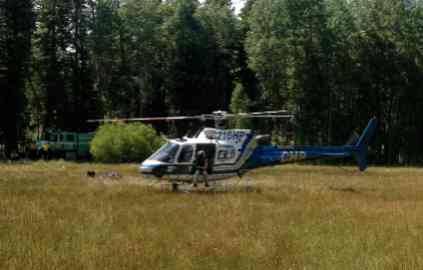
A woman hiking on Angora Peak had to be airlifted out on Wednesday.

El Dorado County search and rescue crews hiked in to where the woman was. She was suffering from a dislocated knee after falling from a rock face, Lt. Pete Van Arnum told Lake Tahoe News.

A CHP unit takes an injured hiker to the hospital. Photo/Damian Frisby

A CHP unit takes an injured hiker to the hospital. Photo/Damian Frisby

The call came in just after 1pm July 10.

A California Highway Patrol helicopter was able to airlift her out of the backcountry and take her to the hospital. Her condition is unknown.

The name of the woman has not been released.

 — Lake Tahoe News staff report


Snippets about Lake Tahoe

slt• Mary Morris has been hired by South Lake Tahoe to be the administrative services director.

• Barton Foundation’s 19th annual golf tournament last month raised nearly $14,000 for the foundation’s Community Health Endowment.

• Martis Camp, the private golf-ski community in Truckee, has 77 property sale commitments totaling $100 million since Jan. 1, the highest volume to date for a six-month sales period.

• Douglas County is having a valley visions workshop July 15 from 5:30-7:30pm at the Carson Valley Inn.

• Baby-Friendly USA, a program sponsored by the World Health Organization and the United Nations Children’s Fund, says Carson Tahoe Regional Medical Center is a baby-friendly birth facility.