Then and now: Tahoe airports change locations

In the 1940s, the Sky Harbor Casino and Airport was where today we know as Rabe Meadow at Stateline, with the popular Lam Watah Trail.

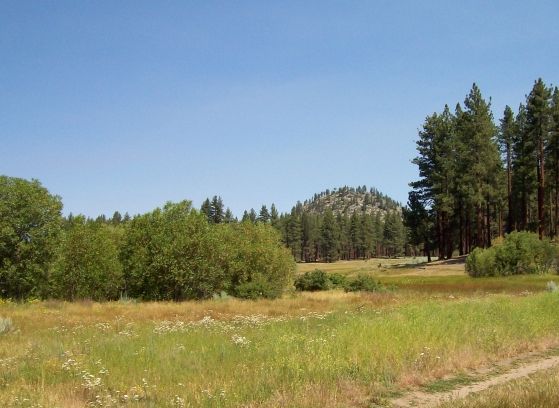
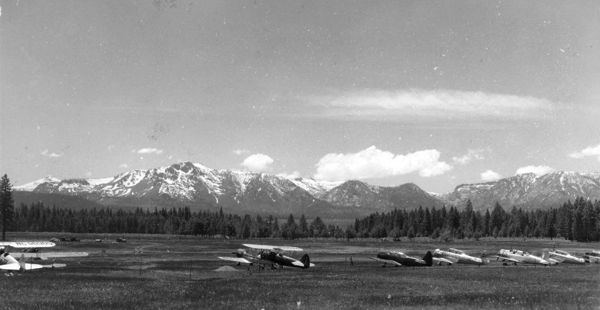
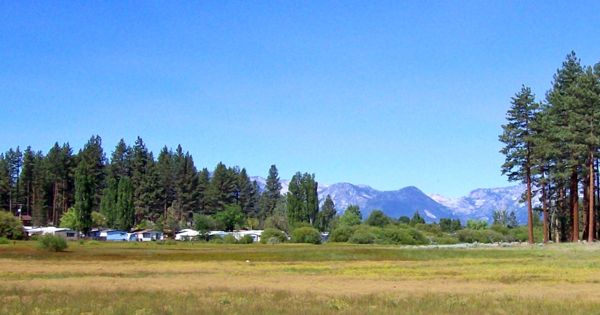
oldPhoto No. 1 (1946) shows the Sky Harbor Casino (“Cocktails, Dancing”). That site is roughly at the foot of today’s Kahle Drive near the entrance to Tahoe Shores Mobile Home Community, photo No. 2 (2013).

The easily identifiable Round Hill is clearly evident in both photos (officially, it is “Round Mound” according to U.S. Geological Survey maps).

Photo No. 3 depicts the 1946 landing area looking toward Mt. Tallac. One observer is quoted as saying, “The airport was so poorly engineered you either took off safely or you splashed in the lake.”

NoToday that area is mostly occupied by Tahoe Shores, photo No. 4 (2013).

After Sky Harbor closed, Lake Tahoe had no airport until 1958.

It is interesting to note that El Dorado County attempted to buy what became Tahoe Keys to pave-over for an airport, but lost-out in the bidding process.

Photo credits: 1946 from David Borges, 2013 from Bill Kingman.

— Bill Kingman34


Garden tour grows into colorful celebration

By Kathryn Reed

A 95-year-old house with a garden that had been certified by the National Wildlife Federation as a wildlife habitat and is on the national registry, a garden that flows into a golf course, one full of veggies, another with antiques that have become yard art to house flowers, some in full shade, others in full sun. A kaleidoscope of colors. A sea of green.

“Eye candy” is how one garden is described. “What is her secret?” someone asks about all those peonies.

One homeowner admits the slope of her yard means it’s 20 degrees cooler at the bottom – just one of her dilemmas. Two owners each have to contend with maintaining an acre of land – and not in a wild, Tahoe pinecone kind of way.

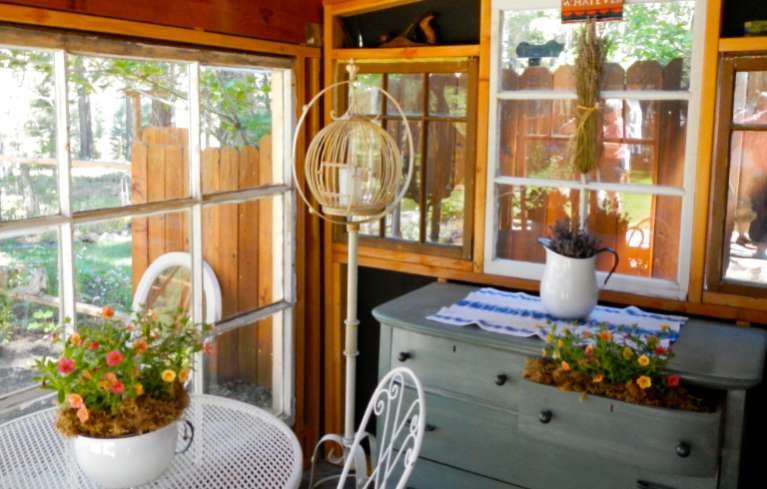
Known as the Tallac Shack because of the view of the mountain, this morning coffee or afternoon wine spot even has flowers in a dresser drawer. Photos/Kathryn Reed

Known as the Tallac Shack because of the view of the mountain, this morning coffee or afternoon wine spot even has flowers in a dresser drawer. Photos/Kathryn Reed

These nine gardens that will be featured July 27 on the Lake Tahoe Historical Society’s garden tour are some of the best ones from the past 10 years. All have been showcased once before. This is the 10-year anniversary edition of the tour.

Homeowners got to see the other gardens on Saturday, while organizers checked things out to make sure everything is ready for the annual event. This tour is the historical society’s No. 1 fundraiser. The 300 $25 tickets sell out each year.

It’s a mix of locals and out-of-towners who come each year. Locals like to see what is able to grow in Tahoe, and visitors make this the reason they come to town this time of year.

What grows is so much more than the native plants and wildflowers agencies talk about. Weeping cherry trees, Japanese maples, meadow rue and grapes are some of the less common items found along the tour.

“For our anniversary tour we tried to pick ones that were all a little different,” Catherine Whelan with the historical society told Lake Tahoe News. Her home, which was first on the tour in 2006, is one of the first houses to visit this year.

She grew up coming to Tahoe to visit her grandparents, and eventually the house became hers. Whelan said her grandmother would keep trying different things to see what would work. Now it’s like walking through a gate into a lush, shade-filled oasis.

Ann Rasmussen said when her home was on the tour in 2003 it was just after she and her husband, Gene, had remodeled. The yard had basically been a construction site. Today, it’s all about maintenance.

She points to the rock work on the house that is covered by the green in the garden. Now she wonders why they thought the rock was a good idea.

Each garden is unique, but many on this tour have views of Mount Tallac. And the owners – they all seem fit – which might prove gardening is a form of exercise. Even so, most gardens have multiple places to sit and enjoy the surroundings – proving it’s not all about working.

Notes:

• Tickets are $25; available at the museum (3058 Lake Tahoe Blvd., South Lake Tahoe) and at Aspen Hollow, Nels, Sunbasin and Tahoe Outdoor Living.

• Event is July 27, 10am-4pm.

• Barton Memorial Hospital’s gardens are the final stop.

ngg_shortcode_0_placeholder (Click on photos to enlarge.)


Online gaming moving forward in Nevada

By Ed Komenda, Las Vegas Sun

Ultimate Gaming has completed its 30-day field trial for Ultimate Poker, the first ever fully legal online gambling site in the United States.

The Nevada Gaming Control Board has recommended approval for the company to offer real money gambling at UltimateGaming.com.

Ultimate Gaming, majority owned by Station Casinos, in April became the first company in history to offer fully legal online poker in the United States.

Read the whole story


Letter: Parking revenue not adding up

To the community,

Another July 4 is history. And on Venice East the kiosks are in and paid parking is a reality. The fee for all-day is $10, but on the Fourth and four other holidays, the fee is doubled to $20.

As of July 9, the city had not striped the street for paid parking. So who knows how many spaces there will be? On the Fourth I rode my bike to the Keys Marina. There were a good many cars parked on Venice East. I guessed perhaps a hundred. I could have counted, but why count when I could guess using the city’s too often used method for creating a project.

Bill Crawford

Bill Crawford

Using the number 100 x $20, the city will bring in $2,000 on July 4. Projecting that number for five holidays on Venice East the sum will be $10,000 a year. In five years the sum will be $50,000. That’s the gross. After expenses, who knows what the net will be.

Yes, there will be midweek parking revenue. I have lived near the Keyes Marina 41 years and midweek parking is rarely packed, so it won’t be a gold mine.

I don’t know how may paid parking spaces the city will finally have. So projecting revenue created by paid parking is impossible. But I do know having lived here 46 years that locals are shy about paying to park. The best lesson on that is the city’s parking garage. City dwellers’ use it sparse. And the garage is in default.

Enough said.

Bill Crawford, South Lake Tahoe


Desserts that focus on peaches

By David Tanis, Los Angeles Times

With hot, sultry weather comes luscious, sweet, juicy stone fruit — just what we’ve been waiting for. Peaches, nectarines, cherries, apricots and plums fall into this category, and they are the true delights of summer. They all taste good together, whether baked in a cobbler or sliced for a fruit salad.

But let’s focus on peaches.

At the market the other day, there were ripe peaches that had been delivered straight from the orchard. They had a hairy exterior called peach fuzz, which is not seen very often these days. There is a reason, though it may seem incredible: modern peaches are mechanically defuzzed before shipping. Evidently, it has been determined that consumers prefer a smoother peach, and they would rather not remove the fuzz themselves. So peach fuzz now refers more to adolescent boys’ cheeks than to fruit.

For a truly smooth-skinned peach, choose nectarines instead. Contrary to popular belief, a nectarine is also a peach, just a different (and completely fuzzless) variety. Consider them interchangeable, though some prefer one to the other.

Most peaches are shipped firm and underripe, an unfortunate reality. Make sure the ones you buy are not rock hard, and have skin that has already turned reddish-yellow, with no green patches. Then a few days at room temperature will suffice to make them soft and sweet.

Now, to peel or not to peel. For peaches that will be cooked, dipping them in boiling water for a brief moment makes the skin easily slip off. For peaches to be sliced and eaten raw, peeling with a sharp paring knife is preferable. With nectarines, it’s O.K. to opt for unpeeled.

Here are two Italian methods to serve peaches to their best advantage as a dessert. One way is rather brilliant. Cool red wine, spiced slightly or not, is poured over sliced peaches in a glass. It’s a simple rustic-yet-elegant way to finish a meal. The tannins in the wine complement the fruit beautifully.

Another way, which requires a bit more finesse, is to serve peaches with zabaglione, the traditional egg custard flavored with musky sweet Marsala wine. Other sweet wines may also be used, like sherry or spumante. It takes just a few minutes to make, whisking over a double boiler. Zabaglione can be served hot, but in summer it is better cool. The faint butterscotch caramel-y flavor seems custom-made to accompany peaches.

Of course you will need ripe peaches for either of these desserts. But if fate should bless you with perfumed, perfectly ripe summer peaches, forget about any further adornment. Eat them as is, outside, letting the ambrosial juices drip where they may.


Boulder Mountain Road to get much-needed fixes

A section of Boulder Mountain Road in the Angora burn area will be closed from July 22-Sept. 2.

The pavement will be replaced. The road has had problems ever since the fire of 2007 because the water table rose and began to cause potholes and the road to buckle.

A 350-foot section will be closed north of the Lake Tahoe Boulevard-Boulder Mountain Drive intersection to just south of the Cone Road-Boulder Mountain Drive intersection.

Motorists may use Tahoe Mountain Road or Forest Mountain Road to access the northern side of Boulder Mountain Road.


Counties honored at California State Fair

Placer, El Dorado and Amador counties won awards at the State Fair.

Counties throughout the state compete for best exhibit. Glenn County took the best in show award.

The 2013 Counties Exhibits Competition includes two new awards: Best of Division for Community Built Exhibits and Best of Division for Professionally Built Exhibits. Although the builders from the communities may be experts, they do not build exhibits for a living.

Here are the results:

Best of Division – Community Built Exhibits – Lake County

Best of Division – Professionally Built Exhibits – Placer County

Best Content Award – Amador County

Best Marketing Presentation Award – Glenn County

Best Craftsmanship Award – Tuolumne County

Best Agricultural Presentation – Yolo County

Best Design Award – Sacramento County

Best Use of Special Effects/Animation Award – Placer County

Best Use of Products, Produce or Artifacts – Mono County

Best Visitor Experience Award – Calaveras County

Superintendent’s Award – Sierra County.

Gold awards went to: Amador County, Butte County, Calaveras County, Colusa County, Glenn County, Humboldt County, Inyo County, Lake County, Mendocino County, Modoc County, Mono County, Nevada County, Placer County, Sacramento County, Santa Cruz County, Sierra County, Solano County, Sonoma County, Stanislaus County, Tuolumne County, Yolo County and Yuba County.

Silver awards were garnered by: El Dorado County, San Joaquin County and Shasta County.

The State Fair in Sacramento runs through July 28 in Sacramento.


Study slams USFS for lack of trail maintenace

By Jeff Barnard, AP

GRANTS PASS, Ore. — Shane Krogen has no trouble finding retirees willing to spend a week in the wilderness grubbing out rocks and swinging a pick or shovel to bring a hiking trail back up to national standards.

The hard part is getting the U.S. Forest Service to come up with a few thousand dollars to buy the volunteers a T-shirt and feed them well, which is all it takes to keep them coming back for more.

“The Forest Service will fund us when they can, if they’ve got the dollars,” said Krogen, executive director of the High Sierra Volunteer Trail Crew in Clovis. “It’s just a matter of their budgets being cut drastically.”
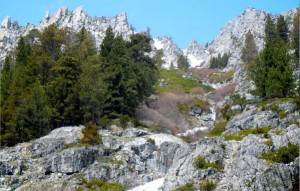
Eagle Falls in Desolation Wilderness. Photo/LTN file

Eagle Falls in Desolation Wilderness. Photo/LTN file

A government watchdog agency has found that hiking trails on national forests suffer from a $314 million backlog in maintenance, with only a quarter of the 158,000 miles of trails meeting national quality standards.

“The Forest Service has more miles of trail than it has been able to maintain, resulting in a persistent maintenance backlog with a range of negative effects,” said the report from the Government Accountability Office.

Annual funding has lagged far behind the need. In 2012, for example, trails needed $523.7 million for maintenance, operations and capital improvements, according to the report, yet received only $81.9 million. The gap in 2006 was similar, with $509.1 million of need, but only $74.2 million in funding.

The report adds that the Forest Service relies heavily on volunteers to maintain trails, but does not take full advantage of them. While the Forest Service manual sets a goal of using volunteers, the agency has not established that as an expectation of trails managers, and training on working with volunteers is limited.

In 2012, the equivalent of 667 volunteers working full time did $26 million worth of work, the report said. The volunteer effort was equivalent to the 667 full-time Forest Service employees working on trails.

The national system of recreational fees does little to fill the funding gap. The Forest Service told Congress last month it collects $66 million a year, mostly from campgrounds, cabins and picnic areas. The law authorizing the fee expires in December 2014.

Jim Furnish is a retired Forest Service deputy chief for the forest system. He says the problem goes back decades, and results from the Forest Service and Congress making recreation a low priority, with a low level of risk when the work doesn’t get done.

“Part of the issue is the consequences of neglect are not seen as severe,” he added. “People can usually get where they’re going, just with difficulty.”

Forest Service Chief Thomas L. Tidwell said in his formal response to the report that the agency agrees with the GAO’s conclusions, and pledged to look for ways to close the funding gap and improve training. He said the growing need to fight wildfires and budget cuts both contribute to the problem.

Krogan said spending $600 for T-shirts and $2,000 for food will keep a crew of 50 volunteers working in the wilderness for five days. A paid crew would cost 20 times that.

Why would someone work so hard for so little?

“Most of us sit at a desk all week and at the end of the week have no tangible outcome for our effort,” said Krogen. “Whether they are cutting out a tree or building rock steps, they have a sense of pride and ownership. ‘Look what I was able to do, and I’ve never done this before. Now I’ll be able to come through here and remember this day for the rest of my life.'”


Beer tasting benefits Live Violence Free

Cork & More is hosting the Pints for Peace Beer Tasting Fundraiser on July 18.

The event benefits Live Violence Free.

It is at 7pm at 1032 Al Tahoe Blvd., South Lake Tahoe.

The event is $15 and will feature beer from Belgium and treats from the deli. Tickets are available at Cork & More.


Mammoth, LA water districts resolve decades-old dispute

By Louis Sahagun, Los Angeles Times

The Los Angeles Department of Water and Power and the Mammoth Lakes Community Water District announced Thursday that they have reached a compromise settlement over use of the High Sierra ski town’s water supply, ending a dispute whose roots reach back a century.

Under the terms, Mammoth Lakes will pay the DWP $3.4 million now and $2.4 million, adjusted higher for inflation, in half a century.

In return, the DWP will allow Mammoth Lakes to continue to draw its water supply from Mammoth Creek, which tumbles through town. The DWP also will drop a pair of lawsuits it filed nearly two years ago, and both sides agreed never to challenge each other’s water rights.

The DWP lawsuits argued that the department has owned the water from Mammoth Creek since 1905. DWP officials said the Mammoth Lakes diversion wasn’t a big concern when that community was small. But after decades of growth, which included condos and golf courses, its water diversions grew to equal 1 percent of the flows in the century-old aqueduct that carries water from the Eastern Sierra to Los Angeles.

Mammoth Lakes insisted it was entitled to as much as 2,760 acre-feet of water annually under licenses and a permit granted by the state dating to 1949. The district also argued that the DWP should not be allowed to claim the water after allowing the community to become dependent upon it for decades by relying on those licenses and permit.

The settlement gives Mammoth Lakes the right to continue to divert up to 2,760 acre-feet of water annually from the creek, an amount both sides agree can be increased as the community grows.

The DWP will use the money contributed by Mammoth Lakes to pay for water-saving improvements designed to increase flows in the Los Angeles Aqueduct system by 1,779 acre-feet of water annually.

“The Mammoth Lakes community is assured of the water it needs to flourish,” DWP General Manager Ron Nichols said in a statement, adding that the water conservation efforts the community pays for would in effect replace water used by the district.

Tom Smith, president of the Mammoth Community Water District board, said in a statement that the board appreciates “the rational approach that L.A. DWP took in resolving these matters. Even though this is a minimal amount of water for L.A., it is critical to our community’s future.”

The district serves 7,700 year-round residents who are largely working-class employees catering to vacationers from Los Angeles, which is about 300 miles south.