Tahoe Tails — Adoptable Pets in South Lake Tahoe

Sequoia

Sequoia

Sequoia is a very nice little rat terrier-chihuahua mix, about 6-months-old. She is friendly and sweet.

She is great with kids and other dogs and wants to play with cats (her feelings get hurt when they hiss at her) and would do well in any kind of home who gives her attention.

Sequoia is spayed, microchipped, and vaccinated. She is at the El Dorado County Animal Services shelter in Meyers, along with many other dogs and cats who are waiting for their new homes. (The shelter continues to have many kittens available for adoption).

Go online to see photos and descriptions of all pets at the shelter.

Call (530) 573.7925 for directions, hours, and other information on adopting a pet.

For spay-neuter assistance for South Tahoe residents, go online.

— Karen Kuentz


Letter: Barton gives back to the community

To the community,

The Bread & Broth program would like to congratulate and thank Barton Healthcare’s Physician Billing and Customer Service Department employees.

As a result of meeting quarterly service goals established by Barton Healthcare, the employees received a monetary award and they decided to donate a portion of their award to sponsor a B&B Adopt A Day of Nourishment on July 8.

In addition to donating $250 for the Monday evening dinner, Diane Caccamise, Sonia Del Mercado, Ryan Justus and Anita Jones arrived at 3pm to help the Bread & Broth volunteers setup and serve a tasty rosemary barbecue chicken dinner to the evening’s guests. Then at 5:15pm, Marisol Jimenez and Kay Stewart joined the B&B volunteers in cleaning tables and sweeping and mopping the kitchen area.

The Barton employees were an enthusiastic and hard working group. In regards to their volunteering to help feed the needy, they agreed that, “It was a rewarding experience. An eye opener that should be shared with family, friends and co-workers.”

Bread & Broth would like to recognize and thank Barton Healthcare’s Physician Billing and Customer Service Department employees for not only consciously performing their job duties but being mindful of the less fortunate in the South Lake Tahoe community.

B&B is a nonprofit, all volunteer organization that serves full course meals every Monday to those in need and is grateful for the support it receives from all our special sponsors.

If you would like to support Bread & Broth’s program, please contact me at (530) 542.2876 or carolsgerard@aol.com.

Carol Gerard, Bread & Broth


Cannabis farmers markets proposed in Colo.

By Eleazar David Melendez, Huffington Post

A Colorado entrepreneur is pushing to make buying marijuana nearly as easy as shopping for heirloom tomatoes.

Justin Hartfield, the CEO of a Denver-based website that maps and collects reviews on marijuana dispensaries, is currently shepherding an initiative that would allow “organic cannabis farmers markets” in the city of Boulder.

Colorado legalized recreational weed in 2012, and regulators at the state level are working out the rules that brick-and-mortar recreational pot shops will have to follow when they open their doors next year. Hartfield wants local officials in Boulder to push even further, allowing the creation of markets like the ones now used to haggle over white asparagus and organic lavender.

“I got news for you: Marijuana is legal in Colorado,” Hartfield, a longtime marijuana activist, said. “It’s no longer a drug in a sense. It’s a plant. It’s a commodity. There’s no reason not to allow trade in it openly.”

Marijuana remains illegal under federal law, but federal authorities have mostly allowed medical marijuana dispensaries to exist in states where the drug has been legalized for that purpose. Now that Colorado and Washington have legalized the drug for recreational use, how federal authorities will respond is unclear.

Hartfield admits his idea — first reported on by Boulder’s Daily Camera newspaper — is likely to be “controversial,” but says it’s nothing more than a logical extension of the movement to make pot legal. His proposal envisions plots within agricultural areas in Boulder set up as secure spaces where cannabis growers would “showcase their products, introduce their customers to the growing operation, demonstrate their practices, and host community-oriented events that provide marketing opportunities.” From 26 to 99 vendors would be allowed.

Hartfield wants weed farmers markets to be legal in zoned agricultural areas in the city.

“It really is very similar to any other organic market,” Hartfield said. “The only difference is this plant has certain peculiarities that, say, a tomato doesn’t. Boulder has a rich history of organic markets, and Boulder is also a city in a state where cannabis is legal. It just makes sense.”


Cities, counties taking on lead paint industry

By Howard Mintz, San Jose Mercury News

From old cottages in Berkeley and Palo Alto to ranch-style homes in Silicon Valley, the remnants of a hazardous past can lurk in the walls — lead paint.

And now 10 California cities and counties and the state attorney general will finally get to try to make the powerful paint industry pay dearly to remove those poisonous ghosts from millions of homes around the state.

In a trial set to begin Monday in Santa Clara County Superior Court, a 13-year, billion-dollar legal battle will move forward over the paint industry’s role in spreading lead-based paint throughout California’s residential landscape.

And the industry will fight back hard, arguing that it never deliberately sold a hazardous product and that lead paint is no longer a significant public health threat in California.

But decades after the government banned lead paint because of its health threat to children, the substance remains in many homes built before 1978, particularly in older, low-income neighborhoods where families are considered less likely to be aware of the threat. Lead paint has been linked to a host of maladies in children, from learning disabilities and stunted growth to seizures and even death.

“Lead poisoning has been the longest-running epidemic in American pediatric history, and is a silent, ongoing tragedy,” David Rosner, a Columbia University professor who will be an expert witness for the governments, said in an email exchange.

Clara County, local governments sued the industry in 2000, alleging paint manufacturers knew of the dangers of lead paint as early as the late 1890s and yet peddled it to consumers without warning for decades. Alameda, Monterey, San Mateo and San Francisco counties are among the players in the case, as well as the cities of Oakland and San Diego and large counties such as Los Angeles.

Public officials will urge Superior Court Judge James Kleinberg, who is hearing the case without a jury, to find five paint manufacturers, including Atlantic Richfield, NL Industries and Sherwin-Williams, liable and order them to remove lead paint from an estimated 5 million homes in the 10 counties — at a cost of about $1 billion.

“It’s all about fixing the problem,” said Joseph Cotchett, a prominent Burlingame lawyer representing the counties.

Unlike cases involving individuals who sue over health hazards, which can be difficult to prove against an entire industry, California officials have alleged the paint makers violated the state’s public nuisance laws. Lead paint, they argue, has created “a substantial and unreasonable injury” to anyone exposed in an older home.

The case has dragged on for years, twice bouncing up through the appeals courts, which have allowed it go forward over the paint manufacturers’ objections.

“The other side has fought tooth and nail for 13 years to try to squash our case,” said Danny Chou, a deputy county counsel for Santa Clara County.

Lawyers for the industry say they’ve been unfairly targeted. In legal briefs, they argue that public health officials have successfully handled any hazards from lead paint, calling it a “public health success story.”

Among other arguments, they say recent studies found scant evidence of California children facing health problems from elevated lead levels in their blood, and, when lead is found, little proof it necessarily comes from lead paint. And they say a costly cleanup would do more harm than good, kicking up lead dust in homes where it would be better left alone.

“I find this litigation-by-hindsight puzzling,” said former Iowa Attorney General Bonnie Campbell, who is helping the industry’s defense. “The fact is, you have a very good, successful public health story, and there is no public nuisance.”

The industry has fared well in fending off similar lawsuits around the country, prevailing in legal battles in states such as Rhode Island, Ohio and Missouri.

But legal experts say the California case, with strong backing from a host of public officials, could be an effective use of public nuisance laws.

“There is a certain gravitas government sometimes brings to these cases,” said Richard Frank, head of the California Law and Policy Center at UC Davis.

Rebutting the industry’s claims, public officials say thousands of children in the 10 counties each year are found to have unsafe levels of lead in their blood. And they point to recent findings from the federal Centers for Disease Control that lead paint is the primary cause of elevated lead levels in children who live in older homes.

Under the judge’s pretrial rulings, government lawyers will not have to show that lead paint actually harmed any particular families. Instead, Kleinberg wrote, they must “provide a reasonable basis” that the industry “assisted in the creation of a public nuisance” through activity, such as promoting the product, that put lead paint in homes “affecting a considerable number of persons.”

Local public health officials in places such as Alameda County, which has a lead prevention program, say the problem persists and is far from cured.

“We’ve had a lot of success,” said Julie Twichell, an official with Alameda County’s lead poison prevention program. “But there is still a lot of work to do.”


More homes being built in fire-prone areas

By Felicity Barringer, New York Times

The death of 19 firefighters in Arizona recently highlights what has become a fact of life in the West: Every summer, smoke fills the big skies yet people continue to build in the places that burn most. More people live in these areas, and many balk at controls on how and where to build.

Just as many Easterners resist stepping back from their increasingly flooded coast, Westerners build where they want to build.

In a report last September, CoreLogic, a business analytics company, estimated that 740,000 homes in 13 Western states, with a total value of $136 billion, were at high or very high risk of burning up. Nationwide, Oregon and Wisconsin researchers found, 98.5 million people lived in 43.7 million homes in what is known as the wildland-urban interface or WUI (pronounced woo-ee) in 2010.

The sentiment that people should build where and how they choose is embedded in the Bitterroot Valley of western Montana, where a series of infamous 2000 blazes helped usher in the era of ever-more-dangerous Western wildfires.
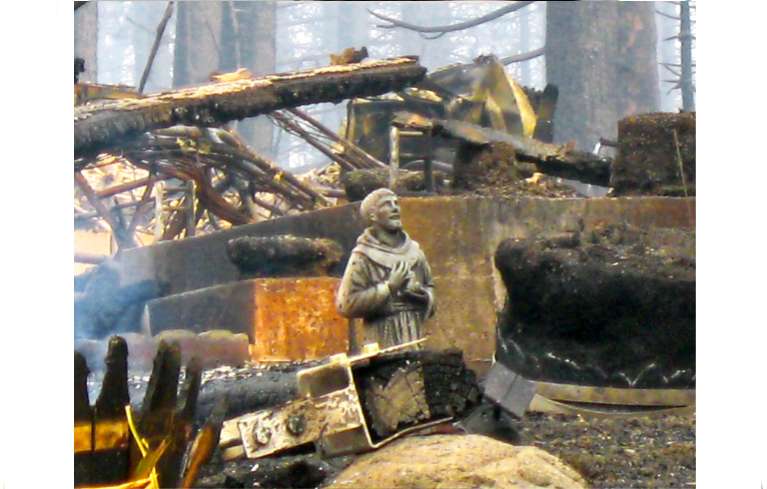
In 2007, 254 houses burned and bout 3,100 acres -- mostly USFS land -- on the South Shore of Lake Tahoe. Photo/Lake Valley Fire

In 2007, 254 houses burned and nearly 3,100 acres — mostly USFS land — near South Lake Tahoe. Photo/Lake Valley Fire

Seventy houses were destroyed, and one flare-up left Becky Koon, a landscape designer and local school volunteer, briefly frantic over the fate of her 13-year-old daughter, who, oblivious to the sudden danger, was sunbathing at a friend’s house. The girls were rescued, and Koon has since tried to help people there lower their risk by reaching out with information about brush- and tree-clearing and other ways to make their homes safer.

But she remains frustrated. “It’s a mixed bag,” was the best she could say of the reception her neighbors in Ravalli County, Mont., had given her efforts. This is a county whose voters decisively rejected a proposal to initiate local zoning and that prides itself on its log cabins and a belief that government should stay out of people’s lives.

Almost 15,700 of Ravalli County’s 19,000 homes are built where fires are likely, according to 2010 data compiled by researchers at the University of Wisconsin and Oregon State University. That is nearly double the 8,062 houses in the same area in 1990. Currently, more than 32,000 of the 40,212 people in the county live in the WUI.

But Ravalli county commissioners refused to adopt new maps of this interface, in the face of objections from homeowners and real estate agents that it would depress property values, increase insurance rates and lead to regulation.

As Greg Chilcott, a county commissioner, said: “Regulatory intrusion is a concern. We have somewhat adopted the philosophy, in my mind, that informing citizens of the risk of their choices as to where they build their homes is what our job is — rather than regulating them out of their homes or away from their lands.”

Ravalli County’s resistance to controls either by governments or insurers is hardly unique among the Western states. In fire-prone areas of California, Colorado, Texas, New Mexico and Arizona, the increase in wildfires has been exacerbated by droughts driven by climate change, and beetle infestations that turn evergreen forests into red tree graveyards. But construction has continued apace.

“Up until 2006 to 2008, the trend accelerated,” said Roger Hammer, a sociology professor at Oregon State University who has studied the issue for years. He called the recession “a speed bump” that “isn’t going to change the trend at all.”

But some of the more heavily inhabited places have started to change. The fierceness of recent fires in places like politically liberal Boulder, Colo., and politically conservative Colorado Springs changed minds. This year, Boulder required fire-resistant construction materials in such areas. Colorado Springs used WUI maps as the basis for new controls on hillside construction.

And Colorado’s governor, John Hickenlooper, this year appointed two public-private task forces to look at the issue of how to deal with fire risks.

“One of the things we’re looking at is, should there be fee assessments if you’re living in that area, to support wildfire-fighting efforts?” said Kelly Campbell, a member of one of the commissions and a vice president of the Property Casualty Insurers Association of America.

Another, she said, is “if we are providing insurance at a rate that is less than the risk, are we encouraging development in an area we might not want to?” But she indicated that until recently the question of wildfire risks was low on the insurance industry’s agenda because fire losses make up perhaps 2 percent of total losses, and wildfires even less.

Some communities, like Ruidoso, N.M., have aggressively used state and federal grant money to inform residents — many there only in summer — about mitigating fire risks. The village has stringent requirements for construction and management of trees and brush.

“Some local communities are getting the word,” said Stephen Pyne, a historian and expert on Western fires. “But we’ve got 30-plus years of backlog, of communities that need to be retrofitted, where we have to go back in and put in building codes and zoning and create a fire-resilient landscape. We are not going to banish fire.”

Even in the wake of a tragedy like the Yarnell Hill Fire in Arizona, northwest of Phoenix, lessons about lessening risk “are not being learned,” said Ray Rasker, executive director of Headwaters Economics, a research group in Bozeman, Mont.

About 16 percent of wildland-urban interface has been developed, he said. “But we’re not even having a national conversation about the other 84 percent.” He added that “the reason that local governments are not responding and not restricting development is that they don’t bear much of the cost” of fighting the fires and cleaning up afterward. “The bulk is borne by the federal taxpayer.”

Indeed, in Ravalli County, Koon pushed to have residents thin out combustible trees and brush on their property. “I was amazed at how many people believe it’s the government’s job to do this,” she said. “… For some of the landowners, it’s summer property. They don’t do anything.”




Food being given away in South Lake Tahoe

The Food Bank of El Dorado County and California Emergency Food Link will be continuing farmers markets style giveaways in South Lake Tahoe.

The dates are July 24, Aug. 28, Sept. 25 and Oct. 23. The free distributions are at 10am each day at the American Legion.

For more info, email info@foodbankedc.org or call (530) 621.9950.


July 4 South Tahoe fireworks debris washing ashore

By Maria Medina, CBS-13

Residents say they’re being forced to clean up the mess more than a week after a fireworks show at Lake Tahoe.

For more than a week, Joan Truxler’s filled bag after bag with fireworks debris left over from south Lake Tahoe’s Fourth of July show.

The first people to alert her about the trash washing up onshore were her grandsons.

“We were clearing out the area around us, and we were shocked and appalled,” she said. “So I continued to walk down the beach and found huge pieces of debris with wires attached to it, and the company’s name.”

The company that puts on the show, Pyro Spectacular, tells CBS13 they cleaned as much of the debris from the water soon after the show and the next morning, just like they do every year.

Truxler says she’s found debris from those South Shore fireworks along a quarter-mile stretch of this beach. But the company says this is the first time they’ve gotten this complaint after more than 30 years putting on the show.

“We spend about $3,000 to $5,000 on cleanup,” said Mike Frye with the Lake Tahoe Visitors Authority.

The group oversees the fireworks show, and Frye says they also hire the cleanup crew, including divers.

“It’s just something that’s never happened before.”

He says they’re working with Pyro and other agencies to figure out what happened this year, especially since the next fireworks show is less than two months away on Labor Day.

“We love the lake and want to take care of it.”

He says half of the debris they found was from Pyro, the other half from illegal fireworks.

But Joan says most of what’s washed up on shore is from the show.

“I was actually able to find their name on some of the debris,” she said. “I would challenge Mike Frye to come look at my debris. None of the agencies here have offered to come and extend a hand.”

The Lake Tahoe Visitors Authority wonders if strong winds that day are to blame, or if a net broke free.

They’re looking into fishing nets for the Labor Day fireworks show.

Meanwhile, the Tahoe Regional Planning Agency is investigating what went wrong.


Snippets about Lake Tahoe

elena hight• South Lake Tahoe snowboarding sensation Elena Hight reveals a lot about herself in ESPN magazine.

• July 17 is the final Business After Hours Mixer of the summer. It’s from 5:30-7:30pm at the Beach Retreat & Lodge at Tahoe in South Lake Tahoe. Tickets are $10 for chamber member, $20 for prospective members.

• On July 31 at 1pm will be a five card no limit Texas Hold’em Poker Tournament before the Phish concert to benefit the Mockingbird Foundation and their work with K-12 music education programs. For tickets, go online.

• Here is the Sierra roadwork schedule from Caltrans for this week.

• Gov. Jerry Brown appointed Kenneth Pogue, 45, of Shingle Springs assistant secretary for legislative affairs at the California Department of Corrections and Rehabilitation.


Letter: Tahoe Bike Challenge a growing success

To the community,

With your support, we have just completed the 8th annual Tahoe Bike Challenge and made significant changes to the campaign that produced measurable results.

I have prepared a thorough event summary for your review. I realize this time of year is busy for your professional and personal life, so I greatly appreciate your time in glancing at the attached document. Should you have any questions, suggestions and/or offers, please feel welcome in contacting me and I will be delighted to be of service.

In reviewing the results, I see great opportunity to increase participation in 2014 and I’m hopeful you will join us to help make that a new reality. One of the key growth opportunities is to engage agencies, organizations and businesses to get more involved internally with their staff/employees, and externally by being more strategic by cross-promoting the campaign — leveraging everyone’s combined resources (email lists, websites, newsletters, etc.).

The Tahoe Bike Challenge is the only basinwide bicycle promotional campaign that is working to transform behavior, reduce dependence on the automobile, improve public and environmental health, stimulate the economy, and demonstrate the need for a basinwide bikeway system connecting our communities. By getting all of us working together, using the Challenge’s momentum, infrastructure, and good will, we can create a “tipping point” for community transformation and show the funding sources our commitment and need for more facilities.

Another new and exciting to the campaign is to extend the Tahoe Bike Challenge until Sept. 30, 2013, and thereby making all the tools available for our visitors. Imagine a family coming to Tahoe and signing up for the Challenge where they can log their miles, upload their photos, and share their Tahoe bike holiday stories about the amount of CO2 they didn’t emit into the atmosphere, the calories they burned, and the gasoline dollars saved – complete with photos and videos.

On behalf of the Lake Tahoe Bicycle Coalition and the Tahoe Regional Planning Agency, I want to personally thank you for helping us make the 2013 Tahoe Bike Challenge a success. We look forward to our continued success, growth and collaboration with you.

Kind regards,

Ty Polastri, Lake Tahoe Bicycle Coalition


Bison Fire cost nearly $8 mil. to extinguish

With the Bison Fire being 100 percent contained, crews are being sent to other fires.

Firefighters will be finishing rehabbing and watching for any hot spots that might still be out there.

Since the fire started July 4 by lightning, four firefighters have been injured — two sustained twisted knees, one twisted an ankle and another had breathing issues.

An old mining structure was lost, but no homes.

It has cost $7.72 million to date to fight fire in the Pine Nut mountains of Douglas County.

“Nevada is seeing the worst drought in 60 years combined with record temperatures that increases the possibility of wildland fires,” fire officials said in a statement. “Those who live in and around the public lands need be extra careful and lessen the possibility of losing your home by clearing 30 feet around your residences.”

— Lake Tahoe News staff report