Then and now: Staying along Emerald Bay

dddddd

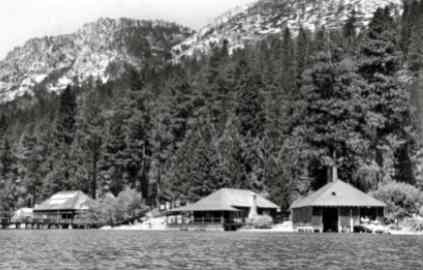
Emerald Bay Resort, circa 1950s

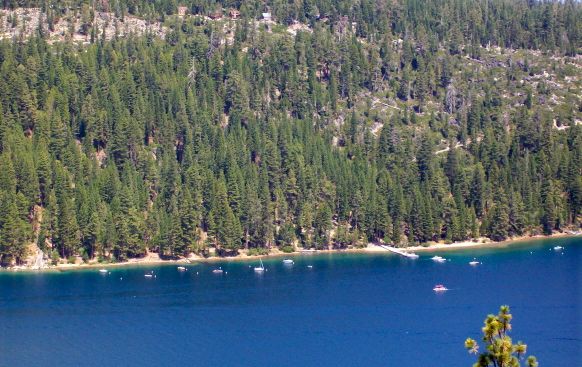
Emerald Bay today offers a Boat Camp on its north shoreline which is accessed publicly only by boat, or on foot via the Rubicon Trail. A pier and several mooring buoys are visible in this current color photo, plus there are campsites on land. Part of an “official vehicles only” access road is visible diagonally at right, which today is gated where it meets Highway 89. There is no public entrance.

Today's boat-in campground.

Today’s boat-in campground.

Dave Wakeman, who has lived at South Tahoe since 1947, remembers this earlier Emerald Bay Camp & Resort of the 1950s and a smaller neighboring resort (possibly the Lakeview Lodge) which also existed on the north side of Emerald Bay. (Black and white photo.) The “official vehicles only” road mentioned above was the main public access driveway to these resorts.

The state of California purchased Emerald Bay (below Highway 89) from Lora Knight in 1952 while allowing the resorts to continue operating on lease until 1959. Wakeman signrecalls a pier and a restaurant where his family had dined lakeside at the resort, and he says that today’s state-operated boat camp campsites are where Emerald Bay Resort used to rent housekeeping cabins. Wakeman notes that a large log and other shoreline remnants of the past remain around the pier today.

I recall viewing a seaplane docked at Emerald Bay in the 1950s.

The Lake Tahoe Historical Society Museum (Highway 50 facing Sno-Flake Drive In) has a huge collection of historical photos, including Emerald Bay Resort. The museum is free.

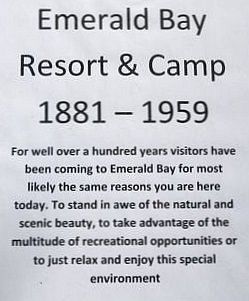
Photo credits: Old photo is from Pomona Public Library Collection of Frashers Fotos; today’s color photo from me, and the sign from Lake Tahoe News.

— Bill Kingman


CPR device frees paramedics to give other care

By Kathryn Reed

It may not be a paramedic doing chest compressions when the ambulance arrives. Instead, it could be Auto-Pulse.

“It has definitely been a game changer in how we run our CPR calls,” South Lake Tahoe firefighter Scott Blasser told Lake Tahoe News. “Auto-Pulse will provide more consistent profusion pressure across the board.”

It’s the size of a boogie board and is heavy, so it’s not something that would be carried by search and rescue crews.

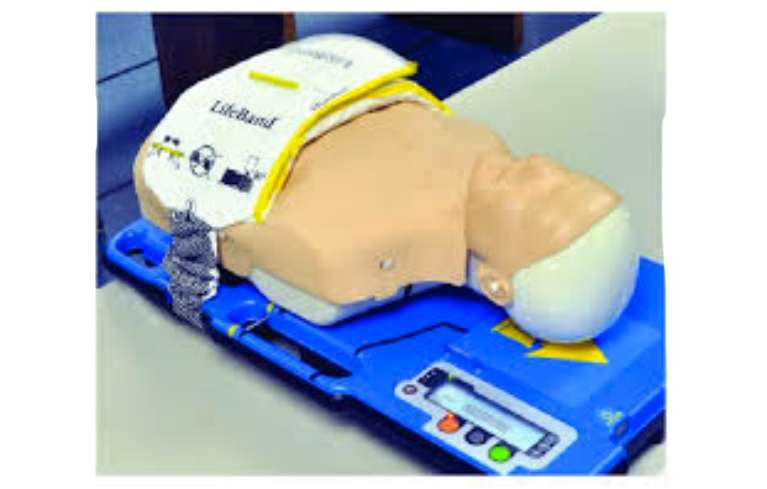
A band is placed over the patient’s chest and the machine does compressions on the heart instead of an EMT or paramedic.

This shows a mock patient on the Auto-Pulse board with the compression strap on. Photo/Provided

This shows a mock patient on the Auto-Pulse board with the compression strap on. Photo/Provided

The devices are on South Tahoe and Lake Valley fire departments’ three primary ambulances. They were bought earlier this year at a cost of about $15,000 each.

It’s something that can be used on most any cardiac call. The limitations of the machine are based on the size of the person – if they are too small or too large.

When a man who nearly drowned earlier this month in one of the canals in the Tahoe Keys was pulled from the water crews used the Auto-Pulse to help revive him.

South Tahoe Fire Chief Bruce Martin has been aware of the devices for about a decade and said they made a world of difference when he worked in Fremont.

“Now we have a machine that takes the place of human labor. It does it consistently and it doesn’t get tired,” Martin told Lake Tahoe News. “We think it contributes to the successful outcome in cardiac care.”

Blasser explained that the evolution of cardiopulmonary resuscitation is that compressions are more important than breaths. And that consistency and depth of the compressions is critical to the recovery of the patient. This machine and others like it can provide pressure and consistency better than a person.

This in turn allows the paramedic to be doing other things like administering drugs, working on wounds, starting an IV, intubation and other vital medical care.

It would also usually take two people to perform CPR because one person can only go so long, so they trade off.

“Given the circumstances we encounter, people have done CPR for an hour,” Martin said.

And if a battery runs out on the Auto-Pulse, manual labor is still possible.

Blasser said another good thing about Auto-Pulse is that is able to keep doing the compressions when the crews are lifting the patient onto a gurney or if they have to be turned.

So far, the Auto-Pulses is being used about a handful of times a month.

“It improves the quality of job we can do,” Blasser said.


Time for back-to-school shots

The El Dorado County Health and Human Services Agency, Public Health Division is offering back-to-school immunizations for eligible children.

Public Health can provide all childhood vaccinations required for school entry, as well as those vaccinations that are recommended to keep children healthy.

Schools are required to verify each child’s immunization record to make sure all shots and boosters are completed before entry to kindergarten and seventh grade. Kindergartners need a total of five DTaP (diphtheria, tetanus, pertussis), four polio, three hepatitis B, two MMR (measles, mumps, rubella) and one varicella (chickenpox) shot.

In addition, since a California law was signed in 2010, students entering seventh grade need to show proof of the Tdap (tetanus, diphtheria, pertussis) vaccine before starting school.

Parents who do not have a health care provider and wish to have their child vaccinated through a scheduled appointment at Public Health may call the Public Health Clinic at (530) 573.3155 in South Lake Tahoe or (530) 621.6100 in Placerville.

Any child on Medi-Cal, who is uninsured or under-insured (insurance does not cover vaccinations), is eligible for Public Health’s immunization services. A $10 administrative fee is charged per shot, though no child will be refused a vaccination due to inability to pay. Parents are asked to bring their child’s immunization record.


Calif. roller coaster rules stringent

Six Flags in Vallejo. Photo/LTN file

Six Flags in Vallejo. Photo/LTN file

By Sophie Kissinger, Huffington Post

Last week, a woman died and nearly a dozen were injured on a roller coaster at Six Flag Over Texas. With all the amusement parks and roller coasters in California, the tragedy made us ask: Could this happen in California?

To great relief, we found that California has more safeguards in place. Texas is one of at least 17 states that have no state or federal agency responsible for enforcing the safety of amusement parks, according to NBC.

California law insists that certified safety inspectors annually perform unannounced inspections of all rides’ operation, physical state and records, according to the Permanent Amusement Ride Safety Inspection Program, which was put into place by a California law passed in 2000.

Read the whole story


Corn can be used in desserts

By Melissa Clark, Los Angeles Times

Ripe summer corn is as sweet as many of the fruits we habitually make into dessert, but rarely do we see it at the end of the meal.

This isn’t at all true in Mexico, where corn ice cream is a year-round tradition. Or in Vietnam and Thailand, where the kernels are often stirred into sugary coconut-milk puddings. Or in the Philippines, where they’re paired with sweet and milky shaved ice.

But here in the United States, the kernels are generally savory fare, even though we use plenty of cornmeal in pastries and cakes.

Not so at my house. During the height of corn season, I try to eat as much fresh corn as possible, desserts included. Homemade corn ice cream is a staple, and has been ever since my very first spoonful.

Read the whole story


Workshop focuses on selling homegrown products

Two new laws that went into effect in Nevada this month are sparking a lot of interest, especially among those involved with the local foods movement. The laws provide farmers, home growers, home cooks and others with increased opportunities to produce and sell their products locally, as well as to hold dinners featuring their homegrown products.

University of Nevada Cooperative Extension has convened a panel of local and national experts to explain the legislation, provide guidance and answer questions at a workshop on Aug. 12 from 9am-4pm.

The workshop will be in Las Vegas, but people throughout the state will be able to participate at several other locations via videoconference.

The workshop is part of Cooperative Extension’s Tomorrow’s Table Program geared toward helping Nevada growers who are new to agriculture or are interested in diversifying their current farming and ranching activities.

Presentations in the morning focus on AB206, the Cottage Foods legislation that clears the way for home cooks and farmers to make and sell up to $35,000 in products such as baked goods, jams, vinegars, dry herbs and more, without the requirement of a commercial kitchen. The afternoon discussions will focus on AB200, the Farm to Fork legislation that allows farmers to hold up to two dinners a month featuring their products, without forcing the farmers to qualify as food establishments and comply with all the accompanying regulations.

The registration fee for the all-day workshop is $20 and includes lunch. Two people per farm may attend for the $20 registration fee. To register or for more information, contact Becky Holys at (702) 397.2604, ext. 0 or holysr@unce.unr.edu.


Farm pesticides found in Sierra frogs

By Becky Oskin, LiveScience

Pesticides from California’s valley farms are collecting in the tissues of a singing treefrog that lives in pristine national parks, including Yosemite and Giant Sequoia, a study finds.

The chemicals include two fungicides never before found in wild frogs, said Kelly Smalling, lead study author and a U.S. Geological Survey research hydrologist. The study was published July 26 in the journal Environmental Toxicology and Chemistry.

“Fungicides have been registered for use for many years, but for some reason, they haven’t really been on anybody’s radar screen until recently,” said Smalling, who is based at the USGS California Water Sciences Center in Sacramento.

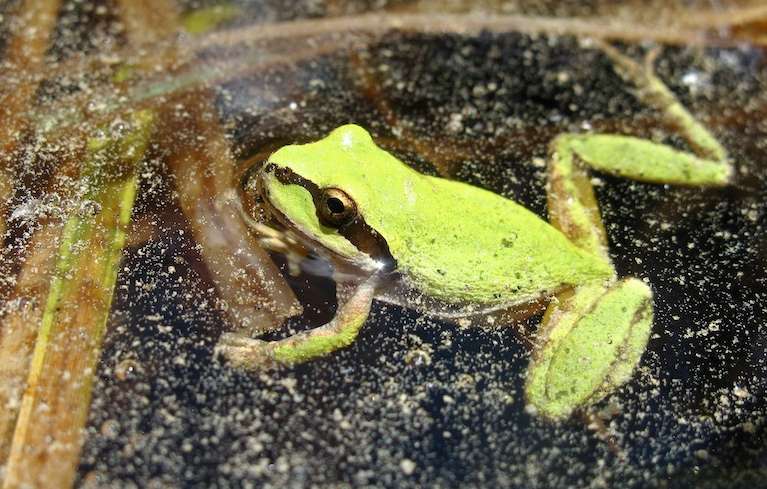
A Pacific treefrog, also known as a Pacific chorus frog. The frog is about the size of a silver dollar. (Photo: USGS)

The Pacific treefrog is about the size of a silver dollar. Photo/USGS

California’s Central Valley is one of the country’s most productive agricultural regions; crops include stellar wine grapes, nuts and kiwis. Agricultural pesticides and fungicides have been detected more than 100 miles (160 kilometers) to the east, in the rural Sierra Nevada’s snow, water, air and amphibians. But valley farmers aren’t the only source of agricultural chemicals: Illegal marijuana gardens hacked into public lands also expose wildlife to fertilizers and toxic rat poison, other studies have shown. Rare predator species, such as spotted owls and fisher cats, eat the poisoned mice and die.

“The marijuana cultivators make trail systems to go in, and put toxicants at every clearing,” said Mourad Gabriel, a UC Davis wildlife disease ecologist who studies the effects of rodenticides on rare species. “A lot of predators will use any type of trail system, so you can imagine the potential risk to multiple different species.”

Scientists first noticed sharply declining frog populations in the Sierra Nevada starting in the 1980s. (The problem is global. Amphibians everywhere are suffering steep population losses and strange deformities.) Earlier studies by the USGS researchers found toxic pesticide concentrations in several frog species living in the national parks. In 2009 and 2010, the scientists resurveyed many of the same sites, Smalling said.

Their species of choice was the bright-green Pacific chorus frog (also known as the treefrog). On spring nights, males gather on the shores of ephemeral ponds and lakes to sing for mates. That’s when biologists headed out with flashlights — to spot the frog’s eyes — and scooped up the silver-dollar-size suitors. “They’re very focused on attracting a female, so they don’t pay much attention to what’s around in their environment,” Smalling said.

Researchers collected Pacific chorus frogs on a north-south transect across Lassen Volcanic National Park, Lake Tahoe, Yosemite National Park, Stanislaus National Forest and Giant Sequoia National Monument. They tested frog tissue, water and sediment samples for more than 90 different pesticides and fungicides.

The most common chemicals in the frogs were the agricultural fungicides pyraclostrobin and tebuconazole and the herbicide simazine. DDE, a byproduct of the pesticide DDT, was also frequently found.

“This hammers home the point that even if you’re in an area that looks wild and natural, it can have very serious impacts from human activities 100 miles, or even more, away,” said Brad Shaffer, director of the UCLA La Kretz Center for California Conservation Science, who was not involved in the study.

The chemical concentrations were often higher in frog tissues than in the environment. “The contaminants in the water and sediments were ridiculously low,” Smalling said.

The frogs may store up small exposures over time, or there simply wasn’t any pesticide when the water and sediment samples were taken, the researchers suggest. “We don’t really understand the biology of these compounds and how they interact with the amphibians,” Smalling said.

While scientists agree that pesticides likely contribute to the dramatic decline in amphibians, there are many reasons that frogs are disappearing. The heavyweight is habitat destruction and degradation, followed by an infectious disease called chytridiomycosis. In the Sierras, introducing trout into mountain lakes also hit frogs hard, because the fish gobbled up tadpoles and tiny frogs.

Climate change is another factor.”The complexity is very hard to deal with,” Shaffer said. “These kinds of field surveys at least tell us what’s out there in those habitats and what’s accumulating in at least some frogs, and that gives you candidates to simplify the problem.”

Most pesticides in the Sierra come from the Central Valley. The pesticides travel to the mountains as aerosols, tiny particles that waft into the atmosphere on warm, rising air currents. Winds coming off the Pacific Ocean blow the aerosols west to the mountains, where they fall out of the atmosphere in rain and snow.

However, a boom in illegal pot farms in the past five years has brought a new chemical source into the parks. The cultivators spray pesticides and fertilizers and spread rat poison. Rodents that eat the poison live for two to seven days before keeling over, giving predators plenty of time to capture their dazed prey.

UC Davis’ Gabriel and his colleagues are seeing the effects of these chemicals on the fisher cat, a carnivore being considered for Endangered Species Act listing. Fisher cats nibble on everything from acorns to deer carcasses. The scientists found rat poison in 85 percent of fisher cat carcasses collected on public and tribal lands, according to a study published in June in the journal Conservation Letters. The animals are also passing the poison on to their kits when the babies nurse, Gabriel said.

The UC Davis group is now testing barn owls, which rely more heavily on rodents for food than fisher cats do. Spotted owls have tested positive for rodenticides in Oregon, and Gabriel said preliminary data indicates barn owls are snaring poison-laced mice.

Incline neighbors disagree about problem bears

By Kendra Kostelecky, KOLO-TV

Controversy remains in an Incline Village neighborhood after a bear and her three cubs were trapped and relocated.

Locals who named the bear Jasper say she was not the intended target.

The young male nuisance bear is suspected of breaking into as many as a dozen home in the area. Some locals are worried it could strike again accidentally injuring dogs or children. They are reluctant to ask the Nevada Department of Wildlife for help removing it, after seeing bear activists harass their neighbor online and around their home.

The victims worked with NDOW, requesting a trap on their property after the aggressive bear began breaking into homes. Activists following the Bear League and the “Lake Tahoe Wall of Shame” Facebook page attempted to talk the homeowners out of working with the state. They say they believe 57 percent of bears that are trapped are killed. Wildlife officials say that’s simply not true. They say most bears that are captured are subject to aversion training, which includes dogs and loud noises. The goal is to make the bears afraid of humans so they will stay away.

In this case, when activists were unable to talk the homeowners out of using a trap, they turned to social media. “Tahoe Wall of Shame” administrator Mark Smith says the goal of the page is to catch people who don’t manage their trash, or that invite bears in to be killed. The homeowners where the trap was set say they had managed their trash, but their home was posted on the site for cooperating with NDOW. Angry followers targeted the family, who say dozens of nasty emails were sent to one of their employers. In addition, they say they feel intimidated by strangers driving by their home.

While Jasper and her cubs have been relocated, the second bear is still on the loose. Some residents say they’re worried about what can happen if they encounter a bear in their home, but they are afraid to ask for help for fear of retaliation from misguided activists.


Teen at Camp Sacramento dies for unknown reasons

Attempts to resuscitate a 13-year-old girl who had stopped breathing at Camp Sacramento were unsuccessful.

El Dorado County sheriff’s deputies were called to the area along Highway 50 in the American River canyon about 10:40pm on July 26.

The girl was taken by ambulance to Barton Memorial Hospital where she was pronounced dead at 12:30 this morning.

The cause of death is pending an autopsy. The family has requested the name of the of the teen not be released.

— Lake Tahoe News staff report


FDA wants to enforce standards for imported food

By Sabrina Tavernise, New York Times

WASHINGTON — The Food and Drug Administration proposed sweeping new rules on Friday that would require food importers like Walmart and Cargill to make sure that their foreign growers and processors were following American food safety standards to prevent contamination in an increasingly globalized food supply.

About 15 percent of food that Americans eat comes from abroad, including nearly two-thirds of fresh fruits and vegetables.

The rules, if made final, would shift the responsibility for ensuring that food is safe from the FDA to companies. American companies would have to prove that their foreign suppliers had controls in place through actions like auditing the foreign facilities, testing food, and reviewing records. American importers would have to keep their own records on foreign suppliers. They would be allowed to hire outside auditors to make on-site inspections.

These are the last major rules needed to implement the Food Safety and Modernization Act, a landmark law passed by Congress in 2010 that was the first significant update of the agency’s food safety authority in 70 years. The administration has been criticized for not moving more quickly to carry out the law. The first set of rules, which applied to domestic producers, was proposed in January. The new rules proposed Friday exempt importers of seafood and fruit juices.

Read the whole story