Calif. shelves massive online education plans

By Steve Kolowich, Chronicle of Higher Education

Legislation in California originally aimed at getting state colleges to award credit for massive open online courses and other offerings from nonuniversity providers has been shelved for at least a year.

The bill, SB520, caused a stir when it was introduced, in March, by State Sen. Darrell Steinberg, D-Sacramento. Faculty unions strongly opposed it, and later drafts of the bill would give faculty-governance bodies more oversight of what outside courses could count for credit.

Steinberg has shelved the bill. The senator will re-evaluate next summer whether the legislation is still necessary, said Rhys Williams, a spokesman.

The senator changed his mind after the three public systems in California moved to expand their online offerings. California State University, for example, announced on Wednesday that it would offer 36 online courses this fall that could be taken for credit by students at any of the system’s 23 campuses.

The latest California budget provides some new money to the state’s public higher-education institutions, and the three systems — California State, University of California, and California Community Colleges — “have all produced plans for developing online access, course completion, which is a very welcome policy outcome,” said Williams.

Steinberg is “willing to see how those plans materialize and then evaluate their impact next year,” said Williams. (Because of how the Legislature operates, it would be possible to simply pick up the bill where it left off, rather than start again from scratch, he said.)

The spokesman did not elaborate on how the senator planned to assess the universities’ online efforts, though he suggested there would be no specific set of criteria. “I don’t think the senator’s going to start prescribing specific goals to meet,” he said.

The decision to put the California bill on hold, which was originally reported by the Oakland Tribune, represents yet another stalled effort to insinuate MOOCs into the existing landscape of credit-bearing higher education. Last month Florida passed a bill that opened the door to public universities’ giving credit for MOOCs, but only slightly. And several institutions that have tried to create nontraditional pathways to credit have seen no takers among MOOC students.


Snippets about Lake Tahoe

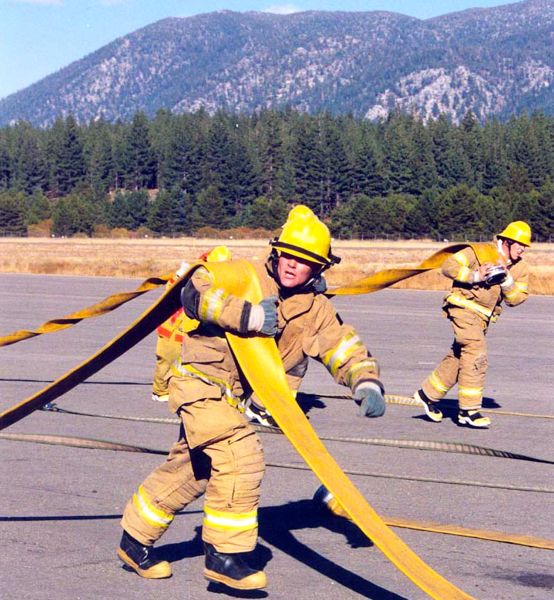
academy• Twenty-four cadets graduated from the Lake Tahoe Basin Fire Academy on June 29 in a ceremony at the Lake Tahoe Community College theater. Three were on a fire with a U.S. Forest Service fire crew within days of the ceremony.

• The Fields Advisory Committee of the South Lake Tahoe Recreation Facilities Joint Powers Authority meets Aug. 12 from 4-6pm at Lake Tahoe Airport.

• Railroad Earth’s 3rd annual Hangtown Halloween Ball will run Oct. 24-27 at El Dorado County Fairgrounds in Placerville.

• Here is next week’s Sierra roadwork schedule from Caltrans.

• Those interested in participating in next year’s Lake Tahoe Basin Fire Academy program must attend an orientation program Aug. 8 at 6 pm at the Lake Tahoe Community College cafeteria. For questions, call Leona Allen at (530) 541.4660, ext. 554.


Forest Service explains river restoration work

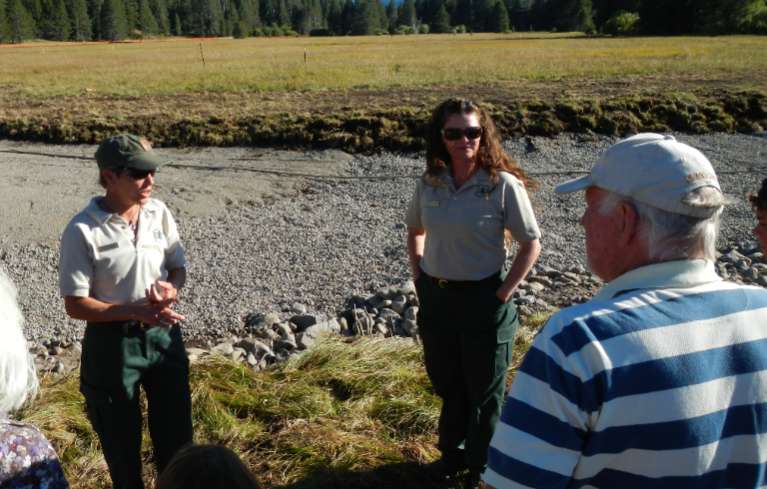
Sue Norman and Stephanie Heller with the U.S. Forest Service talk in front of the new channel of the Upper Truckee River. Photo/Kathryn Reed

Sue Norman and Stephanie Heller with the U.S. Forest Service talk in front of the new channel of the Upper Truckee River. Photo/Kathryn Reed

By Kathryn Reed

Not everyone is buying what the U.S. Forest Service is selling.

What the feds are selling is that changing how the Upper Truckee River flows is a good thing. What many on a tour of the project weren’t buying is whether this four-year $4 million project is needed.

Seventeen people on Aug. 2 meandered through the meadow on the other side of Lake Tahoe Airport looking at the work that is under way and how the current river flows.

“How do they know it will be what they say?” Louise Wigart said to Lake Tahoe News.

The Forest Service points to High Meadow and Cookhouse Meadow as being successful restoration projects.

Wigart’s husband, Corky, called it “overkill.” He’s been canoeing, fishing and hiking on and along the river for decades and sees no need to create a new channel. If something needs to be fixed, fix the existing channel is his philosophy.

But that strategy isn’t being used on any section of the river. Instead, the respective owners are each gradually rerouting the river in an attempt to restore the meander to what it was before humans changed it decades ago. Officials say working in the existing river is cost-prohibitive and would lead to greater degradation of lake clarity.

The goal is to put more curves in the river. Some sections had been straightened during grazing, logging and quarry operations. Curves will slow down the rate at which the water travels. This in turn is designed to lessen the erosion on the banks.

The Upper Truckee River, according to scientists, is the No. 1 contributor of fine sediment to Lake Tahoe. That sediment is what the same scientists claim contributes to the decline of lake clarity.

While this project is about keeping the lake clear, that is not the primary goal.

“This is mostly an ecosystem project,” Stephanie Heller with the U.S. Forest Service told those on the Friday tour. She said raising the water table and providing more habitat are critical components of the project.

The channel today is deep. The eroding banks impossible to miss. The meadow bone dry.

And while the meadow may be dry in August in the future, that will not be the case in early summer. The new channel is being designed so it will be shallower, flow at about one-fourth the rate of the current channel, all with the expectation it will flood the meadow two out every three years.

Some people along the tour questioned whether the project is going to really have an impact on lake clarity.

It is the overall reduction of sediment that is measured, not individual reaches.

There will be another tour of the project on Oct. 25.


Historic excavation work being done at old Indian school

UNR’s Department of Anthropology, in partnership with the Nevada Indian Commission and the Washoe Tribal Historic Preservation Office, is conducting an excavation at the historic Stewart Indian School in Carson City.

The Stewart facility is a 110-acre historic district that is home to more than 50 historic buildings.

Sarah Cowie, assistant professor of anthropology in the university’s College of Liberal Arts, is directing the excavation, which also serves as a summer field school that teaches students about archaeology and historic preservation. This collaborative project combines the efforts of professional archaeologists, Native American specialists in heritage, and students from diverse backgrounds.

The Stewart Indian School was open from 1890-1980 with a federal mandate to educate American Indian children, initially from the Great Basin Tribes (Washoe, Northern and Southern Paiute, and Western Shoshone), but eventually accepting children from tribal nations of the region. The intent of the Indian boarding school was not to prepare the American Indian children for higher education, but to educate them enough so they could work in the dominant society, away from their culture and traditions.

Stewart alumni have told Washoe Tribal Historic Preservation Officer Darrel Cruz that in early years, young native children were forcibly removed from their homes to live on the Stewart Indian School campus. This practice was well documented at other Indian schools around the country and resulted in a traumatic time for both the children and their parents. However, in later years attendance at Stewart was optional and alumni from that period say it was good for some. It provided an avenue for the native population to learn a skill that would allow gainful employment.

The Nevada Indian Commission, a state agency, has been the lead on efforts to preserve the history and legacy of the school. The commission has worked with stakeholders, including the school’s alumni, to identify potential cultural tourism use of the buildings and campus. A cultural center and museum are planned, with future plans for a destination experience. The project is in the planning and fundraising phase.

Although the Stewart Indian School site is now owned by the state, it is located on the traditional homelands of the Washoe Tribe of California and Nevada.

The public is welcome to visit the site (5500 Snyder Way, Carson City) while the team is working there, Mondays through Fridays, 9am-noon and 1-3pm. They expect to conclude their work Aug. 13.


Letter: City Council ruining South Lake Tahoe

To the community,

South Lake Tahoe is an amazing place. We have the most awesome lake in the world, the best tree skiing on the planet, an outstanding hospital and an extraordinary police force that focuses on real crime with real victims.

Best of all, we have the most awesome people you will ever meet. From world-class athletes, to entrepreneurs, artists, musicians and writers, South Lake Tahoe is teeming with culture and vitality.

Steve Kubby

Steve Kubby

Unfortunately, we also have a City Council that has a long and miserable record of failure. Centrally planned economies have been a failure in places like North Korea, but that hasn’t stopped our City Council from seizing private property and pushing their authoritarian redevelopment schemes down our throats.

When the El Dorado Grand Jury investigated the council they found criminal negligence and a culture of ignoring the public. This is the same City Council that has an annual deficit of $1 million, made illegal transfers and is at least $300 million underwater in unfunded liabilities.

South Lake Tahoe deserves and urgently needs a City Council that is honest and truly represents us. It’s up to the voters in this extraordinary town to elect new council members who can better serve us. We also urgently need a forensic audit to untangle the convoluted and deceptive financial records currently being kept by the city.

Steve Kubby, South Lake Tahoe


2 fatalities during I-80 challenge

The Nevada Highway Patrol was successful in meeting its goal of no fatalities on Interstate 80 through Nevada during the July 24-31 I-80 Challenge.

During the eight-day challenge NHP investigated more than 20 property damage, minor injury accidents and wrote more than 1,300 traffic citations. There were also more than 20 arrests; six of those for DUI.

Though Nevada met its goal, there were two fatalities reported along the I-80 corridor. One occurred in Nebraska and the other in Ohio. Reports indicate that this time last year there were four reported fatalities along the I-80 corridor across the nation.


Upper Truckee River restoration

The U.S. Forest Service is restoring a section of the Upper Truckee River.


Congressman convening meeting about frogs

Rep. Tom McClintock, R-Granite Bay, is sponsoring a public forum on the U.S. Fish and Wildlife Service’s proposal to list the Sierra Nevada yellow-legged frog and the northern distinct population segment of the mountain yellow-legged frog as endangered species, the Yosemite toad as a threatened species, and designate critical habitat of these species.

The forum is Aug. 6 at 2pm at the Mother Lode Fairgrounds, Sierra Building, 220 Southgate Drive, Sonora.

Presenting information on the proposed listing will be:

· Mike Applegarth, El Dorado County.

· Kelly Wooster, Calaveras County.

· Randy Hanvelt, Tuolumne County.

· Steve Brink, forester.

· Mark Baird, Siskiyou County.

· Alex Pitts, U.S. Fish and Wildlife Service.

McClintock will be joined by Rep. Devin Nunes and staff members from other congressional offices whose constituents would be impacted by the designations.


Bear caught and released in Stateline

Bear activity is increasing in heavily populated areas of the Lake Tahoe Basin.

A 3-year-old female black bear was trapped near a condo-time share complex July 31 and released the following day in Stateline. Two other traps on the Nevada side of the South Shore remain.

The released bear, which was not nursing so there are no cubs to worry about, had not previously been tagged by the Nevada Department of Wildlife. She weighed about 150 pounds.

Bears in neighborhoods are common in Tahoe. Photo/Judy Brown/File

Bears in Lake Tahoe neighborhoods are common. Photo/Judy Brown/File

“We were able to give her a healthy dose of aversion conditioning treatment during the release. When we can shoot a bear with rubber bullets and chase her with the Karelian bear dogs, it gives us a real chance to change the bear’s behavior and keep it from becoming too acclimated to humans,” NDOW biologist Carl Lackey said in a press release.

Dry conditions can mean less natural food for bears in the high country. This has them coming into populated areas in search of food, where they often find people food.

July in western Nevada was the hottest in recorded history and the area is now in year two of a drought. This is affecting bear behavior.

Now and going forward is the time bears will dramatically increase their food consumption in an effort to put on layers of fat in preparation for hibernation in late November or early December.

“We will see more and more bears searching for food. It is the responsibility of people living in bear country to not attract the bears by poorly handling garbage or leaving other attractants like bird and pet food available,” Lackey said.

— Lake Tahoe News staff report


2 water conservation events in Truckee

The Truckee Donner Public Utility District is hosting two free water conservation events.

There will be a free toilet exchange at Tahoe Donner’s Aug. 10 Waterpalooza. Qualifying TDPUD water customers can bring up to three old toilets and exchange them for new, water-saving toilets.

The event is from 11am-4pm at the Tahoe Donner Driving Range, 12850 Northwoods Blvd.

Call (530) 582.3931 for details and to see if you qualify for the free toilet exchange.

TDPUD Conservation Garden Party & Seminar is Aug. 12 from 5:30-7:30pm at Truckee Donner PUD, 11570 Donner Pass Road.

This event is to learn about water conservation for gardens, erosion and storm water control, and a chance to tour the Patricia S. Sutton Conservation Garden, as well as talk with experts on plant selection, irrigation, and landscape materials. This event includes presentations by experts and a host of local exhibitors to help implement water-saving ideas.