Stateline resident wants no delay in CalPERS case

By Dale Kasler, Sacramento Bee

The central figure in the CalPERS bribery scandal says he is in “failing health,” nearly died two years ago and needs a quick resolution to the pile of litigation he faces.

The disclosure by Alfred Villalobos is part of an effort by the Stateline businessman to thwart a new legal strategy by government lawyers who have been pursuing him for years over his role in the scandal at the California Public Employees’ Retirement System.

In June, federal and state officials asked the courts to put a “stay,” or legal hold, on a series of civil lawsuits involving Villalobos.

Their reasoning: The suits could give Villalobos’ lawyers access to witness statements and documents they could use to fight the U.S. Justice Department’s criminal prosecution of Villalobos and his friend, former CalPERS Chief Executive Fred Buenrostro.

Villalobos, however, wants to keep the lawsuits on track.

Read the whole story


Fire engulfs S. Lake Tahoe house

Fire caused substantial damage to a South Lake Tahoe house on Wednesday.

Firefighters are still trying to determine the origin and cause of the fire that was reported at 12:31pm Aug. 7 at 3732 Paradise Ave.

No one was at the residence when the fire started.

— Lake Tahoe News staff report


Preparation key before getting on water

By Joseph Dowdy

Kayaking is a versatile activity. It can be as peaceful as floating on calm water as you soak in nature or as adrenaline pumping as navigating class five rapids.

For me, I try to keep my kayaking experiences simple and more on the peaceful side of things. One of my favorite things to do on summer weekends is to throw my kayak in the lake and spend the entire day on the water. What I learned over time is that sometimes I tried to keep things too simple and ignored common sense preparation and paid the price with sunburns, loss of gear and other mishaps that could have been avoided. No matter how you intend your kayak experience to play out, every kayaker should adhere to a checklist.

I’m talking about 10 items that every kayaker needs before getting on the water to ensure they’ll be prepared for anything and have a positive experience. You may modify this list depending on what you plan on doing but let’s start here.

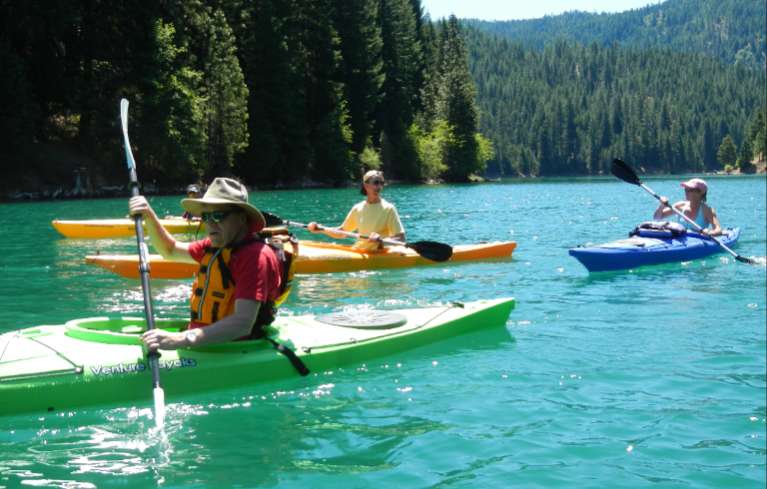
Common safety tips can ensure a kayak goes smoothly. Photo/LTN

Common safety tips can ensure a kayak goes smoothly. Photo/LTN

Life vest (AKA personal flotation device or PFD) — It goes without saying that every kayaker needs to wear a PFD when they go paddling. It’s a safety precaution usually required by law and it’s always better to be safe than sorry. They’ll help you stay afloat should a capsize occur and provide an access point for those on a boat or dock to pull you up by the shoulder strap. Many will be brightly colored or have integrated reflective materials so that you can be seen from afar or at night. Every PFD should include a place to clip in a whistle or noise-making device, which can also be required by law.

Paddle — Of course you know you need a paddle to go kayaking. You won’t get very far without one. Like PFDs, kayak paddles have been designed for every type of paddler and you should take time to find the one that fits you best. Higher end models will be more expensive but are made of lightweight, durable materials that’ll leave you feeling like you can paddle forever.

Paddle keeper — Having a place to secure your paddle is important, especially when partaking in any activity that involves you getting in and out of your kayak, rapids, fishing or photography. Why is it important? Because you don’t want to lose your paddle! You can also substitute the paddle keeper with a leash.

Leashes, hooks and clips — A piece of gear escaping overboard is the easiest way to damper an otherwise great day on the water. Save yourself some worry and lake bottom searching by securing all of your gear onto your kayak. Use a combination of leashes, hooks and clips or carabineers to attach items around your kayak.

Water bottle — It’s smart to bring along a bottle of water or Camelbak to drink from even if you’re just going out for a light paddle on a cool overcast day. Camelbaks are a great investment for kayakers because they are hands free and allow you to drink while you paddle. Otherwise, any water bottle will do.

Sandals or water shoes — I can’t remember the last time I went kayaking without my sandals and that’s because I don’t like coming home at the end of a day with a pair of ruined tennis shoes. Unless you capsize or just decide to jump in, you won’t get soaked when you go kayaking but it is almost guaranteed that your feet will.

Dry bags and boxes — Whether you’re planning on bringing a pair of keys and wallet or a complete change of clothes, you’ll need to make sure this stuff stays dry. Kayak and kayaking accessory manufacturers make a wide variety of options and sizes from bags and boxes to small pouches designed to fit the shape of your phone. It’s always a good idea to keep the items you use more often in a separate location.

Emergency kit — I started off with a red dry bag (red signifying emergency) and stuffed it with a small first aid kit, flashlight, matches, knife, rope, sunscreen, bug repellant and a rain jacket. Hopefully you’ll never have to open this bag, but when you do, you’ll know you’ve got what you need.

Phone — Yes, your phone. While I realize for some the idea of getting outdoors means leaving your electronics behind, bringing your phone with you is a good idea should you get into an emergency situation and need to make a call. It can also serve as your camera too. Protect your phone with dry bag, pouch or box. Trying to avoid emails, texts and phone calls? Simply turn it off and stow it inside your kayak.

Paddling apparel — A pair of cotton shorts and a T-shirt may be just fine, but using apparel designed to get wet and dry quickly will make your paddling experience a more comfortable and safer one. Shop for apparel that is made of synthetic materials that are capable of wicking sweat off your body and dry quickly. If paddling during the colder part of the year, also stick to synthetic materials but don’t forget to layer up.

It shouldn’t be hard to find these basic kayaking accessories. Specialty retailers will have all of these items and most will be fairly inexpensive too.

So, next time you go kayaking, be prepared with the right gear and don’t learn the hard way like I did.

Joseph Dowdy is an avid kayaker based out of the central Texas area. He has paddled many of central Texas’ waterways and has attended and/or participated in many kayak fishing tournaments, races and paddling festivals. He’s currently employed at Austin Canoe and Kayak and loves that he gets to spend time working with his favorite toys.


3-day paddleboard festival in Kings Beach

The Ta-Hoe Nalu Paddle Festival hits the waters of North Lake Tahoe Aug. 9-11 in Kings Beach.

As the nation’s oldest paddle festival located in North Lake Tahoe, this family-friendly event features distance and beginner races, a live concert from Mama’s Cookin’, sand castle building contests, and more than $10,000 in cash and prizes, as well as an attempt to set the world record for the most people doing yoga on a stand up paddleboard.

For a full event schedule and more information, is online.


Government telling people which fish to eat

By Edward Ortiz, Sacramento Bee

A state environmental health agency has issued its first-ever set of statewide guidelines for eating fish from California’s lakes and reservoirs, including many in Northern California and the Sierra.

The California Office of Environmental Health Hazard Assessment’s advisories are meant to help the public decide what fish can be safely eaten – especially from hundreds of lakes and for reservoirs that have not had fish eating advisories established.

Read the whole story


Squaw Valley devoting two days to dogs

The Village at Squaw Valley is paying tribute to man and woman’s best friend with the 4th annual Peaks and Paws Festival on Aug. 24-25.

Dogs and their people can enjoy two stages of live bluegrass, 15 wineries, beer from Lagunitas, pet themed art, and activities and outings specially designed for furry friends.

All of the proceeds from the festival will benefit the Humane Society of Truckee-Tahoe.

The festival is from 11am-6pm, with beer available until 8pm.


Tahoe clarity improves; climate change a concern

Lake Tahoe's clarity improved for the second consecutive year. Photo/Kathryn Reed

Lake Tahoe’s clarity improved for the second consecutive year. Photo/Kathryn Reed

By Kathryn Reed

While Lake Tahoe’s clarity improved for the second straight year, no one is ready to throw a victory party.

“The data shown reveal a unique record of trends and patterns – the result of natural forces and human actions that operate at time scales ranging from minutes to decades. These patterns make clear that Lake Tahoe is a complex ecosystem, behaving in ways we don’t always expect. This was exemplified this year by the decrease in the abundance of (the algae) Cyclotella in the lake, and the corresponding increase in summer clarity,” Geoff Schladow, director of UC Davis Tahoe Environmental Research Center in Incline Village said in the Tahoe: State of the Lake Report 2013 that was released today. “While Lake Tahoe is unique, the forces and processes that shape it are the same as those acting in all natural ecosystems. As such, Lake Tahoe is an analog for other systems both in the western U.S. and worldwide.”

Schladow will be talking tonight at 6 at Sierra Nevada College about the report and lake clarity.

Jeff Cowen with the Tahoe Regional Planning Agency said the results of the report confirm a lot of trends the bi-state regulatory has known about.

“It underscores the approaches we have established,” Cowen told Lake Tahoe News.

In 2012, Lake Tahoe’s annual clarity improved 6.4 feet compared to 75.3 feet. Clarity improved in the summer and winter.

Scientists attribute the improvement to:

• 2012 being dry year in the basin. This means less runoff carrying sediment reaching the lake.

• The lake water not mixing. In winter, surface waters cool and sink downward, mixing with deeper waters. This brings nutrients to the surface, promoting algae growth, while also moving oxygen to deep waters, promoting aquatic life. A lack of deep mixing can contribute to warmer lake temperatures.

• Reduced numbers of tiny Cyclotella algae. An abundance of the microscopic algae over the past five years has been linked to climate change and coincided with reduced summertime clarity.

Since 1968 a Secchi disc – which resembles a white dinner plate – has been used to measure the clarity. That year the disc could be seen at depth of 102.4 feet. People stand on a boat, look in the water and decide how far down they can see the disc.

Schladow said this report is the first to use “other environmental and water quality factors that all provide indicators of the lake’s condition.”

Some of the new tools include an underwater glider that was in the lake for 11 days in May. It provided the first “snapshots” of water quality across an east-west transect. The data confirmed the presence of giant “internal waves” deep in the lake that could move algae and pollutants vertically over 150 feet.

A water-quality monitoring station was placed at a depth of 360 feet off the West Shore that provides data from top to bottom every 30 seconds. This is the first such station in any lake in the world and is expected to provide a better understanding of climate change impacts on Lake Tahoe.

Climate change is a growing concern for Lake Tahoe. The annual average surface temperature was 52.8 degrees, the highest ever recorded for Lake Tahoe.

The lake dropped a foot in 2012 because of the lack of snowfall.

The report says, “In a dry year lake Tahoe typically loses 1.5 feet of water level. Predictions of future climate conditions in the basin point to more extreme events in the future. A five-year drought could conceivably reduce the lake level to 6215.5 feet, or 5 feet below the record 1992 levels.”

Air temperatures are also increasing in the Lake Tahoe Basin. This in turn will mean more rain and less snow. All of this will affect lake clarity, too.

“Although the date on which peak snowmelt occurs varies from year to year, since 1961 it has shifted earlier an average of two weeks (16.3 days). This shift is statistically significant and is one effect of climate change on Lake Tahoe. In 2012, peak discharge was one of the earliest recorded, occurring around May 4,” the report says. “Peak snowmelt is defined as the date when daily stream flows reach their yearly maximum. Daily stream flows increase throughout spring as the snow melts because of rising air temperatures, increasing solar radiation and longer days. The data here are based on the average from the Upper Truckee River, Trout Creek, Blackwood Creek, Ward Creek, and Third Creek.”

While most of the attention in the past half-century has been focused on the disc in the middle of the lake, it’s the gunk growing along the shoreline that has the average resident and tourist concerned. This is what scientists call the near shore.

“Periphyton, or attached algae, makes rocks around the shoreline of Lake Tahoe green and slimy, or sometimes like a very plush white carpet. Periphyton is measured eight times each year. In 2012, concentrations at Sugar Pine Pt. (no urban influence) and Zephyr Pt. (low urban influence) were below the long-term average. The site with the most periphyton (Pineland) is close to an urban area, and was relatively high this year,” the report says. “The Tahoe City value was about average for that site. To date, no statistically significant long-term trend in maximum periphyton biomass has been detected at any of these individual locations. Monitoring periphyton is an important indicator of near-shore health.”

Here is the full 2013 State of the Lake report.


Erica Clifton Drewes — 1945-2013

Longtime Fallen Leaf Lake resident Erica Clifton Drewes died July 21. She was 68.

Also known as Ceci, CE, Two, and Mac, Erica was a fifth generation San Franciscan.

Erica was born March 10, 1945, in Washington, D.C., to Robert Drewes and Caroline Clifton Drewes.

Erica was a proud San Francisco native, an accomplished artist, and a passionate liberal activist. She spent her childhood in Presidio Heights, cavorting through the city and every summer climbing the mountains of the Sierra. She attended Katherine Delmar Burke’s School and then UC Berkeley where she received a BA, and later an MFA. She continued to study art and architecture at the Accademia di Belle Arte in Rome and at Harvard University. She received a second MA in film from San Francisco State.

Erica Clifton Drewes

Erica Clifton Drewes

Her pride and joy was the East Bay Community Arts Project Inc., a nonprofit visual and performing arts school for juvenile prisoners that she founded in 1974.

Erica was a multifaceted artist who used any and every medium to create beauty. She sewed exquisite clothes for her nieces and nephew (and in turn their children), sketched treasured valentines, painted on clothing, built sculptures and bookcases, and restored chairs, teddy bears, windows, and cabins. Every letter or postcard she mailed was a little piece of art full of love, and warmth, personalized with her notes of good humor. Every tool she wielded left a broken something in near mint condition.

A true “flower child,” Erica loved a good argument about politics, culture, art, and literature. She compulsively read the New Yorker, New York Times, and the San Francisco Examiner, and was an avid independent moviegoer.

Every morning, for more than 35 years, she swam in the bay as a member of the Dolphin Club, which, after her death, flew its flag at half-mast in her honor.

She is survived by her brothers, Robert and Stephen; her sister-in-law, Gail; her nieces, Genevieve, Caitlin, and Jillian; nephew, Bartholomew; their spouses and children; and, her many old and dear friends.

Donations in Erica’s name can be made to Planned Parenthood.


Countries increasingly regulating Internet content

By Caitlin Dewey, Washington Post

A new Vietnamese law will make it illegal for citizens to post news or “general information” online, a restriction that sounds absurdly unenforceable but turns out to be more doable – and less of an outlier – than you might expect.

According to analysis from the watchdog group Freedom House, Vietnam isn’t alone in its crackdown, even if its methods are particularly severe. Internet censorship is on the rise worldwide, and restrictive, one-party countries like Vietnam aren’t the only ones legislating what people can post online.

Consider the headlines you’ve seen over the past month alone. In the U.K., a proposed filter would automatically block pornography and, according to Internet rights groups, other unwanted content. In Jordan, news websites can’t operate without a special license from the government.

“What we’ve seen in our research is that as more people access the internet, governments are more and more likely to impose measures that censor certain types of content,” said Sanja Kelly, the project director for Freedom House’s “Freedom on the Net,” which will publish its 2013 report in September. “One of our findings for this year will be that Internet censorship is on the rise: more Web sites are being blocked than ever before and an increasing number of countries are passing laws that would restrict certain types of online content.”

Read the whole story


S. Tahoe gas station attendant shot to death

Updated 1:50pm

A 27-year-old clerk working at a gas station in South Lake Tahoe was shot to death Tuesday night.

Video of the suspect shows that he walked into the USA gas station on the corner of Highway 50 and Lodi Avenue at 10:40pm Aug. 6. Ten minutes later a patron walked in, saw the clerk on the floor in a pile of blood and called 911. The clerk, whose name is not being released pending notification of family, was pronounced dead at the scene.

This man is wanted in the Aug. 6 shooting of a South Lake Tahoe gas station attendant. Photo/Provided

This man is wanted in the Aug. 6 shooting of a South Lake Tahoe gas station attendant. Photo/Provided

The assailant as of Wednesday afternoon was still at-large. He is a male between the ages of 20 and 40, between 5-feet-8 and 5-feet-10, wearing a dark hoodie and dark mask over his face, his skin tone is light but exact race unknown.

“During a very brief encounter with the clerk, the suspect raised a handgun and shot the clerk. The clerk fell to the floor immediately as the suspect fled from the store,” police said in a statement.

Police Chief Brian Uhler told Lake Tahoe News at this point they are not calling the incident a robbery. But they also are not saying if the suspect and victim knew each other.

Reports are that only one shot was fired, but the type of gun involved has not been released.

Anyone with information regarding this homicide should call the police department at (530) 542.6100 or Secret Witness at (530) 541.6800.

— Lake Tahoe News staff report