Residents tested when car bursts into flames

Living in a remote location sometimes requires being self-reliant and not being able to wait for authorities to handle the emergency.

Such was the case July 6 for the residents of Sciot’s Tract along Highway 50.

Several people ran to the highway when they heard a loud explosion. A car towing a trailer was engulfed in flames, and the threat of the fire spreading to the forest was real.

“We jumped on it like a trained team,” Bob Cole told Lake Tahoe News. “We had to pry the hood open to get in there. The car was totaled. There was no paint, no tires.”

No one was hurt.

But that didn’t mean Cole didn’t feel a sense of panic. When he first arrived he didn’t know if anyone was trapped in the vehicle. He admitted his adrenaline was pumping.

The irony is this housing community had never had a fire drill until earlier in the day. About 40 people got out the old fire hoses, practiced how to use the equipment.

No one expected it would be a matter of hours before the training would be tested.

They passed the test. The fire was nearly out when the first official – a California Highway Patrol officer – arrived. And it was out when Lake Valley firefighters arrived.

— Kathryn Reed


Snippets about Lake Tahoe

tough mudder• Tough Mudder returns to Northstar Aug. 16-17. For more info, go online.

• Squaw Valley’s Full Moon Party is returning to the top of the mountain on Aug. 9 immediately following the Brews, Jazz and Funk Festival in the Village at Squaw Valley. The party takes place at High Camp under the super moon. Six disc jockeys will play from 8pm-2am.

• There will be a public hearing Aug. 21 at 1:30pm at the Tahoe Transportation Center in Stateline regarding increasing water rates for Cave Rock, Skyland and Zephyr customers.

• July 14 is when people may start filing for seats that are up in the November election.

• Here is this week’s El Dorado-Tahoe roadwork schedule from Caltrans.


Man arrested after stabbing at Stateline casino

A skirmish between friends in a Stateline hotel room ended with one person being stabbed and another taken to jail.

Christopher Calder

Christopher Calder

Douglas County sheriff’s deputies on July 4 at 7:40am found Timon Sung, 29, of Novato stabbed in the abdomen in a room at Harveys. He was taken to Renown Medical Center in Reno.

Christopher Calder, 30, of San Francisco was arrested on charges of battery with a deadly weapon.

Deputies said four adults and one juvenile were staying in the room. Sung and his girlfriend were sleeping when Calder, his daughter and his friend Eugene Nnodim returned to the room and caused a disturbance. An argument ensued, which escalated.

“Calder armed himself with a knife and pushed Sung into the hallway. Sung attempted to re-enter the room and Calder stabbed Sung in the abdomen with the knife,” deputies said in a press release.

 — Lake Tahoe News staff report


As drought persists, frustration mounts over secrecy of California’s well drilling logs

By Tom Knudson, Sacramento Bee

Inside a government warehouse along a noisy freeway in West Sacramento is a set of metal shelves holding more than 100 carefully labeled cardboard boxes.

Inside those boxes are tens of thousands of state records that could help scientists and water policy specialists better understand and protect California groundwater.

But while all other Western states make such records – known as well completion reports, or well logs, for short – open to the public, California does not.

Lake Tahoe is so low little sand bars are being created at Cove East on the South Shore. Photo/Kathryn Reed

Lake Tahoe is so low sand bars are being created at Cove East on the South Shore. Photo/Kathryn Reed

Here, access to the documents is restricted. While some government agencies and researchers can view them, many scientists and the public at large cannot, a barrier many say reins in knowledge about groundwater supplies as the state struggles with one of the worst droughts in recorded history.

“We’re basically blindfolding ourselves,” said Laurel Firestone, co-director of the Community Water Center, a Visalia-based nonprofit, who argues that access to the records could help improve water quality. “If California is going to be serious about managing its groundwater, it can’t possibly do that without accessible and transparent data.”

By now, the contours of California’s groundwater crisis are familiar: the dried-up wells, sinking farmland, over-tapped aquifers and growing push for more state oversight. But on the edges of that drama is a back story that’s been largely overlooked about groundwater data, government secrecy and scientific opportunities lost.

Groundwater is critical to California. Without it, agriculture collapses, cities shrink, ecosystems die. Yet while our knowledge of rivers and reservoirs is exhaustive, we know far less about water stored inside the earth, including how much can be safely pumped without depleting aquifers and sowing long-term harm.

“Imagine trying to manage a reservoir where you’re not sure what the boundaries of the reservoir are. You’re not sure how much water gets in, how much water gets out, or what the level is,” said Graham Fogg, a professor of hydrogeology at UC Davis.

“Groundwater management is kind of like that,” Fogg said. “You are trying to manage systems that are ill-defined and ill-understood.”

Well completion reports help chart that underworld. Like medical charts, they are filled with data and notes that help researchers and water managers understand a complex system they can’t actually see.

In all other Western states, such records are accessible to whomever wants to see them – from university professors to civil engineers, real estate agents to the media. But in California, well logs are barred from public inspection by a 63-year-old law written to keep data gathered by well-drilling companies from falling into the hands of competitors.

Read the whole story


18 arrests in SLT during holiday weekend; 3 beach fires

Throngs of people line the beaches of Lake Tahoe on July 4. Photo/Howie Nave

Throngs of people line the beaches of Lake Tahoe on July 4. Photo/Howie Nave

The U.S. Forest Service is investigating three fires that occurred at Round Hill Pines Beach on July 4.

USFS spokeswoman Cheva Heck told Lake Tahoe News they were the result of illegal fireworks. The investigation is ongoing

There were a lot of sirens over the holiday weekend on the South Shore. South Lake Tahoe police officers made 18 arrests in the 24-hour period starting at 5am July 4. Seven were for public intoxication, three for driving under the influence, two drug related arrests, and six miscellaneous arrests.

Fire and ambulances responded to 40 calls.

While the Forest Service was busy July 4, beach-goers were better behaved over the weekend, according to officials.

— Lake Tahoe News staff report


Loads of trash left behind on Tahoe beaches

Trash from July 4 that volunteers collected on the South Shore. Photo/Kenny Curtzwiler

Trash from July 4 that volunteers collected on the South Shore. Photo/Kenny Curtzwiler

Either more people were in town or they were less respectful of their surroundings because the beaches in Lake Tahoe were full of garbage from July 4 revelers.

For the 17th year, Skibumfamily Inc. spent July 5 clearing trash from El Dorado and Regan beaches, and the surrounding area. About 42 yards of trash were picked up by volunteers.

“This is the largest amount of garbage we have ever collected,” organizer Kenny Curtzwiler told Lake Tahoe News.

All of this is in addition to the 2,260 pounds of trash that were picked up at five sites around the lake by League to Save Lake Tahoe volunteers.


Tahoe Tails — Adoptable Pets in South Lake Tahoe

Rocky

Rocky

Rocky is one of many special dogs at the shelter right now. He’s had a rough start in life, but he’s still a happy, friendly, and affectionate boy.

He’s 18 months old, 45 pounds, and should probably weigh about 10 to 15 pounds more. He loves other dogs, playing with toys, and going for walks. He is well-behaved at home, sleeping through the night, but does like to climb into your lap and will jump on the counter to see what’s up there.

He needs just a little house training reinforcement, and will quickly learn more commands in addition to the sit and down he already knows. Rocky has a beautiful coat and classic Rottweiler markings, but he has the slender head and body of a small shepherd.

Rocky is neutered, microchipped, tested for heartworm, and vaccinated. He is at the El Dorado County Animal Services shelter in Meyers, along with many other dogs and cats who are waiting for their new homes. Go to the Tahoe animal shelter’s Facebook page to see photos and descriptions of all pets at the shelter.

Call 530.573.7925 for directions, hours, and other information on adopting a pet.

For spay-neuter assistance for South Tahoe residents, go online.

— Karen Kuentz


Tahoe Keys Marina’s troubles keep growing

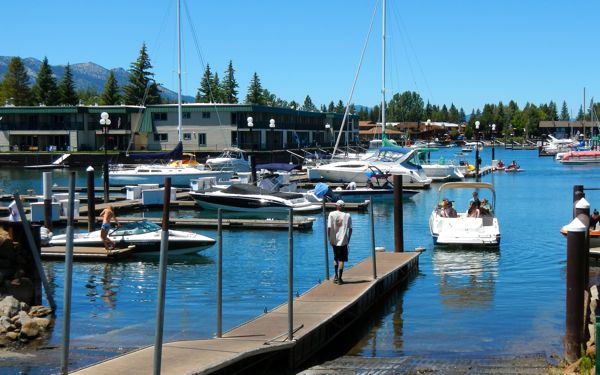
This sailboat on July 4 had to go out on the left to have enough clearance in the water. Photos/Kathryn Reed

This sailboat on July 4 had to go out on the left to have enough clearance in the water. Photos/Kathryn Reed

By Kathryn Reed

Tahoe Keys Marina is in a bit of turmoil. Lawsuits, OSHA investigations and financial troubles have been issues since the ownership change.

Donna and Robert Krilich bought the Tahoe Keys Marina in early 2009 for more than $20 million. South Shore real estate agent Jean Merkelbach has a minority interest in the marina.

But the Krilichs and Merkelbach are now fighting each other in court. Neither party was available for comment.

In early 2013, the Krilichs bought the Fresh Ketch restaurant at the marina from longtime owner Bob Hassett. At the time, the El Dorado County Assessor’s Office listed the value of the property and business at $1,224,913.

Speculation among those dealing the marina is the owners will default on their financial obligations.

“I don’t think we have filed bankruptcy. There has been some talks about it because of some of the litigation,” Robert Krilich Jr. told Lake Tahoe News. Krilich runs his parents’ Krilich Companies, which is based in Illinois.

The marina’s attorney, Bob Anderson, said at this time bankruptcy is not going to happen.

The Safari Rose charter boat just left the Keys because of the low water level. It is now operating out of Round Hill Pines, which for the first season is run by Hassett.

Tahoe Keys Marina has been in trouble since the ownership changed five years ago.

Tahoe Keys Marina has been in trouble since the ownership changed five years ago.

The Tahoe Keys Marina never applied for a dredging permit from the Lahontan Regional Water Quality Control Board. Lake Tahoe’s water level continues to drop because of the prolonged drought. This means some boats won’t be able to get out of or into the marina.

The U.S. Coast Guard, which has a station in Tahoe City, has not yet told the marina operators to warn boaters of the low water level.

Boats besides the Safari Rose are abandoning the marina because the channel is getting too precarious to navigate. On Fourth of July the marina had someone at the entrance of the channel into the docks warning people how to navigate the water. People in the condos were also helping, including directing some boats to stay on the left side to get out because that is where the deepest waters are. (New this year, the marina closed the launch at 9pm instead of midnight on July 4. A worker had no reason for the change.)

Vendors are also complaining they are not getting paid by the marina.

Anderson, the marina’s attorney, has his hands full with legal issues involving the marina. A 21-page 1991 agreement between the marina, Tahoe Keys Property Owners Association, and Tahoe Keys Beach and Harbor Association is at the center of one dispute. The document dictates how the three organizations work together, who pays what to whom and for what. Potable water and water quality are two key issues.

The disagreements have only arisen since the Krilichs took over the marina.

The Krilichs are familiar with the court system – civil and criminal. In 2013, they won a multimillion-dollar lawsuit over a land deal.

Locally, the problem is the marina owners are accused of not paying the bills TKPOA has submitted.

Scott Brooke, the attorney representing TKPOA, deferred comment to the association. However, interim General Manager Dan Moore did not return multiple phone calls.

Anderson also did not want to speak about the disagreements.

These aren’t the only troubles for the marina. The Cal-OSHA investigation is continuing. The state Occupational Safety and Health Administration opened the investigation earlier this year regarding how equipment is maintained and other safety issues.

South Lake Tahoe building officials have also been on site.

“We didn’t find anything of imminent danger,” Dave Walker with the city’s building department told Lake Tahoe News. “There were some minor things.” He said nothing was so egregious to warrant needing to shut down any business.

But Walker admitted it is hard to completely match up all the permits the city has issued and the work that was done.

“They have pulled quite a few permits over the years. When you go back 25, 30 years the description on the permits is limited so it is hard to see how much is permitted (compared to the) scope of work,” Walker said. “It would be very tough to nail down every little change. There are lots of plans, lots of permits. That’s why we kept mainly to life and safety issues. We didn’t see anything that would jeopardize anybody.”

One business practice Walker said has to stop is the marina has been using two of three residential units as vacation rentals. This is illegal.


Opinion: Daly left Amador in financial chaos

By Larry Weitzman

El Dorado County’s chief administrative officer, Terri Daly, has a history. Before she came to El Dorado County, she was the CAO of Amador County from 2007 to 2010. Prior to that she was the assistant CAO of Amador County for about a year and a half. Before assuming that post she was originally hired by Amador County as director of In-Home Health Services.

In 2006, a lease was negotiated by the apparently inept director of Amador Health and Human Services because the department claimed they had outgrown the two buildings they were currently using (a combined 22,800 square feet) at a total cost of about $200,000 annually (75 cents a square foot per month). A “need” study completed in early 2004 showed that by 2023, because of a projected population growth of 15 percent, the county HHS would need about 44,000 square feet.

Larry Weitzman

Larry Weitzman

Using that study, the director of HHS went looking for new space and what she came up with was a build-to-suit structure that the county would lease. It would be 49,000 square feet at the exorbitant rental price of $2.43 a square foot (plus COLA) per month (more than three times the 75 cents the county was paying per square foot) totaling $1.43 million annually (seven times the prior rental rate). That $1.43 million is 2 percent of the total Amador County annual budget; 2 percent of the county budget on a rental property for one department in a county that employs about 400 people. And although you would think for that kind of money you would get the Taj Mahal, it was a simple single-story structure that was nothing special. In showing the plans and pictures to some builders, it shouldn’t have cost more than $8 million to $10 million to build.

The original lease signed in 2006 (it apparently took effect upon occupancy in December 2007) was for 15 years with three five-year options, and it had a walkout clause seven and half years into the lease (July 2015) where the county could terminate the lease with an additional one-time payment of $500,000. The walk out clause continued for a period of five years until 2020 when the county could cancel the lease without penalty. (Each successive year the termination fee decreased by $100,000. In 2016 the fee would be $400,000.)

Before this lease was signed the highest rental rate for suitable space was about half that amount and today it is that or less. Today the building is underutilized with less than 70 percent occupancy. No departments want to move in as their budgets are charged the abhorrent rate of $3.74 a square foot per month. It makes the EDC Logan building look like nickels and dimes.

It turns out the county never grew and in fact slightly declined in population. There is no need for the building. It’s a $1.5 million annual rental albatross around the neck of a county with a total budget of just $73 million a year. Two percent of the annual budget is spent on a space requirement that should cost at most $360,000 annually. Amador County could have with the difference nine more full time sheriff’s deputies or perhaps a dozen more health professionals. By contrast, the EDC budget is about $500,000,000 annually. Amador County’s population at the time of the initial lease was about 37,000 (including 4,000 involuntary residents at Mule Creek State Prison), which has fallen to about to about 36,000 today, not withstanding a small increase in the prison population.

It is a good thing, that is, it is almost a good thing (“almost” being the operative word) that Amador County is only a year away from the walk-out provision from being effective so it can get out of this albatross and not be stuck for another $10.7 million in rent (7½ years of rent) and step down to perhaps 25,000 to 30,000 square feet for about $360,000 a year which is the current going rate for the area.

But everything is not going to be OK.

Something happened on the way to the asylum. In 2008, Terri Daly was the Chief Administrative Officer of Amador County for about a year with a total of about 2½ years as the No. 1 and No. 2 person in the county. The CAO is where the buck stops with county business. And considering this probably is the single largest monthly expenditure of Amador County and its largest boondoggle, you would want to terminate it as quickly as possible.

While the Amador County Grand Jury report publish on June 25 didn’t name names, there are documents which I obtained from the current Amador County CAO a few weeks ago when I started investigating this debacle, including all lease documents, that have Daly’s signature and name all over them, especially for the renegotiated lease agreement done in March 2008. Yes, Amador County officials renegotiated the original lease taking a bad situation into an abysmal, unforgivable situation.

Renegotiating the lease did two very bad things for the county; first it extended the hard lease from 15 years to 20 years with no reduction in rent. Totally unnecessary as the county already had three five-year options. But second and much worse was the elimination of the walkout clause from the first lease. With the renegotiated lease the county is bound to a nearly $1.5 annual payment for an additional five years or about $7.15 million for a space the county could replace for about $360,000 annually. And what did the county receive as consideration for removing the walkout clause and a hard five-year lease extension — $400,000. Some may say the county was in a cash crunch and needed the money, maybe the CAO wasn’t running the county very well, but to trade $400,000 for another $7.1 million obligation is absolute insanity. But wait, there is more.

The grand jury assessed the “mistake” at $7.15 million, five additional years of rent at $119,070 (not counting the COLA) a month (60 x $119,070 = $7,144,200), but the grand jury failed to account for the elimination of the walkout clause which would have shortened the lease by an additional 7½ years, which adds up to an additional $10.7 million (90 x $119,070 = $10,716,300). The renegotiation actually cost Amador County more than $18 million, not the $7 million as the grand jury report said. While the HHS director may have had something to do with this, it is the chief administrative officer who is responsible to recommend it to the board, which she did. If Daly claims stupidity or she does an Obama “I didn’t know anything about it,” there is absolutely no excuse.

Board member Brian Oneto, who had just joined the board, said he tried to give direction to the CAO regarding the lease renegotiation and did not want the walkout provision eliminated but somehow the modification was done via the consent calendar and slipped through.

“What the modification was portrayed as is not what we were sold,” he said.

While $400,000 may seem like a lot, it is less than chicken feed when compared to locking yourself to an additional $18 million albatross you actually didn’t need. It was the worse deal ever done in Amador County. Daly turned a bad deal into a nightmare deal, a nightmare that will last another 13 years. Something smells fishy.

Recently Amador County tried to buy the structure for $8 million, which is the market value of the property. The lessor countered at $16 million, understanding that they will collect $20 million from the county over the next 13 years. Twenty million dollars at current interest rates works out to a present value of about $16 million. And whom does the county have to thank for this heinous monstrosity? That’s right, Daly, who is now in charge of a $500 million budget. And she wants the EDC Charter changed to obtain complete control for herself, including the elimination of the county’s most important check and balance, our elected county auditor. Daly wants the power to hire and fire all county officials. That would essentially give Daly complete control of El Dorado County. And we, the citizens, would have no direct say with anything to do with county business.

The county auditor-controller is probably the only person keeping us from an Amador County-like debacle. I wouldn’t trust Daly to reconcile my checkbook. The next time EDC hires a CAO (and I hope it happens soon) hopefully the candidate will have some proven business background, perhaps a degree in business or better yet, accounting. Running a county is a numbers game.

Larry Weitzman is a resident of Rescue.



Mancuso not letting up with summer workouts

By Lara Rosenbaum, Shape

Last summer, multi-medal-winning Olympian Julia Mancuso was prepping hard for the Sochi Olympics, hoping to add more hardware to her collection.

Her days ran like Excel sheets: each dialed to the hour, with most of those hours involving a workout. Her training paid off, and she came away with a bronze in the combined, making her the most decorated American female alpine skier in Olympic history. This off-season, though, the Squaw Valley skier taking a different approach.

“Because of the stress of the Olympics, this summer is more relaxed for me. I’ve decided to just do what feels good for myself,” she says.

Not that she’s slacking. Here’s how Mancuso enjoys summer—all the while staying in tip-top shape.

Read the whole story