Toy run benefits Christmas Cheer

The 23rd annual Tahoe Toy Run is Oct. 5.

Line up at Horizon casino in Stateline at 10am. At noon riders will depart for Brother’s Bar & Grill, 888 Emerald Bay Road, South Lake Tahoe.

Entry fee is one new toy. This is to benefit Christmas Cheer.

Live music, food, drinks and a raffle will continue at Brother’s.


Looking to curtail U.S. police militarization

By Radley Balko, Huffington Post

When the FBI finally located Whitey Bulger in 2010 after searching for 16 years, the reputed mobster was suspected of involvement in 19 murders in the 1970s and ’80s, and was thought to be armed with a massive arsenal of weapons. He was also 81 at the time, in poor physical health, and looking at spending the rest of his life in prison. Of all the people who might meet the criteria for arrest by a SWAT team, one might think that Bulger would top the list.

Yet instead of sending in a tactical team to tear down Bulger’s door in the middle of the night, the FBI took a different appraoch. After some investigating, FBI officials cut the lock on a storage locker Bulger used in the apartment complex where he was staying. They then had the property manager call Bulger to tell him someone may have broken into his locker. When Bulger went to investigate, he was arrested without incident. There was no battering ram, there were no flash grenades, there was no midnight assault on his home.

That peaceful apprehension of a known violent fugitive, found guilty this week of participating in 11 murders and a raft of other crimes, stands in stark contrast to the way tens of thousands of Americans are confronted each year by SWAT teams battering down their doors to serve warrants for nonviolent crimes, mostly involving drugs.

On the night of Jan. 5, 2011, for example, police in Framingham, Mass., raided a Fountain Street apartment that was home to Eurie Stamps and his wife, Norma Bushfan-Stamps. An undercover officer had allegedly purchased drugs from Norma’s 20-year-old son, Joseph Bushfan, and another man, Dwayne Barrett, earlier that evening, and now the police wanted to arrest them. They took a battering ram to the door, set off a flash grenade, and forced their way inside.

As the SWAT team moved through the apartment, screaming at everyone to get on the floor, Officer Paul Duncan approached Eurie Stamps. The 68-year-old, not suspected of any crime, was watching a basketball game in his pajamas when the police came in.

By the time Duncan got to him in a hallway, Stamps was face-down on the floor with his arms over his head, as police had instructed him. As Duncan moved to pull Stamps’ arms behind him, he says he fell backwards, somehow causing his gun to discharge, shooting Stamps. The grandfather of 12 was killed in his own home, while complying with police orders during a raid for crimes in which he had no involvement.

The Obama administration has begun talking about reforming the criminal justice system, notably this week, when Attorney General Eric Holder announced changes to how federal prosecutors will consider mandatory minimum sentences. If government leaders are looking for another issue to tackle, they might consider the astonishing evolution of America’s police forces over the last 30 years.

Today in America, SWAT teams are deployed about 100 to 150 times per day, or about 50,000 times per year — a dramatic increase from the 3,000 or so annual deployments in the early 1980s, or the few hundred in the 1970s. The vast majority of today’s deployments are to serve search warrants for drug crimes. But the use of SWAT tactics to enforce regulatory law also appears to be rising. This month, for example, a SWAT team raided the Garden of Eden, a sustainable growth farm in Arlington, Texas, supposedly to look for marijuana. The police found no pot, however, and the real intent of the raid appears to have been for code enforcement, as the officers came armed with an inspection notice for nuisance abatement.

Read the whole story


Seed savers and their tomatoes

By Eliza Barclay, NPR

Fortunately for those of us who are suckers for novelty, every year fruits and vegetables seem to come in more bewitching colors, shapes and flavors. Lately, we’ve been tickled by the cotton candy grape and the vibrant orange Turkish eggplant.

If you go to the farmers market this time of year, tomatoes are strutting their stuff in all sorts of glorious and quirky hues: green striped, white, pink and even purplish-brown. They boast intriguing names, like Mortgage Lifter, Arkansas Traveler and Pink Berkeley Tie Dye. Some are true heirlooms, passed down over decades or centuries. Others are brand new to the world, the progeny of the latest cross-breeding experiments.

We got to wondering just who, besides farmers, is to thank for this expanding panoply. And we learned that while there are many professional breeders tinkering with the desirable traits that show up in the new varieties, amateur breeders — passionate seed savers and collectors — also play a vital role in discovering fruit and vegetable varieties guarded and nurtured by families over generations. Every now and then, these amateurs convince seed companies that the rest of the world will want to enjoy something they’ve discovered.

Read the whole story


Talk to focus on autism

Sally Rogers with the UC Davis MIND Institute will give a presentation on the latest findings on effects of intervention on the youngest children with Autism Spectrum Disorder (ASD).

The talk is Aug. 22 at 6pm at the Tahoe Center for Environmental Sciences, Sierra Nevada College, Incline Village. Cost is $5.

This lecture will discuss the need for intervention models for younger and younger children being identified with Autism Spectrum Disorder (ASD), and the effects of interventions that focus on this age group.

Rogers will discuss the need for intervention models for younger and younger children being identified with Autism Spectrum Disorder (ASD), and the effects of interventions that focus on this age group. The number of children who develop autism now overshadows all other early childhood disabilities and represents more than 1 percent of all the children in our country. Supporting and improving the outcomes of young children with autism and other disabilities is a national commitment and health priority, and a community and family necessity.


Plan now to fund your child’s college education

By John McDonough

Generation after generation, parents have taught their children to prepare for college now, which often means in elementary school or even earlier.

These days, financial experts are giving parents the same advice.

Can you afford the college that will give them the best chance in life? Will paying for their education force you to have to work well into your golden years? These are the questions I ask parents every day.

Many parents really don’t know how to begin answering these questions; they are afraid of walking into a financial situation that they won’t be able to safely walk out of. But the alternative – saddling their children with debt well into their 30s and 40s – is not an appealing alternative.”

Here are four disturbing trends in the challenge of paying for a college education:

• The net worth of today’s thirtysomethings: Adults in their 30s have 21 percent less net worth than thirtysomethings 30 years ago, according to a new Urban Institute report. Why? Much of it has to do with high-interest student loans and credit card debt. The return on investment of a college education is excellent – college grads earn 84 percent more than those with only a high school diploma, according to Georgetown’s Center on Education and the Workforce. But paying off that investment without outside help is exceedingly burdensome for a graduate.

• Student loan debt is even greater than credit card debt: That’s right – topping all Americans who have made poor decisions with their credit cards are ambitious high school graduates, whose collective student load debt shoots past $1 trillion. More important than this being a crucial social epidemic, it’s potentially a very real problem for your child. President Obama scored some political points in identifying with most Americans when he said his student load debt was paid off only after he was elected to the U.S. Senate. Two-thirds of students leave college with some form of debt, according to the Federal Reserve Bank.

• Fluctuating interest rates: Recent controversy over federal Stafford loans interest rates adds to the insecurity of borrowing as a college financing strategy. Given the unpredictability of Congress, which allowed the U.S, credit rating to drop while standing on political principles, one can’t reliably predict whether interest rates will rise or fall.

• Your children cannot refinance their loans: While a borrower who has racked up tens of thousands of dollars in gambling debt can refinance their payments, student loans remain at fixed rates. In collecting money on student loans, there is no statute of limitation, and today it’s very common – the norm, actually – for student loan holders to take nearly two decades to pay off their debt. With the annual average cost of public universities exceeding $22,000 per year, and the same often surpassing $50,000 at private universities, it’s no surprise.

John McDonough is the managing member at Studemont Group, which is primarily focused on helping retirees gain peace of mind with unique market rescue and recovery programs.


Snippets about Lake Tahoe

rec center• South Lake Tahoe Recreation Department is partnering with the Tahoe Tri Club to put on a Kids Triathlon on Aug. 18 at the South Lake Tahoe Recreation Complex at 1:30pm. Registration for the event is $35.

• A Kings Beach Commercial Core Improvement Project public meeting will be Sept. 4 at 6pm at the North Tahoe Event Center.

• Tahoe City Parks and Recreation Department is seeking local artists who are interested in displaying their artwork in public places. For more info, contact Shaun Chilkotowsky at (530) 583.3440 or shaunc@tcpud.org.

• Homewood Days Cornhole Tournament is Aug. 17. Call (530) 584.6839 for more info or show up ready to register at noon.

• The Lake Tahoe South Shore Chamber of Commerce in conjunction with U.S. Census Bureau is hosting a free workshop called Census Data for Grant Writers on Sept. 26 from 1-3pm at 169 Highway 50, Stateline.


N. America’s oldest petroglyphs found in Nev.

By Scott Sonner, AP

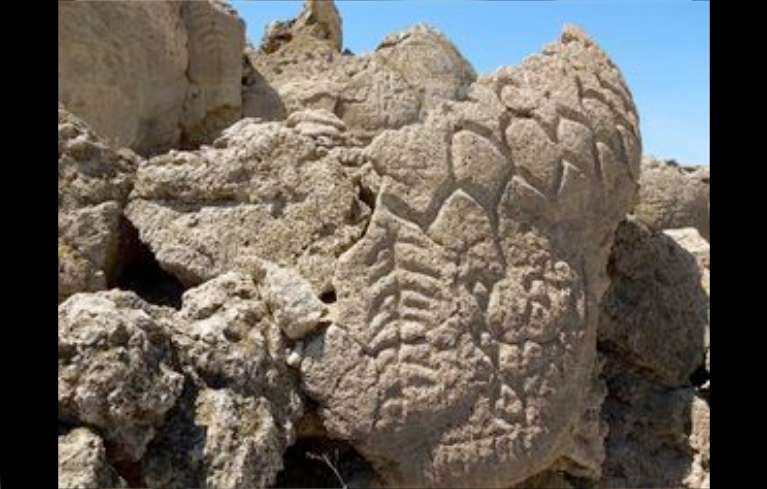
PYRAMID LAKE — Ancient rock etchings along a dried-up lake bed in Nevada have been confirmed to be the oldest recorded petroglyphs in North America, dating back at least 10,000 years.

The petroglyphs found on limestone boulders near Pyramid Lake in northern Nevada’s high desert are similar in design to etchings found at a lake in Oregon that are believed to be at least 7,600 years old. Unlike later drawings that sometimes depict a spear or antelope, the carvings are abstract with tightly clustered geometric designs — some are diamond patterns, others have short parallel lines on top of a longer line.

 USGS, Larry Benson / AP Photo This May 2012 photo provided by the U.S. Geological Survey shows ancient carvings on limestone boulders in northern Nevada's high desert near Pyramid Lake. The carvings have been confirmed to be the oldest recorded petroglyphs in North America - at least 10,500 years old. The findings were published August 2013 in the Journal of Archaeological Science. This site was once the shoreline of the now dried up Winnemucca Lake. Read more here: http://www.sacbee.com/2013/08/14/5650997/nevada-petroglyphs-the-oldest.html?utm_source=dlvr.it&utm_medium=twitter#mi_rss=Latest%20News#storylink=cpy

Ancient carvings on limestone boulders near Pyramid Lake. Photo/Larry Benson/USGS/AP

Scientists can’t tell for sure who carved them, but they were found on the Pyramid Lake Paiute Tribe’s reservation land.

“We initially thought people 12,000 or 10,000 years ago were primitive, but their artistic expressions and technological expertise associated with these paints a much different picture,” said Eugene Hattori, the curator of anthropology at the Nevada State Museum in Carson City who co-wrote a paper on the findings earlier this month in the Journal of Archaeological Science.

The petroglyphs could be as much as 14,800 years old, said Larry Benson, a geochemist who used radiocarbon testing to date the etchings and was the lead author of the research paper.

Radiocarbon testing dated the carbonate layer underlying the petroglyphs to roughly 14,800 years ago. Geochemical data and sediment and rock samples from adjacent Pyramid Lake show they were exposed to air from 13,200 to 14,800 years ago, and again from 10,500 to 11,300 years ago.

“Whether they turn out to be as old as 14,800 years ago or as recent as 10,500 years ago, they are still the oldest petroglyphs that have been dated in North America,” said Benson, a former research scientist for the U.S. Geological Survey and current curator of anthropology at the University of Colorado Natural History Museum in Boulder.

Dennis Jenkins, an archaeologist with the University of Oregon’s Museum of Natural and Cultural History, called it a significant discovery. He led recent excavations of obsidian spear points near Paisley, Ore., that he dated back 13,200 years, and noted that the bigger challenge is identifying who created the petroglyphs.

“When you get back into this time period, if you speak with Native Americans they will tell you they were made (created) there and that is obviously their people and their artwork,” Jenkins said. “But approaching it from a scientific point of view — what we can prove — at this point, it is impossible to connect these to any tribal group.”

William Cannon, a longtime archaeologist for the U.S. Bureau of Land Management who discovered the petroglyphs at Long Lake in Oregon, brought the Nevada site to Hattori’s attention years ago. He said they bore similarities to petroglyphs at nearby Winnemucca Lake, and Hattori began connecting the dots after Benson spotted the carbonate coating on the rocks.

The etchings in Nevada and Oregon have relatively deep, carved lines dominated by linear, curved and circular geometrical designs. Some feature “tree-form designs” with a series of evenly spaced, vertically oriented ‘V’ shapes bisected by a vertical line.

Researchers have suggested the etchings represent various meteorological symbols, such as clouds and lightning, perhaps the Milky Way.

“But we really have nothing to go on for these particular petroglyphs that go back 10,000 or more years,” Hattori said Wednesday.

Benson has no idea what they mean.

“When I looked at it, I said, ‘These things are incredibly beautiful.’ We have so much beautiful, old Native American stuff in the United States, but this shows it didn’t necessarily get more interesting or more pretty with time,” he said.

Ben Aleck, a co-author of the study who is the collection manager at the Pyramid Lake Paiute Tribe’s Museum and Visitor Center in Nixon, said Wednesday he could not comment without permission from tribal leaders.


Portion of forest near American Fire closed to public

Tom Quinn, supervisor of the Tahoe National Forest, has signed an emergency closure order effective Aug. 16 for portions of National Forest System lands within and adjacent to the American Fire.

The temporary closure is designed to ensure public safety during current wildfire suppression efforts and ensuing rehabilitation activities.

The American Fire has burned 5,420 acres since it started Aug. 10. It is 35 percent contained.

The closure area includes:

• The area south of the Foresthill Divide Road starting at Deadwood Ridge Road to Forest Road 43 at Robinson Flat.

• Forest Road 43, which is closed to Forest Road 44 (Cavanah Ridge Road), which is closed, to Forest Road 96 (Mosquito Ridge Road).

• North along Mosquito Ridge Road west to Section 26, Township 14 North, Range 11 East, Mount Diablo Base and Meridian.

The Mosquito Ridge Road is open to public traffic.

Once the fire is suppressed, rehabilitation activities may include trail bridge repairs, hazard tree felling, and heavy equipment use on roads.

For more info, call (530) 367.2224.


Opinion: Public needs to know the government is watching

By Steve Kubby

Information released recently in a story by John Shiffman of Reuters explained how a secretive U.S. Drug Enforcement Administration unit is funneling information from intelligence intercepts, wiretaps, informants and a massive database of telephone records to authorities across the nation to help them launch criminal investigations of Americans.

Although these cases rarely involve national security issues, documents reviewed by Reuters show that law enforcement agents have been directed to conceal how such investigations truly begin – not only from defense lawyers but also sometimes from prosecutors and judges. The Reuters documents show that federal agents have been trained to “re-create” the investigative trail to effectively cover up where the information originated, a practice that some experts say violates a defendant’s constitutional right to a fair trial.
Steve Kubby

Steve Kubby

If defendants don’t know how an investigation began, they cannot know to ask to review potential sources of exculpatory evidence – information that could reveal entrapment, mistakes or biased witnesses.

The unit of the DEA that distributes the information is called the Special Operations Division, or SOD. Two dozen partner agencies comprise the unit, including the FBI, CIA, NSA, Internal Revenue Service and the Department of Homeland Security. It was created in 1994 to combat Latin American drug cartels and has grown from several dozen employees to several hundred.

Today, much of the SOD’s work is classified, and officials asked that its precise location in Virginia not be revealed. The documents reviewed by Reuters are marked “Law Enforcement Sensitive,” a government categorization that is meant to keep them confidential.

“Remember that the utilization of SOD cannot be revealed or discussed in any investigative function,” a document presented to agents reads. The document specifically directs agents to omit the SOD’s involvement from investigative reports, affidavits, discussions with prosecutors and courtroom testimony. Agents are instructed to then use “normal investigative techniques to recreate the information provided by SOD.”

With these new revelations by Reuters about the DEA’s secret SOD program, we can see how any of us can be targeted – in secret – by agents who are trained to trigger a criminal investigation against anyone.

It happened to me and my family and it can happen to you as well. In our case, we believe we would never have been investigated had it not been for an anonymous letter sent to South Lake Tahoe law enforcement on July 2, 1998, during the final months of my campaign as the Libertarian Party nominee for governor of California.

According to former Auburn Journal City Editor Patrick McCartney, this anonymous letter may not have caught the attention of the North Tahoe Drug Task Force were it not for two key fabrications:

“First the letter claimed the authorities could ‘expect to find 1,500 to 2,000 plants.’ The exaggeration could have been a deliberate lie to pique the interest of federal DEA members of the Tahoe task force. For it is well known in criminal-justice circles that federal prosecutors are only interested in pursuing cases involving more than 500 or 1,000 plants in some jurisdictions.

“And then the second fabrication, one conceivably meant to play on the justice system’s responsibility for protecting children from harm.’The other word going around is that he believes it is helpful to give pot to his two year old daughter on a regular basis.’ What allegation could outrage a police officer more than the thought that some zealot would force marijuana on his child?

“The anonymous letter that launched the Kubby investigation was replete with innuendo and rumor, and overly aware of ‘the astonishing fact that this person is running for California governor!

“Did the task force seek to confirm the allegation that Kubby was selling marijuana to support himself and his political campaign? No. The narcotics officers never sought to buy marijuana from Kubby. They never stopped anyone leaving the Kubby home and searched for marijuana. They never observed any trafficking activity whatsoever.”

As a result of this anonymous letter, which we now believe was created by the DEA’s SOD program, our family was subjected to a home invasion of 21 heavily armed officers, our accounts cleaned out, our office equipment seized, resulting in us becoming bankrupted, and charged with 19 felonies that would have resulted in sentences of 40 years to life had we been convicted. Thankfully a jury acquitted my wife. The jury refused to convict me on the marijuana charges, but I was convicted of felony possession of a mushroom stem and peyote button found in our guest bedroom.

Although this conviction was later dismissed by Judge David Nelson in Mendocino County, these covert actions nearly killed me and have damaged my family terribly. Despite the narrative about drug dealers, it was our family and my political activities that ended up being secretly surveilled and targeted by the feds.

As my 17 year old daughter said, “It’s one thing to read about government surveillance, but it is another to have your life turned upside down by them.”

Living here in Lake Tahoe can be a wonderful blessing, but our family has learned the hard way that all of us are under surveillance and even if you are walking the straight and narrow, the government can step on you and try to squish you like a bug. The good news is that it is still possible in this country to take your case before a jury and obtain justice.

As Thomas Jefferson so famously observed: “I consider Trial by Jury as the only anchor yet imagined by man, by which a government can be held to the principles of its constitution.”

Steve Kubby is a resident of South Lake Tahoe.



Landscaping, irrigation talk in Kings Beach

There will be a sustainable landscaping workshop on Aug. 20 from 6-8pm at the North Tahoe Event Center in Kings Beach.

The purpose of the event is to provide people with hints and tips to save water and thereby save money. Water saving technology and practices, water-wise landscaping techniques, turf removal techniques and re-landscaping ideas, yard fertility practices for healthier turf and clean water, and turf irrigation scheduling and seasonal maintenance will be talked about.

This event is free. It is sponsored by the North Tahoe Public Utility District, Tahoe Resource Conservation District and the University of California Extension Master Gardeners.