Recovery evident as U.S. residents hit the road

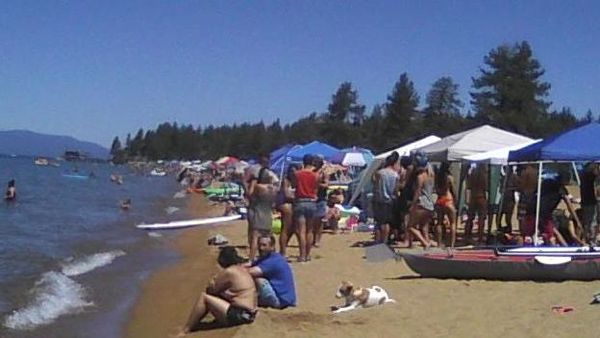
Tahoe was a definite destination Fourth of July weekend. Photo/Bill Kingman

Tahoe was a definite destination Fourth of July weekend. Photo/Bill Kingman

By Steve Matthews, Nina Glinski and Nadja Brandt, Bloomberg

Traci Butler and her husband cut out vacations after the U.S. recession five years ago. This week, the couple is taking their two boys on a weeklong trip that includes a July 4th visit to the nation’s capital, just a few weeks after touring Italy on their own.

In the aftermath of the recession, “things were much tighter,” said Butler, a special education teacher from Washington, Illinois, whose husband works for construction machinery maker Caterpillar Inc. “We didn’t have bonuses for a while. The last two years have been better.”

About 34.8 million people planned to drive 50 miles or more from home during the five days ending July 6, up from 34.1 million last year and the most since 2007, AAA, the biggest U.S. motoring organization, said. The travel recovery is boosting sales for hotels and attractions, a sign that consumer confidence and consumer spending are on the mend, said Mark Zandi, chief economist at Moody’s Analytics Inc. in West Chester, Pa.

Hotel occupancies across the U.S. averaged 62 percent during the first five months of this year, up from 60 percent during the same period last year and the highest average for that time frame since 1996, according to data provided by Hendersonville, Tenn.-based research firm STR Inc. Average room rates climbed 4.1 percent to $113.58.

Read the whole story


Mountain bike clinics at Kirkwood

Tahoe Center for Orthopedics will host mountain bike clinics Aug. 2 and Aug. 23 at Kirkwood Mountain Resort.

Participants will ride with a pro and practice pump track training, while working on climbing, descending, and turning skills.

This is for men, women and children of all riding levels. It is from 9am-3pm.

The fee is $75 for ages 8-13, $150 per adult. Register online or call 530.543.5896.


Craft brews taking over grocery store shelves

By Mark Glover, Sacramento Bee

It’s a job that many might thirst for: official beer taster.

As the wine, beer and spirits buyer for the West Sacramento-based Raley’s grocery chain, Curtis Mann’s typical workday entails visiting wineries and brew pubs to sip, sample and evaluate various alcoholic beverages. Increasingly, those official tastings are for a special category: craft brews.

“All of our potential growth is in craft (beers),” said Mann, 35, who started with Raley’s last August.

As the craft brew scene has exploded over the past decade, both here and nationally, major grocers are increasingly stocking their shelves with more locally brewed beers. In Northern California, larger chains such as Woodland-based Nugget Markets and Pleasanton-based Safeway, as well as mom and pop stores, have devoted staff time – and shelf space – to craft beers.

They’re doing so to meet consumer demand. In 2013, U.S. craft beer sales soared more than 17 percent over the prior year to more than 15.3 million barrels, according to the Boulder, Colo.-based Brewers Association. In an overall beer market of $100 billion in 2013, craft sales totaled $14.3 billion.

Locally, bottles of Coors and Budweiser are increasingly sharing shelf space with regional brews with quirky names such as Elevation 6225 Pale Ale, a shout-out to Lake Tahoe’s elevation, or Rusted Butte Red Ale, named after Sutter Buttes, the Sacramento Valley’s mini-mountain range.

Read the whole story


Zephyr Cove hosting doubles tennis tournament

Top doubles teams from across the nation have signed up for the 31st annual Tahoe Tennis Classic Tournament.

Approximately 110 teams will participate in women’s, men’s and mixed doubles tournament on Aug. 1-3 at Zephyr Cove Tennis Club.

The Tahoe Tennis Class is an all-doubles format tournament with divisions for multiple skill levels. Registration costs $70 per player for the first event, $30 for the second, and includes a player dinner party on Saturday, a raffle, and tournament hat and shirt. Each team is guaranteed two matches.

Complete information about the event and entry form are available online.


Tahoe mountain biking on national radar

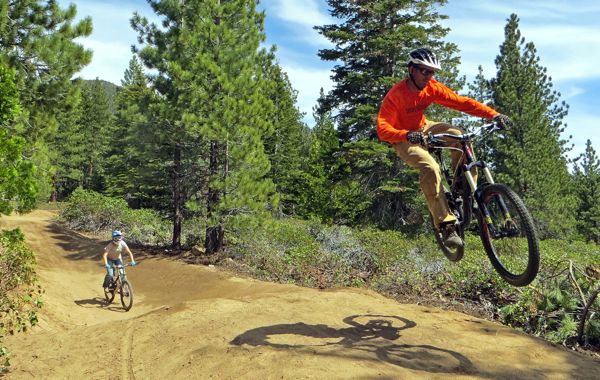
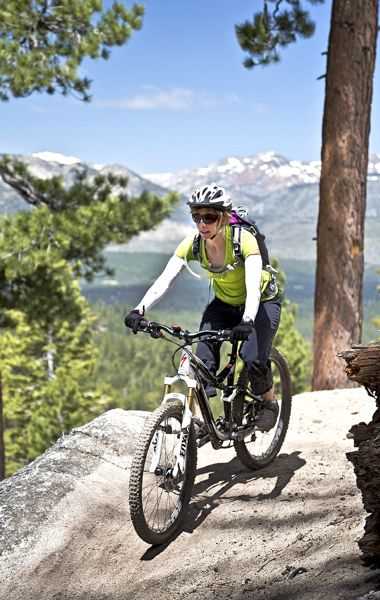
Mountain biking in Lake Tahoe is getting national recognition. Photo/TAMBA

Mountain biking in Lake Tahoe is getting national recognition. Photo/TAMBA

By Jessie Marchesseau

It’s no secret that Lake Tahoe is an outdoor recreation destination. Skiers and snowboarders flock here in the winter, and visitors come to hike and play on the lake during the summer. The local economy depends on people coming here to play. However, one user group it seems Tahoe has yet to really capture is mountain bikers.

With more than 300 miles of mountain bike trails in the basin, there could be room enough for everyone. So the Tahoe Area Mountain Biking Association got together with Bike magazine in an effort to take steps toward bringing in more bikers.

Ben Fish, president of TAMBA, along with TAMBA member Paul Tolme, spent six months discussing and planning with Bike magazine Managing Editor Nicole Formosa the possibility of Bike doing a feature story on mountain biking in Lake Tahoe. Formosa finally made the trip to check out some trails in June.

Bike magazine is an international publication with more than 200,000 subscribers. They are known for their pages of stellar photography and focus more on where to ride than how to. Formosa said Bike tries to get to the “soul of the sport, the adventure of it” and looks for diversity in the destinations they feature. The magazine encourages readers to escape to places with beautiful scenery, a variety of trails and a location they can realistically travel to without it being too cost prohibitive.
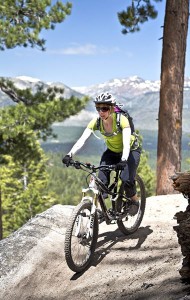
Armstrong Connector Trail Photo/TAMBA

Armstrong Connector Trail Photo/TAMBA

“Someplace you can go and be for a few days and just explore right from your door,” she told Lake Tahoe News, “and I think Tahoe has a lot of those things.”

Fish said he believes one of the reasons Tahoe has not yet sought out mountain bikers as a valid tourist group is a misconception that if they do come, they won’t spend any money. On the contrary he says, they will stay in hotels, eat at restaurants and spend money in the community just like skiers do. Bike magazine’s demographic research suggests he is right. Bike’s readers have an average annual household income of $100,000, more than half are willing to spend more than $2,000 on their next bike and 80 percent of them say they plan on taking a mountain bike trip in the next year.

Formosa said mountain bikers are just starting to be viewed as a valid user group that takes trips and spends money.

Some places such as Moab, Utah, and Whistler, B.C., have jumped on the bandwagon, marketing themselves as top mountain biking destinations. Tolme said with the quality of trails here along with all the other amenities Tahoe has to offer, he sees potential for Tahoe becoming a world-class mountain biking destination.

“We think if they know about it, they’ll come,” he said.

Formosa spent five days here in June riding and researching for the story. Fish, his wife, Amy, also a TAMBA board member, and other TAMBA members spent the week showing Formosa around and taking her on some of their favorite trails.

They rode the Tahoe Rim Trail from Mount Rose, then the Flume trail. They took her on Powerline and up Cold Creek to Star Lake and on the new Monument trail. They rode Armstrong Pass and the new and improved Corral just in time to catch the ribbon cutting ceremony on June 14, then later checked out Van Sickle trail, and, of course, Mr. Toad’s Wild Ride.

“She left exhausted and impressed. At least, that was my impression,” Tolme told Lake Tahoe News.

Some of the trails they rode are relatively new or recently improved. In fact, there is scarcely a trail in the basin which hasn’t been somewhat improved in the last 10 years.
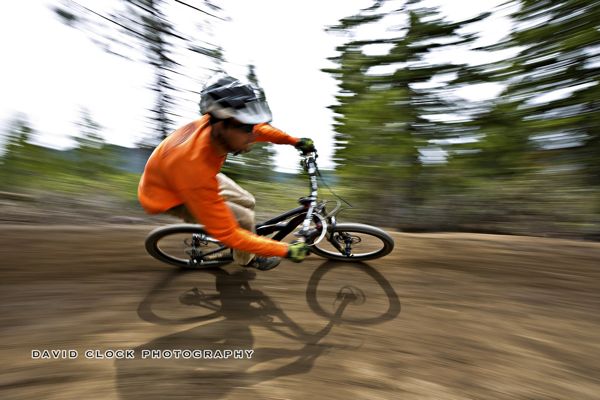
Features are being built in to some of the trails. Photo/Dave Clock

Features are being built into some of the Tahoe trails. Photo/Dave Clock

“[Tahoe] trails are amazing and the work that’s going on is really encouraging,” Formosa said. “Tahoe compared to other places has a really admirable partnership with the Forest Service. I haven’t seen that in a lot of places.”

The U.S. Forest Service was instrumental in helping with the construction and funding for the recent improvements on Corral and other area mountain bike trails. Fish said they have formed a great partnership with TAMBA in the last few years and are really beginning to understand mountain bikers as users of Forest Service lands.

One of Formosa’s favorite aspects of her visit to Tahoe was experiencing the community of mountain bikers here and the partnership they have formed with the Forest Service, something she hopes is indicative of the future of the sport. She also appreciated how they were able to start pedaling right at the Fish’s back door and within a couple hours be someplace that felt completely serene and remote.

Bike magazine has already posted one story from Formosa’s visit on their website. The full feature on Lake Tahoe will appear in print sometime next year.


Opinion: Death to high school English

By Kim Brooks, Salon

Like so many depressive, creative, extremely lazy high-school students, I was saved by English class. I struggled with math and had no interest in sports. Science I found interesting, but it required studying. I attended a middling high school in central Virginia in the mid-’90s, so there were no lofty electives to stoke my artistic sensibility — no A.P. art history or African-American studies or language courses in Mandarin or Portuguese. I lived for English, for reading. I spent so much of my adolescence feeling different and awkward, and those first canonical books I read, those first discoveries of Joyce, of Keats, of Sylvia Plath and Fitzgerald, were a revelation. Without them, I probably would have turned to hard drugs, or worse, one of those Young Life chapters so popular with my peers.

So I won’t deny that I owe a debt to the traditional high-school English class, the class in which I first learned to read literature, to write about it and talk about it and recite it and love it. My English teachers were for the most part smart, thoughtful women who loved books and wanted to help other people learn to love them. Nothing, it seemed to me at the time, could make for a better class. Only now, a decade and a half later, after seven years of teaching college composition, have I started to consider the possibility that talking about classics might be a profound waste of time for the average high school student, the student who is college-bound but not particularly gifted in letters or inspired by the literary arts. I’ve begun to wonder if this typical high school English class, dividing its curriculum between standardized test preparation and the reading of canonical texts, might occupy a central place in the creation of a generation of college students who, simply put, cannot write.

For years now, teaching composition at state universities and liberal arts colleges and community colleges as well, I’ve puzzled over these high-school graduates and their shocking deficits. I’ve sat at my desk, a stack of their two-to-three-page papers before me, and felt overwhelmed to the point of physical paralysis by all the things they don’t know how to do when it comes to written communication in the English language, all the basic skills that surely they will need to master if they are to have a chance at succeeding in any post-secondary course of study.

advertisement

I’ve stared at the black markings on the page until my vision blurred, chronicling and triaging the maneuvers I will need to teach them in 14 short weeks: how to make sure their sentences contain a subject and a verb, how to organize their paragraphs around a main idea, how to write a working thesis statement or any kind of thesis statement at all. They don’t know how to outline or how to organize a paper before they begin. They don’t know how to edit or proofread it once they’ve finished. They plagiarize, often inadvertently, and I find myself, at least for a moment, relieved by these sentence- or paragraph-long reprieves from their migraine-inducing, quasi-incomprehensible prose.

Sometimes, in the midst of this grading, I cry. Not real tears, exactly — more a spontaneous, guttural sob, often loud and unpleasant enough to startle my husband or children. There’s just too damned much they need to learn in such a short period of time. It seems almost too late before we’ve begun.

Read the whole story


Use of caffeine powder a growing trend

By Erin Beresini, Outside

On May 27, an Ohio teenager was found dead in his home, the victim of a caffeine overdose. The tragedy could have fueled the energy drink debate, which has spiked in recent years and rages on due to recent lawsuits alleging drinks like Red Bull contain unsafe levels of stimulants. But no mention of these. That’s because the teenager, Logan Stiner, didn’t chug a Red Bull or a Monster Energy Drink before he died; he ingested caffeine powder.

Caffeine powder is your favorite stimulant in its purest form, either produced synthetically or extracted from foods that naturally contain caffeine, like coffee beans and kola nuts. It’s easy to buy the fine, white powder in bulk on the Internet. It’s completely legal, and there’s no age restriction. One hundred grams of the stuff costs just $9.50 on Amazon.

Why the heck would anybody buy pure caffeine? Mother Nature Network reports that it can “increase alertness, improve concentration, and enhance mood.” Caffeine has also been shown to improve athletic performance by warding off mental and physical fatigue, and reducing the perception of pain.

As the Washington Post reports, “energy-boosting foods racked up more than $1.6 billion in domestic retail sales” in 2012, up nearly 50 percent from 2007. But consumers know those are jacked-up prices, and some try to make their own. Enter caffeine powder.

Read the whole story


Is Flores the Latina star Dems have been waiting for?

By Benjy Sarlin, MSNBC

LAS VEGAS — “I don’t have the background of a typical politician, right?” Lucy Flores told a crowd of Democratic activists as she accepted the party’s nomination for lieutenant governor of Nevada in June.

It’s a line you’ve heard before: Candidates love to brag about how they didn’t grow up like those “typical” politicians. But there’s no other way to describe Flores, a Latina rising star who was born into an impoverished family of 13 children, whose mother abandoned her in grade school, who fell in with a gang, who was sentenced to a youth prison, who dropped out of high school and who became a lawyer and a state legislator– all by age 31.

Lucy Flores

Lucy Flores

“There are Lucys in every town across this state,” she told activists. “That’s why my focus is on making sure that this is a state that works for every Nevadan, not just the privileged few.”

Flores isn’t the only one betting big on her life story either. Nevada Democrats are looking to her underdog tale to lead their entire party in a challenging year.

Republican Gov. Brian Sandoval is running virtually unopposed and may challenge Sen. Harry Reid in 2016. Because the lieutenant governor would take over if Sandoval wins, Reid and Sandoval are each throwing their full weight behind strong candidates for that office – Flores for the Democrats and Mark Hutchison, a state senator and successful attorney, for the GOP. This proxy fight makes the Flores-Hutchison matchup one of the most closely watched races of the year in the West.

Read the whole story


K’s Kitchen: Roasted peach cobbler

By Kathryn Reed

Peaches are so delectable right now that I bought a flat of them at last week’s farmers’ market.

When buying peaches, consider what you are using them for and when. I looked for ones that were slightly firm because I knew I would not be using them for a few days. But I never let peaches go bad. If I can’t eat them fast enough, I cut them into pieces and put them into freezer bags to use down the road for smoothies.

Most of the ones bought last week ended up in a peach cobbler on July 4. One nice thing about cobblers is that they are a bit easier to make than a pie. This mostly has to do with not having to make a crust.

Cobblers can also be made in ramekins so people may be served individual desserts. This, though, means seconds are not an option without looking a bit piggish. However, ramekins are good for guests; in large part for presentation.

I made enough so we’d have this for breakfast for a few mornings. Yes, really. It’s healthier than a lot of foods that pass for breakfast.

 peach cobblerRoasted Peach Cobbler

12 small/medium peaches, cut into bite-size pieces

¼ C brown sugar

¾ C flour

3/8 C sugar

3/8 tsp baking soda

3/8 tsp kosher salt

6 T cold unsalted butter, cut into pieces

2 large egg yolks

¾ tsp vanilla extract

2 lemons, juiced

Vanilla ice cream, optional

Toss peaches and brown sugar in bowl.

On rack about 6 inches from top, broil peaches on rimmed baking sheet for about 8 inches, turn peaches and broil another 8 inches. They should be juicy and caramelized.

Let peaches cool. Reduce oven temperature to 375 degrees.

In bowl, combine dry ingredients. Cut in butter. Stir in vanilla and egg yolks.

Spread peaches, including juice, in 9 x 13 baking pan. Drizzle lemon juice on peaches. Sprinkle topping across peaches. Bake for 25 minutes or until topping is golden and juices are bubbling.

Serve with vanilla ice cream.


Reid leaves Searchlight a richer man

By Rosalind S. Helderman, Washington Post

SEARCHLIGHT — Harry Reid grew up in a shack in this dusty old gold-mining outpost in the middle of the desert.

As he rose to political power, he amassed personal wealth and began living part time in a condo in Washington. But he never stopped holding tightly to a gritty public persona grounded in his Searchlight roots — building a house here and keeping the town his official residence.

Along the way, a tiny town that thrived only briefly during a gold rush more than a century ago gained bragging rights as home to the most powerful man in the U.S. Senate.

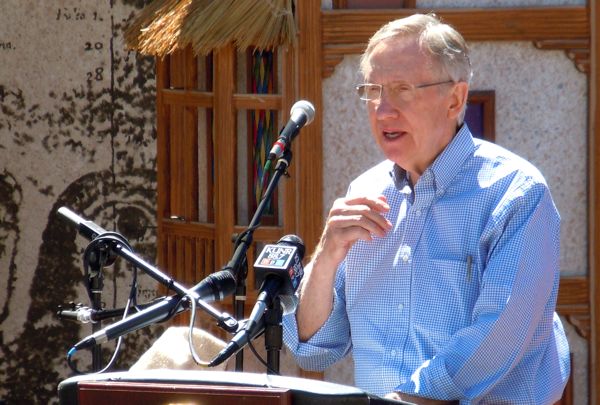
Sen. Harry Reid sells Searchlight property to gold mining company. Photo/LTN file

Sen. Harry Reid sells Searchlight property to gold mining company. Photo/LTN file

But this month has brought a remarkable turn of events for Searchlight and its population of a few hundred: A new gold rush has reignited investor interest here. And Reid, whose land quite literally sat on a gold mine, has seized the opportunity to cash out of the town at the center of his political identity.

He announced last month that he had sold his house along with 110 acres of Joshua-tree-dotted, rocky land to Nevada Milling and Mining, a small South Dakota company that bought an abandoned mine next door in 2010 and has high hopes for a new era of gold production.

The $1.75 million deal was a handsome payout for the Democrat, who is paid a Senate salary of $193,400 per year. Nearly all of the land had been in Reid’s family for decades, much of it originally deeded to his father and some bought by Reid from family members. His brother will continue to live in Searchlight, where Reid will also retain some holdings.

Reid, 74, said he and his wife, Landra, wanted to be closer to their children and grandchildren, as well as his political base in Las Vegas, an hour’s drive across the desolate Mojave Desert.

Now Reid, who as Senate majority leader is presiding over the Democrats’ efforts this year to retain control of the Senate and looking ahead to his own potentially difficult re-election in 2016, will need to adjust the carefully tended life narrative he has presented to voters since he entered politics in the late 1960s. And Searchlight is pondering a new but possibly brighter future without its native son.

“We’re all very, very sad to see Harry go,” said Reggie Doing, 32, whose family owns the Searchlight Nugget Casino and Restaurant, which offers 10-cent coffee, $1 beer and is the town’s main gathering place. But he said the return of gold mining marked by the sale could renew the town. “Nothing is guaranteed and nothing is forever. Change can be a blessing.”

A video that Reid recorded to break the news of his land sale to constituents shows the senator lovingly describing Searchlight trinkets he keeps in his Washington office, including an old miner’s helmet with a carbide lamp. “Even after all these years, you can still smell the carbide,” he said, sniffing the item.

“Searchlight is my birthplace, it is my home, my favorite place in the world,” Reid said in a statement provided to the Washington Post. He called the sale a “a very difficult decision.”

The return of gold mining to Searchlight is part of a new rush throughout Nevada made possible by a spike in gold prices following the economic crash of the last decade, when gold was thought to be a safe investment in a volatile financial world. The price of gold soared to over $1,900 an ounce in 2011; it has now settled back to about $1,300 an ounce, still a historically high price.

Read the whole story