South Lake Tahoe cracking down on arts-crafts festivals, outdoor displays by businesses

By Kathryn Reed

Who gets to sell what and where dominated Tuesday’s South Lake Tahoe City Council meeting. At the root of the discussion is what the five electeds want the city to look like.

Less junky was the overwhelming, though not unanimous, decision.

No longer will arts and crafts festivals be allowed in South Lake Tahoe every weekend during the summer. Starting in 2014 four will be allowed instead of the current 12.
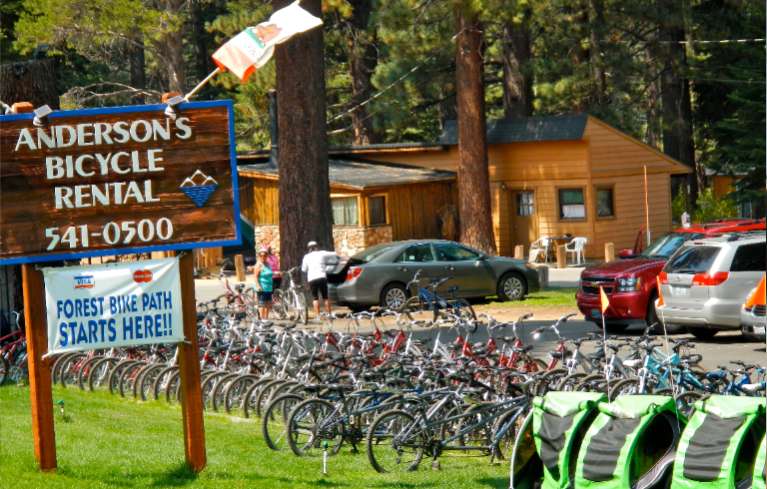
Anderson's has a special use permit that allows it to display its bikes in South Lake Tahoe. Photo/LTn

Anderson’s has a special use permit that allows it to display its bikes in South Lake Tahoe. Photo/LTN

This topic is usually a heated discussion and Sept. 3 did not disappoint. Voting against the change in numbers were councilmembers Tom Davis and JoAnn Conner.

“They add to the ambiance of the community,” Davis said of the fairs. “They are selling what the customer wants.”

Conner said she sees locals as vendors and customers at the fairs.

The topic was brought forward because in the past the promoter had to give $5,000 from each event to a local nonprofit. A recent U.S. Supreme Court ruling has made this mandate by governments illegal.

“I have consistently felt that arts and crafts shows have been detrimental to the city,” Councilman Hal Cole said. He has voted for them in the past because of the nonprofit component.

He believes tourists have a limited amount of discretionary income and that offering these fairs takes away from established businesses.

Loretta Bookhammer with the Tahoe Art League told the council that promoter Bob Williams, who secures all 12 festivals, allows their members free booth space. Artists then give a percentage of their proceeds to TAL. She lobbied for as many fairs as possible.

The council was open to a larger juried art festival that might fall under a special event and not a crafts fair that would allow TAL to make money.

On a related matter the council was in unanimous agreement to actually enforce the ordinance on the books that deals with outdoor displays.

“I think the policy helps improve our built environment,” Councilmember Brooke Laine said. “You can’t just put all of your goods on the sidewalk.”

But Davis cited specific businesses that rent bikes, standup paddleboards and sell wood carved bears that ought to be allowed to display their wares. He worries businesses will go out of business if the ordinance is enforced.

City Attorney Tom Watson admonished him by saying that would be favoritism and the council can’t do that. The policy must apply to everyone and be enforced equitably.

“By enforcing (the ordinance) we are going to say take down the display by Oct. 15,” City Manager Nancy Kerry said. The plan is to send a letter to the offenders explaining the rules and telling them they don’t get to break them again in the spring when the weather is nice.

A business like Anderson’s Bike Rentals has a special use permit so it can display its bikes.

The goal of the ordinance is to not allow businesses to take things out of their store and clutter the entrance and walkway with goods.

The ordinance allows businesses to seek a special permit to have outdoor sales or the like four times a year.

Councilwoman Angela Swanson said the predominant complaint she hears from constituents is how “crummy” the town looks. And the outdoor displays are one example of that crumminess.

The amended ordinance, which had a 5-0 vote, calls for no longer allowing food trucks or any mobile vending business to receive a temporary use permit that would allow it to be parked at a business for up to six months.

The amendment now allows temporary activities for four days with four days between the activities. Security deposits for these activities will be required to discourage violations of the ordinance.

This was the first reading of the ordinance, with the second expected at the Sept. 17 council meeting.

The council agreed at a future meeting to come up with a policy regarding mobile vendors, whether certain businesses may have outdoor displays on a more permanent basis, and whether there is flexibility with the four special events a year at any one location. The latter is a Tahoe Regional Planning Agency mandate.



Book lays out a path for career success

By Kathryn Reed

We can learn a lot from animals – especially butterflies and elephants.

With these two as the main “characters” in “Risk to Succeed: Essential Lessons for Discovering your Unique Talents & Finding Success”, author Ricky Cohen is able to connect to readers in a way that isn’t preachy and is captivating.

Self-help type books are not something I usually read. And it’s not because I don’t need help. But it takes being sent a review copy (as was the case here) or a friend recommending the book for me to start turning the pages.

book 21-02-02Cohen is the former CEO of Conway Stores, one of the top discount retail chains in the country. He is the current CEO of the Conway Organization, a holding company with a large real estate and operating portfolio. The book was published this year.

The book could easily be read and reread at various times in a person’s life because of the struggles that seem to crop up from time to time. It’s a reminder to look at the big picture, that work is not the answer to total happiness and that success can be defined various ways.

I can see this book appealing to people starting off in a job – or those still in college – as well as seasoned workers who are needing to be recharged.

“Risk to Succeed” also points out how failing publicly can be liberating, as it becomes one of life’s lessons. And as with so many of life’s lessons, while they may not be fun to go through at the moment, they often make us stronger and more appreciative.

With a butterfly’s help, an elephant is able reach her full potential in “Risk to Succeed”. This book might do the same for you.


Opinion: Time to make forests healthier

By David A. Bischel

The Rim Fire is one of the largest fires in recent California history. It highlights how every Californian has a stake in our forests, no matter how far away you are from the flames. Thousands of firefighters are working to attack the fire before it destroys the watersheds of Hetch Hetchy Reservoir – the water supply for millions in the Bay Area.

Many of our forests are overgrown because of more than a century of fire suppression and lack of forest management. Dense and unhealthy forests make fires burn hotter and faster. They then become too dangerous to attack on the ground, limiting the ability of our firefighters to contain the fire quickly.

As California experiences the effects of climate change, our forest environment will become hotter and drier. More severe and more frequent fires are predicted. About three-quarters of the state’s water, millions of homes, not to mention a multibillion-dollar tourism industry, are just a few of the benefits we reap from our forests. So, suppressing fires to protect our natural resources is not bad policy in itself, but it must be matched with efforts to create stronger, healthier forests that are more resilient to wildfire.

One way to begin to strengthen our forests is to burn them. “Prescribed fire” – intentionally set and closely controlled fire – is an effective tool, and we should not ignore its benefits. In California’s forests, fire is a natural process that benefits forest health by eliminating brush and trees that would fuel hotter, more intense fires. Low-intensity fires also can rid the forests of disease and insect infestation. In the Sierra Nevada forests, where the Rim Fire is burning, low-intensity wildfires historically occurred every 10 to 20 years.

But prescribed fires have potential drawbacks, including smoke and the potential for escape, which preclude its use in many forested areas bordering homes.

Another important tool is forest thinning, which is a process of selectively removing thick vegetation while leaving the majority of larger, more fire-tolerant trees in place. Trees from the thinning can be sold to cover the cost of the program. Thinning projects put people to work, create funding for the state and protect us from dangerous, costly wildfires.

When thinning is used as a part of an integrated strategic fire-prevention approach, it can make forest lands not only resilient after wildfire but also resistant to erosion, which harms water quality. Thinning also can create openings or paths that can be used as escape routes and locations where firefighters can safely attack the flames.

Forest management tools like prescribed fires and thinning imitate natural processes so that when fires do occur, our watersheds, our wildlife and our communities are all protected.

David A. Bischel is a registered professional forester and president of the California Forestry Association.


Donner museum opening delayed one year

By Barbara Barte Osborn, Sacramento Bee

TRUCKEE – Mired in the bureaucracy of a contract dispute and lacking the funds to hire a coordinator, California state parks officials have delayed the opening of a new museum at Donner Memorial State Park.

Instead of opening this fall, the High Sierra Crossing Museum – a 9,400-square-foot structure that’s nearly complete – will sit empty until fall 2014.

When it finally does open, the museum will feature exhibits on the Donner Party, regional American Indian history, the history of railroad development through Donner Pass and early highway construction.

Donner Memorial State Park is probably best known as the site where most members of the Donner Party, an 81-member wagon train from the Midwest, camped in 1846 and became trapped by heavy snows.

Read the whole story


North Tahoe firefighters return from Rim Fire

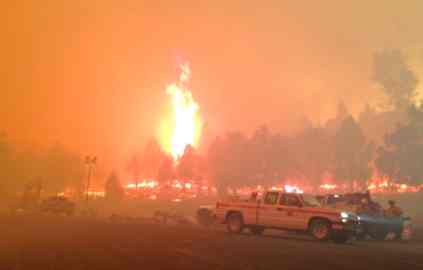
The Rim Fire on Aug. 21. Photos/ Greg Smith

The Rim Fire on Aug. 21. Photos/ Greg Smith

The five North Tahoe Fire Department firefighters who were sent to the Rim Fire are expected back in Tahoe Tuesday tonight.

Several Tahoe firefighters have been working the Rim Fire.

Several Tahoe firefighters have been working the Rim Fire.

They have been helping fight the Yosemite area inferno for nearly two weeks.

Firefighter Greg Smith shot the photos from the camp burn over when he and his trainee were caught in a safety zone.

“It was a big safety zone and we were fine,” Smith wrote to his colleagues in Lake Tahoe.

The fire has burned 235,841 acres and is 80 percent contained.

— Lake Tahoe News staff report


Free fishing day Saturday in California

The California Department of Fish and Wildlife is waving the fishing license requirement on Sept. 7.

This is one of two free fishing days the department sponsors each year.

Size and number limits remain, thought.

Angler must have an appropriate report card if they are fishing for abalone, steelhead or sturgeon anywhere in the state, or for salmon in the Smith and Klamath-Trinity river systems.


Court sides with DCSD in expulsion

By AP

A federal appeals court has upheld Douglas County High School’s decision to expel a former student who referenced the Virginia Tech massacre and threatened violence against classmates through social media five years ago.

The 9th U.S. Circuit Court of Appeals ruled last week that Landon Wynar’s threat to massacre classmates at at the Minden school were not a form of speech protected by the First Amendment.

Wynar was a 16-year-old sophomore when he was arrested in 2008 after students reported his comments in messages on MySpace. He filed a lawsuit in 2009 saying the school board had no authority to suspend him for things done off school property.

The San Francisco-based appellate court upheld the suspension partly because his comments evoking images of the slayings at Virginia Tech presented a clear danger to others.

Wynar was jailed for 31 days and suspended for 10 days until an expulsion hearing before the Douglas County school board led to him being removed from school.

The 9th Circuit Court concluded Wynar “engaged in a string of increasingly violent and threatening instant messages sent from his home to his friends, bragging about his weapons, threatening to shoot specific classmates, intimidating that he would ‘take out’ other people at a school shooting on a specific date and invoking the image of the Virginia Tech massacre,” Judge Margaret McKeown wrote in the opinion on Thursday.

The Virginia Tech campus was the scene of the worst mass shooting in modern U.S. history when a student-gunman killed 32 students and faculty before killing himself on April 16, 2007.

Wynar said in interviews with two sheriff’s deputies that he sent the messages but also said they were a joke, prosecutors said.

The MySpace messages included threats against two or three specific students and disturbed friends who reported them to school officials. They included references to “that stupid kid from vtech” and said, “I bet I could get 50+ people and not one bullet would be wasted.”

“The nature of the threats here was alarming and explosive,” the court ruled. “The messages presented a real risk of significant disruption to school activities and interfered with the rights of other students. Under the circumstances, the school district did not violate Landon’s rights to freedom of expression or due process.”

The court said that in such a circumstance, the district could take disciplinary action against off-campus speech and was responsible to do so.

“Landon specified a date for the attack and described how he would kill two specific named classmates,” the justices wrote, adding, “Douglas County did not need to wait for an actual disruption to materialize before taking action.”


Controversy surrounds Sierra stream poisoning

By Louis Sahagun, Los Angeles Times

WALKER — State fisheries biologist Dave Lentz poured poison into a remote High Sierra stream and watched quietly as every rainbow and golden trout in the water turned belly up.

After the rotenone spread along 11 miles of Silver King Creek last Wednesday, other biologists poured in a neutralizing agent, making the river again habitable — and a suitable home for the rarest trout in the world.

Kneeling beside a small brass spigot that dripped the milky white toxin into a pool edged with alders, Lentz, a conservation coordinator for native trout with the California Department of Fish and Wildlife, smiled and said, “Looks like everything is working as intended. The Paiute cutthroat trout belongs in this stream, not the nonnatives in here now.”

The Paiute trout is native to the Alpine County stream in the Eastern Sierra’s Carson-Iceberg Wilderness of the Humboldt-Toiyabe National Forest. But it had been squeezed out by rainbow and golden trout, which are not native to this portion of Silver King Creek.

The plan to restore the Paiute trout had been held up in federal court for more than a decade by opponents who believe that poisoning a stream is about the worst thing that could happen in a designated wilderness. They also question the safety of rotenone and worry about its possible long-term effects on wildlife and regional water supplies.

Read the whole story


Sustainable fish that are good for you

By Russ Parson, Los Angeles Times

Sustainable seafood is one of the big buzzwords in food these days. And it is important: So many of our most popular fish are close to being overfished. The trick is expanding our palates, finding fish that we aren’t already loving to death.

But finding alternatives is daunting – most of us didn’t grow up with great markets, so the range of fish we know is limited. Still, there are great fish out there. So I put the question to a panel of seafood experts at Saturday morning’s “Field to Fork” segment of the Taste: What one fish would you want to put in people’s hands that is both sustainable and delicious?

Lisa Hogan, a vice president of Santa Monica Seafood – one of the leading seafood wholesalers on the West Coast – chose Santa Barbara spot prawns. They’re trapped off the Southern California coast and sold live from tanks. “They are so sweet and so delicious,” she said. “I guarantee you that once you taste these, you’ll never go back to farmed tiger or white shrimp again. They’re just amazing.”

Read the whole story


Volunteer to work on Tahoe Paradise Park

The League to Save Lake Tahoe is spending the 16th annual Tahoe Forest Stewardship Day at Tahoe Paradise Park.

On Sept. 28 from 9am-2pm volunteers will work on trail restoration, stream bank stabilization and native garden planting.

Contact info@keeptahoeblue.org to register.